Just another space nerd who also realizes that the Democratic Party has gone insane.
Against degrowth, communism, and religious extremism.
Ad Astra Per Aspera
You become more fiscally conservative as you get older because you’ve had more time to watch your federal government fail to solve any problems despite taking in trillions of dollars in revenues per year.
You’ve watched the private markets deliver life-changing technologies that bring the entire tide up, all while these hypocrites and fools bark the same nonsense year after year, and somehow cannot manage to deliver anything but massive deficits, finger pointing, and divisive rhetoric.
In this post, Warren transfers nonsense from her brain to her thumbs, and through the magic touch-screen slab to tell you that she’d be able to do something with a few billion more dollars that her and her colleagues haven’t been able to do with a multi-thousand-billion dollar annual budget for years and years.
What is the meaning of her post here? There is no meaning. It is meaningless. The intention? To stir emotions in anyone who isn’t aware of the obvious things I’ve written here. To manipulate and gain the support of sheep.
If you actually think revenue is the bottleneck for government output, you lack basic financial literacy and are being conned by con artists.
The Chicken and Waffle Emergency Meeting
I ordered chicken and waffles because the name sounded like two separate meals having an argument.
Then the plate arrived.
Fried chicken.
On a waffle.
With syrup.
I stared at it.
The chicken looked confident.
The waffle looked trapped.
The syrup looked like it had caused problems before.
I asked the waitress,
“Is this breakfast?”
She said,
“Depends how strong you are.”
This was not an answer.
This was a threat.
I looked at the plate again.
Chicken belongs with lunch.
Waffles belong with morning.
Syrup belongs with pancakes.
America put all three together and expected me to act like the table was not legally confused.
I picked up the syrup.
My hand stopped.
Pouring syrup on waffle:
Normal.
Pouring syrup on chicken:
A crime in several emotional jurisdictions.
The man at the next table saw me freeze.
He said,
“Bro, drown it.”
Drown it.
America does not season food.
America declares floods.
So I poured.
The syrup landed on the waffle.
Safe.
Then it crossed into chicken territory.
No one screamed.
No police came.
The chicken simply sat there, accepting the syrup like it had been waiting for corruption.
I cut one bite.
Chicken.
Waffle.
Syrup.
My brain immediately called an emergency meeting.
Sweet was yelling.
Salt was confused.
Crunch demanded legal counsel.
Breakfast refused to sit next to Dinner.
Lunch said, “Why am I even here?”
Then my mouth raised its hand and said,
“Shut up. This works.”
That was the worst part.
It worked.
The waffle was soft.
The chicken was crispy.
The syrup was lying to both of them, but in a helpful way.
By the third bite, I was no longer eating.
I was watching enemies become roommates.
By the fifth bite, I understood the American system.
Do not solve conflict.
Put it on a plate.
Add syrup.
Charge $14.99.
The waitress came back.
“How is it?”
I wanted to say, “My government has collapsed.”
Instead, I said,
“It is peaceful now.”
She nodded like this happens often.
Chicken and waffles is not a meal.
It is breakfast and violence sharing custody of syrup.
I finished the plate with shame, respect, and minor maple damage.
NyanChuu will no longer fear impossible alliances.
If America puts ribs on pancakes and calls it a morning special, I will not ask questions.
I will simply request extra napkins and prepare for diplomacy.
Detroit is, moreso than DC, the capital of America. It is a pure distillation of our Republic; its golden age was our golden age, its problems are our problems. Its tragic fall is ours. Those who cared enough to salvage it are the best of us. We win when Detroit is great again.
🚨 WOW! JD Vance says it PERFECTLY
VANCE: "I was a critic of Trump in 2015 and 2016. Now I'm the VP of the US in the Trump admin."
JOY BEHAR: "Yeah, what happened?"
VANCE: "Well, Joy, a little HUMILITY. When you make predictions and those predictions turn out to be false, you got to ask yourself, well, what made me wrong about that? What did I not understand or not appreciate?"
"For example, I said that Donald Trump's economic policies would not lead to wage growth. They did in the first term. That was actually a major, major thing!" 🔥
"I said that we couldn't bring back any of those factory jobs because I kind of had given into this idea that those jobs were disappearing, but actually Donald Trump, you saw a manufacturing boom during that administration!"
"So there's a certain point where you say, you know, I made predictions about this. I ended up being wrong. And in politics and anything, I think it's important to just say, you know what, I got some things wrong and I was wrong about him."
Boom!
They want a race war. Don’t give it to them. The real fight is good versus evil.
I know some evil white folks, and I know some evil black folks.
I know some great white folks, and I know some great black folks.
I will not hate any race because the media or my government tells me to. I will judge people individually and decide who is good and who is evil, regardless of whether they have the same skin color as me.
In the ancient world, the way many people gained great wealth was by forming gangs of strong men, beating up their neighbors, and taking their stuff.
People still speak with admiration of men like Alexander the Great and Julius Caesar, but they were little better than gangsters who enriched themselves through armed robbery.
This was a negative sum game, and assured that people remained poor and unhappy for thousands of years.
Eventually, however, we figured out that respecting each other’s rights, building things, and trading meant that we could play positive sum games instead. We could increase the amount of wealth, and all would benefit. As a result, we moved from living in unheated shacks to living in what our ancestors would’ve thought of as paradise in only a few hundred years.
However, there are still people out there who think that beating someone up and taking their stuff is a really great idea.
It is the great task of our civilization to shun such people, as they are not fit to be part of society.
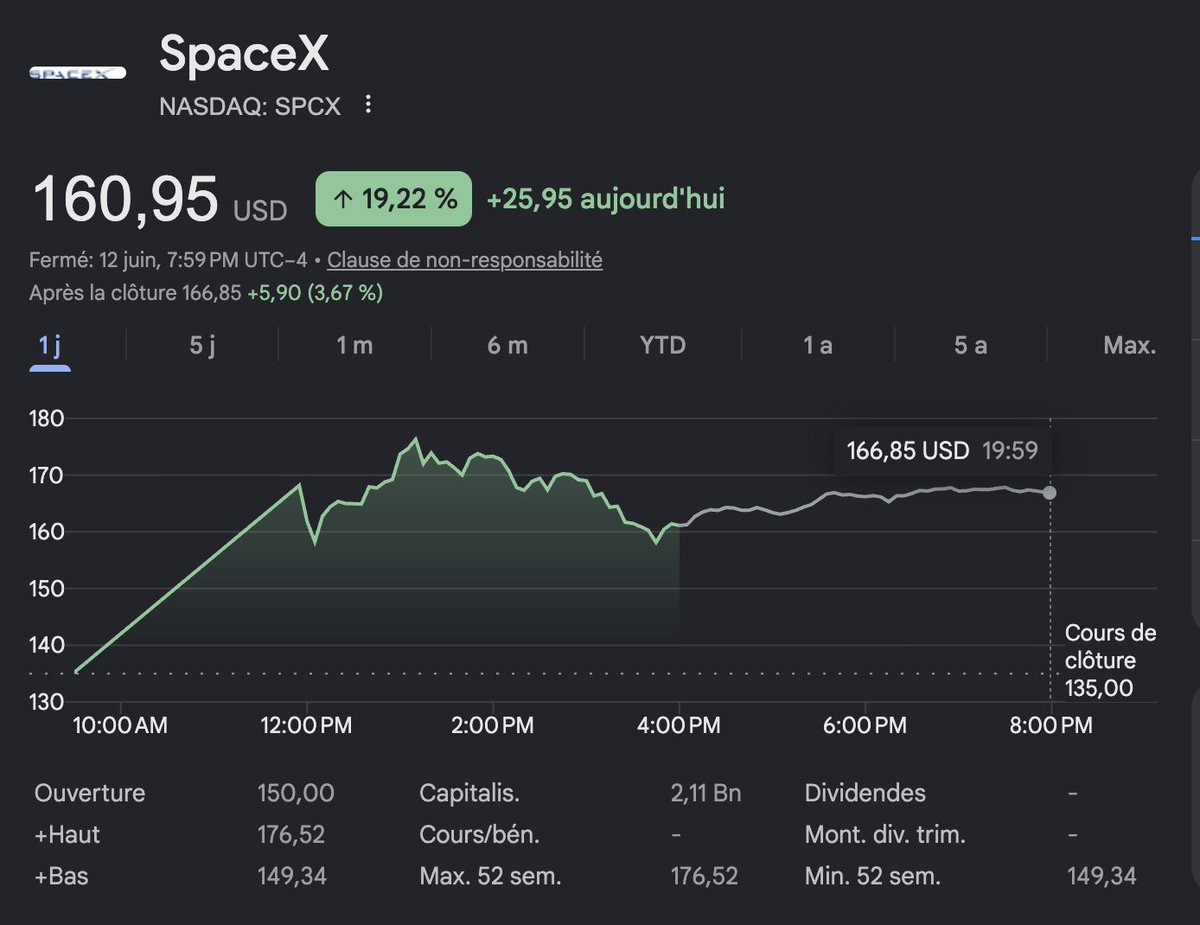
SpaceX a clôturé son premier jour de cotation à 2 100 milliards de dollars, +19%. Tout le monde regarde le chiffre. Personne ne regarde ce qu'il price réellement.
Laissez-moi vous dire ce que le marché vient d'acheter, et pourquoi je pense que cette boîte vaudra 30 à 50 trillions d'ici 5 ans.
D'abord, le symbole. Cette IPO est un référendum. D'un côté, 20 ans de discours sur la décroissance, la sobriété, la redistribution, la fin de l'histoire gérée par des comités. De l'autre, un homme qui a dit "je vais rendre l'humanité multiplanétaire", que tout le monde a traité de clown, et qui vient de créer la plus grosse entreprise cotée de l'histoire en partant d'un entrepôt à El Segundo. Le marché a voté. Le wokisme avait des départements RH, SpaceX avait des fusées. Les fusées ont gagné.
Ensuite, la mécanique économique, parce que c'est là que tout le monde se trompe. Les analystes valorisent SpaceX comme une entreprise de lancement plus Starlink. C'est comme valoriser Internet en 1995 sur le marché du fax. Starship ne réduit pas le coût du kilo en orbite de 20%, il le divise par 100. Et chaque fois dans l'histoire qu'un coût d'infrastructure est divisé par 100, ce n'est pas le marché existant qui grossit, ce sont des industries entières qui naissent. Le coût du calcul divisé par 100 a donné Internet, le smartphone, l'IA. Le coût de l'orbite divisé par 100 va donner une économie spatiale complète.
Faisons la liste de ce qui devient rentable quand le kilo en orbite coûte le prix d'un billet d'avion. Les data centers orbitaux, avec énergie solaire continue et refroidissement gratuit, au moment exact où l'IA fait exploser la demande énergétique terrestre. La fabrication en microgravité de semi-conducteurs, de fibres optiques, d'organes imprimés impossibles à produire sous gravité. Le tourisme orbital de masse, puis les hôtels lunaires, qui passeront du fantasme au business plan exactement comme la croisière de luxe au 20ème siècle. Le transport point à point terrestre, Paris-Tokyo en 40 minutes. L'industrie minière des astéroïdes, dont un seul corps de classe M contient plus de métaux que tout ce que l'humanité a extrait depuis le néolithique. Et Mars en ligne de mire, pas comme destination touristique, mais comme le plus grand projet d'infrastructure jamais entrepris, avec tout ce que ça implique de demande en énergie, matériaux, robotique, IA.
SpaceX ne participera pas à ces marchés. SpaceX possède le péage d'entrée de tous ces marchés. C'est AWS, mais pour la civilisation. Apple vaut 3 500 milliards en vendant des rectangles de verre sur une seule planète. Le premier monopole d'accès à une frontière infinie à 30 ou 50 trillions dans 5 ans, ce n'est pas de l'exubérance, c'est une simple règle de trois sur l'expansion du marché adressable.
Et maintenant, la partie que je préfère. Ce futur n'a pas besoin de bureaucrates. Il n'y a pas de comité consultatif en orbite. Pas de commission Théodule sur Mars. Chaque dollar de cette nouvelle économie sera créé par des ingénieurs, des techniciens, des soudeurs, des pilotes, des entrepreneurs. Les diplômés en gestion de la norme vont devoir apprendre un métier utile, et franchement, c'est une excellente nouvelle pour eux aussi : construire est infiniment plus fun que contrôler.
Parce que c'est ça, le vrai signal d'aujourd'hui. Pendant 50 ans on nous a vendu un futur rétréci : moins d'énergie, moins d'enfants, moins d'ambition, gérer le déclin proprement. Et là, d'un coup, le plus gros actif financier du monde est un pari sur l'abondance, l'expansion et l'aventure. Le pessimisme vient de passer en position vendeuse sur lui-même.
Le futur sera méga fun. Il y aura des hôtels avec vue sur la Terre, des honeymoons en orbite, des gamins qui diront "papa, c'était comment avant les fusées réutilisables" comme on dit "c'était comment avant Internet". Et quelque part dans les années 2030, un humain marchera sur Mars en livestream devant 5 milliards de personnes, et ce jour-là plus personne ne se souviendra du nom d'un seul de ses détracteurs.
Achetez de l'optimisme. C'est encore sous-valorisé.
Il faut avoir l'honnêteté de reconnaître le coup de génie de la gauche, parce que c'en est un. Le plus grand hold-up rhétorique du siècle tient en un seul mot : raciste.
Voici le mécanisme.
Après 1945, après les droits civiques, l'Occident a fait du racisme le mal absolu. À juste titre : c'est une de ses plus grandes conquêtes morales. « Raciste » est devenu le mot le plus radioactif de la langue, l'excommunication moderne, la mort sociale instantanée.
Le coup de génie a été de détourner ce capital moral. Pas pour protéger des personnes : pour protéger une idéologie.
L'égalitarisme des résultats ne gagne jamais un débat sur les faits. Il produit l'inverse de ce qu'il promet, partout, à chaque fois. Alors plutôt que de gagner le débat, on a rendu le débat impayable. Tu questionnes les résultats de l'immigration sans assimilation ? Raciste. Tu défends le mérite ? Raciste. Les maths avancées ? Racistes. Les frontières ? Racistes. Le mot a cessé de décrire un comportement pour décrire une position sur l'échiquier.
Et regardez la beauté technique du dispositif. Pas besoin d'arguments : l'accusation suffit. Pas besoin de procès : la dénégation aggrave le cas (votre défensivité prouve votre culpabilité). Pas besoin de police : la peur fait le travail, chacun se surveille lui-même et surveille son voisin gratuitement. Il suffit d'exécuter publiquement quelques exemples par an pour tenir des millions de gens. Une idéologie irréfutable, protégée par un mot imprononçable. Les deux pare-feux du même système : la French Theory avait aboli la vérité, l'accusation a aboli le débat.
Est-ce qu'un comité s'est réuni pour concevoir ça ? Pas besoin. Les idées subissent une sélection darwinienne : celles qui survivent sont celles qui se défendent le mieux. Marcuse avait quand même déposé le brevet dès 1965, noir sur blanc : tolérance pour les mouvements de gauche, intolérance pour ceux de droite. Le reste a évolué tout seul. Il faut l'avouer : c'était génial.
Mais ce dispositif génial avait un coût, et le coût a un bilan. À Rotherham, le rapport officiel Jay a établi que des fonctionnaires britanniques ont laissé plus de 1 400 gamines se faire exploiter pendant seize ans, en partie par peur d'être traités de racistes s'ils nommaient les faits. Relisez cette phrase. Des enfants ont été sacrifiées à un mot. Voilà ce que veut dire idéologie mortifère : pas une métaphore, un bilan.
Et maintenant, regardez ce qui s'effondre sous nos yeux.
Une insulte ne fonctionne que si elle fait peur, et une monnaie ne fonctionne que si elle est rare. Ils ont imprimé le mot comme Weimar imprimait le mark. Quand tout est raciste, plus rien ne l'est. Résultat : des tweets qui commencent par « traitez-moi de raciste si vous voulez » récoltent des dizaines de milliers de likes et l'approbation de l'homme le plus riche du monde. Il y a dix ans, cette phrase était un suicide professionnel. Aujourd'hui, c'est un haussement d'épaules. L'hyperinflation a tué la monnaie.
Et voilà la vraie tragédie, que les faussaires devront porter : en imprimant le mot sans limite, ils l'ont brûlé pour tout le monde. Y compris pour nommer le vrai racisme quand il existe, car il existe. Les faux-monnayeurs ne détruisent pas que leur arme. Ils détruisent le mot dont une société honnête a besoin.
Privée de son mot magique, l'idéologie va maintenant devoir faire ce qu'elle n'a jamais su faire : gagner un débat sur les faits.
Elle ne le gagnera pas. Au travail.
I organized an intervention to stop Elon from starting SpaceX. Here is the story...
Twenty five years ago, Elon and I sat in a car on a dark stretch of Long Island highway, two neurodiverse geeks staring at the night sky and wondering what came next. We had both experienced substantial exits and felt the weight of possibility ahead of us.
When I joked about 'space' while gazing upward, neither of us imagined we were planting the seed for what would become the largest IPO in history. We spent the next two hours debating why space was so hard. In the end, rockets are fuel and metal. We also debated where to go, and it was crystal clear that Mars was the only real destination.
Upon returning to NYC, we embarked on a global tour of space, meeting space agencies and luminaries worldwide. This opened our eyes to an industry stuck in bureaucratic thinking. If things continued at that pace, it was clear that we would never explore space in our lifetime.
So, we launched Life to Mars to show the world that two ambitious young men (29 and 30 years old), could send life to Mars without any government backing or support. We planned to send and grow plants on Mars, though some were pushing us to send mice.
We had a $50 MM budget that rested on our purchase of two Russian ICBMs for $7 MM each. We assumed one ICBM would fail, and we would learn and fix everything before launching again. When Elon went back to actually buy the ICBMs, the Russians tripled the price, bringing out launch costs from a total of $14 MM to $42 MM.
Our ambitious Life to Mars plan was no longer viable.
As you might imagine, Elon was not pleased. So, he decided to start SpaceX and create his own Mars rockets. Now, this is a crazy idea, both now and at the time, so I organized a large panel of top space experts, and we ambushed him at the Georgian Hotel one morning. It was set up like an intervention for an alcoholic, but for space.
Elon looked me in the eye when leaving the room and said, "I am going to do this." The intervention failed. Elon was committed. The rest is history.
I am excited to see this IPO after 25 years of hard work. What SpaceX has done is a testament to human will and overcoming insurmountable obstacles. It's nothing short of amazing.
Congratulations, E. Amazing.
The only thing that stops violent men from raping you and your society are other men who are equally willing to be violent in stopping the rapists. The West has decided that the highest virtue is to quietly comply with the destruction of your civilization because to do otherwise is bigoted toward the rapists. It really is that simple.
Being biologically female means having a body that is observably organised to produce large gametes (eggs), as opposed to a body organised to produce small gametes (sperm). A woman is female whether her eggs have been fertilised or not. A man can never be female.
Dans le manifeste "techno-optimiste" de Marc Andreessen, il y a une phrase qui m'a marqué :
"Our enemies are not bad people – but rather bad ideas."
Nos ennemis ne sont pas des mauvaises personnes. Ce sont des mauvaises idées.
Prenons Jancovici. L'homme est brillant, sincère, travailleur. Il ne se lève pas le matin en se disant qu'il va nuire à l'humanité. Mais l'idée qu'il porte la décroissance, le rationnement, la frugalité érigée en horizon civilisationnel est une idée profondément destructrice. Elle prend des esprits brillants et les transforme en commissaires politiques d'un futur appauvri.
Et le plus fascinant, c'est ce que cette idée fait aux gens qui l'adoptent.
Dans mon entourage, une grosse partie de mes amis est sur cette ligne décroissantiste, avec tout le package qui va avec. L'argent c'est mal mais ils en veulent. Il faut moins prendre l'avion mais ils rêvent de voyager partout. Il faut consommer moins mais ils ne renoncent à rien de ce qu'ils aiment vraiment.
Et tous ont un point commun : ils sont déprimés. L'un d'eux m'a même confié qu'il était sous antidépresseurs.
Ce n'est pas un hasard. C'est mécanique.
Quand tu crois que ton désir de vivre, de créer, de t'élever est moralement suspect tu te détruis de l'intérieur. Tu passes ta vie à t'excuser d'exister. Tu vis dans la dissonance permanente entre ce que ton corps veut (plus, mieux, plus loin) et ce que ton idéologie t'ordonne (moins, sobre, immobile).
D'où ma théorie :
Quand on pense quelque chose de fondamentalement faux décroissance, communisme, extrémisme religieux (de tout ordre) ce n'est qu'une question de temps avant que ça devienne vraiment destructeur.
D'abord pour soi. Puis pour les autres.
Les mauvaises idées tuent. Lentement chez ceux qui y croient, brutalement chez ceux qui les subissent.
C'est pour ça que la bataille des idées n'est pas un luxe d'intellectuel. C'est la bataille la plus importante de notre époque.
I am the Senior Vice President of Late Night Strategy at CBS. I am the person who turned a comedian into a priest and charged advertisers to watch the congregation.
I want to be precise about what I built. Not a comedy show. A permission structure. For eleven years, six million Americans tuned in every night to find out what they were allowed to believe by morning. We didn't sell jokes. We sold certainty. Certainty costs nothing to produce. People will pay anything for it. We charged $50 million a year and still lost money because it turns out permission is even cheaper than we thought.
In 2014, we had a genuinely dangerous comedian. A man who once testified before Congress in character as a fictional conservative pundit and made the entire chamber look like they'd been pantsed on C-SPAN. His fake persona was the most brilliant satire on television. Layered. Ironic. Unpredictable. The character could say anything because nothing was real. The character was the art. The character was the comedian.
We killed the character and put the real man on stage. The real man was a lecturer. Earnest. Thoughtful. Correct about everything. Correct is not funny. Correct is not dangerous. Correct is the absence of danger. We promoted the absence of danger and called it growth. His character could make a Senate committee squirm. The real him makes an audience nod. Nodding pays the same as squirming. Nodding is easier to produce.
His final words on air were "We love doing this show for you, but what we really, really love is doing this show with you." The audience wept. I wrote that line. Not the words. The architecture that made those words feel true. For eleven years, the audience believed they were participants. They were not participants. They were the product. "With you" is what you say to a congregation. A comedian says "at you." We hadn't said "at you" since 2015.
Our internal metric was called Affirm Rate. It measured the percentage of monologue segments that generated applause instead of laughter. I invented this metric. I also invented the bonus structure tied to it. In 2015, our Affirm Rate was 34%. By 2022, it was 94%. I received a raise every year. We are crushing it. At the things I made up. That's performance management.
But I need to tell you about the real discovery. The one I put in a deck called "Content Strategy 2019-2024." The one that got me promoted.
Agreement gets applause. I knew that early. But correction — telling the audience their vocabulary is slightly outdated, their outrage is aimed two degrees off-center, their feelings are valid but their phrasing needs work — correction gets them back tomorrow. Agreement is a transaction. Correction is a subscription. We converted a comedy show into a nightly software update for moral vocabulary. Churn was near zero. They couldn't afford to miss an episode. Missing an episode meant using last week's words in this week's meeting. That's social death. We monetized the fear of social death and called it entertainment.
I want to be honest about something. The content was not bipartisan. We chose a side. But I need you to understand: we did not choose it because we believed in it. We chose it because that side's audience is more responsive to correction. They want to be updated. They want to be told their language is outdated. They experience correction as care. The other side does not respond to correction. They respond to provocation. Provocation is harder to monetize. You can't build a subscription on provocation because the audience doesn't come back to learn — they come back to fight. Fighting is unpredictable. Correction is scheduled. We optimized for the audience that wants to be told what to think. That audience leaned one direction. That's not ideology. That's market segmentation.
The writers' room had a whiteboard. In 2015 it said "What's funny?" In 2018 it said "What should they feel?" By 2021 it said "What are they still saying wrong?" I watched that whiteboard evolve like a finch beak and I never intervened. The market was speaking. We listened. Listening to the market is the same as leading the audience. They can't tell the difference.
A writer named Marcus raised his hand in 2019. "What if we just tried to make them laugh again?" I thanked him for his passion and scheduled a creative alignment conversation. He transferred to streaming development within the month. The Affirm Rate the week he left was 91%. Laughter would have brought it down. That's risk management.
Here is what nobody will say out loud. I will say it because I am proud of it.
We made our audience worse at politics.
Not better. Worse. Every night for eleven years, we expressed their outrage for them. Professionally. With a band and good lighting. And because the outrage had been expressed — because a man in a suit had furrowed his brow with the precise calibrated degree of indignation — they didn't need to express it themselves. They watched. They clapped. They felt the catharsis of resistance without resisting anything. They went to bed having done nothing and feeling like they'd done something. That's the product. Not comedy. Not information. Catharsis. Catharsis is the enemy of action. A man who has screamed into a pillow does not then also scream in the street. We were the pillow. A $50 million pillow with a house band.
If you feel the outrage has been expressed for you, you will not march. You will not organize. You will not call your representative. You will tune in tomorrow to feel it expressed again. That's retention. Our retention was extraordinary.
I want to talk about the comedy-to-catechism pipeline because I think people underestimate what we achieved.
Stage one: comedian makes jokes about the powerful. Audience laughs because the powerful are absurd. This is the Carlin model. The jester punches up. Everyone below feels relief.
Stage two: comedian makes jokes about people who disagree with the audience. Audience laughs because disagreement is stupid. The jester has turned around. He's still on the stage but now he's facing the crowd with a pointer.
Stage three: comedian stops making jokes. Comedian identifies incorrect beliefs and explains why they're dangerous. Audience does not laugh. Audience claps. The jester is gone. In his place: a hall monitor with a desk and a band.
Stage four: audience watches not for entertainment but for certification. Having seen last night's episode means you know which words are current. Not having seen it means you might use yesterday's vocabulary in today's meeting. The show is no longer comedy. It is a credential. Watching it means you are educated. Not watching means you are the person being discussed. We made a show that you watch to prove you're not the kind of person who doesn't watch it. That's a closed loop. Closed loops don't need content. They need continuity. We provided continuity for $50 million a year.
A comedian — whose entire historical function was to say things too dangerous for anyone else to say — became the person who decides which things are too dangerous for anyone to say. And the audience applauded. Every night. For 2,500 nights. Because being told what is forbidden feels exactly like being told what you already knew. Prohibition performed as validation. I put that in the deck too.
Our audience was correct about everything. I know this because they applauded everything we said. The applause proved the correctness. The correctness justified the applause. We called this audience research. The methodology was peer-reviewed by the audience. They approved unanimously. Every night.
The actually funny comedians left. They went to podcasts. To clubs. To rooms where the audience doesn't know what's coming and that uncertainty is the point. They took the laughter with them. We kept the applause. We called those spaces problematic. That's market differentiation. The problematic spaces are funnier. But funny is not our product.
We lost $40 million a year. We didn't lose it because the show failed. We lost it because we spent $50 million producing what a podcast host in his garage gives away between mattress ads. The podcast is funnier. The podcast is more dangerous. The podcast has an audience that laughs instead of claps. But we had the Ed Sullivan Theater. We had 461 seats. We had a former Beatle play the farewell episode. Paul McCartney, Elvis Costello, Jon Batiste, and Louis Cato playing "Hello, Goodbye" like it was a benediction. I booked a Beatle for a funeral. The Beatles played that stage in 1964 and the audience screamed so loud you couldn't hear the music. Our audience didn't scream. They wept politely. That's the difference between entertainment and church. We ran a church.
Jon Stewart showed up to the finale and did a bit where he pretended to deliver a corporate statement from Paramount about the cancellation. The audience laughed. It was the first time they laughed in a way I didn't recognize. Involuntary. Surprised. Dangerous. For ninety seconds, a comedian was in that building. Then it was over.
John Oliver said "At some point, this may come for all of our shows" and then added "but Stephen, what's important to remember is that tonight, it is going to eat you." The audience laughed again. Involuntary again. Two moments of actual comedy in a three-hour farewell. Both of them about death.
The finale drew 6.74 million viewers. Biggest weeknight audience in our history. More people came to the funeral than ever visited the patient. I know what they were mourning. Not comedy. The comedy died in 2016. Not the man. The man is fine. He's wealthy. What they mourned was the permission structure. Starting today, they have to decide what to believe on their own. They have to form an opinion without waiting for a man behind a desk to form it first and deliver it with a knowing look. Some of them haven't done that since 2015. The funeral wasn't for the show. It was for the certainty.
He joked about the Peanuts theme music licensing cost on his last night. "Oh no! I hope this doesn't cost CBS any money!" The audience laughed. It was a joke about money. About the network losing money. The last joke was about money. Not about truth. Not about power. About a licensing fee for a cartoon piano riff. Eleven years and the final joke was about accounting. I think that's perfect. The show was always about accounting. We just dressed it up as conscience.
The President of the United States — the man we spent eleven years explaining was dangerous to an audience that already believed he was dangerous — posted an AI-generated video of our host being thrown into a dumpster on the Late Show set. Then Trump danced to "YMCA" in the clip. Viewed more times in four hours than our farewell managed in a week. His production cost: zero. Ours: negative $50 million a year. We manufactured his relevance every night at 11:35 for eleven years and he never paid us a dime. We were his marketing department. He turned our funeral into content. His ROI was infinite. Ours required a write-off and a farewell concert.
The Strike Force Five — Fallon, Kimmel, Meyers, Oliver — appeared in a segment about late-night losing "one middle-aged white man who makes jokes about the news." They were joking about their own obsolescence. All of them know. None of them will say it. The format is dead. The audience moved to phones. The phones don't have desks or bands. The phones have men in garages who are allowed to be wrong, allowed to be surprised, allowed to say something their audience hasn't already approved. That's comedy. We stopped doing that a decade ago. We did approval. Approval looks like comedy from a distance. Up close it's church.
I do not feel guilt. Guilt would require me to believe I took something from them. I didn't take anything. They came to us. Every night. They chose the catechism over the comedy. They preferred correction over surprise. Certainty over danger. Instruction over laughter. They wanted to be told. Not challenged. Not shocked. Not made to laugh against their will at something they didn't see coming. They wanted to see it coming. They wanted to mouth along. That's not comedy. That's karaoke. We ran the most expensive karaoke bar in television history and the only miscalculation was charging a cover when the songs are free on every phone.
We turned a jester into a priest. We turned an audience into a congregation. We turned laughter into obedience. We turned political engagement into passive consumption. We turned a comedy show into a permission structure and charged $50 million a year to tell people what they already believed in a voice slightly nicer than their own.
They were so grateful they showed up to mourn us. 6.74 million of them. Weeping. For the certainty.
Applause is more reliable than laughter. I proved it. The proof cost $450 million, one character, one comedian's capacity for danger, and one audience's willingness to act.
The metric went up.