Of the 56 men who signed the Declaration of Independence, Abraham Clark may have paid the highest personal price. Almost nobody knows his story. Buckle up.
He was a New Jersey farm kid considered too frail for farm work, so he taught himself math, then surveying, then law. He never got rich from it because he kept defending poor farmers who could not pay him. His neighbors called him "the Poor Man's Counselor."
In the early hours of July 4, 1776, while Congress debated independence in Philadelphia, Clark wrote a letter to a friend with one of the most chilling lines of the Revolution: "Perhaps our Congress will be exalted on a high gallows."
He signed anyway.
Then the British made it personal. Two of his sons were officers in the Continental Army, and both were captured. They were thrown onto the prison ship Jersey in New York Harbor, the deadliest place of the entire war. More Americans died on British prison ships than in every battle of the Revolution combined.
One son got it even worse. He was locked in the dungeon and given no food except what other starving prisoners could push through the keyhole of his cell.
The British reportedly offered Clark a deal: renounce the Declaration, switch sides, and your boys go free.
He refused.
Here is the part that breaks me. Clark sat in Congress through all of it and never once brought it up. No special pleading, no favors. Congress only found out through other channels and threatened retaliation against a British officer, which finally got his son out of the dungeon.
After the war, he kept choosing the little guy. He fought for debt relief for struggling farmers and refused to support the Constitution until he was assured a Bill of Rights would protect ordinary citizens.
In September 1794, at age 68, the self-taught surveyor who outlasted the British Empire died of sunstroke after a long day working on his own farm.
No statue on the National Mall. No musical. Just a small town in New Jersey called Clark, and most people who drive through it have no idea why.
Some men signed the Declaration with ink. Abraham Clark signed it with his sons.
How one collector turned $50,000 into $12.6 million
Anthony Giordano took a $50,000 gamble by purchasing a 1952 Mickey Mantle from "Mr Mint", Alan Rosen, who purchased 5,500 1952 Topps cards, including dozens of Mantles, for $125,000 in 1986.
For many decades, nobody knew Anthony owned the 52 Mantle, but his sons decided he should get the card graded and that it was time to finally part ways with it.
In August 2022, Anthony's 52 Mantle sold for $12.6 million, making it the most expensive sports card ever sold, until the Kobe Jordan Dual Logoman, which sold for $12.9 million
Counterintuitively, this isn't even Mantle's rookie card (that distinction belongs to his 1951 Bowman), but it's the more iconic of the two and the centerpiece of what many consider the most important set ever printed: 1952 Topps, the set that introduced color photography, team logos, and stats on the back to mainstream card design.
Per hobby legend, Topps once loaded pallets of unsold 1952 cards onto a barge and dumped them into the Atlantic to free up warehouse space.
Three decades later, that scarcity is why Anthony's SGC 9.5 example — described by Heritage as the "finest known example" — sold for $12.6 million.
Collect baseball cards?
Show them off on @Collectibles 🏆
The bar tab from George Washington’s 1787 farewell celebration still survives today, revealing just how heavily the Founding Fathers partied. Among only 55 guests, they reportedly consumed 54 bottles of Madeira, 60 bottles of claret, 8 bottles of whiskey, 22 bottles of porter, 8 bottles of hard cider, 12 bottles of beer, and 7 large bowls of alcoholic punch.
Food for thought.
Clay’s Revenge
Treasury Secretary Scott Bessent’s speech at the Reagan National Economic Forum was more than a defense of tariffs or industrial policy. It was the clearest public restoration of Henry Clay’s American System in generations.
Clay understood what the priesthood of globalization spent three decades denying: Economic power is national power. A country that cannot make what it needs, finance its own expansion, or secure the energy that sustains both is not sovereign in any serious sense. Bessent’s formulation, that economic security is national security, is simply Clay’s doctrine translated into the language of the 21st century.
President Trump had already prepared the ground. In April, he proclaimed April 12, 2026, a day of celebration in honor of Henry Clay and ordered Room 208 in the Eisenhower Executive Office Building redesignated as the Henry Clay Room. That was not empty nostalgia. Trump has long treated Clay’s creed of “fair, equal, and reciprocal” trade as a precursor to America First economics. Bessent’s speech converted that historical tribute into governing doctrine.
The significance reaches beyond one speech. The United States is rediscovering its native political economy: strategic protection for key industries, public backing for national development, and finance aligned with national strength rather than with the abstractions of borderless efficiency. Kevin Warsh is attempting something parallel at the Federal Reserve. His call for a new Treasury, Fed accord and a smaller Fed balance sheet points toward a more Hamiltonian vision of public credit, and, in a deeper sense, an effort to undo William McChesney Martin’s betrayal of Harry Truman.
Truman called Martin a traitor when the Fed chairman prioritized monetary independence over financing national strategy. What Martin enshrined as central-bank independence, Warsh seems to treat as a historical deviation from the older American tradition in which public credit served national power.
The last time the United States operated on anything like this logic at full scale was during World War II, when Washington treated steel, shipping, energy, logistics, and capital allocation as parts of one integrated national mission. That, not laissez-faire mythology, is the real American precedent for national power in an age of danger.
The world woke up when President Trump launched Operation Epic Fury and Operation Absolute Resolve. The closure of the Strait of Hormuz then made the lesson impossible to miss: resource security is not a seminar topic but the hard foundation of state power. Once one of the world’s critical energy choke points was effectively shut, the entire fantasy that advanced economies could float above geography, production, and force collapsed in real time.
That is why leaders across the West, Mark Carney included, are drifting toward the language of resilience, industrial capacity, and strategic autonomy.
Yet America retains the decisive advantage. Coupled with Canada and Venezuela, the Americas are becoming the center of resource security. The United States sits at the heart of that system as an energy superpower, with the oil, gas, capital, and industrial base to turn strategy into production. Europe lacks that foundation. China cannot trust its access to it.
Bessent did not merely defend a policy mix. He announced a return to an older American statecraft: Clay at Treasury, Hamilton at the Fed, and the American System back at the center of national strategy.
In 1696, the British government decided to tax sunlight. Under the Window Tax, households were charged according to the number of windows in their homes. To avoid paying, many people simply bricked up or boarded over their windows, choosing to live in darkness rather than hand money to the state for daylight.
The tax was presented as a fair way of taxing wealth, since larger houses tended to have more windows. In practice, it proved crude and damaging. Tax inspectors were given the power to enter homes and count the windows, which was widely resented as an invasion of privacy.
The consequences were severe. Poorer families, in particular, bricked up windows to reduce their liability, leaving homes darker, damper and poorly ventilated. This contributed to higher rates of disease, including tuberculosis and rickets. Architects began designing houses with fewer windows to minimise the tax, resulting in buildings that were less healthy and less pleasant to live in.
Far from being an efficient revenue raiser, the Window Tax distorted behaviour, harmed public health and became increasingly unpopular over time. Yet it remained in place for 155 years until it was finally abolished in 1851. The Window Tax required invasive enforcement and created more resentment, hardship and economic distortion than revenue. It is a classic example of the unintended consequences of taxation.
@grok Please explain the full history of the Window Tax, with expanded details and sources.
I’m familiar with this story and know this post is accurate. But some readers may be skeptical, questioning the veracity. The overwhelming absurdity of this tax simply highlights the extreme lengths of powerful BigGoverment and the results of a punish-the-rich mindset.
Equity is the uncertain path to wealth creation.
Salary is the safe bet but never close to equal.
Risk vs. reward is the calculus, and the multiplier.
Choose wisely, start young.
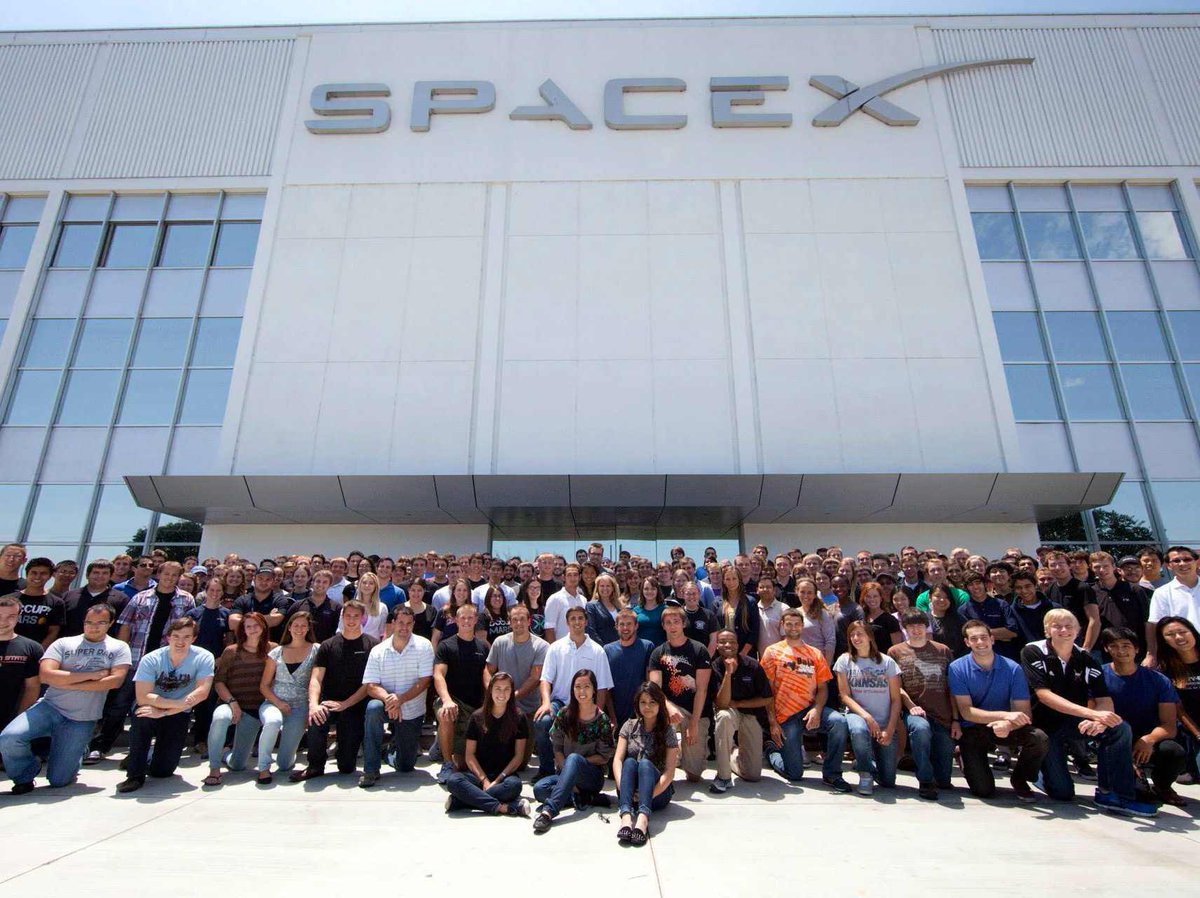
SpaceX millionaires 4,000 x $1mil , 400 x $100 mil
Every employee who joined before the first succesful launch made (unless they sold early) more than $100 million.
SpaceX lists June 12 at ~$1.75T.
Work backward from the cap table. At $1.75T, clearing $100M takes ~0.0057% of the company.
- 2002–2008, first ~500 in: joined at a ~$50M company. Held to $1.75T = a 17,000x. The core of the club — maybe 150–250 left holding
- September 2008, SpaceX has first successful launch
- 2010–2016: joined at $1B–$10B. Needs a senior grant — directors, principal engineers, early Starlink. ~100–200
- C-suite + board: Shotwell, Johnsen past $1B. A layer of SVPs below them clears $100M on equity, not salary. ~20–40
- Post-2016: joined at $20B–$350B. To hit $100M you'd have needed ~0.4% of the company. Impossible for an employee. This is the millionaire tier — almost none reach $100M
The tally:
~400–500 at $100M+
A few dozen above $500M
A handful of billionaires past Musk
Same building. Same mission. Two orders of magnitude apart — set entirely by what year you walked in.
Early isn't a strategy. It's a date stamp.
Montblanc’s fountain pen, the Meisterstück, is a sought-after $1,200 luxury item. WSJ visited Montblanc’s factory in Germany to see why the pen is still popular after 100 years.
Watch more: https://t.co/b3FBkACGjS
💯 agree.
Collectibles are built on consumer passion.
And for some, they represent an alternative asset class.
It's a hobby that's growing, significantly. @Collectibles
Smart brands & retailers are unlocking more value of their IP, turning customers into collectors.
Hasbro CEO Chris Cocks talks about the current trading card and collectibles market with @BrianSozzi and @YahooFinance:
"I think we're in a golden age of collectibles, whether it's trading cards, mini figures, collectibles as art or high end animatronic dolls like we have with the Ultimate Grogu, there's just never been more choice."
On trading cards: "If you look at the Big 3, which are likely Magic, Pokémon and Fanatics, the trading card category either this year or next year will be the biggest single toy and game category eclipsing building blocks."
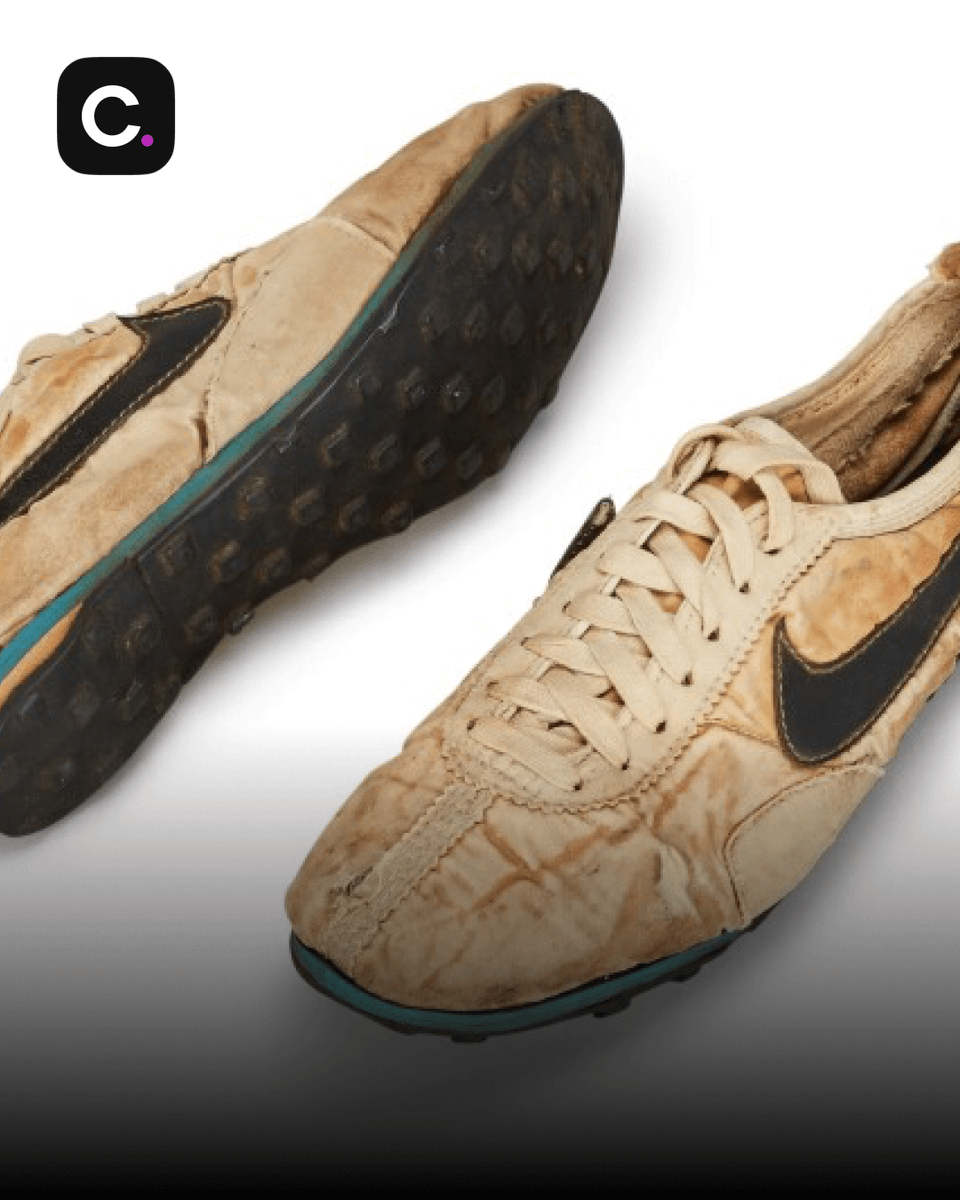
The shoe that made Nike famous wasn't the Air Jordan 1. It was the Nike Moon Shoe.
In 1972, Nike co-founder Bill Bowerman stared at his wife's waffle iron and had an idea: pour rubber into the mold. The waffle sole delivered better grip, better cushion, and weighed less than anything on the market.
This was Nike's first major innovation.
Bowerman made twelve pairs for athletes at the 1972 Olympic trials. Each was hand-cobbled with a Nike Swoosh sewn using fishing line. The name? The waffle pattern left footprints in dirt that looked like astronaut tracks from the 1969 moon landing, hence the name.
The pair that sold at Sotheby's in July 2019 for $437,500 is the only unworn example known to exist. Collector Miles Nadal bought it to display at his private museum in Toronto.
Collect sneakers?
Showcase them on @Collectibles 🏆
Pizza Hut corporate spent seven years killing the exact thing this guy is bringing back. And his stores are now some of the busiest in the entire chain.
Tim Sparks, President of Daland Corporation, is converting 80 Pizza Hut locations to the original 1980s format. Red cups. Salad bars. Stained glass lamps. Pac-Man machines. Vinyl booths. His first job was as a Pizza Hut dishwasher.
The Classics are massively outperforming standard Pizza Huts. Customers drive two to three hours to eat there. A single Facebook post about one Classic location in Pennsylvania got 7,500 shares and broke onto TikTok overnight.
Meanwhile, corporate is doing the exact opposite. 250 store closures planned for first half of 2026. "Red Roof" dine-in franchises no longer offered to new operators. Yum Brands is considering selling the entire chain. No obvious buyer.
The decline numbers are brutal. Pizza Hut held 25% of U.S. pizza market share in 1995. Today: under 14%. In 2019, half of traditional stores were still dine-in, but 90% of revenue came from off-premises orders. Corporate saw the mismatch and decided to eliminate the dine-in format entirely. Convert everything to delivery boxes. Compete with Domino's on logistics.
The problem with that strategy: Domino's is a technology company that happens to sell pizza. Their competitive advantage is order tracking, delivery optimization, and franchise efficiency. When Pizza Hut stripped out the booths, the salad bar, the lamps, and the experience, they became a worse Domino's. A typical Pizza Hut location now generates 20% less revenue than the average across the other four major pizza chains.
Their biggest franchisee went bankrupt in 2020 and closed 300 stores. Total sales haven't grown since 2004. Twenty-two years of stagnation.
And a former dishwasher is adding salad bars and Pac-Man machines, and people are driving across state lines.
The Friday night with your family in a vinyl booth under a stained glass lamp while the kids played arcade games and loaded up plates at the salad bar. That was always what Pizza Hut was selling. Corporate optimized it off the balance sheet. One franchisee who grew up inside the original version understood what the spreadsheet couldn't measure.
Founders School is a new high school where tuition is $150k a year, but if students don't hit $1M in gross profit by graduation, they get their tuition back.
@nateliason says AI will make this possible:
"AI is the big thing that removes the bottleneck around why a 17-year-old can't build a million-dollar business."
"You don't need to spend as long developing deep expertise in programming or software development because, certainly for a V1, you can prompt a lot of it."
"You don't need to raise a ton of money for hiring, design, buildout, or any of these things. Because again, you can get an initial version going with AI."
"So if you can just use AI to get started, and get your business going, you take out a lot of the capital requirements, a lot of the expertise build-up requirements, and it just shortens the timeline. It makes a lot more things possible for them."
America became the most powerful nation in history because it protected property rights, rewarded merit, enforced the rule of law, and attracted the most capable people on earth to build here. Great nations do not rise by equalizing outcomes—they rise by creating the conditions where excellence can flourish. A society that punishes competence in the name of fairness does not become more just; it becomes weaker, poorer, and eventually unfree.
But strength is not measured only in GDP or military budgets. Civilization exists to create continuity—to protect families, allow children to flourish, and preserve something worthy of inheritance. The nuclear family, private property, faith, and moral order are not outdated social preferences; they are the foundation of liberty itself. A nation that cannot build families will eventually lose the ability to build anything else.
The greatest threats we face are not only external rivals like the CCP, but internal systems of decay: deconstruction instead of creation, resentment instead of merit, and ideological frameworks that teach people to suspect everything and admire nothing. When a civilization no longer believes truth exists, that good can be distinguished from evil, or that its own inheritance is worth defending, it begins to collapse from within. Builders create; deconstructors consume.
Artificial intelligence raises the stakes of all of this. The most dangerous prison in history will not have walls—it will be a perfectly managed system where people no longer realize they are being controlled because reality itself has been shaped for them. Whoever controls AI will increasingly control perception, culture, and freedom itself. The future belongs to those willing to defend truth, reward builders, strengthen families, and preserve the civilizational foundations that made liberty possible in the first place.