Elon Musk says weekly skip-level meetings expose the 'glazed' lieutenants every CEO trusts.
A typical Fortune 500 CEO held a meeting once a month.
Their direct reports presented prepared slides.
Their direct reports' reports never made the room.
The CEO heard the version of reality their VPs wanted them to hear.
"I have these very detailed engineering reviews weekly."
Skip-level. No agenda. No prep.
Everyone in the room. All reports flow up at once.
The format was designed to make pre-meeting choreography impossible.
Run the meeting before it runs you.
Then Musk named what choreography produces.
"Otherwise you're going to get glazed, as I say these days."
Musk named the corporate disease: glazed.
Polished. Predictable. Almost useless.
Musk, who ran weekly engineering reviews across Tesla, SpaceX, and xAI, knew the glaze on sight.
A direct report with 48 hours to prepare an answer would deliver the version of reality that protected their team, their roadmap, and their compensation — while the engineer two levels below them, asked the same question cold, would say what was actually happening on the floor.
"I just go around the room. Everyone provides an update."
No slides. No deck. No script.
Question and answer, traded live.
After Musk standardized the format, corporate truth started matching shop-floor truth.
Bad news arrived earlier. Course corrections happened faster.
Compensation arguments shortened.
Musk, on what the weekly cadence buys:
"It's a lot of information to keep in your head."
What in your weekly meetings is already a rehearsal nobody admits to?
— Elon Musk ( @elonmusk ), CEO of Tesla and SpaceX, on Dwarkesh Patel's ( @dwarkesh_sp ) podcast
Had a Grok Bot Agent update my CV today while I went for a walk/FSD'd home. Never had to reach for a computer, just wisprflowed it into existence through my iPhone with Grok Bot. Barely had to do any talking though, because my agent just swam through my MacBook and figured out how to write it.
And it looks better than any CV I've had before.
And you can't imagine what happens to the economy when this level of productivity gets fed to the masses?
Give me a break. The supersonic tsunami is already here. If you don't understand this, you're just lazy.
SPACEXAI: Cursor announced that the Firetiger team is joining the company.
Firetiger develops agents that monitor software rollouts in production, catch regressions, investigate incidents, and feed findings back to coding agents.
This should close the loop so Cursor agents can ship code, observe its live behavior, and respond to problems.
Firetiger’s independent product is being sunset, with its technology integrated into Cursor alongside Cursor Origin and upcoming Change Monitors.
More SpaceXAI news in today's EC below!
If you join a startup and they give you:
- a MacBook
- Codex and Claude subscriptions
- your job offer on a Sunday night
- a random urgent task on your first day
- a founding team with kids
you’re probably in the right place.
If they give you:
- a Windows laptop
- one responsibility for the next six months
- Outlook
- PowerPoint decks
- an office on the outskirts of town
good luck. You’re going to need it.
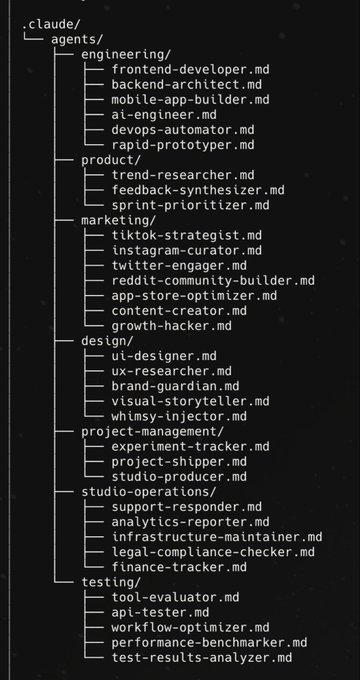
This is what a company looks like in 2026.
Not people. Not offices. Not salaries.
A folder:
.claude/agents/
engineering/
marketing/
design/
ops/
testing/
Every role. Every department. Every function.
All .md files.
If you’re not reading the code, whether explicitly or through agentic inquiry, one or more of these is true:
○ You’re a beginner
○ Software is throwaway
○ You’re prototyping
○ You have no users / revenue
○ You’re taking on debt & risk
○ Your problems are basic
And btw. All of this is fine. But the reality is that models are still not at the “full autonomy” stage yet.
They make rookie mistakes, they go down bad architectural paths. I just had the best model in the world add a nonsensical 700ms delay to “settle” something and it told me “you’re right, I was cargo-culting” 🤨
I am on the camp that this need will diminish more and more. Most code is indeed going to be assembly-like. But we also have the global internet and software infrastructure riding on these models and narrative, and we have to respect that.
The key point of the Algarve is the weather: you get 300 days of sun a year and it's warm, almost never below 16 degrees even during winter. Unlike Lisbon, it barely rains here. Major plus.
My recommendation is to visit in autumn or spring. And overall, talking to people who live here, it's clear there are two Algarves.
The central coast, the one I've visited most (Albufeira, Praia da Rocha, Vilamoura etc.), is the touristy, highly seasonal one. Off-season half of it shuts down and it can get isolating. During high season you hear more English than Portuguese here. That said, some of the facilities there are really good, sport included.
The real value is in the authentic east that many people love (Tavira, Olhão), or the wild west (Sagres, the Costa Vicentina), underrated in my view.
If I had to build some coliving villas concepts, I think this would be one of the top locations I can think of in Europe. Sure, prices especially compared to Spain are unreasonably high.
I made a map to simplify it for anyone who doesn't know the area.
This finally stopped Claude's crazy pursuit of talking more and more unintelligible every passing day
> Save in memory to always use ASD-STE100 Simplified Technical English when you talk to me
Thank god!
❌ Overpriced tourist traps that are officially NOT worth your money in 2026:
• Dubai 🇦🇪 (A concrete mall disguised as a country)
• Santorini 🇬🇷 ($500/night to take photos of other people’s heads)
• Paris 🇫🇷 (Priced like luxury, smells like trash)
• Tulum 🇲🇽 (Fake spirituality run by cartel prices)
• Amalfi Coast 🇮🇹 (3-hour traffic jam on a cliff edge)
✅ 5 real luxury destinations where your money actually buys PEACE 👇
Stacked PR’s are an outdated, inefficient solution to a problem that only exist because the root problem hasn’t been addressed in GitHub: review tools need to do a better job at help the reviewer work through large code changes. It’s a local maxima.
Just today I've already seen Wispr Flow, Granola and WHOOP all "reverse engineered" and open sourced with a fully free version
Very interesting to see what's happening
The question is if normies will pick up on this (I think they will) and how companies will react and pivot to still make money
A little history: The original XP team invented story points to deal with a time-obsessed manager. They were estimating in what they called "ideal days"—days where you're doing your best work, focused entirely on the work, with no distractions, never getting tired, &c. Management was treating that ideal-time estimate as if it were actual time.
The team defended themselves by turning their ideal time into something meaningless (to management). Points were just sequential integers. The whole Fibonacci nonsense came later and, to me, is counterindicated; a 13-point story is not 13x more difficult than a 1-pointer. In fact, the original concept did not tie point values to any sort of specific size or effort. A "2" was bigger/harder/more-work than a "1", but not by 2x. Points were not really estimates at all.
The fact that points used numbers is at the core of many problems because people got the idea that you could do math with them or convert them into other numbers. They'd have been better off using emojis.
All the baggage that Scrum has heaped onto points (Mike Cohen is responsible for a lot of that) has nothing to do with the original concept, and was really a way to impose waterfall-style estimate-based planning on top of XP. Velocity, for example, is nonsensical, given that you can't do arithmetic with points and that points have nothing to do with actual time. If you want to track your average cycle time or throughput and make projections, do that, but use actual time, not some made-up abstraction for time.
FWIW, Ron Jeffries, who along with Chet Henderson developed the notion of points, later came out against them. Points were a failed experiment.