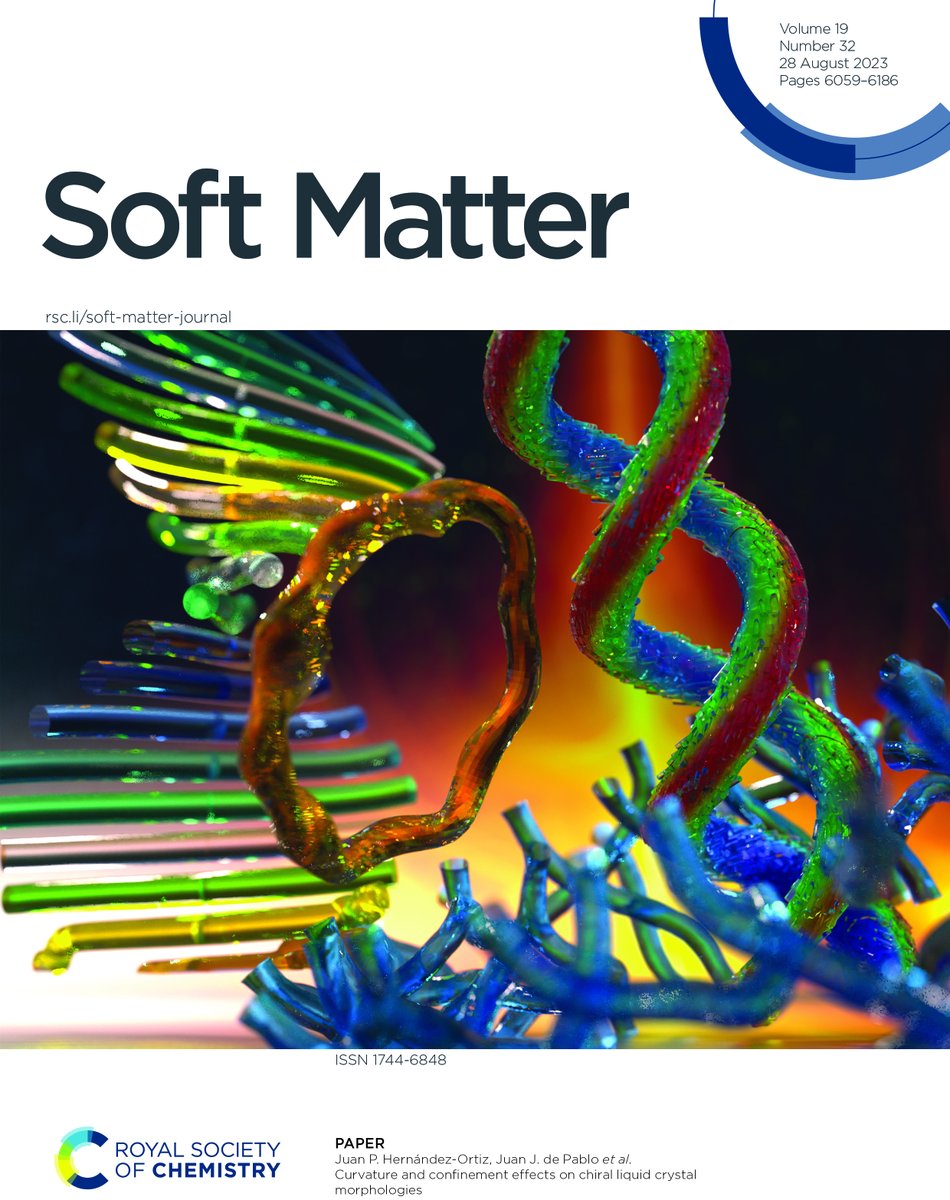
This week's front cover article, Curvature and confinement effects on chiral liquid crystal morphologies led by Viviana Palacio-Betancur, Julio C. Armas-Pérez, Juan P. Hernández-Ortiz and Juan J. de Pablo @Uchicago https://t.co/YNMR3JIjHK
This week's front cover article, Curvature and confinement effects on chiral liquid crystal morphologies led by Viviana Palacio-Betancur, Julio C. Armas-Pérez, Juan P. Hernández-Ortiz and Juan J. de Pablo @Uchicago https://t.co/YNMR3JIjHK
Made it to the PME website! Our most recent paper in @softmatter in which we use confinement and curvature to mold liquid crystals into helical morphologies.
In recent work published in @softmatter, @JuandePablo6's group at @uchicagopme manipulate liquid crystals defects to explore new optical technologies. - https://t.co/lUuW8EyEEP
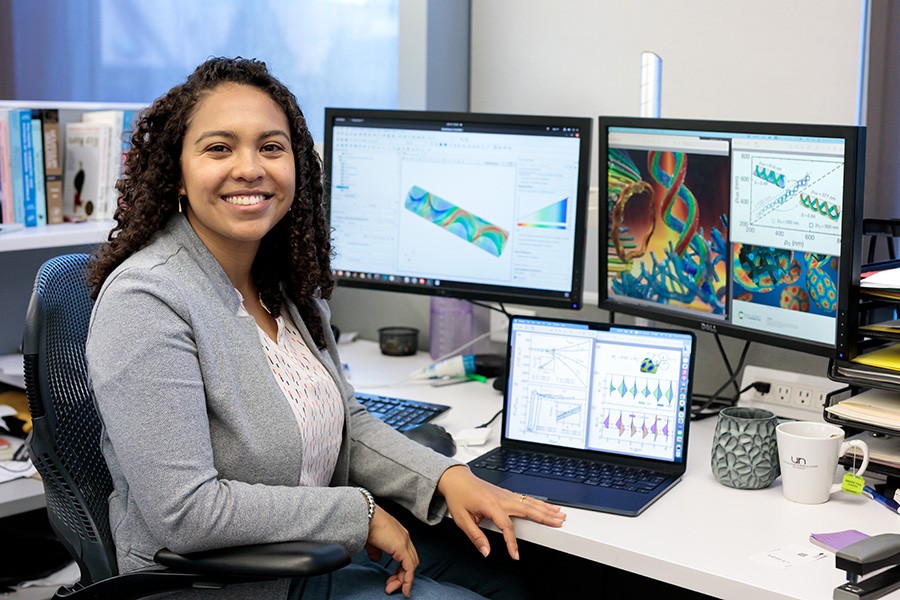
I successfully defended my Ph.D. thesis last week! It was a great privilege to share my science and celebrate with many colleagues, friends, and family present. Grateful for the incredible support throughout the years and excited for what's next! 😎
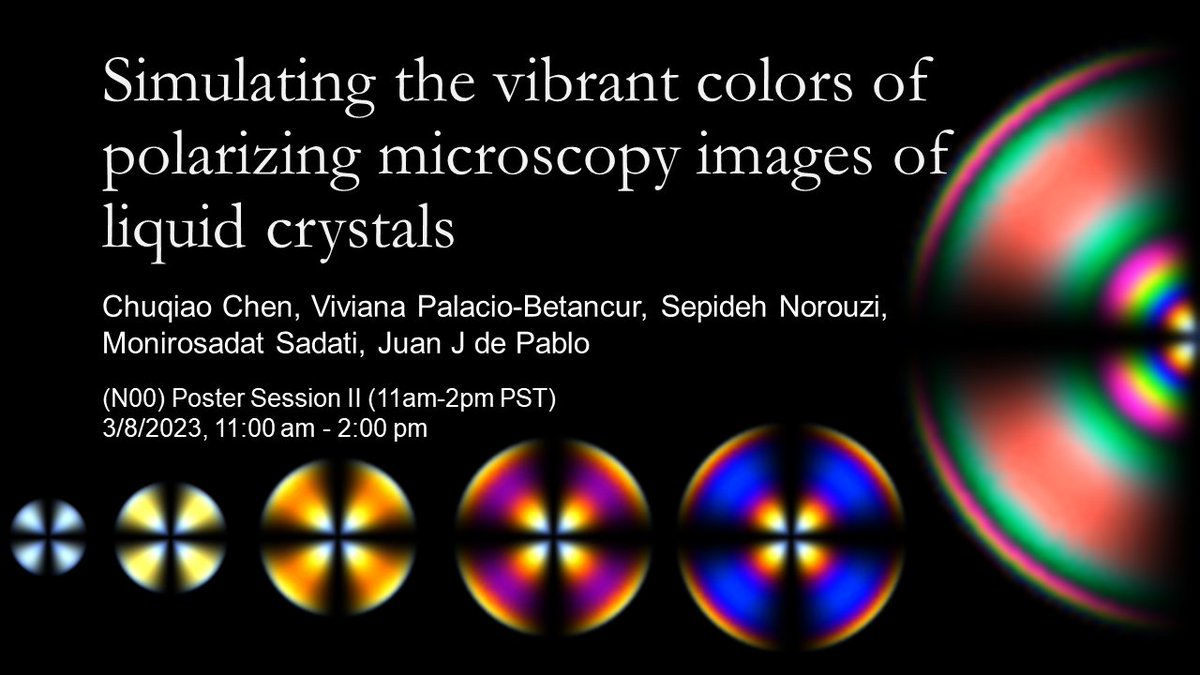
One of the exciting things at this year's APS was being recognized for our poster on simulating color POM of liquid crystals. Thanks to @ApsDsoft for organizing a great poster session and to the judges for their interest! 🖥️🔬 #APSMarch2023 @JuandePablo6
@FergLab Good question! So here we used a Poiseuille flow as a starting point, since the relationship between flow and order is not straight forward. The other flows you mentioned are very interesting, especially considering that stagnation points could be a source for defect creation.
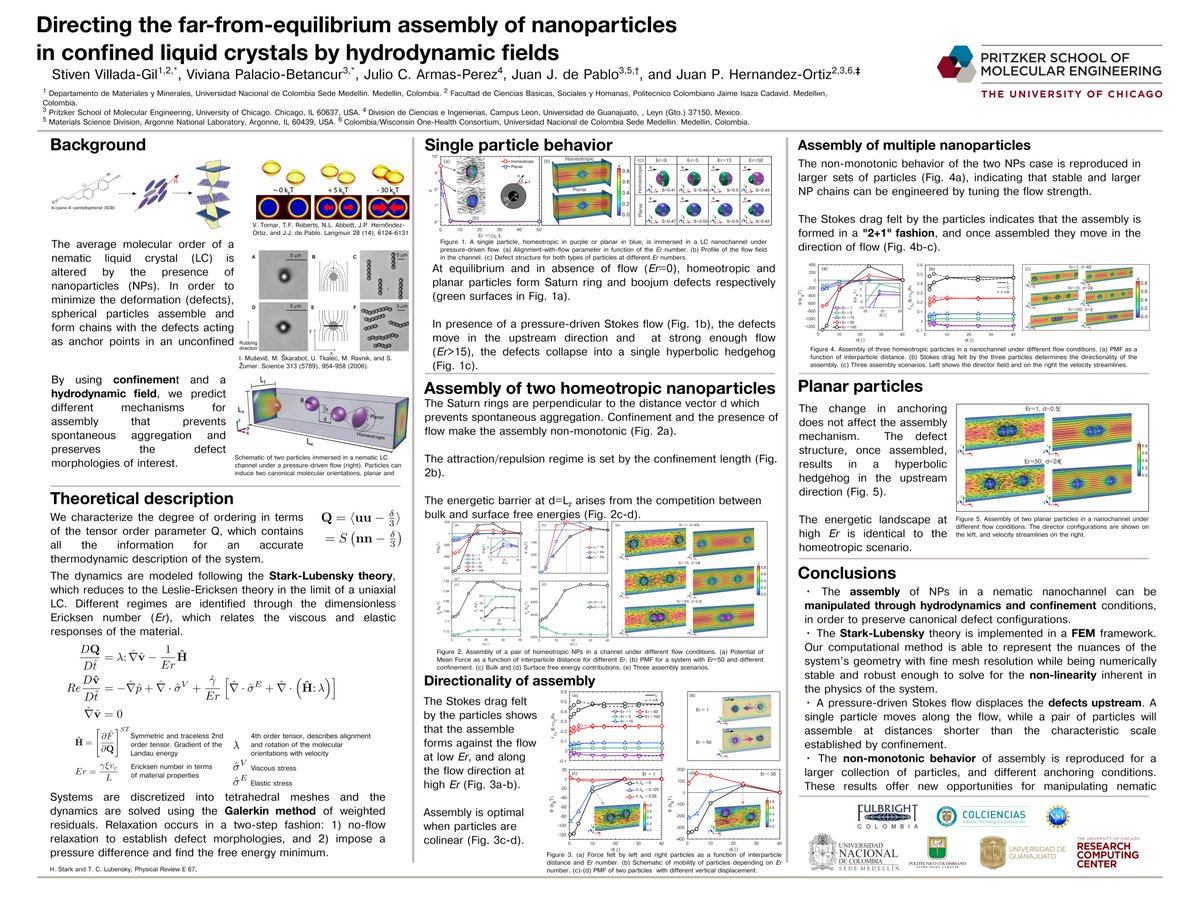
Excited to participate in my first virtual poster session today! Here is my #MolEngPoster2020#RSCPoster exploring how to direct the assembly of nanoparticles when immersed in a nematic channel and under a pressure-driven flow. I'll break it down below 🧵👇.
The #MolEngPoster2020 session is still going! Lmk if you have questions about how we predict and find new ways of assembling nanoparticles in a LC media. 👩🔬🖥️
Excited to participate in my first virtual poster session today! Here is my #MolEngPoster2020#RSCPoster exploring how to direct the assembly of nanoparticles when immersed in a nematic channel and under a pressure-driven flow. I'll break it down below 🧵👇.
In conclusion, you could use the channel dimensions to control how/when the particles assemble, and the flow strength to establish the height of the energetic barrier. All of this while being able to preserve the defect structure, too!
We do this through simulations. The nematic order is coupled to the velocity using the Stark-Lubensky theory, and implemented in a Finite Element framework. We use the Ericksen number to identify different regimes: Er<1 the LC elasticity prevails, Er>1 viscosity dominates.
And if we think about larger assemblies, we see that the behavior from before still applies! Three particles will assemble in a "2+1" fashion, when once a pair is formed is will attract the third particle.
In the past, these defects around the nanoparticles have been used as anchoring sited to form 1D or 2D structures @ equilibrium. In this case, we want to use confinement and a hydrodynamic field to control the assembly.
A liquid crystal shows a natural tendency to align uniformly, and this order is altered by external fields (temperature, pressure), a confining surface, or the presence of nanoparticles. When the order mismatches, we get defects which are regions of high elastic energy.