Our lives depend on hope. If you have hope, you'll be able to overcome problems you face. But if you're without hope, your difficulties will increase. Hope is linked to compassion and loving kindness. In my life, I've faced all sorts of difficulties, but I never gave up hope.
Hemant Kumar Lata Mangeshkar duets are on a different level.
The romance they bring to the song is so palpable.
This duet from the 1954 release Shart .
Music was by Hemant himself.
Lyrics by S H. Bihari.
Song is picturised on Shyama and Deepak.
The soundtrack had a record 12 songs.
Directed by Bibhuti Mitra.
Ravi worked as Hemant Kumar's music assistant on this soundtrack before making his own debut as an independent music director.
Song courtsey @Upjeet7
Bunker Roy (1945–2026)
Bunker Roy has died in Tilonia, the village he chose over every comfort his birth had promised him.
I have been to Tilonia and seen the Barefoot College at work. It rested on an idea most of us with degrees still struggle to accept: that the poor are not a problem waiting for experts, but people with knowledge of their own. He proved it by turning grandmothers who could not read into solar engineers.
India has lost one of the few men who took Gandhi literally.
We will praise him today. The harder tribute would be to believe what he believed.
Hemant Kumar had a voice that felt like poetry woven into music. His singing carried a rare elegance. Gentle, soulful, and overflowing with emotion. Every word told a story, every note touched the heart, and every melody awakened something beautiful within us. ❤️❤️
My colleague @VinayakD has put together a really cool (and representative) dashboard for Delhi’s bad air. It is comprehensive and scrapes data from multiple sources to understand meteorological conditions and source of pollution. https://t.co/6sma9cfRlI
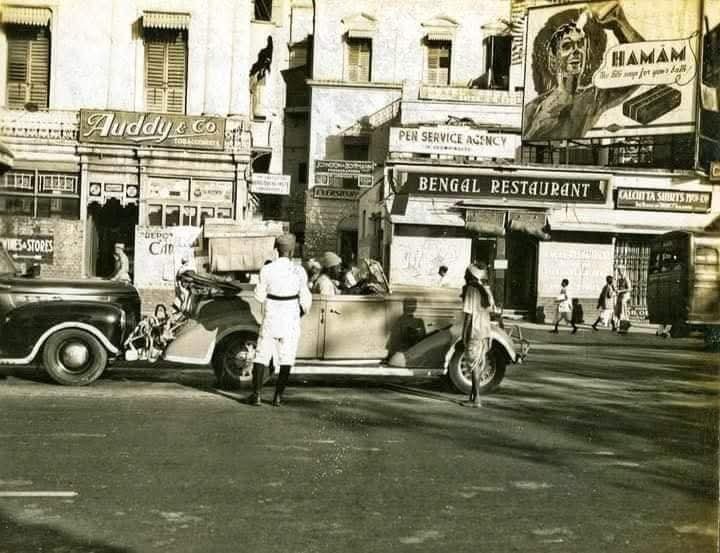
Chowringhee Road, Calcutta, India. Photograph circa 1944. You can see the Bengal Restaurant and PEN service agency. Chowringhee (officially renamed Jawaharlal Nehru Road for its main stretch) is one of Kolkata's oldest, most historically significant thoroughfares and commercial hearts, running along the eastern edge of the Maidan.
Long before the British arrived, the path was a dirt trail (known as Kali Rasta) linking the villages of Kalighat and Chowringhee. The name is traditionally linked either to a small fishing village named Chirangi or to the saint Chowranginath of the Nath mystic sect who had a camp (dera) there. In the 17th century, the area was largely a dense, tiger-infested forest and bamboo jungle.
After the British won the Battle of Plassey in 1757 and built the new Fort William, European settlers moved out of the old fort area and built grand neoclassical mansions and bungalows along Chowringhee. By the 19th and 20th centuries, the residential nature of the street gave way to a bustling commercial, entertainment, and hotel district featuring iconic European department stores and luxury venues.
It houses major cultural and civic landmarks, most notably the Indian Museum (the oldest and largest museum in India), heritage structures like The Oberoi Grand, and historic apartment blocks like the Edwardian-style Chowringhee Mansions (built in 1907).
The Bengal Restaurant was a popular middle-standard eatery located at 10 Chowringhee Road in Calcutta (now Kolkata) during the 1940s. It functioned as a well-known, accessible mid-range restaurant rather than an ultra-exclusive colonial club, frequented by locals, students, and city-goers. It's fondly remembered by patrons for items like its prawn cutlets and tea, enjoyed typically after catching an English film at a nearby theatre during wartime and pre-independence Calcutta.
#history #Kolkata @TheRightGhose@somnath1978
An Indian by birth, a Karachiite by marriage, & a celebrant of every festival from Eid to Christmas! Yet Diwali holds a particularly special place in my heart. Celebrating it in Karachi at home, brings back the fondest memories of my childhood.
Happy Dhanteras &
#Diwali2026
Simon Winchester, RIP. 'The Professor and the Madman', on the making of the Oxford English Dictionary, is his best-known work, but he also co-edited a 2004 book on Calcutta with his son, Rupert.
Lovely little historical vingette of Calcutta in the late 60s.
Also another reminder that the decline of Calcutta/WB started much before the Left took power (the process started after Partition).
Every one at that time knew it as this piece, movies, newspapers etc etc show. In fact, the Left rose because of economic decline. But the causality has been reversed in 2026.
https://t.co/FFSzkDOcr9
"I never went into business to make money. I went into business so that I could do interesting things that hadn’t been done before."
Nani Gopal, a revolutionary in Bengal in the 1920s, had to flee Calcutta to avoid the British police and came to the US, where he took a job as a salesman & married an American schoolteacher His son, young Amar supplemented his family income by repairing radios.
“We put up signs in all the little hardware stores where my father used to sell his imported goods,��� The signs said, ‘We repair radios. So people would drop off their radios at the store and I’d take them home and repair them, and we’d give the store 10% of the invoice. I had a little pact with my father that if my grades remained good, I could go to school only four days a week and he would write an excuse saying I had a headache or something.”
The teachers all knew this; it was always on a Friday and so on Monday, they’d ask me, ‘How many radios did you fix, Bose?’” Amar Gopal Bose went on to study at MIT & after he graduated and joined MIT as a professor in 1964, his mentor Y W Lee advised him to start his own electronics company.
Lee said about the name “...we don’t want to be tied to a specific technology or industry because we don’t know what we’ll do in the future. The name should be pronounceable in many different languages and easy to trademark. And ideally, it’s one syllable.”
Everyone laughed because they knew what he was suggesting without saying it: “Bose.” Bose started his company focussing mainly on high end products for the military. His noise cancelling headphones were originally designed for army use. Soon his audio products were making waves.
Today, Bose has revenues of over $3 billion, and before he passed in 2013, Amar Gopal Bose donated a majority of his shares to his beloved MIT to help sustain their research. And it all started with one revolutionary in Bengal!
Amar Gopal Bose, born on this day in 1929.
The Story Behind a Masterpiece: Mohammed Rafi’s Own All-Time Favorite "Husn Wale Tera Jawab Nahin"
When we look back at the golden era of Hindi cinema, certain songs transcend time to become eternal melodies. One such absolute gem is the romantic ballad "Husn Wale Tera Jawab Nahin". While many fans frequently misattribute the track to the movie Sasural, this timeless creation actually belongs to the 1961 cinematic hit Gharana.
Beyond its commercial success, the song holds a legendary status in music history for one profound reason: it was widely known to be one of Mohammed Rafi's own personal favorite recordings out of the thousands of tracks he sang in his illustrious career.
Behind this beautiful composition lies a treasure trove of fascinating studio anecdotes and artistic synergy that created pure magic.
The "One-Take" Wonder
Mohammed Rafi was celebrated for his flawless work ethic and dedication to rehearsals. However, he also possessed an unparalleled ability to intuitively connect with a melody. When the brilliant music director Ravi first hummed the tune to Rafi in the recording studio, the singer captured its emotional wavelength instantly. According to industry lore, the final version of the song that we hear today was recorded in just one single take. The flow was so seamless and Rafi's control over the gentle, romantic modulations was so perfect that Ravi knew any further retakes would only dilute the pure magic captured in that moment.
Shakeel Badayuni’s Sudden Inherent Poet’s Inspiration
The lyrics, penned by the legendary Shakeel Badayuni, are considered a high watermark for Hindi film poetry. The story goes that Shakeel was struggling to find the right words to describe a beauty that felt pure and ethereal rather than merely physical. He wanted to write a song that felt like an Urdu ghazal but could adapt perfectly to a commercial family drama.
He struck creative gold with the verses:
"Teri surat jo dekh le shayar, apne sheron mein taazagi bhar le..."
(If a poet glimpses your face, he would infuse his verses with freshness...)
When Ravi set these poetic words to a slow, rhythm-heavy acoustic guitar and harmonium beat, it instantly transformed into a timeless anthem of admiration.
Why it Captured Rafi's Heart
Rafi saheb loved this song because of its unique vocal demand. It required an intricate technique known as "soft-singing" or whispering romance. Rafi had to sing exceptionally close to the microphone without raising his pitch, keeping the voice deeply intimate—like a private conversation between lovers. He later shared with his peers that this song allowed him to express the gentlest, most respectful form of romance without sounding overly dramatic or theatrical.
The "Jubilee Kumar" Magic
On screen, the song was picturized on Rajendra Kumar, who was affectionately known as "Jubilee Kumar" during the 1960s because nearly all his films ran for at least 25 weeks in theatres. A massive pillar of Rajendra Kumar's historic box-office run was Mohammed Rafi’s voice. The actor openly admitted throughout his life that a massive portion of his romantic charm on screen was gifted to him by Rafi's playback genius.
Even today, decades later, "Husn Wale Tera Jawab Nahin" remains a masterclass in romance, poetry, and vocal perfection a true testament to the genius of Rafi, Shakeel, and Ravi.
#MohammedRafi
#RafiSaheb
#GoldenEraBollywood
#OldHindiSongs
#RetroBollywood
#MusicDirectorRavi
#ShakeelBadayuni
The foundation stone of Chandigarh was laid by President Dr Rajendra Prasad on 7 October 1953. That, therefore, is Chandigarh’s Foundation Day.
1 November 1966, on the other hand, marks the trifurcation of Punjab and the creation of Chandigarh as a separate Union Territory. The two occasions should not be confused.
https://t.co/2JJJPDmdq0
"I learnt music in her lineage, so I grew up on stories about her — incredible music, some legend, and some bits of gossip, all irresistible. While working on creating Akhtari in 2013, my tribute performance, I realised her life and music were inextricably fused together." The incredible @vidyasings remembers to the Malika--ghazal, Begum Akhtar. Read
https://t.co/gJSjv8ss6U
It is said, #RabindranathTagore had handed over his manuscript of Rakta Karabi (The Red Oleander) to veteran thespian Sisir Bhaduri in the early 1920s. But the play could not be staged. Because, no one could be found for the role of Nandini, the protagonist, an earth angel who represented indomitable human spirit against tyranny, oppression and greed. Until, 1954, that is. Long after the poet's death, when Bohurupee staged the play with Tripti Mitra in the lead role. And history was made. #Today is her birthday. She would have been a centenarian. Tripti as Nandini. (Right) At one of the shows, PC Mahalanobis must have invited #Nehru 👇
Professor Ashoke Sen is an extraordinary human. In 2012, he won the inaugural Fundamental Physics Prize, worth $3 million. He could’ve well used the amount for personal luxury, instead he donated a large chunk of it to help students, fund fellowships & support science in India.
Ek Ladki Bheegi Bhaagi Si - The song that was not just shot, it was lived.
The year is 1958. The film is Chalti Ka Naam Gaadi, directed by Satyen Bose. It has the three Ganguly brothers, Ashok, Kishore and Anoop, and the most beautiful woman on screen, Madhubala. The music is by S D Burman and the words are by Majrooh Sultanpuri. And the voice, the voice is Kishore Kumar himself.
The situation is simple and magical. It is raining heavily in Bombay. Madhubala's car breaks down at night. She walks into a garage that says open 24 hours. Inside, Kishore Kumar is fast asleep. She wakes him up and scolds him for sleeping on duty. He gets angry, then agrees to help. He pushes her car to the garage and while repairing it, starts singing, looking at her through the windshield, at her wet saree, at her trying to dry her hair. She is shy, she is smiling, she has no idea this mechanic in front of her will become her husband two years later in real life.
Now for the stories behind the song that people do not know.
Chalti Ka Naam Gaadi was Kishore Kumar's own production. There is a famous anecdote that he made this film hoping it would flop. He had a huge income tax notice and he wanted to show a loss. So he made a film with his own brothers and a simple story of cars and love. But destiny had other plans. The film became a superhit, one of the biggest comedies of its time. Kishore was so annoyed with its success that he gifted the entire film and all its rights to his secretary Anoop Sharma. That income tax case, by the way, went on for almost 40 years.
This film is where the real love story began. During the shooting of Ek Ladki Bheegi Bhaagi Si, Kishore and Madhubala were just co-stars. But Kishore's carefree energy, his ability to make everyone laugh between shots, made Madhubala fall for him. On this set, Kishore used to mimic S D Burman Da's style of singing and make Madhubala laugh continuously, that famous Madhubala laugh that you see 20 percent of the film is actually real. Two years later in 1960, they got married.
And about the song itself, S D Burman Da composed it like a Broadway musical piece. Notice how it starts from dialogue, it does not start like a typical song. Kishore is talking while holding a spanner and suddenly the tune starts. Majrooh Sahab wrote that cheeky line, tan bheega hai sar geela hai uska koi pench bhi dheela hai, such a playful way to say she is both beautiful and a little crazy.
That is why even after 67 years, when it rains and a girl runs with a hand on her head, every Indian heart still sings, ek ladki bheegi bhaagi si, soti raaton mein jaagi si.
#EkLadkiBheegiBhaagiSi #ChaltiKaNaamGaadi #KishoreKumar #Madhubala #SDKing #SDBurman #MajroohSultanpuri #GoldenEra #OldIsGold #RetroBollywood #EvergreenSongs #RainSong #MonsoonMelody #BollywoodClassics #1950sBollywood #KishoreKumarSongs #MadhubalaForever #VintageBollywood #ClassicHindiSongs #BollywoodTrivia #BehindTheSong #BollywoodHistory #HindiCinemaMagic