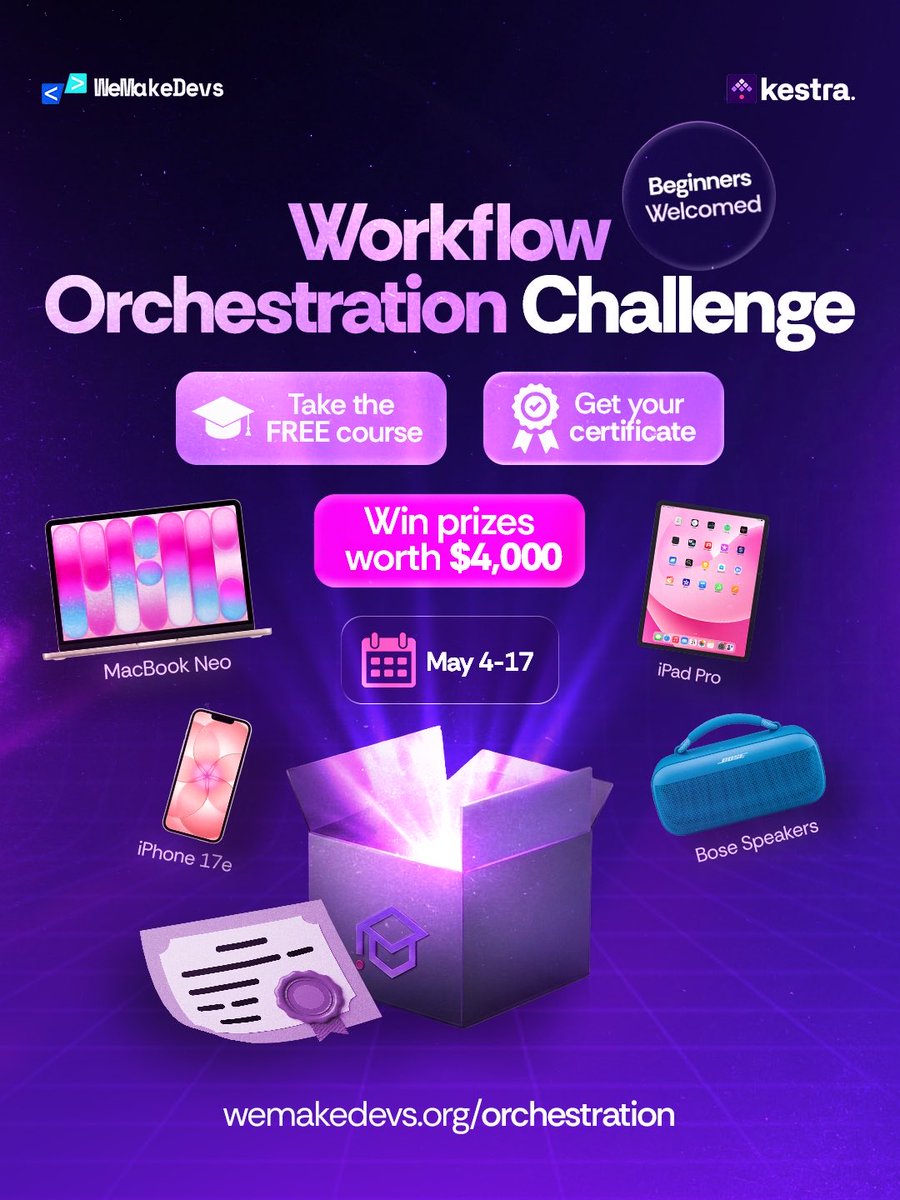
Kubesimplify is proud to be a community partner for The Kestra Orchestration Challenge by WeMakeDevs, powered by Kestra.
Learn workflow orchestration, get your certificate, and win a Apple MacBook, iPad, iPhone, and more worth $4,000! 💰
Writing code is easy, the real challenge is managing the flow between services and APIs. Kestra open-source simplifies this by making orchestration seamless.
👉 Learn more and register: https://t.co/xPEw1tC1uu
The course starts from zero. Winners will be announced on a rolling basis starting this week! ⏰
Currently dissecting @GoogleCloud Run workflows and trade-offs.
We’re having a great discussion right now on the Google Developer Community Discord about best practices for Cloud Run.
Join us 👇
#GCP#CloudEngineering#DevOps#CloudRun#Kubernete
https://t.co/EDLG2xDLZD
Automation isn't just about the tools, it's about the people building the future.
Check out the official Amsterdam after-movie to see what went down. Huge thanks to everyone who presented, attended, and contributed to the conversation.
See you at the next one! 🚀
AI Agents are interesting. Running on K8s? 🤔
Standard Kubernetes was built to run "web servers" (just to handle traffic).
But AI Agents are different: they think, write code, and act on your behalf.
This obviously creates a huge security risk. if an AI agent makes a mistake or is "tricked" by a prompt, it could delete your entire database ROFL 😅
There are 2 projects Sympozium and Kagent that make running these agents safe, but they focus on different parts of the problem.
Which one do you need?
Choose Kagent if you are a DevOps Engineer who wants an AI "teammate" that can look at your logs, check Prometheus metrics, and help you troubleshoot your cluster using standard AI patterns.
The Goal: Efficiency. It’s about reducing the "Mean Time to Recovery" (MTTR).
Choose Sympozium if you are a Platform Engineer who needs to give 100 different users their own "AI Workspace" and you want to be 100% sure that User A's agent can never see User B's data, even if the agent is compromised.
The Goal: Security. It focuses on the Runtime Environment. It often uses technologies like micro-VMs (Kata Containers) or gVisor to ensure that even if the agent tries to run malicious code, it’s trapped in a "cell."
Hope this is useful. A repost helps. Thank you.
10 engineering blogs every devops professional should read
1) netflix technology blog: a guide for cloud-native resilience and chaos engineering.
↳ https://t.co/zSUQLhPxnf
2) cloudflare blog: practical networking and security for edge computing. focus on low-latency infrastructure.
↳ https://t.co/7DJOo2ojWW
3) google cloud blog: essential for the gcp ecosystem and platform engineering.
↳ https://t.co/cAIqY3zlWN
4) slack engineering: insights into observability, database scaling, and incident management.
↳ https://t.co/sWcEFSCEni
5) uber engineering: details on large scale distributed systems and geospatial indexing. focus on stateful workloads.
↳ https://t.co/x6DgerrWBT
6) doordash engineering: clear examples of migrating from monoliths to microservices and service mesh.
↳ https://t.co/Fc9917zfuE
7) airbnb engineering: resources for data infrastructure, automated testing, and workflow orchestration.
↳ https://t.co/1ZzdOH0aRR
8) meta engineering: covers the open-source ecosystem, hardware, and network innovation.
↳ https://t.co/faCnxocL5v
9) stripe engineering: api design and reliability with a focus on zero-downtime migrations.
↳ https://t.co/mMIu1VpmcJ
10) discord engineering: high-concurrency systems, rust in production, and performance optimization.
↳ https://t.co/qCeE1dnTrV
Tutorials will only get you so far.
You can memorize all the yaml syntax you want, but to get hired as a devops engineer, you need to build production-grade projects.
When I started, the biggest frustration was finding realistic projects. Watching is not doing.
Stop watching cloud overviews. Start doing architecture deep-dives.
These blogs cover distributed tracing, data consistency, and high availability. These are the problems you will face in a job.
Which blog from this list will you read first this week? Let me know.
• • •
🔔 follow me (piyush sachdeva) for more devops learning tips
♻️ share so others can learn as well
We are hiring and giving away $4,000 in cash prizes in this week’s hackathon.
The Vision Possible hackathon is officially LIVE. Your goal is to build AI Agents that can see using the @visionagents_ai open source project. In simple terms: instead of just typing text to an AI, you’re building an app where the AI watches a live video feed, understands what’s happening in real-time, and reacts to it.
It is very easy to get started. You can jump in solo or grab your friends and compete as a team. The hackathon ends Sunday so register today at the @WeMakeDevs website.
Happy hacking!
T 5/5Started on 25-Nov. Today, it's a production-grade infra. Humble enough to know there's more to learn, confident enough to build it. Next stop: Full CI/CD via @GitHub Actions. Let's keep building. 🚀 #DevOps#HomelabOps
Engineering Lessons & Refactoring
T 1/5The hardest part of V2.0? Debugging what you can't see. 🔍 Wan connectivity & MTU issues nearly broke my VPN tunnel. Lesson: Always verify the physical layer before blaming the code. #Linux#Networking#Homelab
T 4/5Why do this? 🧐 Because simulating enterprise constraints at home makes you a better Engineer. Handling @googlecloud IAM, Proxmox APIs, and K8s networking at once is the ultimate 🧠 workout. #CloudNative#Kubernetes