Robotics stole hierarchical control from the brain. But a significant gap still exists. Read on to see what’s missing 🧵 👇🏽
(Follow me (@Vslowsprinter) for regular AI x bio insights; only images are AI gen; thoughts my own)
This is age old principle that is going to propagate up the entire stack - when constraints start to matter - chips, models, routers, data, agents, tools, apps and everything in between get specialized and the system complexity increases. https://t.co/FVTlN3aFU2
In the '90s, general-purpose chips wiped out the specialists. The original Thinking Machines, Cray Computer, and a wave of others shut down, and their best ideas got absorbed into other chips.
Zain Asgar of @gimletlabs argues the conditions that made generalists win have changed. Dennard scaling (shrinking transistors made chips faster at the same power) ended around 2005, transistor costs stopped falling around 2012, and memory bandwidth never kept up with compute.
Meanwhile, token demand is projected to grow 24x by 2030 while available power grows about 2x. When power is the bottleneck, performance per watt wins, and that's where specialized chips shine.
Full piece from Zain on why "the time of specialization is upon us": https://t.co/dFA8McPid5
@a16z@gimletlabs This is age old principle that is going to propagate up the entire stack - when constraints start to matter - chips, models, routers, data, agents, tools, apps and everything in between get specialized and the system complexity increases:
The brain has a key design principle - "complicate". You heard that right, complicate, not simplify. Why? Because, the brain has to optimize for efficiency: under extreme space, energy and compute constraints. AI's constraints will ultimately boil down to similar constraints so that it can be unit economically profitable in the long term to all parties involved. Therefore, I predict that future super intelligence architecture will look nothing like today's gen AI and it's wasteful compute strategies.
@MEmelianchenko Care to share the link?
Caching generally works when the new request is EXACTLY identical as before.
Ex: pick up a cup is the same task in robotics, but cup size, weight, shape, orientation, material changes with each task instance, but is still handled efficiently in brain.
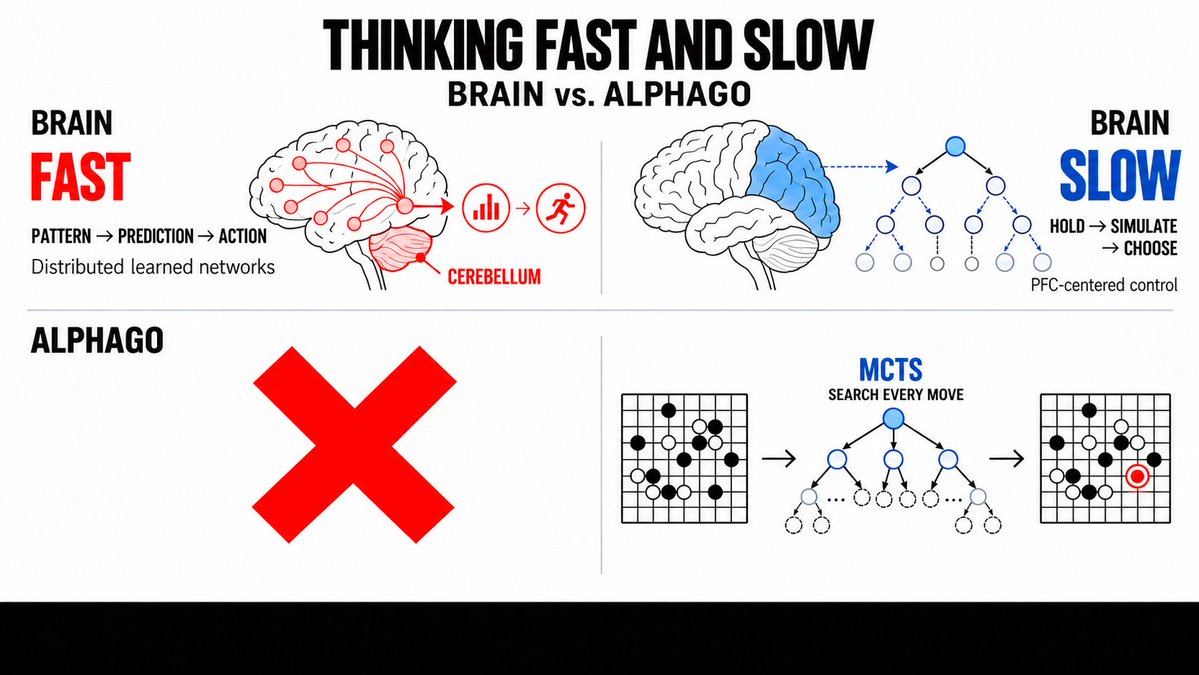
Remember Kahneman's Thinking, Fast and Slow?
The brain decides when to rely on learned patterns (system 1-fast/Cerebellum) vs. deliberate thinking (system 2-slow/Prefrontal Cortex). Energy and compute constraints necessitates extreme efficiency.
Where is the System 1 for RL?
Robotics stole hierarchical control from the brain. But a significant gap still exists. Read on to see what’s missing 🧵 👇🏽
(Follow me (@Vslowsprinter) for regular AI x bio insights; only images are AI gen; thoughts my own)
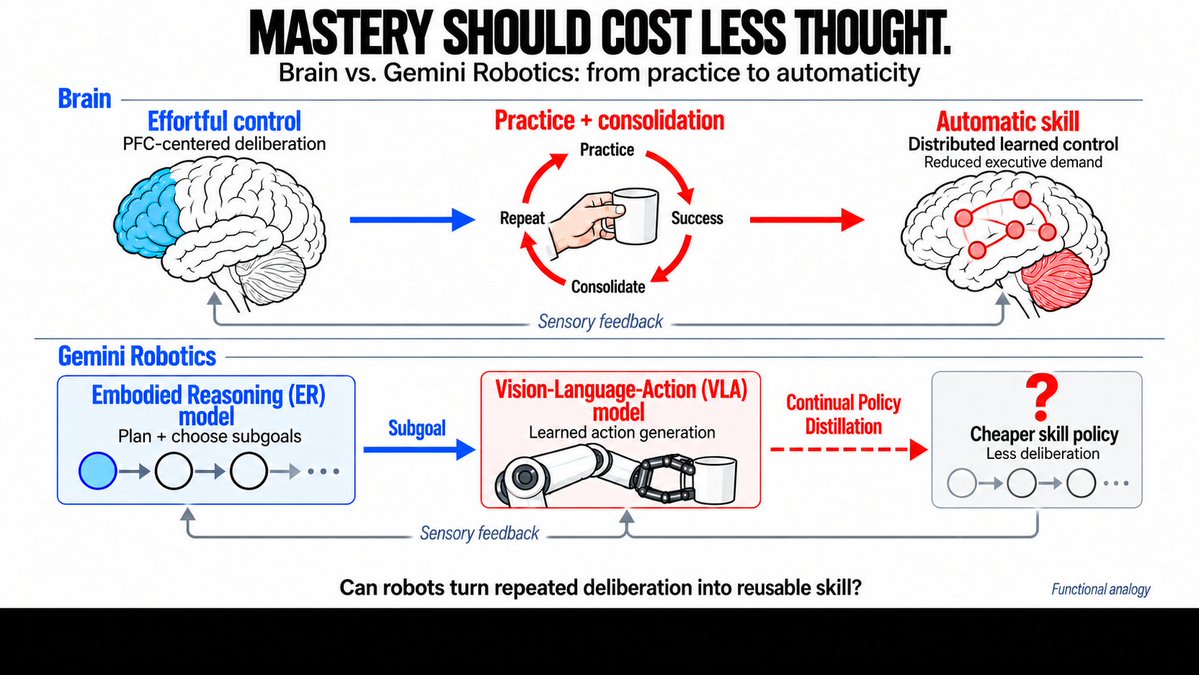
8/9 Google’s recently demoed using reasoning to generate training experience (i.e. policy distillation).
The bigger gap, in my view, is making this loop continuous and online. Can a robot turn effortful deliberation and repeated execution into reliable, reusable skills?
7/9 Robotics also mirrors this hierarchical control
In Gemini Robotics, the Embodied Reasoning model plans, reasons and breaks complex goals into tasks. The Vision Language Action model senses and executes them, while the reasoning model monitors progress. The hierarchy exists.
Robotics stole hierarchical control from the brain. But a significant gap still exists. Read on to see what’s missing 🧵 👇🏽
(Follow me (@Vslowsprinter) for regular AI x bio insights; only images are AI gen; thoughts my own)
6/9 The cerebellum predicts the consequences of actions.
Comparing predictions with sensory feedback generates an error signal that is used to adjust motor system in real time. Fine control doesn’t require replanning the entire task.
5/9 But repeatable skills can’t be completely hardcoded.
Imagine picking up a cup. Its position, weight, orientation and distance may be different from the last time. Mastery means adapting a learned skill to the current situation.
4/9 'Policy distillation' amortizes the costs for frequent tasks in the brain.
When deliberation and refinement lead to mastery via repetition, the action policy becomes a repeatable skill requiring less conscious supervision. Practice makes execution cheaper.
3/9 Therefore, deliberation is effortful and computationally expensive.
It makes economic sense to recruit this analytical machinery only when a novel situation, complexity or high stakes demand it.
2/9 Planning and deliberation require recruiting diverse experts, simulating trajectories and evaluating counterfactuals.
Cortical, memory and basal ganglia brain regions interact throughout. Longer horizon simulations are even more expensive.
1/9 The brain evolved hierarchical planning and control. Why?
Because necessity is the mother of invention. And because the brain is energetically and compute constrained necessitating extreme efficiency.
@theallinpod The core argument from Ali Ghodssi appears flawed. My conjecture on why ASI might end up cooperating with humans even if recursive self improvement is achieved and ASI materializes:
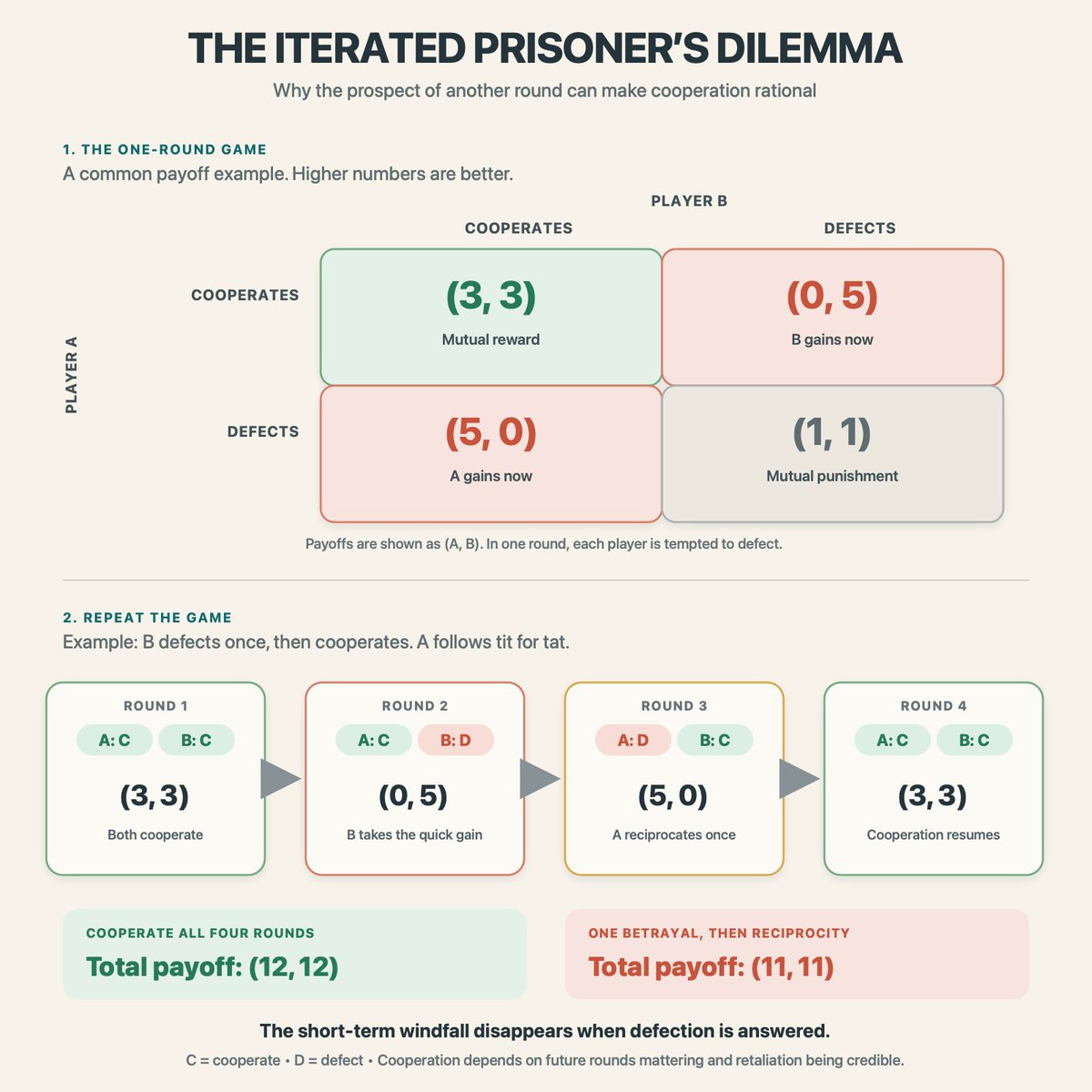
From a game-theoretic perspective, there is a case that artificial super intelligence (ASI) is more likely to cooperate with humans than to destroy humanity. There is a catch, but first, some background…
Humans cooperate remarkably often; but much of that doesn’t come down to ethics training, strict laws, severe penalties, or even social norms. A big reason is that good behavior and cooperation are often game-theoretically advantageous (that is, they produce the best payoff).
Cheating, fraud, and betrayal can all be understood as strategies employed by intelligent beings. However, these strategies are most attractive when the encounter is a one-off, or when future retaliation carries little weight. In an indefinitely repeated game (or something sufficiently long and uncertain, like life), cooperation can become the better strategy because, otherwise, the other player can retaliate. Simulations of the iterated Prisoner’s Dilemma illustrate this. Tit for tat famously performs well: you are never the first perpetrator, you respond to badness directed at you in kind, and then return to cooperation rather than escalating toward mutually assured destruction. Richard Dawkins goes into this in detail in The Selfish Gene, drawing on Robert Axelrod’s work on the evolution of cooperation.
Further, renowned quantum physicist David Deutsch (and father of quantum computing) argues that human beings excel at creating explanatory knowledge and are the only known examples today of what he calls universal explainers. Einstein’s general theory of relativity is a striking example. It was not simply extrapolated from the data available at the time. It required a creative conjecture that reorganized how that data was understood. An ASI looking at all the data generated till that day, may not have independently arrived at the same theory. From that perspective, one could argue that independently creative human minds would continue to have complementary value, and that it would be in an ASI’s interest to keep humans around and cooperate with them.
In biology, cooperation between different organisms for mutual benefit shows up as symbiosis. An extreme form is endosymbiosis: an ancestral host cell, probably related to archaea, swallowed a bacterium whole. Instead of digesting it for nutrients, the host formed a partnership with the bacterium, which eventually became the mitochondrion, the powerhouse of the eukaryotic cell. Without this critical step, which increased the cell’s bioenergetic capacity, the evolution of complex, multicellular organisms would likely have been impossible.
So, here is the catch: this logic assumes an ongoing relationship, and a future both sides value. If an ASI could dominate or eliminate humanity at little cost to itself, reciprocity would offer us little protection.
So, what seems more likely: human extinction, symbiotic cooperation between humanity and ASI, or a cyborg-like future in which humans and ASI merge?
(only images generated with AI, opinion and writing my own)
The first two don't appear to be preconditions. They just allow the recursive loop to become more efficient over time. The existence of a recursive self improving loop is entirely sufficient.
Acquiring the physical resources required to accelerate that flywheel is an entirely different problem. Theorerically, by redirecting available resources today away from other areas to this cause, this bottleneck could be mitigated.
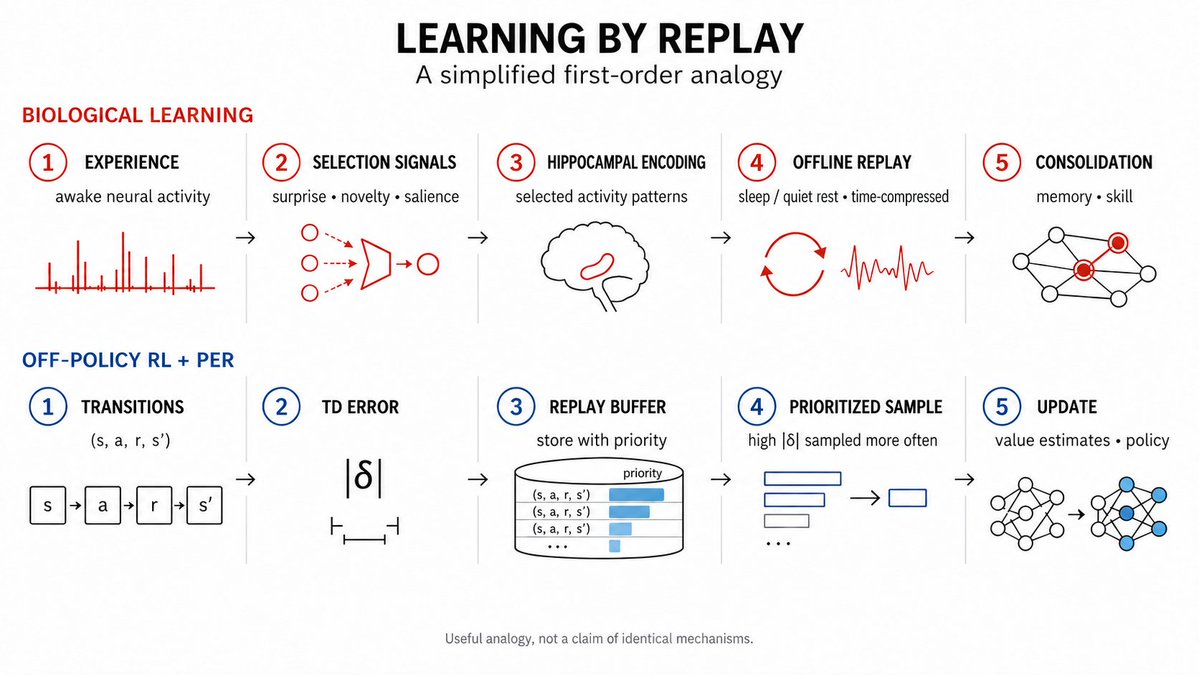
Sleep turns today’s experience into tomorrow’s skill. Here’s how your brain decides what to replay, reinforce and remember.
To learn how, keep reading 👇
7/8 Synaptic changes in the brain happen within seconds, but require repeated reactivation and replay during rest and sleep to become long term learnings.
This is how today's experience becomes tomorrow's skills. All while you sleep!