i asked my grandpa what the secret to a long life was. He said, "Having at least one person who's genuinely happy to see you come home." I've never forgotten that answer.
Be ordinary. There is nothing wrong with an ordinary life. Wake up slowly. Make your coffee. Cook simple meals. Go for walks. Love people who match your vibe. Do honest work. But the thing is... bring your whole awareness to it. Every little thing you do, be there. That’s what changes everything. Stop rushing through life. When you are fully present, even the simplest things become beautiful. A quiet morning. A good conversation. A book in your hands. The warm sun on your skin. Stop trying so hard to create a special life. A special life is the one that aligns with your heart. Live an ordinary life with extraordinary awareness. That’s what makes it special.
Eventually I think the best coping mechanism is a hobby. Your interests will always nurse you back to joy. Reading, writing, playing a sport - find something that brings joy, then spend enough time nurturing it. Rely on it to always help you find your way back.
Author unknown shared from Everyday Magic
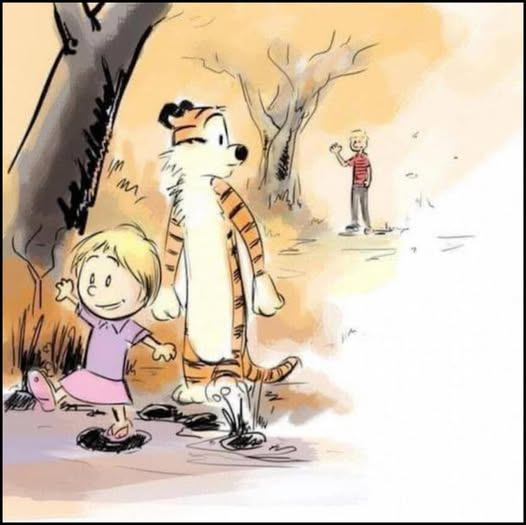
"Calvin? Calvin, sweetheart?"
In the darkness Calvin heard the sound of Susie, his wife of fifty-three years. Calvin struggled to open his eyes. God, he was so tired and it took so much strength. Slowly, light replaced the darkness, and soon vision followed. At the foot of his bed stood his wife. Calvin wet his dry lips and spoke hoarsely, "Did... did you.... find him?"
"Yes dear," Susie said smiling sadly, "He was in the attic."
Susie reached into her big purse and brought out a soft, old, orange tiger doll. Calvin could not help but laugh. It had been so long. Too long.
"I washed him for you," Susie said, her voice cracking a little as she laid the stuffed tiger next to her husband.
"Thank you, Susie." Calvin said.
A few moments passed as Calvin just laid on his hospital bed, his head turned to the side, staring at the old toy with nostalgia.
"Dear," Calvin said finally. "Would you mind leaving me alone with Hobbes for a while? I would like to catch up with him."
"All right," Susie said. "I'll get something to eat in the cafeteria. I'll be back soon."
Susie kissed her husband on the forehead and turned to leave. With sudden but gentle strength Calvin stopped her. Lovingly he pulled his wife in and gave her a passionate kiss on the lips. "I love you," he said.
"And I love you," said Susie.
Susie turned and left. Calvin saw tears streaming from her face as she went out the door.
Calvin then turned to face his oldest and dearest friend. "Hello Hobbes. It's been a long time hasn't it old pal?"
Hobbes was no longer a stuffed doll but the big furry old tiger Calvin had always remembered. "It sure has, Calvin." said Hobbes.
"You... haven't changed a bit." Calvin smiled.
"You've changed a lot." Hobbes said sadly.
Calvin laughed, "Really? I haven't noticed at all."
There was a long pause. The sound of a clock ticking away the seconds rang throughout the sterile hospital room.
"So... you married Susie Derkins." Hobbes said, finally smiling. "I knew you always like her."
"Shut up!" Calvin said, his smile bigger than ever.
"Tell me everything I missed. I'd love to hear what you've been up to!" Hobbes said, excited.
And so Calvin told him everything. He told him about how he and Susie fell in love in high school and had married after graduating from college, about his three kids and four grandkids, how he turned Spaceman Spiff into one of the most popular sci-fi novels of the decade, and so on. After he told Hobbes all this there was another pregnant pause.
"You know... I visited you in the attic a bunch of times." Calvin said.
"I know."
"But I couldn't see you. All I saw was a stuffed animal." Calvin voice was breaking and tears of regret started welling up in his eyes.
"You grew up old buddy." said Hobbes.
Calvin broke down and sobbed, hugging his best friend. "I'm so sorry! I'm so sorry I broke my promise! I promised I wouldn't grow up and that we'd be together forever!!"
Hobbes stroke the Calvin's hair, or what little was left of it. "But you didn't."
"What do you mean?"
"We were always together... in our dreams."
"We were?"
"We were."
"Hobbes?"
"Yeah, old buddy?"
"I'm so glad I got to see you like this... one last time..."
"Me too, Calvin. Me too."
"Sweetheart?" Susie voice came from outside the door.
"Yes dear?" Calvin replied.
"Can I come in?" Susie asked.
"Just a minute."
Calvin turned to face Hobbes one last time. "Goodbye Hobbes. Thanks... for everything..."
"No, thank you Calvin." Hobbes said.
Calvin turned back to the door and said, "You can come in now."
Susie came in and said, "Look who's come to visit you."
Calvin's children and grandchildren followed Susie into Calvin's room. The youngest grandchild ran past the rest of them and hugged Calvin in a hard, excited hug. "Grandpa!!" screamed the child in delight.
"Francis!" cried Calvin's daughter, "Be gentle with your grandfather."
Calvin's daughter turned to her dad. "I'm sorry, Daddy. Francis never seems to behave these days. He just runs around making a mess and coming up with strange stories."
Calvin laughed and said, "Well now! That sound just like me when I was his age."
Calvin and his family chatted some more until a nurse said, "Sorry, but visiting hours are almost up."
Calvin's beloved family said good bye and promised to visit tomorrow. As they turned to leave Calvin said, "Francis. Come here for a second."
Francis came over to his grandfather's side, "What is it Gramps?"
Calvin reached over to the stuffed tiger on his bedside and and held him out shakily to his grandson, who looked exactly as he did so many years ago. "This is Hobbes. He was my best friend when I was your age. I want you to have him."
"He's just a stuffed tiger." Francis said, eyebrows raised.
Calvin laughed, "Well, let me tell you a secret."
Francis leaned closer to Calvin. Calvin whispered, "If you catch him in a tiger trap using a tuna sandwich as bait he will turn into a real tiger."
Francis gasped in delighted awe. Calvin continued, "Not only that he will be your best friend forever."
"Wow! Thanks grandpa!" Francis said, hugging his grandpa tightly again.
"Francis! We need to go now!" Calvin's daughter called.
"Okay!" Francis shouted back.
"Take good care of him." Calvin said.
"I will." Francis said before running off after the rest of the family.
Calvin laid on his back and stared at the ceiling. The time to go was close. He could feel it in his soul. Calvin tried to remember a quote he read in a book once. It said something about death being the next great adventure or something like that. He eyelids grew heavy and his breathing slowed. As he went deeper into his final sleep he heard Hobbes, as if he was right next to him at his bedside. "I'll take care of him, Calvin..."
Calvin took his first step toward one more adventure and breathed his last with a grin on his face
I'm a cardiologist. I've held dying hearts in my hands. Let me tell you what I've learned.
At the end of the day, you live with yourself.
Not with the applause. Not with the criticism. Not with the version of you that performed for strangers. Not with the opinions you chased or the approval you never needed.
Just with the choices you made — and the person you became in the making of them.
The patients who haunt me aren't the ones who died on my table. They're the ones who survived but never started living. The ones who got the second chance and spent it the same way they spent the first — waiting, scrolling, avoiding, postponing the only decision that ever mattered.
I've watched someone take their last breath while their family stood behind the glass realizing that every grudge, every postponed phone call, every "I'll do it next year" was a lie they told themselves about a future that never came.
Time is the only currency that never comes back. Money returns. Opportunities return. Even love sometimes returns. Time — never.
The life you want is not hidden in some distant future. It's waiting on the other side of the decision you're afraid to make right now. The conversation. The risk. The leap. The version of you that stopped rehearsing and finally stepped onto the stage.
Every day you postpone it, the emptiness deepens. Every day you move toward it — even afraid, even uncertain, even alone — something inside you fills back up.
I've been a physician for over twenty years. I left my birth country as a child with nothing. I rebuilt everything from zero. And if there is one truth I would carve into stone, it's this:
You were not built for comfort. You were built for a life that leaves marks.
Sun on your skin. Weight in your hands. Honest words in your mouth. A purpose that pulls you out of bed before the alarm.
Fix your body. Chase the mission. Let the rest fall away.
Say yes to the hard thing.
Build the life.
Step into the arena.
Be grateful. Get moving.
Your heart — the one I treat and the one I'm talking to right now — deserves nothing less.
I’ve been playing with ChatGPT and Claude every once in awhile as I write, not for my own sake or to apply to my work, but to understand it better given its proliferation among students and others.
And I have to say.
It’s worse than you think.
Every story you hear about making up quotes and sources, not being able to adjudicate good from bad research, writing in a reductive and generic idiom, “apologizing” for doing shabby work instead of doing it right the first time, etc. is not a bug but a feature.
As I keep telling students, your attempts at using it even “for research” is actually making your work worse. And it’s very best, it’s a supercharged Google, which isn’t saying much. An AI-produced paper, even with the best intentions and prompts, is C-level at best when compared to my expectations.
If you sneak it by me, shame on you. And maybe shame on me a little too.
Of course, the deeper issue is it’s robbing you of creative discovery, hard-won knowledge, and the ability to articulate thoughts—all sorely needed skills in ministry.
It just ain’t worth it.
#HYDTPweBringAwareness
⚠️ The Gap is an Illusion!
Never attempt to squeeze through the gap between heavy vehicles such as buses, trucks, tankers, or trailers. What may appear to be enough space can quickly disappear due to vehicle movement, blind spots, or sudden lane changes.
✅ Maintain a safe distance from heavy vehicles.
✅ Avoid overtaking through narrow gaps.
✅ Stay visible and alert at all times.
✅ Follow lane discipline and traffic rules.
A moment of patience can save a lifetime.
Drive Safe • Stay Safe • Reach Safe
#HyderabadTraffic #RoadSafety #StayAlert #SafeDriving #TrafficAwareness #DriveResponsibly #RoadSafetyFirst 🚔🚦
The situation has escalated
Customer service in India has undergone a significant transformation over the few years. The change is subtle and most people don't notice it immediately, but after a few interactions, they notice a pattern. Every company claims to be customer-centric. Every advertisement promises personalized service. Yet, when customers actually reach out for help, they often encounter the same predictable conversation regardless of the company, industry, or issue.
It almost feels as if an entire generation of customer service representatives is being trained from the same handbook.
The interaction starts with a greeting that sounds warm but has become entirely mechanical.
“Hello Sir/Madam Good morning, I am Rajesh/ Priyanka ”
"I am sorry for the inconvenience caused."
"I completely understand your concern."
"I assure you that I will help you with this issue."
The words are polite and the tone is very friendly. The intent too appears genuine. Yet customers hear these statements so often that they have lost all meaning. They have become verbal placeholders, inserted into conversations before the actual problem has even been understood.
Then comes that ritual.
"Can I put you on hold for two minutes while I check?"
Two minutes become five. Five become ten. The representative returns.
"Thank you for your patience."
A few keyboard clicks later comes the next standard response.
"The issue has been escalated to the concerned team.”
Escalated to whom? Who is the concerned team ? Is there one ? Does the escalation team know they are the chosen ones?.
When will something happen? Nobody can say.
The customer is expected to derive comfort merely from the existence of the word "escalated."
If the issue persists, another familiar statement arrives.
"You will receive an update on your registered email ID."
Customers have learned that this sentence can mean almost anything. The email might arrive in an hour. It might arrive in a week. It might contain useful information. It might simply acknowledge receipt of the complaint. Sometimes it never arrives at all.
Then comes another classic.
"The concerned team will call you back."
The concerned team is perhaps one of the most mysterious entities in modern business. Every customer has heard of this team. Nobody has ever spoken directly to them. They exist somewhere in the organizational universe, possessing great knowledge and authority, yet remaining permanently inaccessible.
The interesting part is that this phenomenon is not limited to one provider, one industry, or one company. Telecom companies, Banks , E-commerce platforms Airlines sound similar. Even government service centers sound similar.
The responses have become truly deterministic.
In fact, experienced customers can almost predict the conversation flow.
At this point, customers are no longer having a conversation. They are participating in a scripted play whose ending is already known. They even place bets perhaps.
In many cases, today's representative is functioning less as a problem solver and more as a human interface sitting between the customer and a workflow management system. Their job is not necessarily to resolve the issue. Their job is to move the issue from one queue to another while ensuring the interaction remains polite and compliant.
The customer is speaking to a human being, yet the interaction feels automated.
Customers do not necessarily need empathy statements.
They need progress, the evidence that someone is actually doing something about it.
The last thing they need is another ticket number. And a promise of a resolution in 24 hours or multiples of it..
Imagine how different the experience would feel if the response were:
"I can see that you contacted us on three previous occasions regarding the same issue. The first escalation was closed without resolution because of an internal dependency. The second escalation is currently pending with the network operations team. I have personally reopened the case and set a follow-up reminder for tomorrow. If there is no update within 24 hours, I will contact you directly."
The response contains less sympathy but far more accountability.
The question is whether the replacement of humans with bots will make things worse or better.
“AI”se din aage aur aayenge …
Hope this reaches folks who are in the services business. #service #support #India @suchiswriting
Civic sense abroad is one thing, but how to stop people from playing music on speaker phones? And in places like Lal Bagh and Cubbon Park where the mornings are full of birdsong. :(
Do you still write pending work or small things to do in a diary or register… and once finished, cut them off with a pen or mark them with a highlighter 😊
I still do.
I think this habit came from my early years working in a CA firm. We used to maintain audit notes very systematically in registers, and somewhere that discipline quietly became part of life itself.
Over the years those audit note habits slowly transformed into personal "to do" lists 😊
And yes, written neatly with a fountain pen no less.
Even today there is a strange satisfaction in physically crossing out one completed task on paper. Digital reminders are convenient, but somehow they still cannot recreate that feeling. @JustPunforfun@varoun3883@MusingGee
I took a day trip to a small village outside Takayama. Really rural, barely any tourists.
I was walking around and got completely lost. Like no phone signal, no idea where I was, I couldn't find any signs in English.
I saw a woman working in a rice field and approached her to ask for directions. She was probably in her 60s, wearing traditional work clothes and a hat.
I tried to show her on my phone map where I needed to go, but no signal. I said the name of the bus stop I needed.
She didn't speak any English. I didn't speak enough Japanese.
She motioned for me to follow her. I thought she'd point me in the right direction.
Instead, she walked me the entire way. Like a 20 minute walk through the village. She was still in her work boots, covered in mud.
I felt so guilty. I kept saying "I'm sorry" and "thank you" over and over.
When we got to the bus stop, I tried to give her money. She refused, looking almost hurt that I offered.
She said something in Japanese, smiled, and started walking back.
An old man at the bus stop who spoke a tiny bit of English told me "she said: when you are lost, someone helps you. That is normal."
I watched her walk all the way back across the village to her rice field.
The bus didn't come for another 45 minutes. The whole time I sat there thinking about how she just... stopped her work in the middle of the day to help a completely random foreigner.
Didn't expect anything in return. Seemed confused why I'd even offer.
That was five years ago and I still think about her sometimes.
Underrated life advice: Have more hobbies and fewer opinions. Learn an instrument. Plant a garden. Build something with your hands. Cook. Paint. Run. The happiest people I know spend less time debating life and more time actually living it.
The IT industry is slowly turning young engineers into patients before 30.
Because of workload, continuous upskilling, certifications, interview preparation, and now the fear that AI may take jobs people are spending 10-12 hours daily connected to screens.
After that, nobody feels like going outside, hitting the gym, walking, or working on their body.
People just want to lie down and relax.
But slowly this lifestyle is damaging health.
In IT, most of the work happens sitting on a chair with very little physical movement. If you don’t exercise regularly, chances of neck pain, back pain, migraines, stress, obesity, and diabetes increase heavily.
Career growth is important.
But don’t build a successful career with an unhealthy body.
Prioritise your health too.
Your brain has a part that gets stuck overthinking. Walking switches it off. Stanford caught it on brain scans.
In 2015, Stanford researchers put 38 people through brain scans, sent them on a 90-minute walk, then scanned them again. One group walked through trees and grass. The other walked along a busy four-lane highway. Only the nature walkers came back with a calmer brain. The region that flares up when you keep replaying something embarrassing you said five years ago had quieted down. The highway walkers got no benefit.
Walking also makes you smarter on the spot. In 2014, Stanford asked volunteers to come up with creative ideas while sitting, then while walking on a treadmill. Walking won by 60% on average. Even on a treadmill facing a blank wall, walking beat sitting. Steve Jobs and Mark Zuckerberg both held walking meetings.
Over the long term, walking grows your brain. In 2011, scientists followed older adults who walked 40 minutes, three times a week. After a year, their memory center had grown 2% bigger. That undoes about 1 to 2 years of normal age-related shrinkage. Your brain releases a growth chemical called BDNF every time you walk. Think of it as fertilizer for brain cells.
The peace also has a chemical signature. In 2019, University of Michigan researchers found that 20 to 30 minutes outside in nature drops your cortisol levels (the stress hormone behind that wired, tense feeling) more than any other duration they tested.
The rhythm of walking does something separate. The left-right pattern shows up in trauma therapy too. It's called EMDR, and it's used to help people process PTSD. A psychologist named Francine Shapiro discovered it by accident in 1987, walking through a park feeling anxious. She noticed her dark thoughts faded as her eyes moved back and forth with each step. She built an entire form of trauma therapy around it.
When a walk feels beyond peaceful, your overthinking circuit is going quiet, your memory center is growing, your stress chemicals are dropping, and your brain is doing the same back-and-forth motion that trauma therapists charge $200 an hour to recreate.
♻️ OLD BULKY WASTE TO DISPOSE OFF?
Bengaluru now has a smarter way!
🚛 FREE Doorstep Pickup for Bulky Waste across Bengaluru
To promote responsible waste disposal and a cleaner city, Bengaluru Solid Waste Management Ltd. (BSWML) has launched the DCLUTTER App — a simple, citizen-friendly solution for safe and hassle-free bulky waste collection across Bengaluru.
🪑 Old furniture
🛏️ Mattresses
📺 Broken electronics
🚲 Unused household items
Dispose of bulky waste responsibly from the comfort of your doorstep.
📲 Download the DCLUTTER App today and keep Bengaluru clean & clutter-free! 🌿🏙️
#GreaterBengaluruAuthority #BSWML #DKShivakumar #gbachiefcommissioner
@DKShivakumar
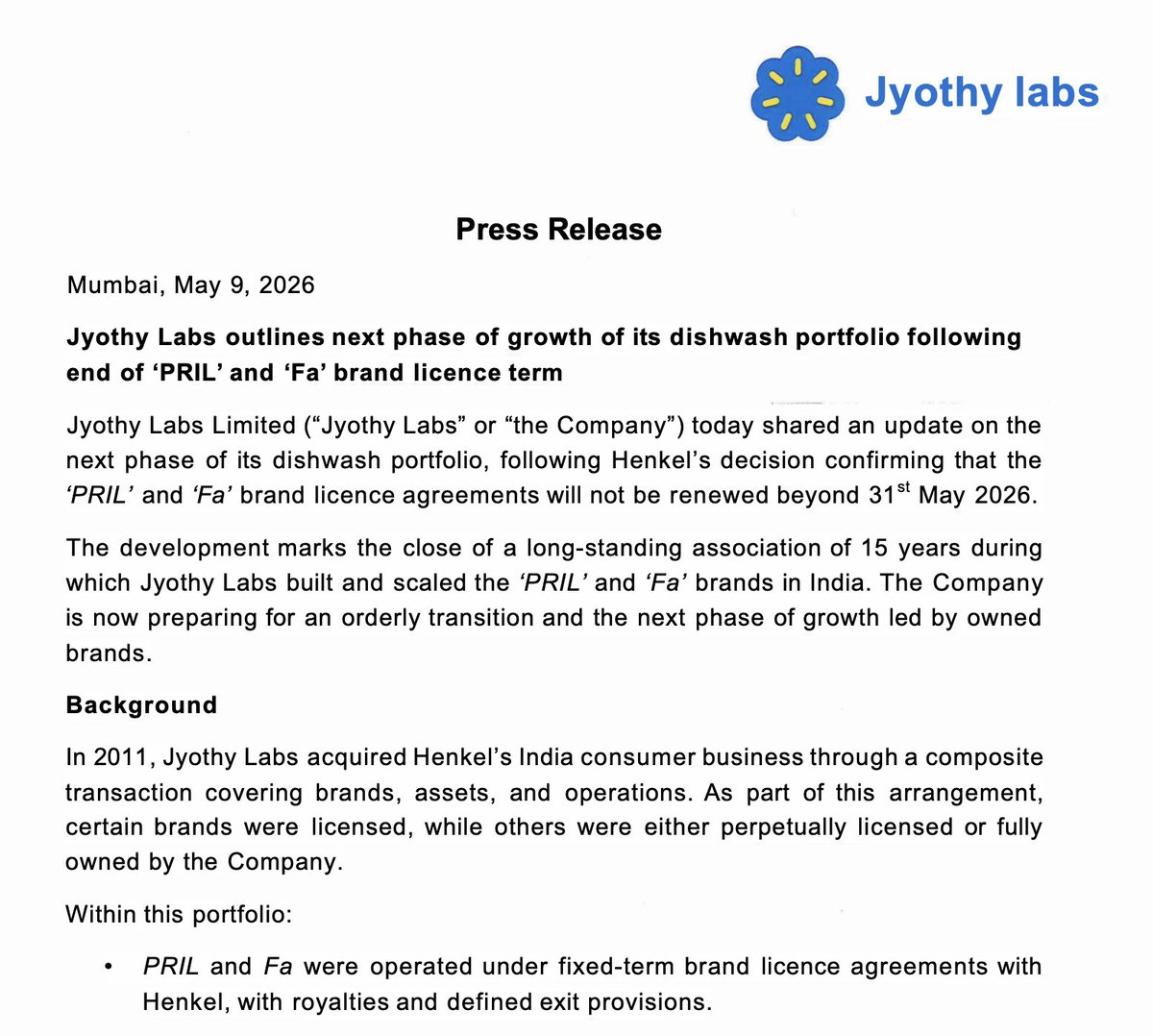
Jyothy Labs losing rights to their flagship dishwashing brand PRIL is such a big risk playing out in a listed company. Wonder even if the analysts or shareholders saw this coming. It is a brutal reminder how investing can have its blind spots and sometimes those seemingly low probability events end up hurting so bad.
Perpetual brand rights are such an integral part for long-term success of any business.
Some business leaders like TT Jagannathan (TTK Prestige Ltd) were cognisant of this - he fought hard to secure perpetual rights to Prestige brand in India, from the Prestige Group UK.
While many Indian listed businesses continue to face such vulnerabilities, surprisingly their stock valuations may not reflect those risks. @Stalwartsadvise
If you see elderly folks struggling at a metro station, please take five seconds to help them out.
They are already overwhelmed by the idea of traveling in a metro. They are not a smartphone generation. The QR code tickets, the electronic gates, language barriers, figuring out which platform to get on.
It is a very different and intimidating world from the one they grew up in.
But the reason they are traveling alone is because they don't want to be a burden on anyone. They also want to navigate this new world on their own. Get around without having to depend on anyone.
You have no idea the enthusiasm and pride with which they will tell their children (and grandchildren), that they "travelled alone" in a metro from X to Y. All by their self, figuring out everything!
It costs us nothing - to tell them to just stand a bit behind at the electronic gates, or show them where to scan the QR code, or help them with the platform on which their metro will arrive.
But it means everything to them. They will give you the biggest smile, and bless you for taking out that tiny bit of time to assist them.
Most of all, it gives them that confidence that they can do it all over again.
And navigate this new world like the rest of us!
I'm convinced that writing is the ultimate tool for personal growth.
• Clearer thinking
• New friendships
• Learning new topics
• Increased awareness
• Keystone daily consistency
• Foundational skill you can apply anywhere
Hard to find anything else that comes close.