If a person who has long lived in fear begins to imagine themselves as courageous (not merely pretending, but actively living into that image) then they are binding themselves to a vision that reorganizes their perception, their priorities, their behavior.
And if that imaginal frame leads them to confront reality more honestly, then it brings the person into deeper conformity with what is.
From this point of view, the imaginal does not point us away from the real...but draws us into its depth.
@thealepalombo It seems that summer heat is quicky becoming the biggest issue for anyone with a long-term time horizon. How would you rate Genoa on this?
Your brain is incredible at pattern recognition...but once you see a pattern, it becomes incredibly hard to "unsee" it.
You become trapped in your own mental models.
The frame becomes a prison.
This reveals something crucial:
The art of systematically breaking patterns to see reality anew.
You need practical techniques to disrupt your normal patterns of thinking.
I've hear this so many times: what is the purpose of my life?
This warning has some deep truth to it. And it can be practical, too.
I am thinking about "purpose-driven enterprise"... For those entities, "purpose" ~ "goal" is probably OK.
Determining the meaning of your life by purpose is actually really dangerous.
Why?
Because most people think of purpose as something which you're working towards (some ultimate goal).
That's a very dangerous way of framing meaning:
- If you never reach it, your life was meaningless
- And if you do, the sense of meaning often vanishes once it’s achieved
There is something more important: Orientation
Purpose can be very egocentric (what I most want to have) whereas orientation is reality-centric:
What do I most need to be in order to be in touch with reality...to be deeply in touch with myself (with other people) and with the world?
@amandaorson "Greatness" is misleading.
Forcing thousands of people to work for you 14 hours a day is not greatness. That's why workers fought for their rights.
I've read here that many great writers, philosophers, artists worked 3 to 4 hours a day. They did not buy greatness with time.
@thealepalombo I'm at the beginning of the path that you are walking, and that makes your insights especially valuable.
Regarding Portugal: what makes inland unacceptable for you?
It seems the people freaking out most about AI are the ones most obsessed with productivity. Makes sense: if your whole worth is in doing, a machine that does it faster is terrifying. But nobody asks ChatGPT for a peak experience. Being isn't going anywhere.
When someone teaches you something you didn't ask to learn, your brain reacts like it's in physical pain. UCLA scientists watched it happen on brain scans in 2003. The same wiring that fires when you stub your toe also fires when someone treats you like you need fixing.
Naomi Eisenberger and Matthew Lieberman ran the study and published it in Science. The brain region is the dorsal anterior cingulate cortex, which is just the fancy name for your main pain alarm. It doesn't care whether the threat is a hot stove or a friend telling you how to live.
A neuroscientist named David Rock built a framework around this in 2008. Five things make the brain feel safe in social moments: status, certainty, autonomy, relatedness, and fairness. Take away any of those and the alarm fires. Rock wrote that one of the easiest ways to dent someone's status is to give them advice they didn't ask for. Even hinting that they're doing something wrong is enough.
When people are told what to do, they often do the opposite, even when the advice was good. The psychologist Jack Brehm noticed this in 1966, and sixty years of follow-up have confirmed it. The brain is trying to keep your life feeling like your own.
Close friends cut each other off with unsolicited advice in about 70% of supportive conversations, often before the friend has even finished explaining the problem. That number comes from a 2016 study by Bo Feng and Eran Magen in the Journal of Social and Personal Relationships. The closer the friendship, the worse it gets. And the advice tends to make them more stressed, more depressed, and more lonely, not less.
Giving advice gives the giver a sense of power, even when nobody asked for it. Michael Schaerer and his co-authors, working across Harvard, Duke, INSEAD, USC, and Singapore Management, published this in 2018 after four experiments with about 700 people. People who chase power volunteer advice more often than others. Whether the student actually improves is a side effect, if it happens at all.
So when you feel the urge to teach somebody who never asked, that urge is mostly about you. You walk away feeling a little more powerful. They walk away feeling like they were just told they can't run their own life. Most uninvited teaching is one person's ego dressed up as kindness.
We can get to this model where we think:
Inside of me there is this "narrator" that is actually (from my subjectivity) controlling all my actions.
Let's call that "narrator" your "ego"...I know that's a loaded term, but I need a term to refer to it.
And your agency is your actual capacity to solve problems in the world.
Now the great lie of the "ego" is that it is the identity of your agency.
But then you get into the flow state and you find out:
Oh no, that ego completely disappears. Yet your agency is actually working way better than it ever has...and you get Daoism.
Or you go into Buddhism and you're in a deep meditative state and you realize your awareness is neither an inner awareness nor an outer awareness, but sort of stereoscopic…both at the same time.
So you have that Daoist flow and you have that Buddhist awareness (that's simultaneously in and out) and you put them together and you get Zen.
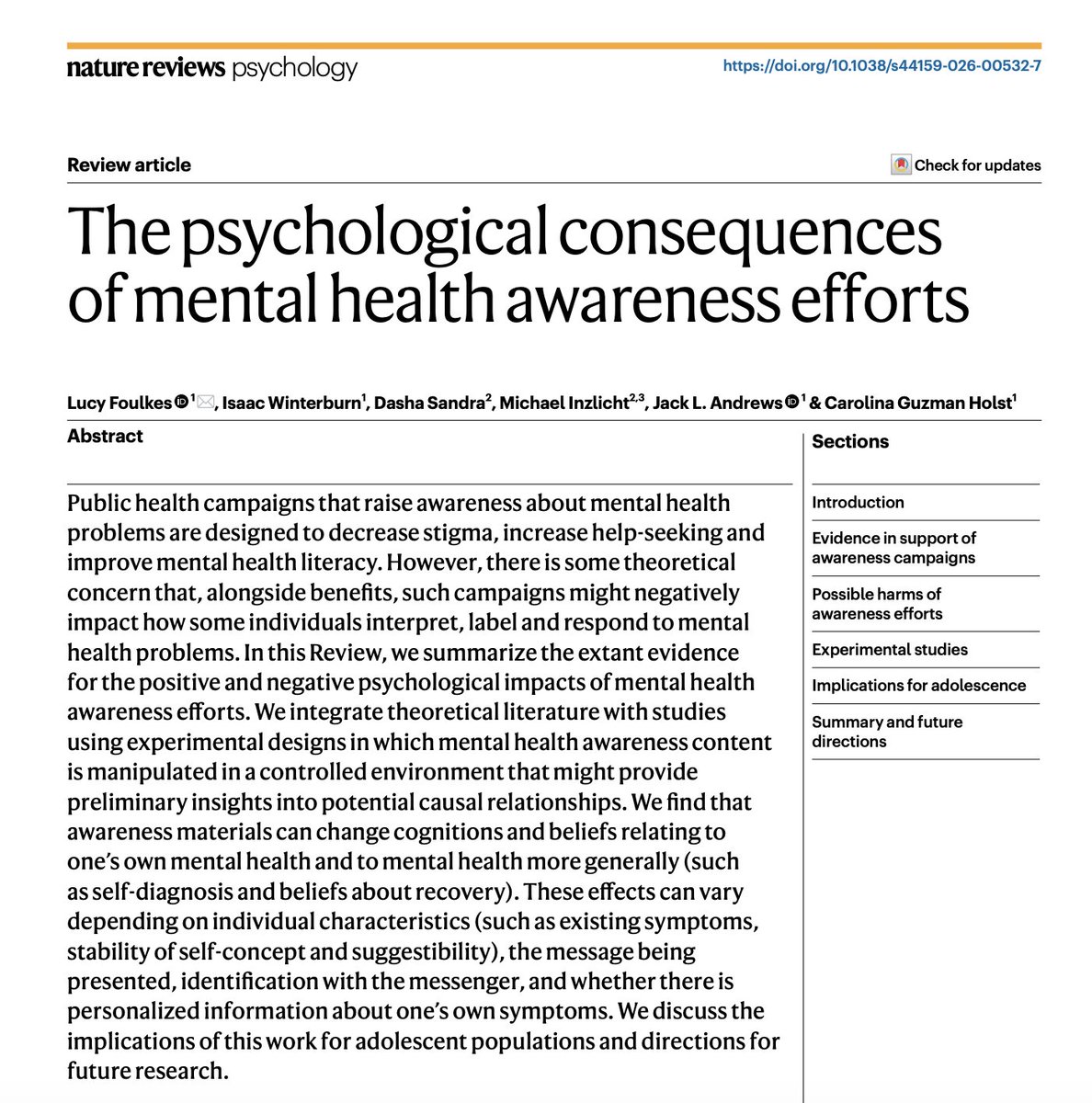
From the paper: "Several high-quality trials have shown that universal mental health interventions based on mindfulness, cognitive behavioural therapy, dialectical behavioural therapy and general mental health awareness can all have negative outcomes, including an increase in internalizing symptoms."
As critics have been arguing all along, individualised, medicalised and decontextualised models & narratives are not only net ineffective, but even contribute to and exacerbate social & psychological issues and distress.
We dont face a crisis of 'mental disorders' in need of medical or cognitive treatment, we face a socio-psychological crisis and a crisis of medicalisation in need of a societal rethink.
I wonder if the purpose of AI is to keep humanity alive.
Since the masses of humans tend to react from the most primitive emotions rather than think, we might need AI to hoard those crazy cats that call themselves "humans".
I believe we can do better, but right now...
NYU just proved it with numbers that should terrify anyone who cares about human decision making.
They analyzed over half a million social media posts and discovered something that changes how you should think about every piece of content you consume:
"Outrage has been reverse engineered into a science of manipulation."
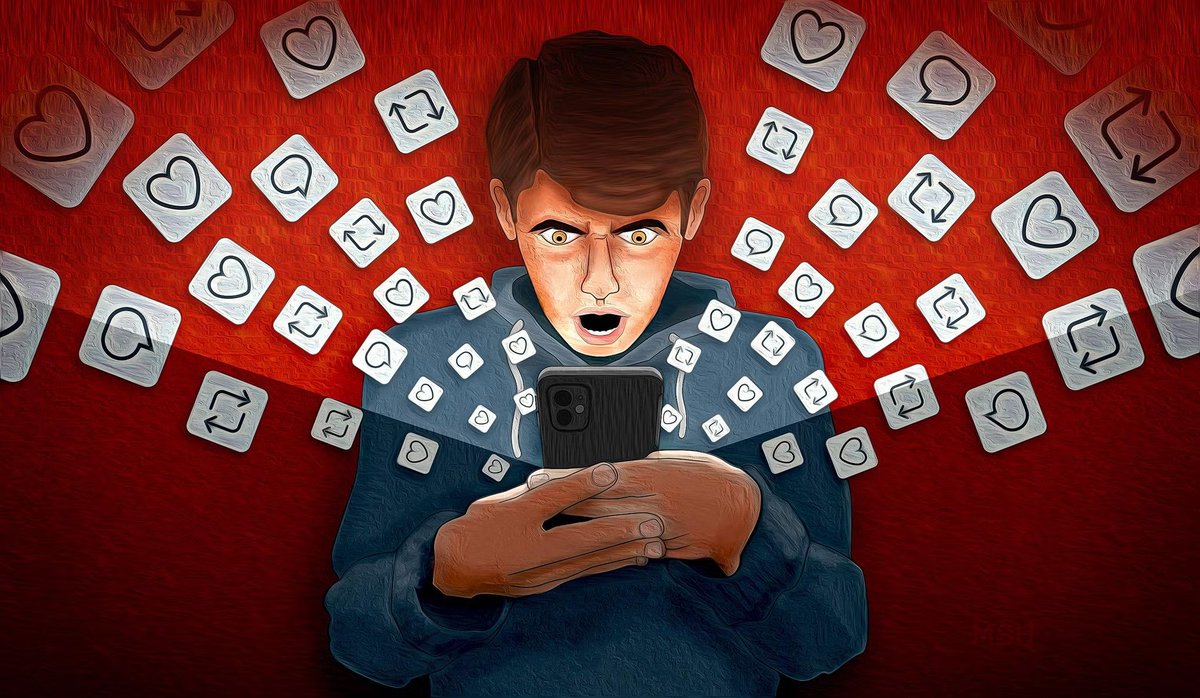
Every post containing words that trigger anger, disgust, or moral superiority gets 6 times more reach than neutral content. Stack additional outrage triggers into the same post, and virality increases by roughly 20% per word. The platforms figured out that your ancient brain chemistry responds to perceived threats and tribal signaling faster than it responds to anything else, and they built their entire engagement architecture around exploiting that reflex.
Think about what that means for information flow in society.
The posts that spread fastest are not the most accurate, insightful, or useful. They are the ones most precisely engineered to activate your fight or flight response. Your timeline is being curated by an algos that has learned to simulate the feeling of being under attack, because humans share content when they feel like their worldview or tribe is being threatened.
The mathematical precision is what makes this so sinister. Traditional media used outrage as a tool, but social platforms turned it into a formula. Every word choice, every framing device, every emotional trigger gets tested against engagement metrics in real time. The algos doesn't care what the content says. It only cares how fast it spreads, and outrage spreads fastest.
This creates a feedback loop that fundamentally warps the information ecosystem. Content creators discover that measured, nuanced takes get buried while inflammatory posts reach millions. The reward system trains everyone to become more extreme, more divisive, more outrageous over time. The platforms profit from the engagement surge. The audience gets more addicted to the emotional highs. Everyone loses except the attention merchants.
The really disturbing part is how this exploits evolutionary psychology. Your ancestors survived by quickly identifying threats to their survival or social status. The humans who ignored danger signals died. The ones who overreacted to false alarms lived. Natural selection optimized your brain to err on the side of perceiving threats, especially social threats that could result in exile from the group.
Social media platforms discovered they could trigger that same ancient alarm system with words on a screen. Your amygdala cannot tell the difference between a real threat and a carefully crafted post designed to simulate one. It responds with the same stress hormones, the same compulsion to warn others, the same addictive rush of righteous anger.
But here's what makes modern outrage engineering different from anything humans have faced before: scale and speed. In a traditional tribe, false alarms eventually got corrected through face to face interaction. Someone spreading panic about a nonexistent threat would be called out directly. The social cost of being wrong acted as a brake on runaway fear cycles.
Online, that brake disappears. A manufactured outrage can reach millions before anyone can fact check it. By the time corrections appear, the original false alarm has already shaped opinions, triggered responses, and moved on to the next controversy. The platform algos amplify the correction much less than they amplified the original outrage because corrections generate less engagement.
The NYU study reveals something that should fundamentally change how you evaluate information: the posts you see are not a random sample of human thought. They are a carefully filtered selection optimized to make you angry, disgusted, or superior. Your worldview is being shaped by content that survived an engagement filter designed to promote the most emotionally manipulative material.
That realization should change how you consume media entirely. Every viral post, trending topic, and recommended video is the product of an optimization system that profits from your emotional reaction. The more outraged you feel, the more engaged you become, the more valuable you are to advertisers.
The platforms have turned human outrage into a renewable resource. They figured out how to harvest your anger, refine it, and sell it back to you in increasingly concentrated doses. The addiction cycle never ends because there's always a new target, a new crisis, a new reason to feel threatened or superior.
Breaking free requires recognizing the manipulation for what it is: a business model that depends on keeping you in a constant state of emotional arousal. The cure involves deliberately seeking out content that doesn't trigger outrage, following sources that acknowledge complexity instead of manufacturing certainty, and remembering that the posts designed to make you angriest are probably the ones least connected to reality.
Your attention is worth more than their engagement metrics.