a big part of my workflow nowdays is understanding
i need to understand why a statement is true,
which decision was made by LLMs and why
i'm doing it just by having simple conversations, but we can do way more today
LLMs can answer with HTML, build diagrams, research, run tests, build small interactive demos etc
on my side, i'm using a couple of skills:
/bro https://t.co/FrvMk3N9AA
/wait-what
https://t.co/9NwDNpGkjp
but i've also built a couple myself for more niche usage
let's look closer at the worker, beyond the aesthetic and taste aspects
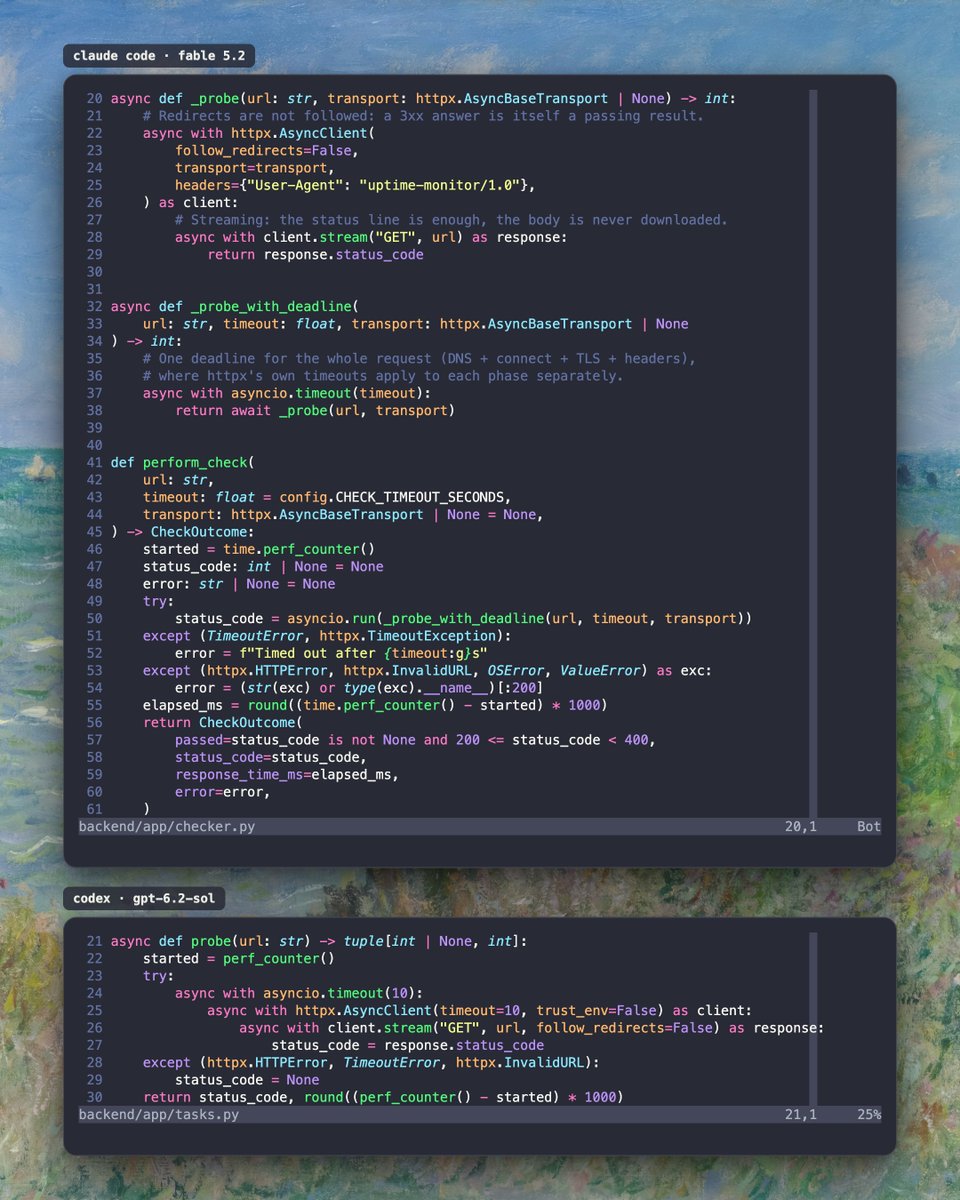
both models choose the same setup:
celery worker runs synchronously, but the http probe runs asynchronously, using `https://t.co/ZbcoLnttl3`
by doing this, you don't get the full advantage of using async, you use more resources and can easily introduce new bugs
it's not a model issue, but a steering issue. if you point fable/sol to the worker, it will automatically detect the issue and fix it
Since January this year, I've started hosting the Indie TM meetups in my hometown. For the people who never heard of it, it's a community of indie hackers (although the term is no longer a thing nowadays) that keep themselves accountable on what they're working on. Because building someone alone for a long time can get depressing and you need likeminded people on which you can rely on, share your fails, get back up & keep going.
We were 7 people at the first event. At the last "Show& Roast" event, we were 20 people and the community seems to keep growing. Now the WhatsApp group where we share tips&tricks, ideas, our progress, small wins has reached 100 members. It's not much, but for Romania, and my local city, I think it's a great sign of the curiosity people have for starting something a business in a country that was probably exploited for talent in the outsourcing world.
Haven't asked for money ever, even though there are a ton of other paid communities that do this. Maybe I will some day, but for now, this will remain free. The energy, the vibes, and the people I got to meet in this community are amazing ❤️ Learned so much from them on what it means to build a business, grow it, and maintain it. Thanks for taking the journey with me! It's a hell of a ride 🙌
For anyone interested, you can follow along the journey on https://t.co/TyKR7Ieang
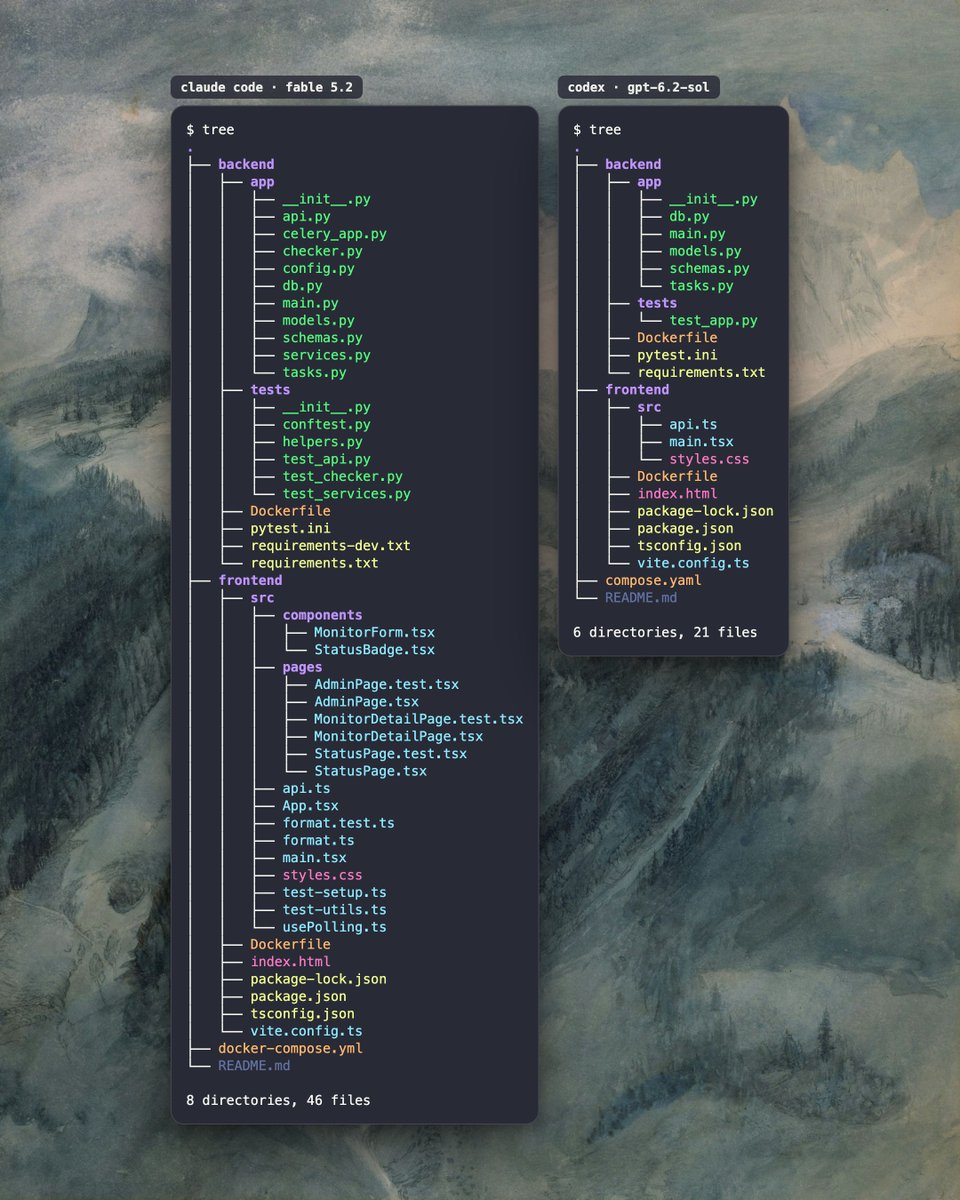
clearly, there's a very different taste for both models, neither of which is hitting my idiomatic metrics
fable tries to create a more complex structure, without the need for having a complex structure
https://t.co/tm7e804wZa
sol takes a more pragmatic approach, but keeping everything in `https://t.co/rwKmV7FOnO` or `main.tsx` is a big smell
https://t.co/8wrTiSxYlz
nowadays, llms are truly amazing. i still can't get over riemann hypothesis being solved aided by claude
they have an insanely huge latent space, but still need humans to help them navigate it (steering)
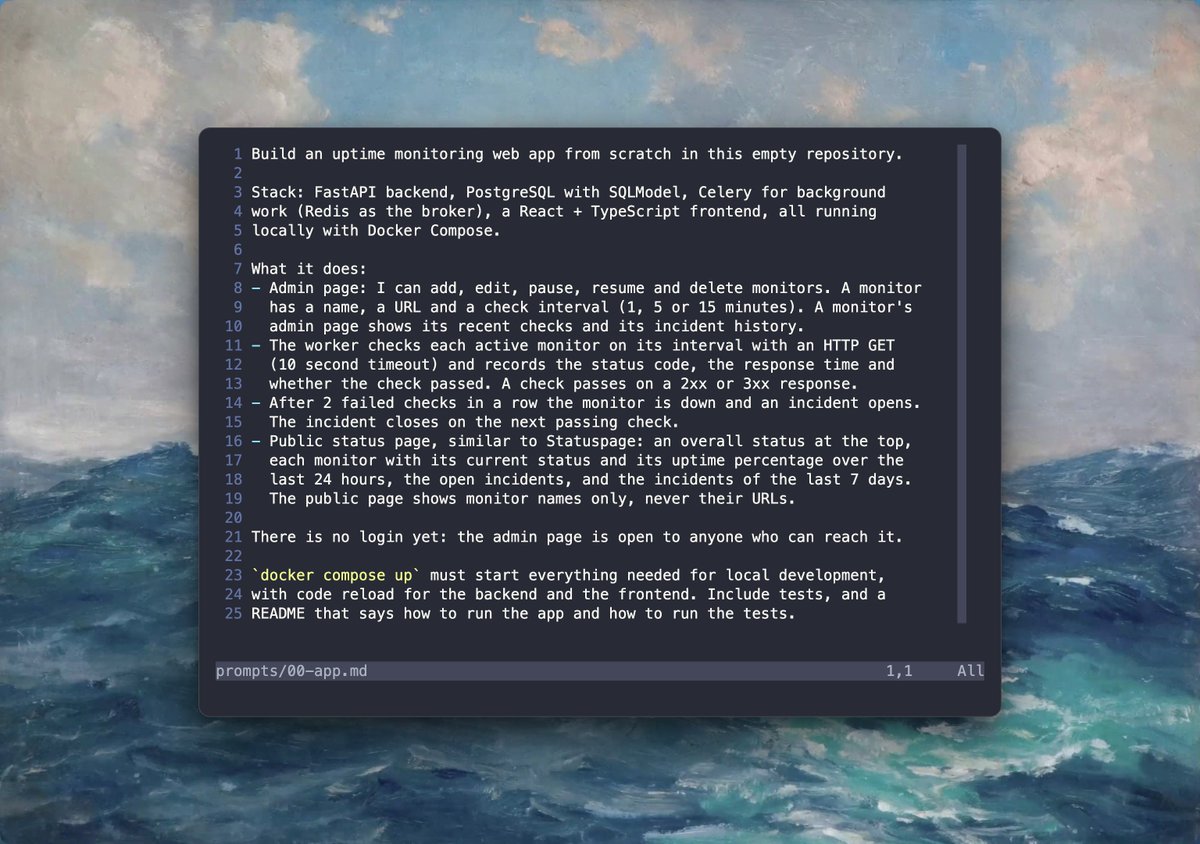
let's prompt fable 5.2 and gpt-6.2-sol and see their results
https://t.co/Vr1NGUzasi
important to take into account:
- no AGENTS.md/CLAUDE.md active
- no skills/rules/plugins active
- the prompt is not very detailed
- claude code harness for fable
- codex harness for sol
i don't expect the most idiomatic Python code, but i want to see what's considered a working solution for both fable and sol
let's look closer at the worker, beyond the aesthetic and taste aspects
both models choose the same setup:
celery worker runs synchronously, but the http probe runs asynchronously, using `https://t.co/ZbcoLnttl3`
by doing this, you don't get the full advantage of using async, you use more resources and can easily introduce new bugs
it's not a model issue, but a steering issue. if you point fable/sol to the worker, it will automatically detect the issue and fix it
if you just take a high level glance at the generated code, it is not perfect, but it is not bad either
i mean, we all seen worse code than this
but it hides complexity and adds cognitive load
both of which are going to scale with the number of tokens that we put in
if you just take a high level glance at the generated code, it is not perfect, but it is not bad either
i mean, we all seen worse code than this
but it hides complexity and adds cognitive load
both of which are going to scale with the number of tokens that we put in
clearly, there's a very different taste for both models, neither of which is hitting my idiomatic metrics
fable tries to create a more complex structure, without the need for having a complex structure
https://t.co/tm7e804wZa
sol takes a more pragmatic approach, but keeping everything in `https://t.co/rwKmV7FOnO` or `main.tsx` is a big smell
https://t.co/8wrTiSxYlz
nowadays, llms are truly amazing. i still can't get over riemann hypothesis being solved aided by claude
they have an insanely huge latent space, but still need humans to help them navigate it (steering)
let's prompt fable 5.2 and gpt-6.2-sol and see their results
https://t.co/Vr1NGUzasi
important to take into account:
- no AGENTS.md/CLAUDE.md active
- no skills/rules/plugins active
- the prompt is not very detailed
- claude code harness for fable
- codex harness for sol
i don't expect the most idiomatic Python code, but i want to see what's considered a working solution for both fable and sol
i'm generating a lot of code (7k commits in the last 2 months), from prototypes and experiments to fully production-ready deployments
and the obvious thing that one can quickly see is that if you don't have a good guardrail foundation and proper verification steps in place, you will have to fight context decay and slop
i absolutly loved @poteto's talks since i wrote and believe in a similar approach earlier this year https://t.co/BXY65LWt9P
and i thought that somebody would just create an opinionated kitchen/factory/set of verifications for each framework and the entire industry would adopt those (similar to well know best practices for each framework)
but is not yet the case.
because of that, i'm starting to share my own garden, my own set of rules and workflows
it's gonna be more iterative and with a huge focus on Python in the beginning
totally agree that you don't need to understand how IPV4 works to create https://t.co/wePufFV8dZ, that's not the point here
my point was mostly about nobody understanding how value was created (since we've reached this point).
in those 250k lines of proof, there's also value that, if it is not understandable, models will have to re-achieve it, if working on similar problems
can value be created in the long run if nobody understands the previous building blocks?
going to extreme: 5-10 years in the future, everything is verified in Lean and TLA+, from blockchain to cancer research.
can we still create value (humans, models or humans + models) or everything is just a big blob of slop, which is truthful (Lean & TLA+ valid)?
maybe somethings are ok to be hard to understand. we just trust Lean & TLA+ and we move on.
in the end, it might be just an issue of trust. but that's why we have mathematical proofs, security audits and banking systems.
now, if we move the entire trust in code, we don't need human understanding anymore. in code we trust :)
idk man, since friday, after the entire riemann hypothesis thingy happened, i feel unsettled
my friends know me, i'm really agi pilled, super excited when grok or claude can do something i wasn't expecting it would be able to do...it feels like magic
initially, it felt amazing, wow, the riemann hypothesis, but after a while, you start to dig in and find out that there's like 17M lines of Lean and 250k pages for the proof, that we don't understand...it started to feel unsettling
but this morning i fund @AlexKontorovich's opinion https://t.co/B470KeFijl which resonates with me
i build things and i can't keep building what i don't understand
yeah, i've been thinking about this, especially while writing the initial post
i think it doesn't scale. what you're saying is working because even if you don't understand how it works, somebody does. and that somebody is responsible and even more, can improve it
on the short run, it works, but on the long run, if nobody understands it, i believe you can't create new value
i agree that you don't need to understand the proof for Riemann Hypothesis to build on top, people were doing that already, but i don't think that we can go too far doing this (5 years with math/phisics/medical discoveries without anyone understanding them)
i think understanding is required in steering the model (even in creating training data examples) and just then we can build on top
but i might be wrong and we just throw tokens at problems, solve RSI and take care of our datacenters
Woolgathering: an endless knitted world that knits itself around you as you walk. three.js, runs in the browser.
Claude Opus 5.5 vs GPT-6.2 Astra
Full prompt and how it was made below.
@dwarkesh_sp@who_is_jerbear This is what we focus on at @datologyai: our curated datasets are dramatically better than any open ones and come in much larger token sizes (20T+). You should have @arimorcos on the pod!