Three days ago I left autoresearch tuning nanochat for ~2 days on depth=12 model. It found ~20 changes that improved the validation loss. I tested these changes yesterday and all of them were additive and transferred to larger (depth=24) models. Stacking up all of these changes, today I measured that the leaderboard's "Time to GPT-2" drops from 2.02 hours to 1.80 hours (~11% improvement), this will be the new leaderboard entry. So yes, these are real improvements and they make an actual difference. I am mildly surprised that my very first naive attempt already worked this well on top of what I thought was already a fairly manually well-tuned project.
This is a first for me because I am very used to doing the iterative optimization of neural network training manually. You come up with ideas, you implement them, you check if they work (better validation loss), you come up with new ideas based on that, you read some papers for inspiration, etc etc. This is the bread and butter of what I do daily for 2 decades. Seeing the agent do this entire workflow end-to-end and all by itself as it worked through approx. 700 changes autonomously is wild. It really looked at the sequence of results of experiments and used that to plan the next ones. It's not novel, ground-breaking "research" (yet), but all the adjustments are "real", I didn't find them manually previously, and they stack up and actually improved nanochat. Among the bigger things e.g.:
- It noticed an oversight that my parameterless QKnorm didn't have a scaler multiplier attached, so my attention was too diffuse. The agent found multipliers to sharpen it, pointing to future work.
- It found that the Value Embeddings really like regularization and I wasn't applying any (oops).
- It found that my banded attention was too conservative (i forgot to tune it).
- It found that AdamW betas were all messed up.
- It tuned the weight decay schedule.
- It tuned the network initialization.
This is on top of all the tuning I've already done over a good amount of time. The exact commit is here, from this "round 1" of autoresearch. I am going to kick off "round 2", and in parallel I am looking at how multiple agents can collaborate to unlock parallelism.
https://t.co/WAz8aIztKT
All LLM frontier labs will do this. It's the final boss battle. It's a lot more complex at scale of course - you don't just have a single train. py file to tune. But doing it is "just engineering" and it's going to work. You spin up a swarm of agents, you have them collaborate to tune smaller models, you promote the most promising ideas to increasingly larger scales, and humans (optionally) contribute on the edges.
And more generally, *any* metric you care about that is reasonably efficient to evaluate (or that has more efficient proxy metrics such as training a smaller network) can be autoresearched by an agent swarm. It's worth thinking about whether your problem falls into this bucket too.
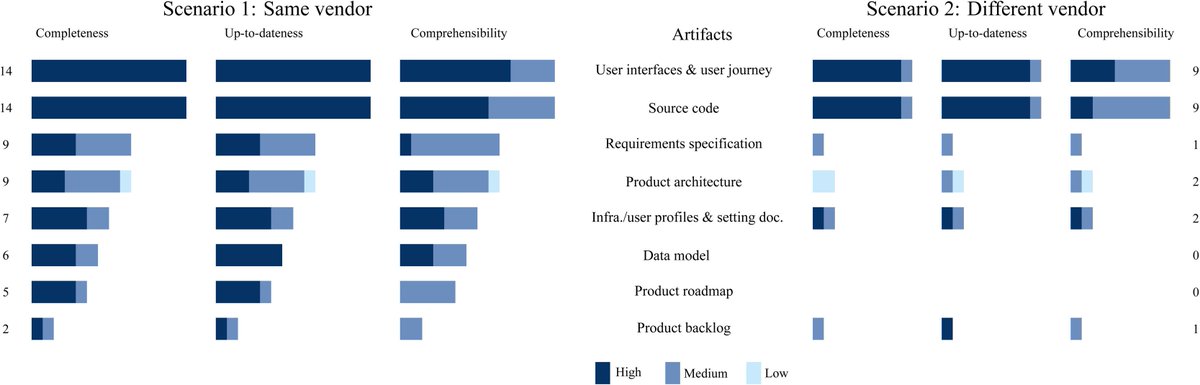
📝 New article: "Understanding the Product Knowledge Acquisition Process in Multiprovider Software Evolution Scenarios: An Exploratory Study" by @AnelisVale, @vtomasv, Carlos Vasquez, @danielperovich, @jsimmond , Sergio F. Ochoa
👉 Get your copy at https://t.co/IaDforlgYY
El Tribunal de Internet de Pekín ha sentenciado que un fabricante de software ha vulnerado los derechos de una persona tras emplear una herramienta basada en #IA para replicar su voz, sin su consentimiento:
https://t.co/aUKYcybFbM
Lo que está en disputa permanentemente es el cerebro. El #cerebro es el campo de batalla del futuro. Es por esto que nosotros consideramos que Worldcoin viola la norma de #neuroderechos que está en la Constitución chilena, porque no hay sistemas de consentimiento ni claridad del uso que le darán a estos datos obtenidos desde el iris de las personas.
Detalles aquí ⬇️
https://t.co/t2Gxx0DSO4
📚Conoce a los expert@s que participaron en el libro “En Defensa de los Neuroderechos”
⬇️ Descarga en https://t.co/Qal0Cv3kIn
#neuroderechos#neurorights#neurodireitos
¡Descubre la revolución de la #IA en nuestros Talleres de #InteligenciaArtificial en #CF2024! 🌐
Explora teoría y práctica de la IA con instituciones, universidades e investigadores líderes.
¡Felicitamos a la profesora del #dccuchile, @jsimmond quien fue recientemente ascendida a Profesora Asociada de la @uchile! 👏🎉
📌Noticia en: https://t.co/lvzr54j9FQ
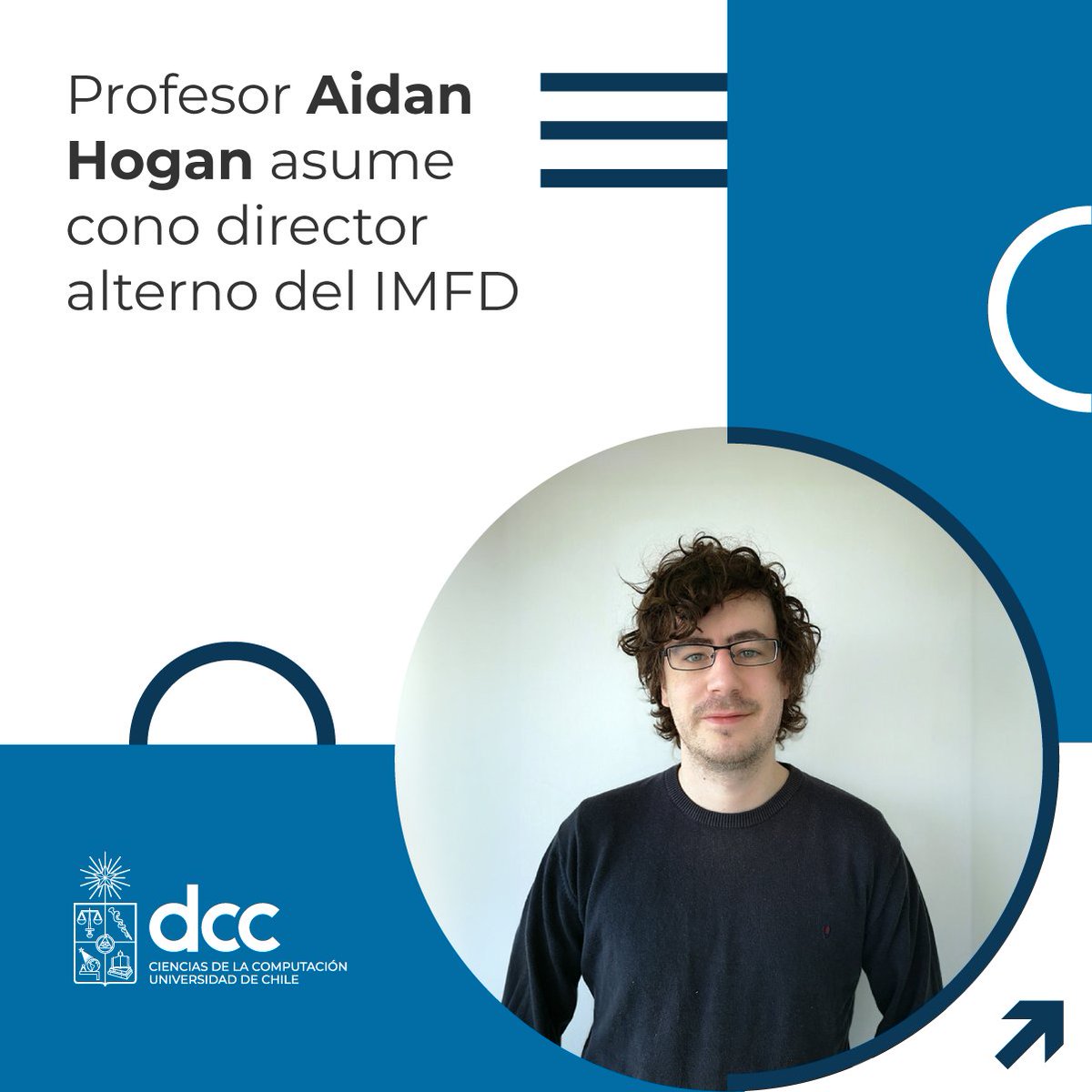
👏Felicitamos al Prof. Aidan Hogan, quien asumió como director alterno del @IMFDChile. El académico señaló que una de sus primeras metas será aumentar la participación y visibilidad del IMFD en las universidades asociadas al Instituto.
📌Noticia en 👉 https://t.co/en8C3CH5dw
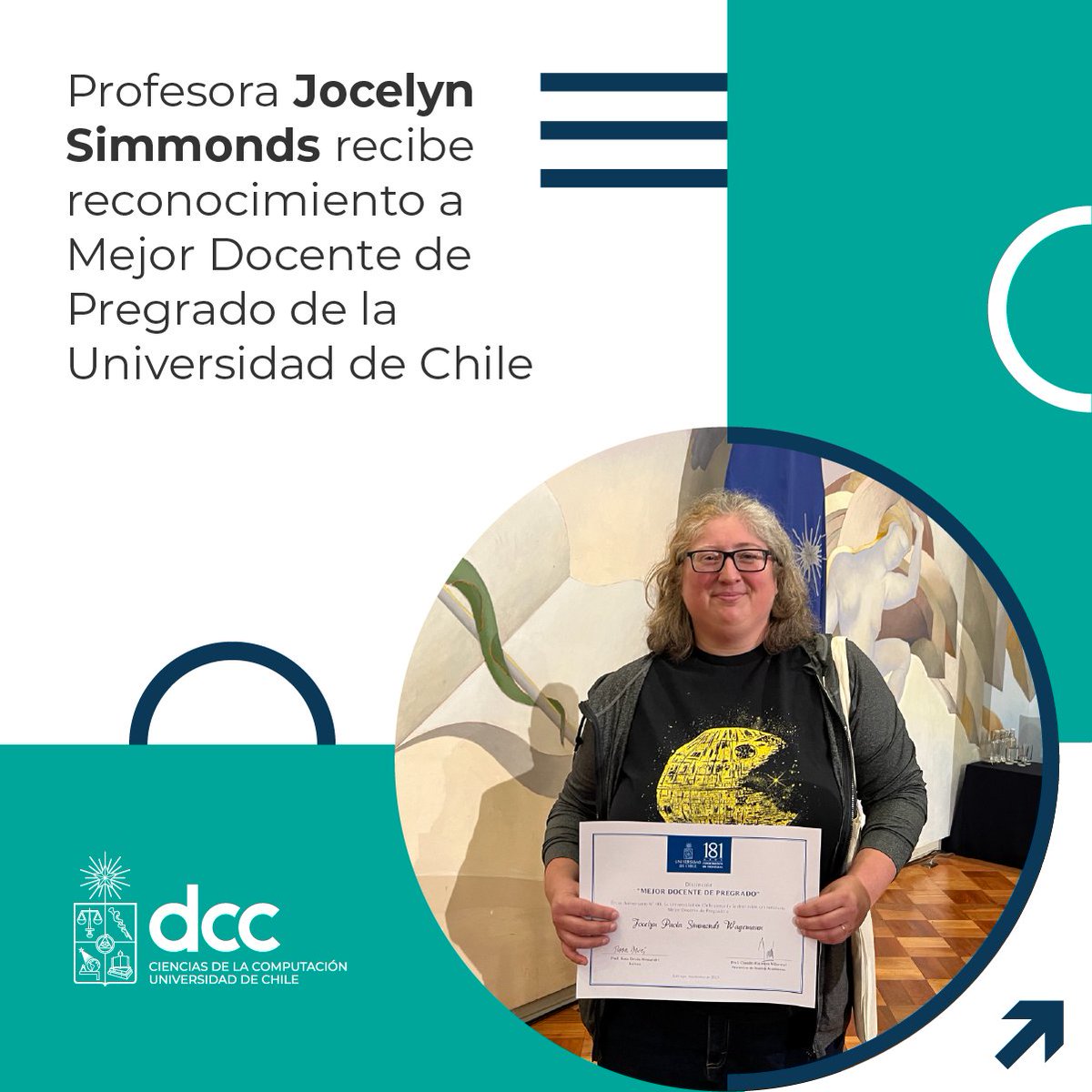
🎉👏Felicitamos a la profesora Jocelyn Simmonds, reconocida como Mejor Docente de Pregrado. Esta distinción fue otorgada en el marco de las actividades del 181° aniversario de la @uchile.
Noticia en: https://t.co/2w9dl55Qj4
@DotCSV Posiblemente este video (https://t.co/O7N48tyxPo) ayude a reforzar lo que dices @DotCSV, programo desde los 10 y tengo 42, confío plenamente en que va a cambiar radicalmente la forma en la que programamos, el tiempo se acabo ya es hora de que lo hagamos distinto.
¡ES HOY! 🎉 ¡NOCHES NERD! ⚡
Recuerda, hoy a las 19:30 horas, se llevará a cabo @NochesNerd en Taller 1, General Salvo 20, Providencia.
📍Referencia: Metro estación Salvador.
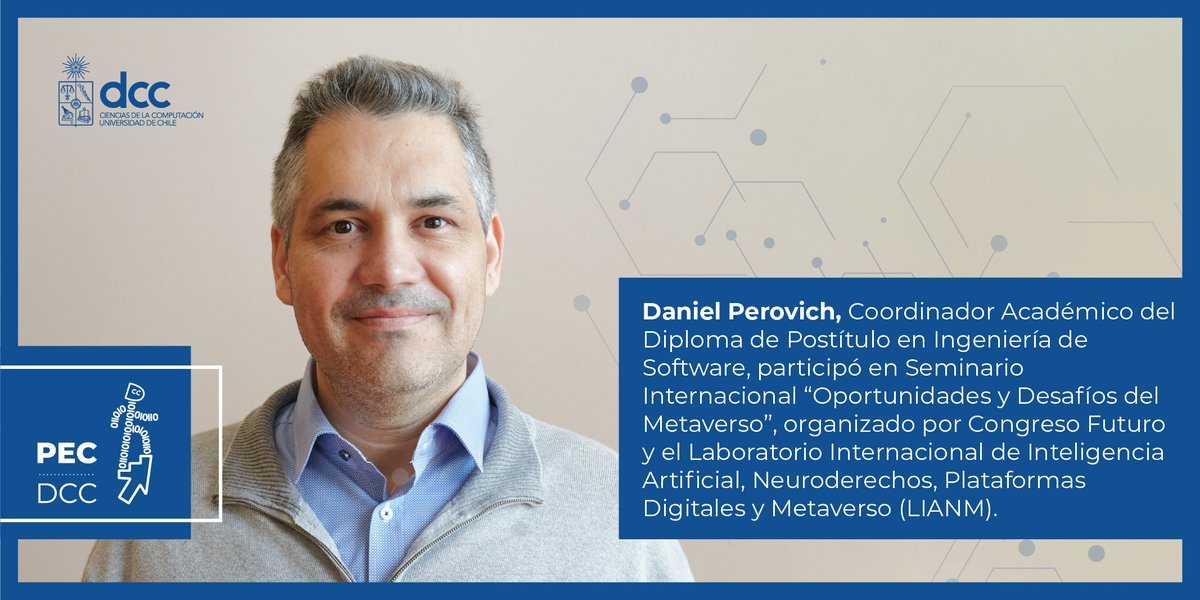
El Coordinador y profesor de nuestro Diploma de postítulo en Ingeniería de Software @danielperovich, participó el 17 de marzo en el Seminario Internacional: “Oportunidades y Desafíos del Metaverso” @congresofuturo 👏
Te invitamos ver su participación en👉https://t.co/42rbAQlYBn