I’m sorry, but I just can’t stand it anymore.
This massive, outrageous, pork-filled Congressional spending bill is a disgusting abomination.
Shame on those who voted for it: you know you did wrong. You know it.
Astranis is building a new satellite for Taiwan. 🇹🇼
With our customer, Chunghwa Telecom, we will bring Taiwan its first-ever dedicated communications satellite. Chunghwa Telecom is the largest telco in Taiwan, with a market cap of more than $30 billion USD.
Independent, secure internet infrastructure has never been more geopolitically important — and because it’s impossible to replicate with LEO constellations or even terrestrial links, it merits some spelling out.
Astranis was founded on the belief that access to secure, reliable communications infrastructure is foundational to peace, prosperity, and self-determination.
The satellite we’re bringing to Taiwan represents resilience. It will serve as a critical backbone for cellular connectivity, maritime communications, and essential government services across Taiwan. And it will ensure that Chunghwa Telecom’s network remains operational in times of crisis, whether in the face of natural disasters or other disruptions to terrestrial infrastructure.
Importantly, Astranis provides more than just a satellite — we give our customers a standalone, dedicated network. A network that can be rapidly deployed and fully spans their geography of choice. With enterprise-grade security, customizability, and deep insights into the configuration and operation of the network.
And as an independent piece of infrastructure, it safeguards against geopolitical risks, and is beyond the reach of hostile neighbors.
Those are the benefits of having your own, dedicated satellite and network. And that’s why so many customers are choosing Astranis.
We at Astranis are honored to be part of this moment, and to have a product that has proven so uniquely needed in today’s world.
We look forward to continuing to support Taiwan and its people for many years to come.
A US satellite startup will launch the first communications satellite dedicated to Taiwan, strengthening the self-ruled democracy’s resilience against possible Chinese attempts to impose an information blackout in the event of an invasion https://t.co/WyxcTmKlBI
By launching the tariffs on April 2nd, President @realDonaldTrump has enabled our trading partners to experience the visceral impact of the tariffs on their markets, companies, and citizens, and he has shown that he is prepared to do what is necessary to address unfair trading practices.
The result has been nations lining up to negotiate deals with the administration. So far so good.
By pausing reciprocal tariffs for 90 days and exempting certain goods from tariffs this weekend, he has also shown considerable flexibility in understanding the challenges to US companies in adapting to the tariffs overnight.
By leaving a 145% tariff on China for the last few days, he has sent a message to China about the consequences to China of retaliating rather than coming to the negotiating table.
The problem is that there remain millions of small and medium-size American businesses that suffer from an inability to adapt to the tariffs on China overnight.
If President Trump were to pause the China tariffs for 90 days and reduce them temporarily to 10%, he would achieve the same objective in causing US businesses to relocate their supply chains from China without the disruption and risk to these businesses in the short term, and he would have time to negotiate a deal with China.
China is under the same pressure to negotiate a deal whether the tariffs take effect immediately or if they take effect in 90 days.
The benefit of waiting 90 days is two fold. It gives all US businesses the opportunity to make supply chain adjustments, and it gives China the opportunity to show that it is willing to negotiate a trade deal in good faith.
If China does not cooperate and negotiate a deal that makes sense for our country, President Trump can bring the hammer down in 90 days.
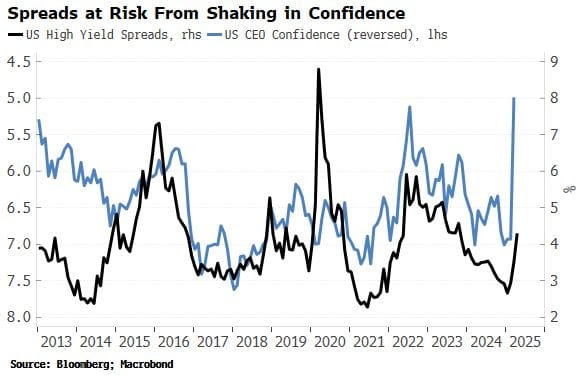
📊 CEO Confidence vs Credit Spreads
Even with a tariff pause, the damage is done.
👔 CEO sentiment is sliding fast...
Historically, that’s been a leading signal for wider credit spreads.
Confidence is cracking — and markets are listening.
Source: Bloomberg
#Markets #CreditSpreads #CEOConfidence #Macroeconomics #Investing
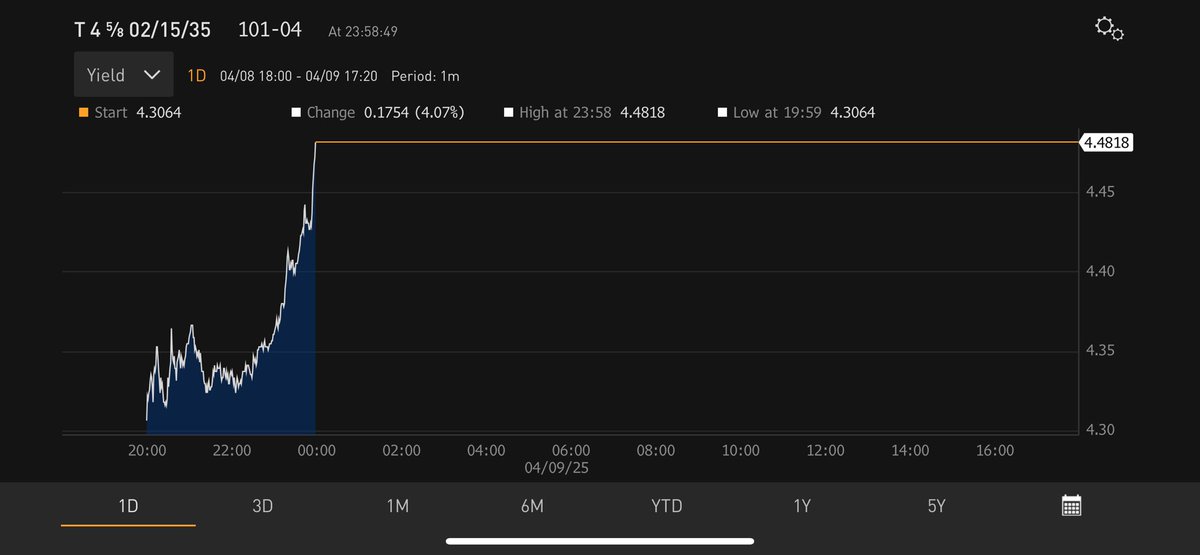
BREAKING: US 10Y rises to 4.48%, the largest single weekly increase since 2001.
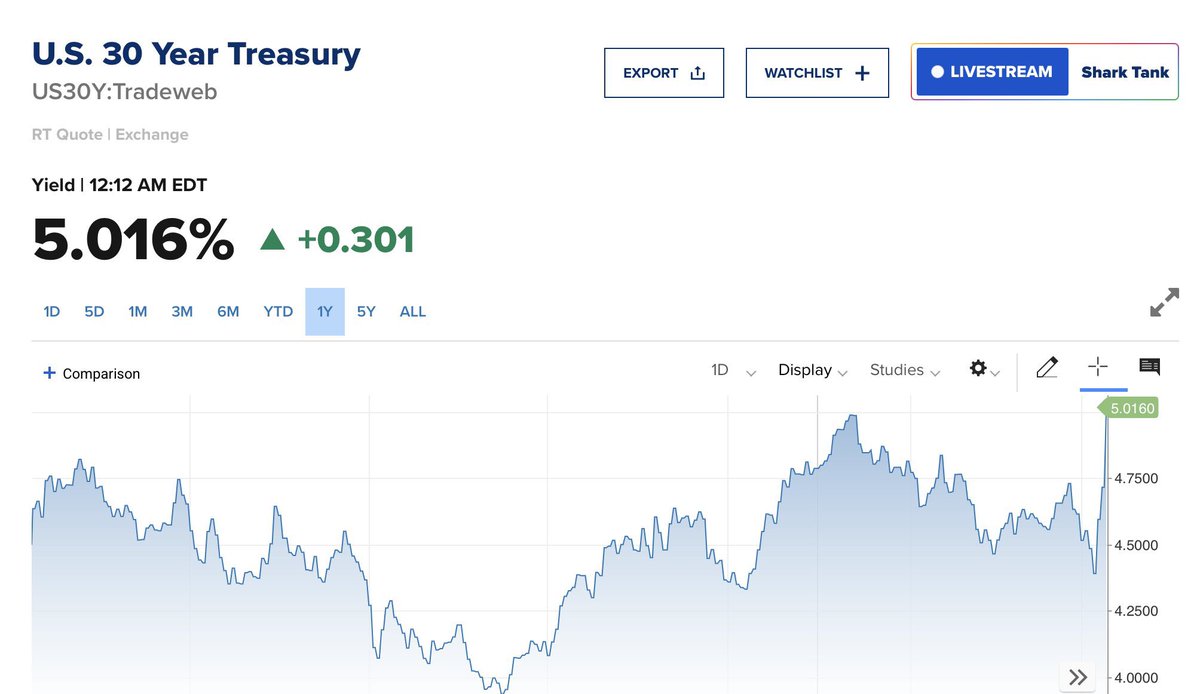
U.S. 30-year treasury yields rise to 4.95%, weekly increase is biggest since 1982.
Here’s the real question, who gives up first?
1. President Trump
2. China
3. Bond market
At this rate, the 10Y Note Yield will be at 5% next week.
Inevitably, one of these 3 factors has to give very soon; this is unsustainable.
Which cracks first?
If Trump's secret agenda is to crash the stock market to bring down long-term interest rates, the plan already failed. The yield on the 30-year Treasury is now above 4.75%, its highest since February 19th. So the plan to crash the stock market is now crashing the bond market too.
The crash that's now happening in the bond market has more dire implications than the crash in the stock market. If these tariffs remain in place, the U.S. could have a full-blown financial crisis by the fall that makes the 2008 Financial Crisis look like a Sunday school picnic.
Administration would cave perhaps more quickly for a fall in crypto than their voters' 401Ks and small businesses. Silver lining, a bit of crypto selloff is happening right now.