The biggest irony is that by banning Fable / Mythos, the US govt has caused everyone to root for open source, and China is a leader in open source AI.
The most dangerous model will soon be widely distributed, just not by a US company.
Giant victory for China, massive setback for the users.
I have a strong conviction about this point. We might end up becoming Viksit without any Enlightenment or a Renaissance of sorts. A greedy "what's in it for me" attitude. Growth without a soul.
Indian private sector earns in India via favourable Government policies, cheap labour and land, then invests capex in US & UK.
Only manufacturing billionaires (like Hero, Bajaj, TVS etc whom GoI treats unfairly) are nation builders, rest are just plain and simple thugs.
The sheer nonsense being peddled on USD/INR exchange rate is breathtaking!
I repeat, for the vast majority of Indians (over 99% of the population, perhaps more than 99.9% of the population) there is no need at all to consider foreign investments or be bothered by what the USD level is at.
Beware, there are some motivated financial interests and typical “intellectual” retards, which are hectoring the Govt and scaring consumers about this non-issue, or trying to pressurize the central bank to “defend” the rupee - which as the erudite Prof. @APanagariya has laid out, would not be wise at all https://t.co/9SKlmH1ejv
https://t.co/brd7TVJSbr
1. I came back to India as soon as I finished studying. Saw the light. Never looked back. Respect matters. Only 1% choose.
2. The egalitarian elements of Western society need to seep into the Indian way of operating. Blame the jugaadu/conniving mindset
3. We need remittances.
Open letter to Indians in America.
--
Dear brothers and sisters from Bharat:
Like I did 37 years ago, you arrived in America with no money but with a good education and cultural heritage from Bharat. You achieved outstanding success. America was good to us. For that we must remain grateful - gratitude is our Bharatiya way.
Yet today, a significant number of Americans, may be not the majority but not too far from it either, believe that Indians "take away" American jobs and our success in America was unfairly earned.
You may think the next election will fix this, but your choice would be between people who hate our Bharatiya civilisation and people who hate civilisation itself. That is the "hard right" vs "woke left" battle. You are mere bystanders to that conflict.
Meanwhile there is one thing that is true now and will be true in the future: the respect Indians command world-wide will substantially depend on the fortunes of India herself. If India remains poor, the woke left will give us moral lectures with pity and the hard right, different moral lectures with scorn ("hellhole") and we must not confuse either with respect.
Respect in today's world, along with prosperity and security, comes from one source: a nation's technological prowess. India produces sufficient brain power to achieve that prowess but alas we exported so much of that talent, particularly to America. As we develop that prowess in India, our civilisational strength will assert itself.
As difficult as it is for many of you to contemplate this, please come back home. Bharat Mata needs your talent. Our vast youthful population needs the technology leadership you gained over the years to guide them towards prosperity. Let's do it with a missionary zeal.
Respectfully
Sridhar Vembu
something i've noticed: AI agents create a weird new kind of burnout. esp for young people.
a lot of ambitious 22 year olds are going to think the answer is simple:
- spin up more agents
- ship more code
- sleep less
- outwork everyone
and for a while, it will feel incredible.
you can keep multiple agents running, feed them tasks, review outputs, fix mistakes, make decisions, and keep the whole loop moving.
the problem is that the work no longer drains you through typing. it drains you through judgment.
More attention.
More context switching.
More verification.
More decisions per hour.
so instead of 8-10 normal productive hours, you might get 4-5 extremely intense hours before your brain is fully cooked. and you feel numb until you sleep properly and reset
some of my friends are already burnt out. they don't say it out loud but i can tell.
the agent can keep working 24/7.
the human still has a hard limit
My reading: it is a sign of lack of control in their lives. The despondency of voting being the only lever to improve one or one's family for the better. Pro or anti incumbent.
Democracy is overrated.
Let me elaborate. A consistently very high turnout isn’t something very healthy. These are the last elections in these countries.
US: ~65%
UK: ~59%
Japan: 54%
Italy: 63%
Canada: 63%
You can see a pattern. Unless it’s an anti-incumbency wave, a very high turnout is like inflammation in your body. Like fighting an infection. People trying to change the outcome of their lives by voting. Barring exceptions, 90+ turnout is a symptom of a problem, and not a signal of good health. Thanks.
The more you understand this world, the more you destroy yourself.
That’s why fools are happy, and intelligent people live in loneliness.
The more you understand the world, the more illusions fall away.
You begin to see patterns, motives, and contradictions that once went unnoticed.
With understanding comes disillusionment.
Expectations shrink.
Trust becomes cautious.
Innocence fades.
Fools appear happy not because they live better lives, but because they carry fewer questions.
They are spared the weight of constant reflection.
Intelligence often leads to loneliness.
Not from arrogance, but from distance.
It becomes harder to relate when you see beneath the surface while others remain comfortable on it.
Yet this awareness is not a curse.
It is a responsibility.
Wisdom hurts before it heals.
Clarity isolates before it frees.
Learn the world.
But do not forget to protect yourself from it.
If you’re a hyperactive, high agency type of guy, the only path where you don’t go insane is entrepreneurship. It’s the only life that will stimulate you enough and put you in different situations and problems that actually make your brain function. The more you try to tame that energy the less you will feel alive. Some of us were made for complexity and ambiguity. The safe path is the most dangerous one. You know deep down you’re made for something different. Business is what gives you that. Avoid traditional jobs at all costs. Of course the price is high stress, uncertainty and lots of ups and downs… but let’s be honest, would you have it any other way? No. It’s too boring.
Decades from now, economists will talk about how India turned around from an FII to a DII led market economy -- the biggest reason for it becoming a unique superpower. Currency strength would be an interesting discussion then.
Asked someone from the industry whether foreign investors are still interested in allocating to India. The TLDR:
Interest has pretty much died out. India is seen as geopolitically exposed, especially to an oil shock. There are no real AI plays. Valuations are rich. And the rupee situation doesn't help.
On top of that, investors who were sitting on gains have taken money off the table and are now looking at markets like Japan, Taiwan, Korea, Europe etc instead.
He also pointed out that our LTCG/STCG structure and the increase in STT have made India less attractive compared to other markets that are seeing inflows.
If we need to attract FPIs back, and we do, fixing this feels like pretty low-hanging fruit.
India is reactive. While I am optimistic about it being #1, it will be closer to 2100 than a 2050. Why?
1. In 5-10 years, AI will make a lot of jobs obsolete. India lags there massively
2. Reforms are too slow.
3. Bad neighborhood.
4. Egalitarianism is missing.
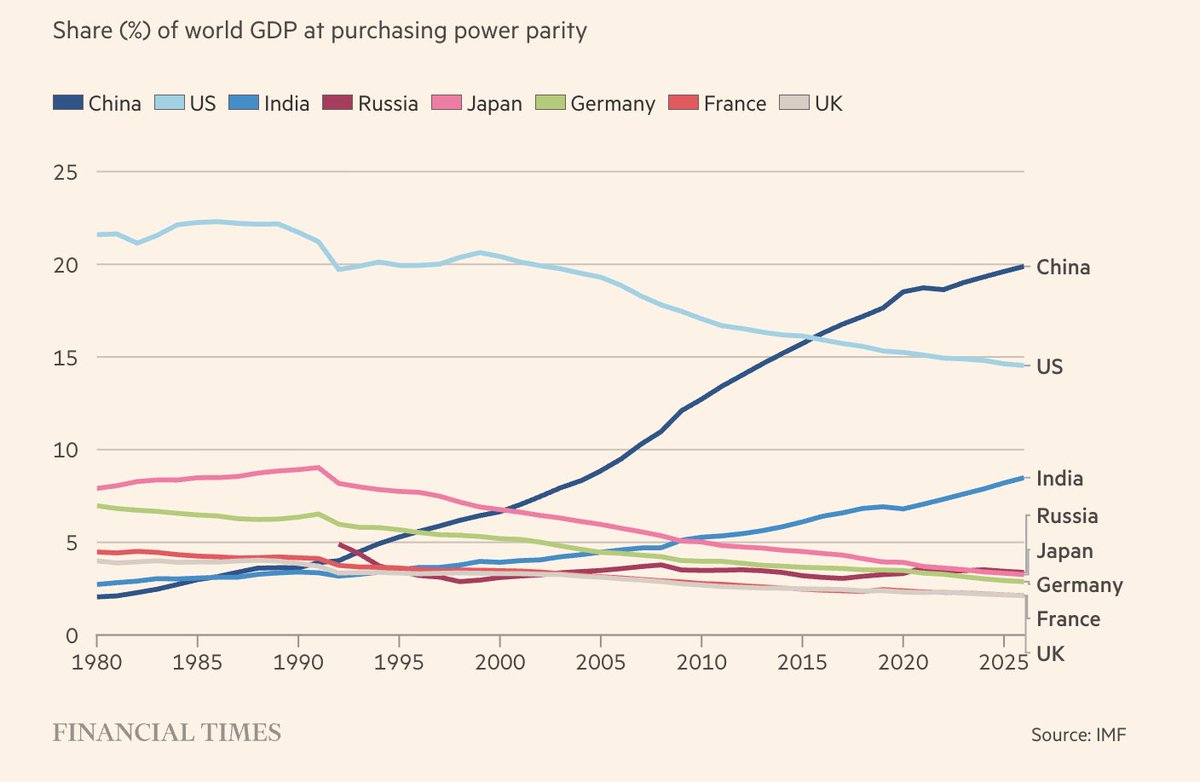
Smart Chinese analysts have started talking about US and India fighting for #2 slot in the coming decades, while Beijing takes #1 slot. That is good, for despite their non-democratic system (and hence no internal competitive pressures), they finally feel emboldened to claim top slot. Why not? They certainly have a strong shot - definitely better than America's which is 1/4th their population. May these analysts speak more openly in coming years. Enough hide-bide.
Meanwhile, this is the demographic lay of the land when juxtaposed against India, which is also investing in its human capital. The difference of differences of working age population over the next 25 years (China falling, India rising) would be more than the entire US population. If you define it as 15-64 it is slightly more (like here) and if you define it as 25-64 the number is a bit less, that is about it.
Demographics is not destiny in toto yes, but a key part. So additionally, to get 5% GDP print the Chinese are adding crazy total debt to their systems. India is growing at 8% while deleveraging. Going forward, a ~3% per capita real growth gap (and hence ~2% RER gap too) can be assumed for a couple of decades. So that makes it Demographics and Debt which are both tailwinds for India and headwinds for China. Decarbonisation and Digitalisation are tailwinds for both India and China. Democracy is a tailwind for India and lack thereof a headwind for China going forward. And finally, India's Domestic oriented model is much more sustainable than China's geo-economically.
Of course nothing is automatic or pre-destined but policy is endogenous to politics which in turn is endogenous to societal factors, on which I am very structurally constructive in India. Three generations ago, China was bigger than undivided India comfortably. Now 'truncated' India is bigger than China. In a generation, even the civilisational core will outnumber China's equivalent within a generation.
Modinomics is the catalyst. Whether you believe in structural-forces historiography or the great-man version (reality is a bit of both), Narendra Modi is the Deng, the Bismarck, the Lincoln of India. He has further united India, further stabilised it, further invested in its future with an iron hand where needed within a democracy and he is not yet done. Things could have been very different, but then again I do think, angularities of key-men-risk aside, increasingly good governance is now endogenous to India's increasing coherence.
India is going to be the world's largest economy by mid-century and it will not stop there, for the ultimate metric is per-capita and not aggregate. It has all the institutions and complexity required, all the anti-fragility and huger necessary. Our system does not require bide-hide and in any case, the Americans and Chinese have hardly been friendly so there is not much to gain anyway. They have seen the movie before and they are now witnessing the sequel's trailer. India will arrive after announcing its arrival.
Those who feel this is triumphant - I disagree, for I think there is nothing special about an average American or Chinese citizen compared to an average Indian one. Those who think this is too premature, I understand that but constant negativity has its own reflexivity so why not let us see the empirical trends and where it leads us. India's scale is such that every measure of progress converts a previous headwind into tailwind (internal fissures get dissolved, elite agricultural taxation becomes viable, urban governance gets prioritised, cost of capital reduces, civilian and military indigenous technology gets demand aggregation, and so on.)
So yes, as 2025 ends, do not be "blackpilled" or whatever the kids say. India is here to rise and #1 is for us to lose. We will continue to work hard for that, but why should we shy away from ambition?
These days you may have seen Arnab Goswami roaring on TV.
Republic TV may be losing TRP because for years it acted like a mouthpiece of the government instead of questioning it. Real journalism was missing. Now it looks like they have finally understood their duty and started raising real issues of the people. This change is good, but it should not be temporary.
Every news channel must question the government when it is wrong because common people are already struggling to earn, survive, and afford 3 meals a day.
Read the Gita recently. It is a mind-blowing philosophical goldmine. Puts every other philosophy work to shame. And then you see humans who swear by it, don't understand its depth and focus on a few rituals which just turns out to be a social validation/virtue signalling of sorts
Hindus are ritual-heavy and scripture- illiterate people i.e., most Hindus express their faith through everyday rituals, fasting, temple visits,etc BUT ask them what actually is written in their scriptures, they barely know anything beyond the famous mantras and shlokas
This needs to change and a healthy balance needs to be maintained, you cannot be full of rituals and have no knowledge of the complete stories of your Gods and what the wise sages have to say.
Sure, rituals keep the cultures alive but without scriptural understanding, it will lose its depth.
There's so much to learn from the scriptures. It's been bothering me a lot how at a societal level, reading Gita or Ramayana, or Upanishads is not encouraged as much as practicing rituals are, specially to kids.
There's an entire ocean of wisdom sitting untouched by the masses and in the age of internet and free resources, this can easily be changed.
During a 10-hour flight from Seoul, South Korea, to San Francisco, USA, this mother distributed a plastic bag to over 200 passengers.
The bag contained candy, chewing gum, and earplugs as a pre-emptive apology in case her 4-month-old baby cried during the flight.
The bag also contained a note that read: "Hello, I'm Jan Woo. I'm 4 months old, and today I'm going to America with my mom and grandma for my aunt's coming-of-age ceremony. I'm a little nervous and scared. This is my first flight ever. It's normal for me to cry or cause a disturbance. I'll try to stay calm, but I can't promise. Please use this if my voice gets too loud... Have a nice trip. Thank you."
This is a wonderful example of respecting the freedom of others.
@ever_pessimist@WF_Watcher Thank you for the update. Poor planning. It will mean more metro travellers from Bannerghatta Road change at RV and Majestic making the journey worse
Startups are totally sleeping on the alpha of having a fractional CTO as Chief Recruiting Officer in your early team building days.
I personally know of dozens of startups whose early trajectory would have been so different without that one cracked engineer folks like @_svs_@_swanand@AjeyGore@ponnappa@vinayakh just recommended in passing to the founder.
I was studying other times in history when gold prices more than doubled in the reserve currency of the time, as they did in the past year: it's rare and almost always a sign of a profound loss of confidence in the existing monetary and political order, going all the way back to the Roman empire (the so-called "Crisis of the Third Century").
And it often marked the transition from one era of power to the next: the fall of Rome, Spain's decline from world power, the French Revolution and Terror, the end of Bretton Woods, etc.
Interestingly, it's often actually as much a cause as a sign of these episodes, as this is effectively a transfer of real wealth from the poor to the rich elites who protect themselves with gold - this being what ignites the political upheaval.
The weird aspect of the current episode is the relative silence around it: we're witnessing what may be one of the great pivotal moments in financial history yet it's being barely discussed.
Finally had a chance to listen through this pod with Sutton, which was interesting and amusing.
As background, Sutton's "The Bitter Lesson" has become a bit of biblical text in frontier LLM circles. Researchers routinely talk about and ask whether this or that approach or idea is sufficiently "bitter lesson pilled" (meaning arranged so that it benefits from added computation for free) as a proxy for whether it's going to work or worth even pursuing. The underlying assumption being that LLMs are of course highly "bitter lesson pilled" indeed, just look at LLM scaling laws where if you put compute on the x-axis, number go up and to the right. So it's amusing to see that Sutton, the author of the post, is not so sure that LLMs are "bitter lesson pilled" at all. They are trained on giant datasets of fundamentally human data, which is both 1) human generated and 2) finite. What do you do when you run out? How do you prevent a human bias? So there you have it, bitter lesson pilled LLM researchers taken down by the author of the bitter lesson - rough!
In some sense, Dwarkesh (who represents the LLM researchers viewpoint in the pod) and Sutton are slightly speaking past each other because Sutton has a very different architecture in mind and LLMs break a lot of its principles. He calls himself a "classicist" and evokes the original concept of Alan Turing of building a "child machine" - a system capable of learning through experience by dynamically interacting with the world. There's no giant pretraining stage of imitating internet webpages. There's also no supervised finetuning, which he points out is absent in the animal kingdom (it's a subtle point but Sutton is right in the strong sense: animals may of course observe demonstrations, but their actions are not directly forced/"teleoperated" by other animals). Another important note he makes is that even if you just treat pretraining as an initialization of a prior before you finetune with reinforcement learning, Sutton sees the approach as tainted with human bias and fundamentally off course, a bit like when AlphaZero (which has never seen human games of Go) beats AlphaGo (which initializes from them). In Sutton's world view, all there is is an interaction with a world via reinforcement learning, where the reward functions are partially environment specific, but also intrinsically motivated, e.g. "fun", "curiosity", and related to the quality of the prediction in your world model. And the agent is always learning at test time by default, it's not trained once and then deployed thereafter. Overall, Sutton is a lot more interested in what we have common with the animal kingdom instead of what differentiates us. "If we understood a squirrel, we'd be almost done".
As for my take...
First, I should say that I think Sutton was a great guest for the pod and I like that the AI field maintains entropy of thought and that not everyone is exploiting the next local iteration LLMs. AI has gone through too many discrete transitions of the dominant approach to lose that. And I also think that his criticism of LLMs as not bitter lesson pilled is not inadequate. Frontier LLMs are now highly complex artifacts with a lot of humanness involved at all the stages - the foundation (the pretraining data) is all human text, the finetuning data is human and curated, the reinforcement learning environment mixture is tuned by human engineers. We do not in fact have an actual, single, clean, actually bitter lesson pilled, "turn the crank" algorithm that you could unleash upon the world and see it learn automatically from experience alone.
Does such an algorithm even exist? Finding it would of course be a huge AI breakthrough. Two "example proofs" are commonly offered to argue that such a thing is possible. The first example is the success of AlphaZero learning to play Go completely from scratch with no human supervision whatsoever. But the game of Go is clearly such a simple, closed, environment that it's difficult to see the analogous formulation in the messiness of reality. I love Go, but algorithmically and categorically, it is essentially a harder version of tic tac toe. The second example is that of animals, like squirrels. And here, personally, I am also quite hesitant whether it's appropriate because animals arise by a very different computational process and via different constraints than what we have practically available to us in the industry. Animal brains are nowhere near the blank slate they appear to be at birth. First, a lot of what is commonly attributed to "learning" is imo a lot more "maturation". And second, even that which clearly is "learning" and not maturation is a lot more "finetuning" on top of something clearly powerful and preexisting. Example. A baby zebra is born and within a few dozen minutes it can run around the savannah and follow its mother. This is a highly complex sensory-motor task and there is no way in my mind that this is achieved from scratch, tabula rasa. The brains of animals and the billions of parameters within have a powerful initialization encoded in the ATCGs of their DNA, trained via the "outer loop" optimization in the course of evolution. If the baby zebra spasmed its muscles around at random as a reinforcement learning policy would have you do at initialization, it wouldn't get very far at all. Similarly, our AIs now also have neural networks with billions of parameters. These parameters need their own rich, high information density supervision signal. We are not going to re-run evolution. But we do have mountains of internet documents. Yes it is basically supervised learning that is ~absent in the animal kingdom. But it is a way to practically gather enough soft constraints over billions of parameters, to try to get to a point where you're not starting from scratch. TLDR: Pretraining is our crappy evolution. It is one candidate solution to the cold start problem, to be followed later by finetuning on tasks that look more correct, e.g. within the reinforcement learning framework, as state of the art frontier LLM labs now do pervasively.
I still think it is worth to be inspired by animals. I think there are multiple powerful ideas that LLM agents are algorithmically missing that can still be adapted from animal intelligence. And I still think the bitter lesson is correct, but I see it more as something platonic to pursue, not necessarily to reach, in our real world and practically speaking. And I say both of these with double digit percent uncertainty and cheer the work of those who disagree, especially those a lot more ambitious bitter lesson wise.
So that brings us to where we are. Stated plainly, today's frontier LLM research is not about building animals. It is about summoning ghosts. You can think of ghosts as a fundamentally different kind of point in the space of possible intelligences. They are muddled by humanity. Thoroughly engineered by it. They are these imperfect replicas, a kind of statistical distillation of humanity's documents with some sprinkle on top. They are not platonically bitter lesson pilled, but they are perhaps "practically" bitter lesson pilled, at least compared to a lot of what came before. It seems possibly to me that over time, we can further finetune our ghosts more and more in the direction of animals; That it's not so much a fundamental incompatibility but a matter of initialization in the intelligence space. But it's also quite possible that they diverge even further and end up permanently different, un-animal-like, but still incredibly helpful and properly world-altering. It's possible that ghosts:animals :: planes:birds.
Anyway, in summary, overall and actionably, I think this pod is solid "real talk" from Sutton to the frontier LLM researchers, who might be gear shifted a little too much in the exploit mode. Probably we are still not sufficiently bitter lesson pilled and there is a very good chance of more powerful ideas and paradigms, other than exhaustive benchbuilding and benchmaxxing. And animals might be a good source of inspiration. Intrinsic motivation, fun, curiosity, empowerment, multi-agent self-play, culture. Use your imagination.