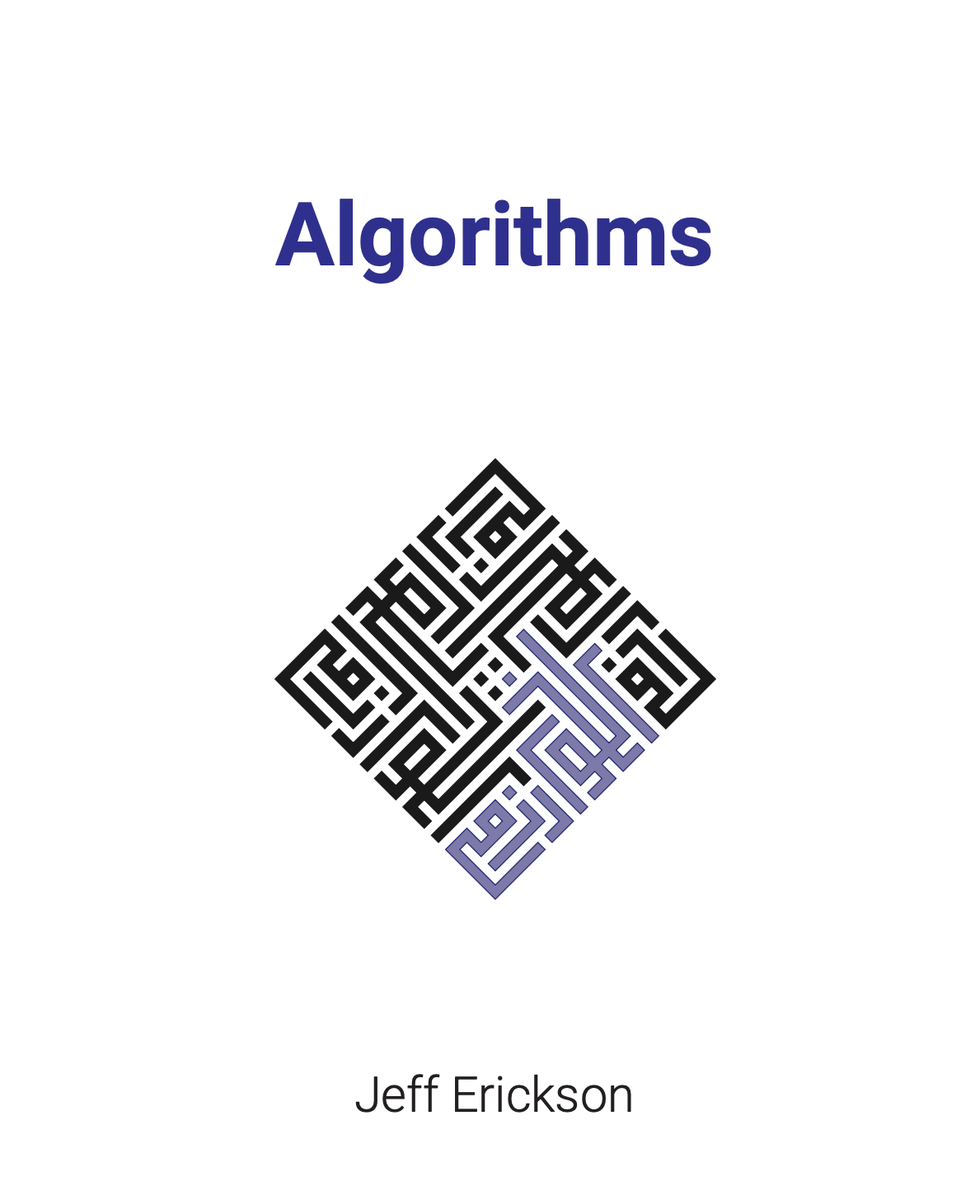
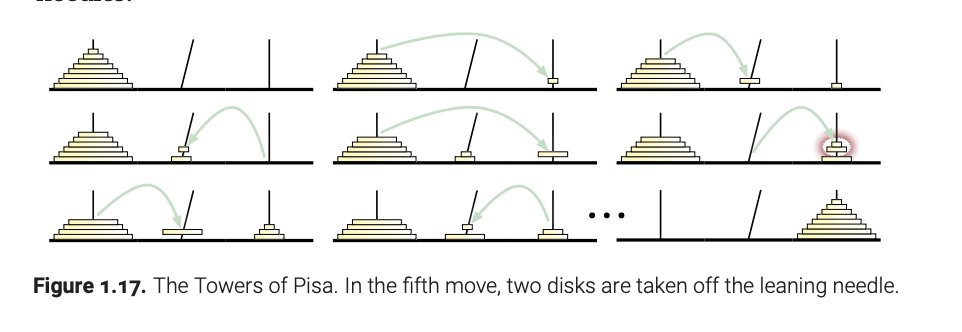
Este libro de algoritmos y estructuras de datos es espectacular y te lo recomiendo mucho.
Muy completo, ilustraciones detalladas, con pseudo código y temas desde lo más básico a avanzado.
Disponible en PDF totalmente gratis
→ https://t.co/n3JX0AlNYG
eBPF is unhinged technology and I mean that as a compliment
Imagine running sandboxed programs inside the Linux kernel without recompiling, without restarting, without crashing the box. That's it. That's the pitch. It's like usb-c for the kernel
Real numbers from prod (not vibes):
- Meta's Strobelight cut CPU usage by ~20% across their fleet
- Datadog dropped CPU by 35% on network observability
- Alibaba shaved 19% off infra costs with adaptive L7 LB
- Cloudflare drops ~10M packets/sec on a SINGLE core via XDP
- Polar Signals cut k8s network costs in half. half!
Why it slaps: kernel-level visibility with near-zero overhead, attach to a running process and trace syscalls live (no redeploy, no debug logs, no praying), replace the iptables nightmare with Cilium and watch your service mesh stop being a sidecar zoo, and catch fileless malware at the LSM layer before it forks a thing.
The wild part? You're already using it. If you run k8s, observability, or modern security tooling odds are eBPF is quietly carrying your stack on its back like Atlas with a kernel module.
Stop sleeping on it. Cloud Native 2.0 is eBPF-shaped wether we admit it or not
Btw, I'm building pktz, an eBPF network monitor that maps live traffic to specific processes and connections. It's raw, but great for seeing exactly where your data is going during debugging
Repo: https://t.co/SpTi3U8Ny2
Also, I am currently open to b2b remote from Armenia - dm me
#ebpf #networking #cilium #cloud #devops #k8s #kubernetes #sre
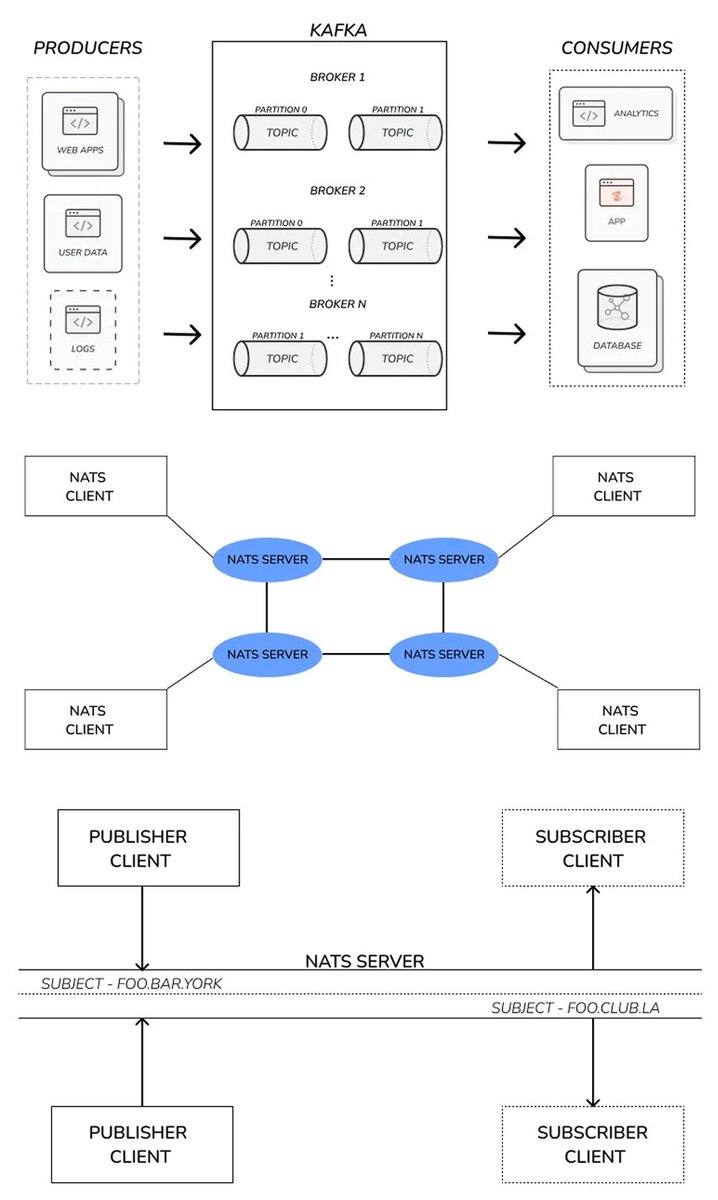
🚀 NATS vs Kafka — real talk for devs & architects
NATS is tiny, super low-latency pub/sub perfect for microservices & real-time control planes. Kafka is beefier — built for high-throughput streaming & long-term durable logs
- Latency & perf — NATS wins: single-digit ms, very lightweight, minimal hops, tiny binary in Go = crazy fast messaging. Kafka trades latency for batch throughput
- Operational simplicity — NATS is easy to stand up, reason about & monitor; no JVM jungle, no complex broker configs. Kafka gives you power but also operational debt
- Persistence & guarantees — Core NATS is fire-and-forget; add JetStream for persistence, replay, consumer state, at-least-once & exactly-once options. Kafka has persistent logs & strong durability out-of-the-box
And a few tips:
- Use JetStream stream + consumer configs (ack policies / flow control) to mimic Kafka-style backlog + replay, but keep the NATS protocol simplicity
- For microservices RPC patterns, NATS request-reply + wildcards beats Kafka’s topic + consumer group hand-rolling any service call semantics
So, when to pick what: if you need auto-scaling, huge historical retention & analytics pipelines → Kafka.
If you want sub-ms control plane events, telemetry, IoT bursts, internal bus → NATS
Many shops use NATS for real-time meshes and Kafka for durable event lakes — best of both worlds
And saying NATS can't keep message order is a myth — JetStream gives per-subject and per-consumer ordering, and tons of companies use NATS for real-time control planes, service-to-service calls, financial systems, and high-fanout microservices, not just IoT toys
And btw here are a few resources, which are really useful for @nats_io comparison to Kafka and more:
- NATS Comparison to Kafka, Rabbit, gRPC, and others - https://t.co/1kof6FGz2O
- NATS & Kafka Compared: Part 1 | Rethink Connectivity - https://t.co/ZE5GRGwZNj
- NATS & Kafka Compared Pt 2: Consumers | Rethink Connectivity - https://t.co/vRx5PH3AzD
#kafka #nats #golang #cloud #messaging #cloud_computing #cloud_native #devops #sre
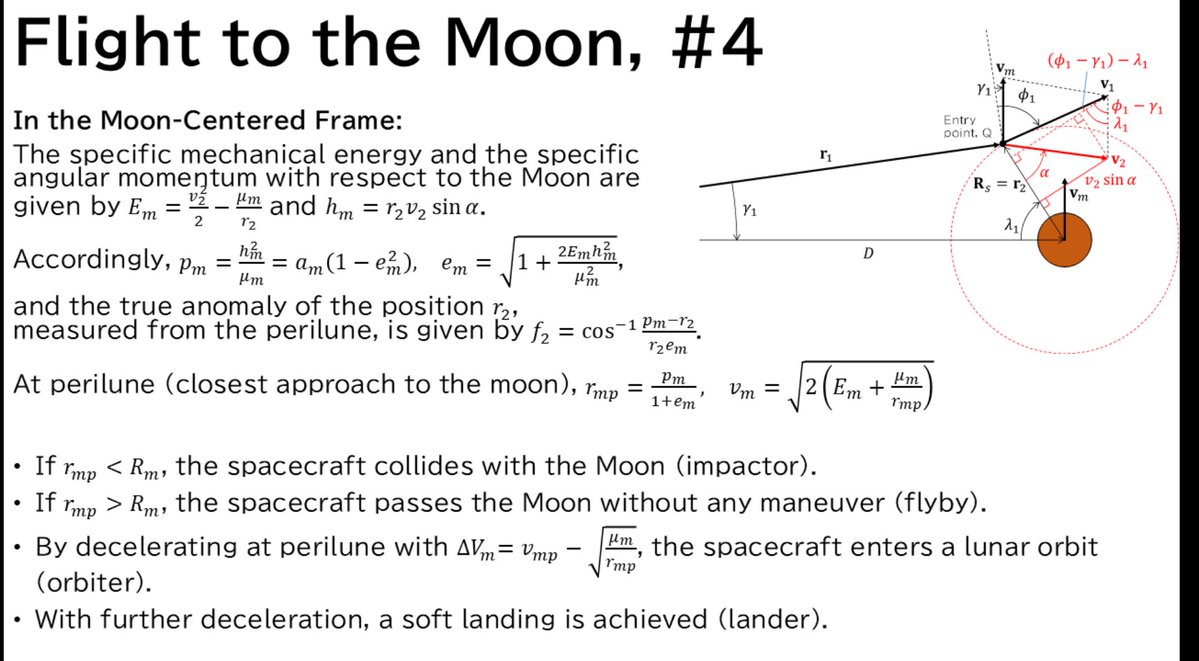
Math, physics, reality.
Which "God" decided this would be the best way to setup the universe?
Source: M. G. Raymer, Brian J. Smith, https://t.co/bNrjUIevn3
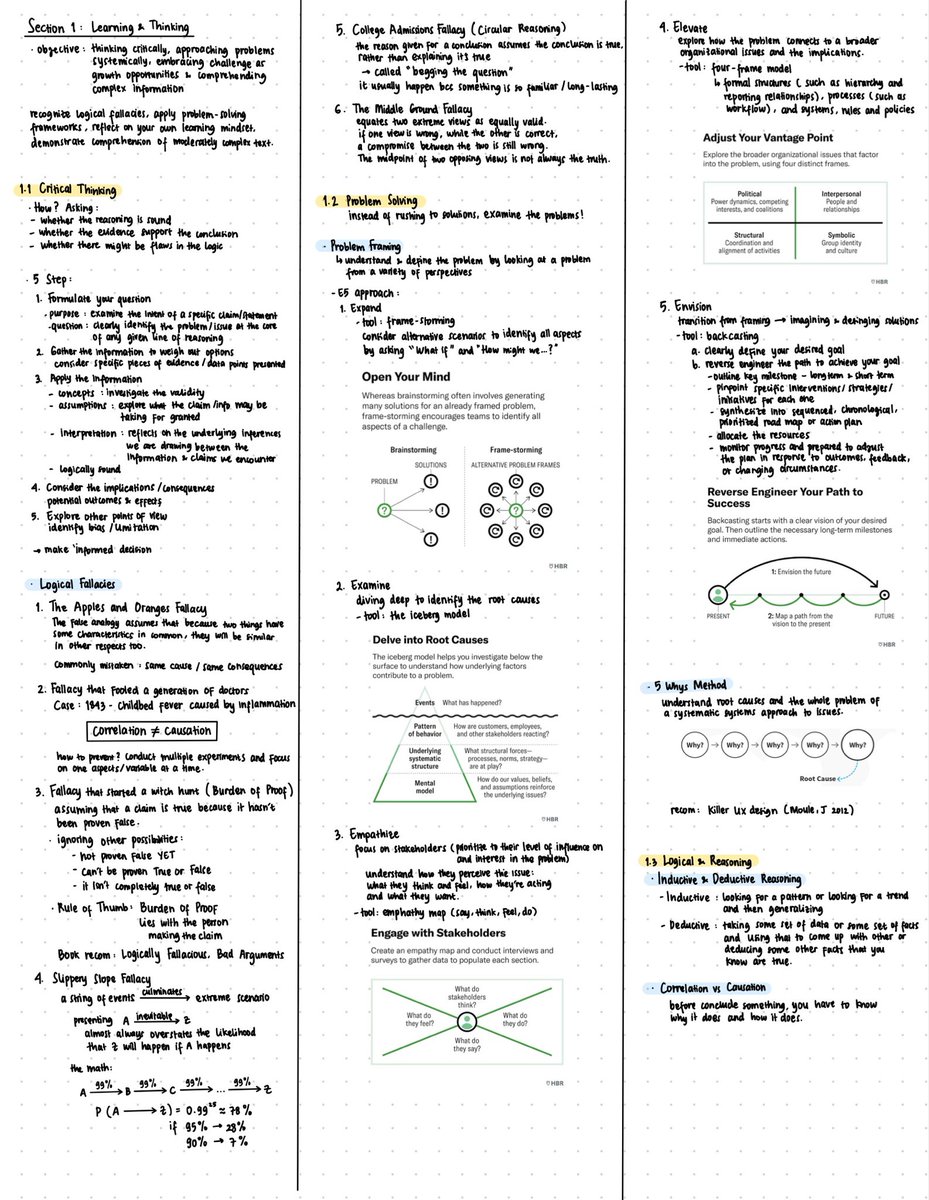
another day 1: learning how to learn and think
- critical thinking
https://t.co/8aqQzPnQKY
- logical fallacies
https://t.co/CV0a25EQtF
- reframe problem
https://t.co/Hu5RodZYCg
- 5 whys method
https://t.co/YC4Z94gfPX
- inductive & deductive reasoning
https://t.co/tR15VDewhR
@dankvr woah, i literally call my distributed mesh database / packet routing system
Governed. Under. None
at dWeb camp we hooked it up to mesh radios & stuff too!
cool to see more people using this language and working on the hardware side!!
https://t.co/S0PDRRWX57
Continuing my fun with the Enigma machine: I wrote two emulators for a Commodore 64, one in BASIC and the other in Assembly (Turbo Macro Pro, coded on a C64).
The BASIC version does about 3 characters per second. The assembly version can encrypt/decrypt roughly 1500 characters per second.
Ufology:
From Fringe to Mainstream to Fringe?
The best article on the subject to date, by the great @nickpopemod one of the most informed and thoughtful observer of the phenomena. A must read for everyone in this space:
https://t.co/NFNK12ukXT
62 years ago today, the backyard photographs Marina Oswald took of her husband made the cover of LIFE magazine.
Lee Harvey Oswald is holding the rifle that was ballistically proven to be the weapon used to assassinate President Kennedy. The revolver on his hip is the one used to kill Dallas Police Officer J.D. Tippit 45 minutes after the President was shot. In front of his chest, Oswald holds copies of The Militant, a Trotskyist weekly newspaper published by the Socialist Workers Party, and The Worker, the weekly newspaper of the Communist Party USA.
From my book, Case Closed:
“On Sunday afternoon, March 31 [1963], Marina was in the small fenced-in backyard hanging up diapers when Lee asked her to take a picture. She protested that she had never taken a photo in her life, but he assured her it was simple. He returned to the apartment and in a few minutes emerged dressed all in black, a revolver tucked into the waist of his pants, a rifle held in one hand, and a camera and some newspapers in the other hand.
Marina broke into laughter: ‘I asked him then why he had dressed himself up like that … I thought he had gone crazy, and he said he wanted to send that to a newspaper. I thought that Lee [was] … just playing around.’
But he was absolutely serious, and angry that she thought it was funny. Marina became a ‘little scared’ as she worried about taking the pictures correctly and whether anyone in the neighborhood could see him.
‘It was quite embarrassing the way he was dressed,’ she recalled.
He posed and she snapped the shutter. Then he walked over and reset the shutter and she did it again, and again.
Oswald developed the photos himself, probably the next day when he returned to work. He brought one back to Marina and inscribed on the back: ‘For Junie from Papa.’ Marina was flabbergasted and asked why June would want a picture of him holding guns. ‘To remember Papa by sometime,’ Oswald said.”
The photographs of the man accused of assassinating the President, posing with the murder weapon, were so incriminating that many conspiracy theorists reflexively insisted they had to be fake.
Some made a small business out of producing videos, booklets, and lecture series arguing the images were composites. They cited alleged shadow inconsistencies, body proportions, facial variations, even supposed grafting lines. The Warren Commission’s FBI experts found no evidence of retouching. By the late 1970s, advances in forensic photography allowed the House Select Committee on Assassinations to settle the matter definitively. Twenty-two leading experts determined the negatives were taken by Oswald’s Imperial Reflex camera, to the exclusion of any other camera ever made. They found no evidence whatsoever of faking. They also matched the rifle in the photograph to the rifle recovered on the sixth floor of the Texas School Book Depository.
The science was conclusive.
The mythology persists.
Brilliant long read by the great @shaunwalker7 on Ukraine, how the CIA and MI6 got hold of Putin’s Ukraine plans and why nobody believed them.
It's a long one, so put the kettle on.
https://t.co/WWb9oPYhac
Vector search is not always the answer.
A 30-year-old algorithm with zero training, zero embeddings, and zero fine-tuning still powers Elasticsearch, OpenSearch, and most production search systems today.
It's called BM25, and it's worth understanding why it refuses to die.
Let's say you're searching for "transformer attention mechanism" in a library of ML papers.
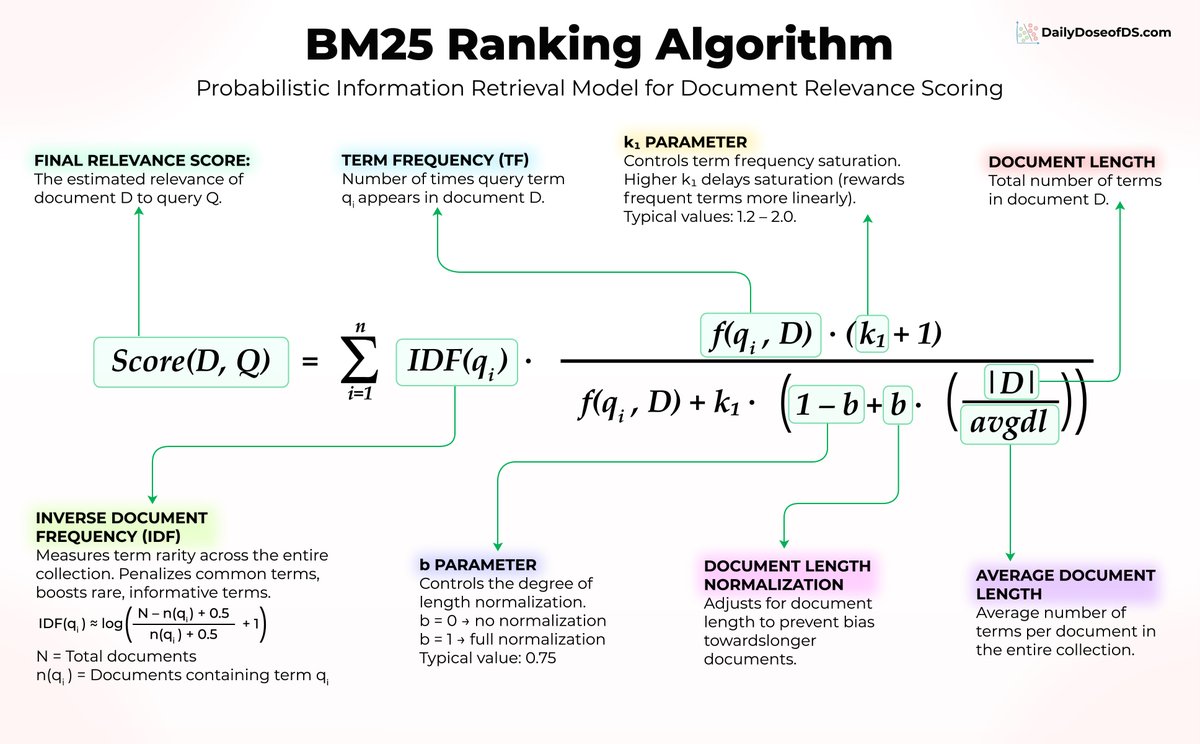
BM25 scores documents using three core ideas:
1) Word rarity matters more than word frequency
Every paper contains "the" and "is" so those words carry no signal.
But "transformer" is specific and informative, so BM25 gives it a much higher weight. In the formula, this is captured by IDF(qᵢ).
2) Repetition helps, but with diminishing returns
If "attention" appears 10 times in a paper, that's a strong relevance signal. But the jump from 10 to 100 occurrences barely moves the score.
BM25 applies a saturation curve controlled by f(qᵢ, D) and the parameter k₁, preventing keyword stuffing from gaming the results.
3) Document length gets normalized
A 50-page paper will naturally contain more keyword hits than a 5-page paper.
BM25 adjusts for this using |D|/avgdl, controlled by parameter b, so longer documents don't dominate the rankings just because they have more text.
Three ideas. No neural networks. No training data. Just elegant math that has stood the test of time.
Here's the part most people overlook: BM25 excels at exact keyword matching, which is something embeddings genuinely struggle with.
When a user searches for "error code 5012" vector search might return semantically similar error codes. BM25 will surface the exact match every time.
This is exactly why hybrid search has become the default in top RAG systems.
Combining BM25 with vector search gives you semantic understanding AND precise keyword matching in a single pipeline.
So before you throw GPUs at every search problem, consider that BM25 might already solve it, or at the very least, make your semantic search significantly better when the two are combined.
The Joy of Cryptography is finally on bookshelves! Thanks to @mitpress for supporting the adventure. The book will eventually be completely open-access, but for now the first 3 chapters are available at https://t.co/gsiUIjWGim, featuring some fun interactive elements.
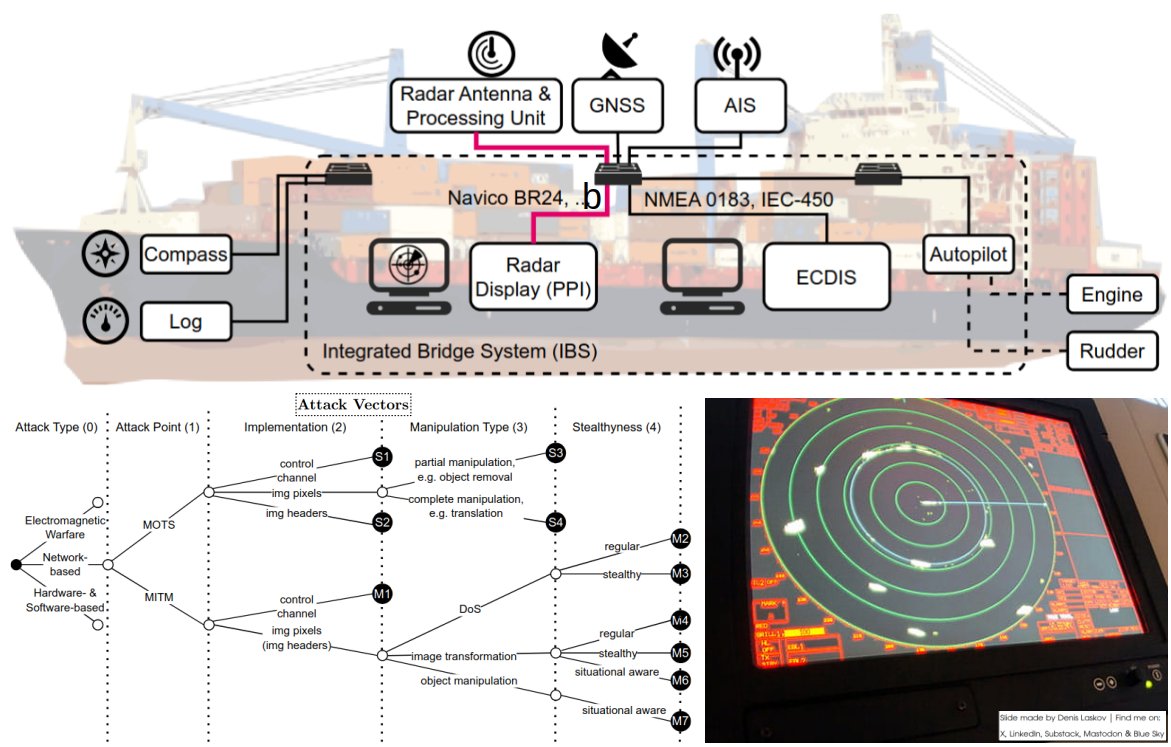
Hacking Marine Radar Systems (MRS): Cybersecurity challenges of modern ships. 😈📡၊၊||၊🚢🙈
More details on:
LinkedIn: https://t.co/pa062eUZ7b
Substack: https://t.co/0Obl4Spq3r
SSH reverse tunnel lets a machine behind NAT or firewall expose a local service to the outside by having the remote server forward connections back through the tunnel 😎👇 #infosec
Find a pdf book with all my #cybersecurity related infographics from https://t.co/1EiISaBeYX









![geraldposner's tweet photo. 62 years ago today, the backyard photographs Marina Oswald took of her husband made the cover of LIFE magazine.
Lee Harvey Oswald is holding the rifle that was ballistically proven to be the weapon used to assassinate President Kennedy. The revolver on his hip is the one used to kill Dallas Police Officer J.D. Tippit 45 minutes after the President was shot. In front of his chest, Oswald holds copies of The Militant, a Trotskyist weekly newspaper published by the Socialist Workers Party, and The Worker, the weekly newspaper of the Communist Party USA.
From my book, Case Closed:
“On Sunday afternoon, March 31 [1963], Marina was in the small fenced-in backyard hanging up diapers when Lee asked her to take a picture. She protested that she had never taken a photo in her life, but he assured her it was simple. He returned to the apartment and in a few minutes emerged dressed all in black, a revolver tucked into the waist of his pants, a rifle held in one hand, and a camera and some newspapers in the other hand.
Marina broke into laughter: ‘I asked him then why he had dressed himself up like that … I thought he had gone crazy, and he said he wanted to send that to a newspaper. I thought that Lee [was] … just playing around.’
But he was absolutely serious, and angry that she thought it was funny. Marina became a ‘little scared’ as she worried about taking the pictures correctly and whether anyone in the neighborhood could see him.
‘It was quite embarrassing the way he was dressed,’ she recalled.
He posed and she snapped the shutter. Then he walked over and reset the shutter and she did it again, and again.
Oswald developed the photos himself, probably the next day when he returned to work. He brought one back to Marina and inscribed on the back: ‘For Junie from Papa.’ Marina was flabbergasted and asked why June would want a picture of him holding guns. ‘To remember Papa by sometime,’ Oswald said.”
The photographs of the man accused of assassinating the President, posing with the murder weapon, were so incriminating that many conspiracy theorists reflexively insisted they had to be fake.
Some made a small business out of producing videos, booklets, and lecture series arguing the images were composites. They cited alleged shadow inconsistencies, body proportions, facial variations, even supposed grafting lines. The Warren Commission’s FBI experts found no evidence of retouching. By the late 1970s, advances in forensic photography allowed the House Select Committee on Assassinations to settle the matter definitively. Twenty-two leading experts determined the negatives were taken by Oswald’s Imperial Reflex camera, to the exclusion of any other camera ever made. They found no evidence whatsoever of faking. They also matched the rifle in the photograph to the rifle recovered on the sixth floor of the Texas School Book Depository.
The science was conclusive.
The mythology persists.](https://pbs.twimg.com/media/HBsY61aWwAEfPuB.jpg)