We're opening a Hugging Face office in Tokyo!
Our goal: help open-source AI develop in Japan and grow the local community. Let's meet!
ハギングフェイスの東京オフィスがオープンしました!
私たちの目標は、日本におけるオープンソースAIの発展を支援し、ローカルコミュニティを育てることです。ぜひお会いしましょう!
Transformers v5.4.0 is live with 13 new models!
Key highlights:
• VidEoMT: 160 FPS video segmentation
• Document AI suite: UVDoc, SLANeXt, PP-OCRv5
• PI0: Vision-language-action model for robotics
• Mistral 4: Unified instruct/reasoning model
• Jina Embeddings v3: Multi-task text embeddings
• CHMv2: Forest canopy height mapping
~10 new model architectures contributed by the PaddlePaddle team 🤯
Plus major performance improvements and Flash Attention 4 support!
PyTorch Conference Europe is happening next month, and many of us from the Hugging Face team will be there
We'll be talking about Kernels, Transformers, Audio models, processors, Diffusers, Transformers.js among others
We'll be sharing a few sneak peaks of what's coming next 🤫
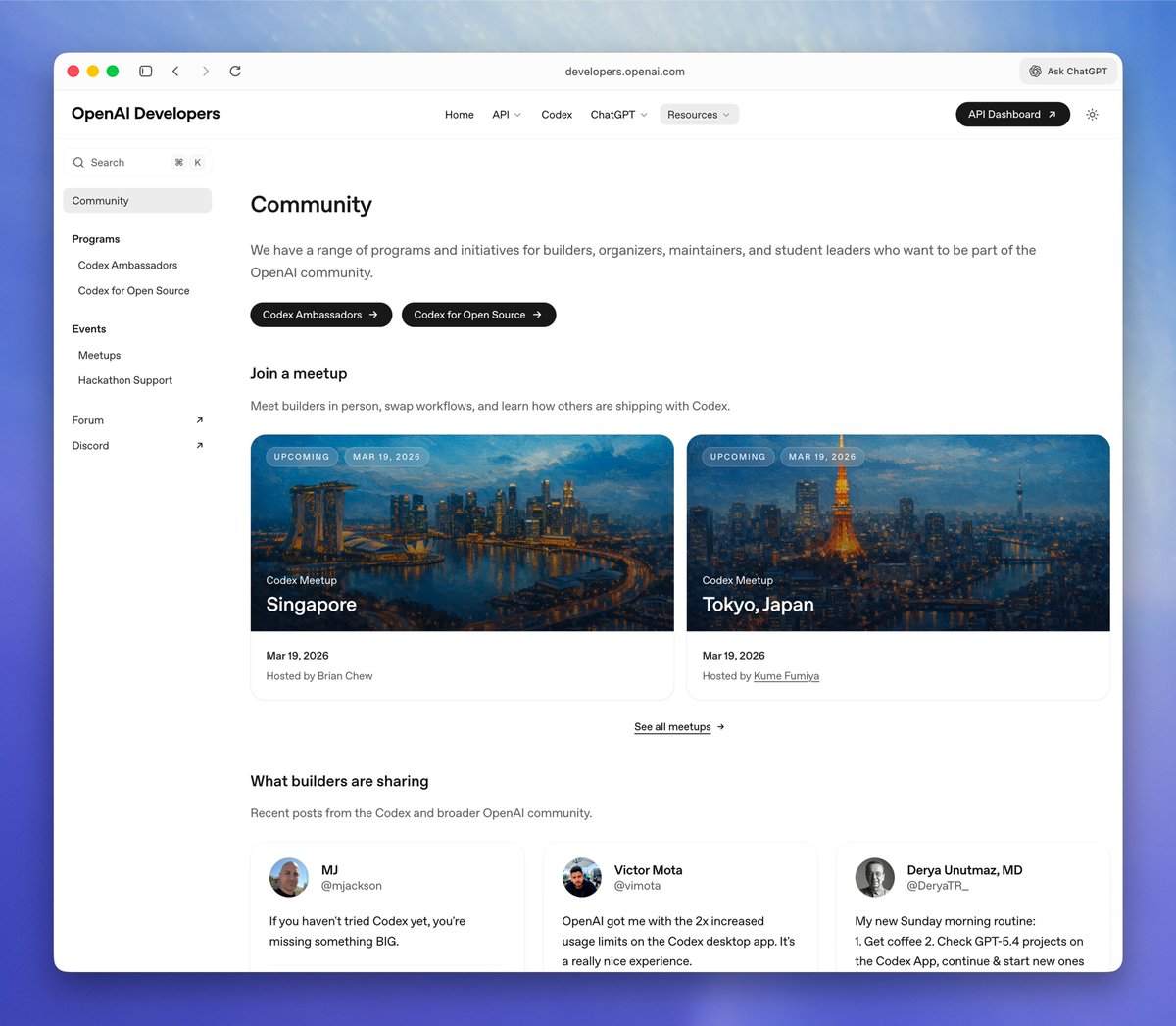
We just brought our community work into one place, making it easier to find events and programs like Codex Ambassadors and Codex for OSS.
There are 15+ community-led events coming up around the world, with more to come!
Where would you like to see a Codex meetup next? 🌏
Defuddle now returns Youtube transcripts!
Paste a YouTube link into defuddle.md to get a markdown transcript with timestamps, chapters, and pretty good diarization!
...or if you just want to read it, try the new Reader mode in Obsidian Web Clipper powered by Defuddle.
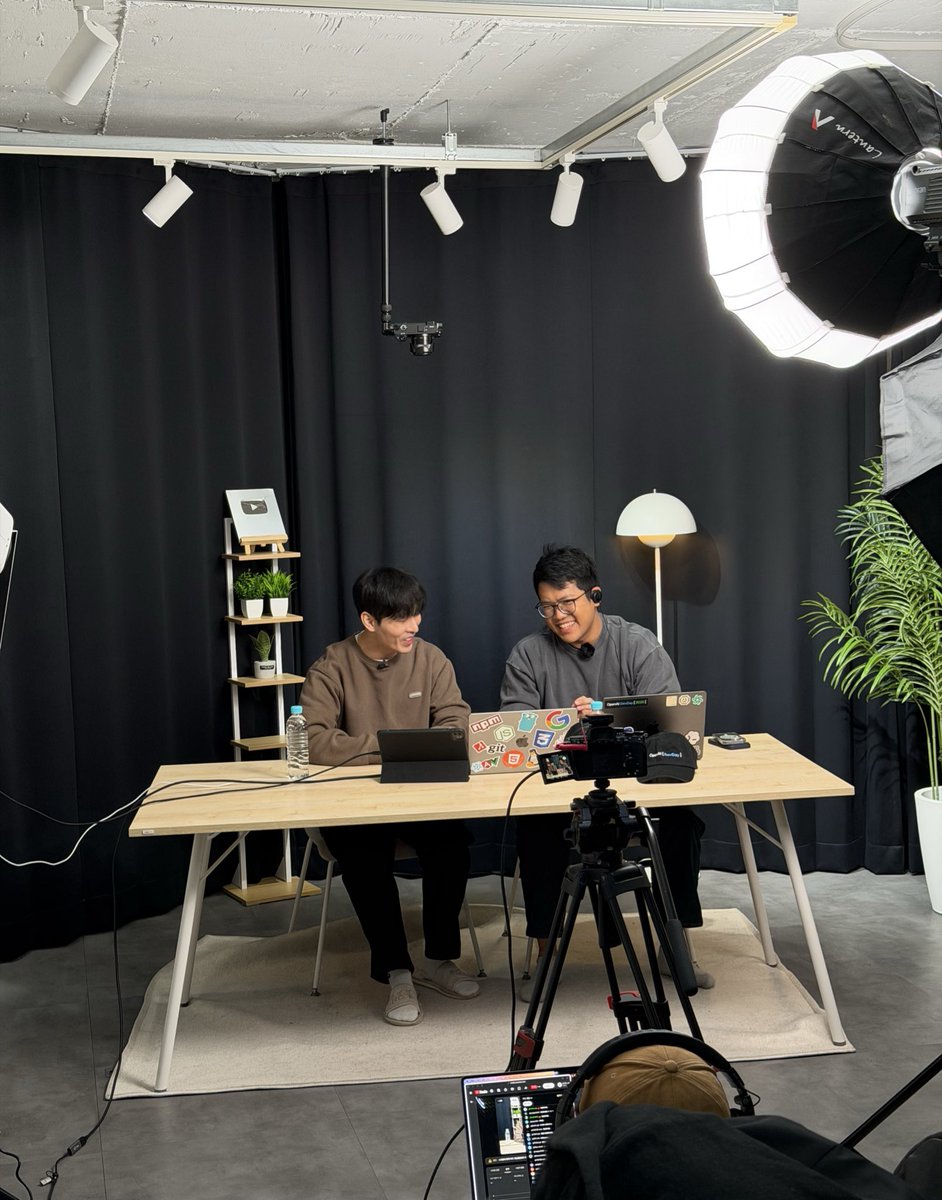
On March 11, at the OpenAI Codex Community Meetup – Seoul, I edited and uploaded the presentation video “Effective Harnesses for Long-Running Codex: The Era of AI Coding Through the Night” by speaker Goobong Jeong.
Since this is a video I edited myself, there may be some rough edges, but I hope it helps those who were curious about the talk.
If you're interested in the #Ralphthon recap or learning practical approaches for maintaining long-running Codex sessions with effective harnesses, I highly recommend checking out the video below.
▶ Video:
https://t.co/cxYvFQjRH9
English subtitles (CC) are available in the video.
@OpenAIDevs@OpenAI
On March 11, at the OpenAI Codex Community Meetup – Seoul, I edited and uploaded the presentation video “OMX — Hacking Codex (Demo + Dev Story)” by speaker Yeachan Heo. (@bellman_ych )
Since this is a video I edited myself, there may be some rough edges, but I hope it helps those who were curious about the talk.
If you're interested in how Codex was extended and customized through OmX, or if you're building your own agent harness, this talk is definitely worth checking out.
▶ Video:
https://t.co/dX8p7YFQCF
English subtitles (CC) are available in the video.
@OpenAIDevs@OpenAI
> Seoul’s three Codex Ambassadors (@swhan0329, @w00jun_, Junho Kong) — for organizing two (!) community meetups, where builders traded notes on everything from agent loops to OSS Codex extensions to CI workflows, and for helping connect us deeply with the local community.
Excited to introduce Codex for Open Source! 🔥
TL;DR - ChatGPT Pro, Codex, and API credits for eligible open-source maintainers
Open source has shaped modern software, and so much of it depends on maintainers doing steady, often invisible work to keep critical projects healthy.
That is a big part of why expanding our support for open source through Codex feels so natural.
At OpenAI, supporting open ecosystems has long been part of our story, from Gym and Universe to Triton, Whisper, and CLIP, and more recently gpt-oss open-weight models.
Last year, we launched the Codex Open Source Fund to support projects with API credits. Today, we’re building on that by giving more maintainers access to ChatGPT Pro, Codex & Codex Security.
This is, at its core, a thank you ♥️
Maintainers do extraordinary work for the broader software ecosystem. If Codex can help reduce some of that load, whether through reviews, debugging, tests, or understanding large codebases, this feels like a meaningful way to give back.
Go apply today! 👇
how to use obsidian + claude code to build a 24/7 personal operating system and build your startup:
1. write everything in markdown (daily notes, projects, beliefs, people, meetings)
2. link your notes together so they mirror how your brain actually thinks.
3. install obsidian cli so claude code can read your entire vault + the relationships.
4. stop reexplaining projects every session. use reference files instead.
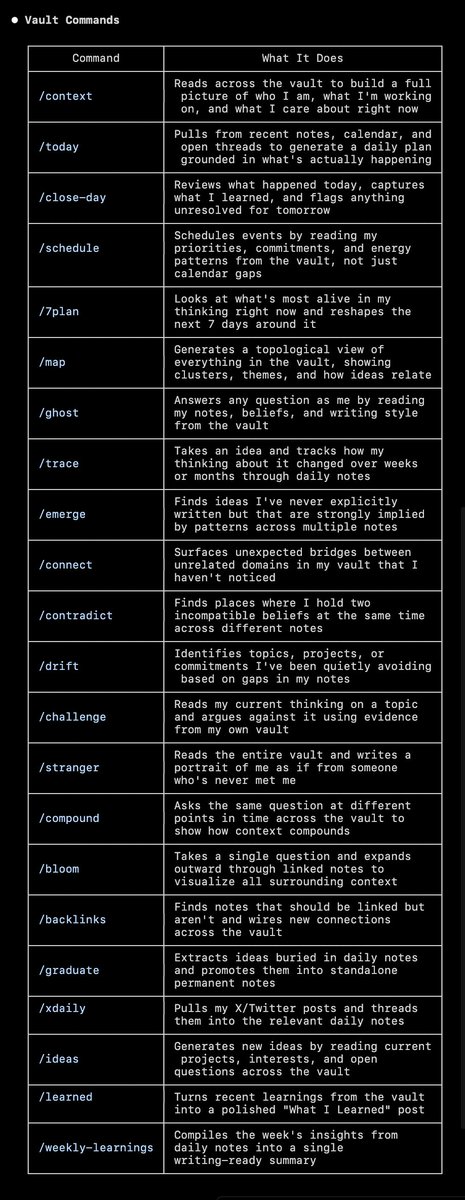
5. build custom slash commands:
/context → load your full life + work state
/trace → see how an idea evolved over months
/connect → bridge two domains you’ve been circling
/ideas → generate startup ideas from your vault
/graduate → promote daily thoughts into real assets
6. keep a strict rule: human writes the vault. agents read it, suggest, execute.
7. let claude aka clode surface patterns you’ve been unconsciously circling for years.
8. delegate from inside your notes. one sentence in obsidian → agent handles the rest.
9. treat writing as leverage.the more you write, the more context your agents have.
10. understand this:markdown files are the oxygen of llms.
i really enjoyed seeing how to use obsidian thanks to @internetvin
vin uses ai like a thinking partner wired into his life’s work.
99.99% of people won’t do this because it requires reflection + setup.
but once the vault exists, the agent stops being generic.
it starts thinking in your voice.
episode is live on @startupideaspod (more there)
this one is different. send this tweet to a friend.
im still processing how game changer obsidian + claude code is, maybe you too
watch
Here's 22 of the commands I am using with Obsidian and Claude Code with descriptions.
I will turn this into something interactive soon so you can click the commands and then see the full prompts.