Rheumatology Physiotherapist, who sometimes likes talking to plants more than people!😀 Views expressed are my own.Retweets are not necessarily an endorsement
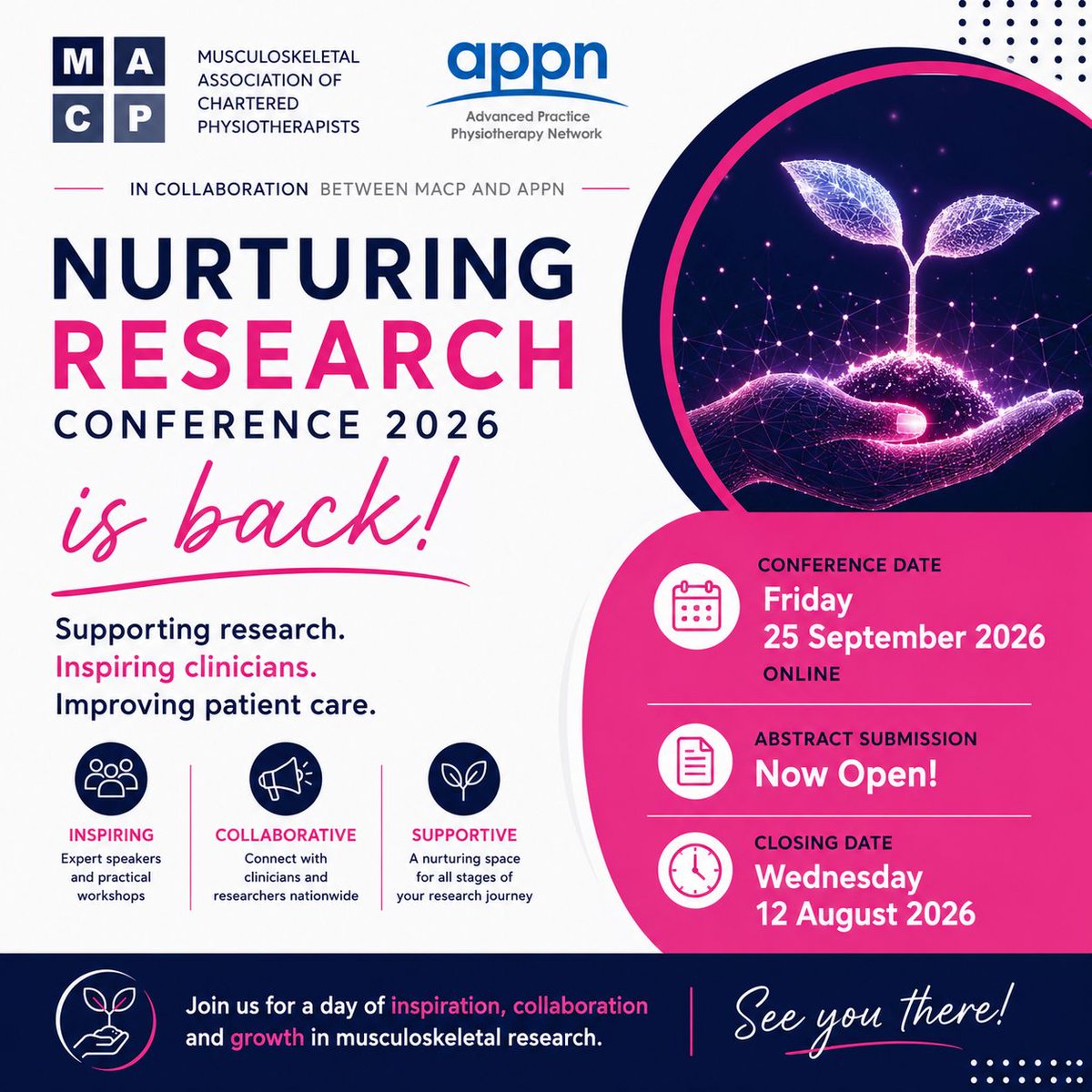
Don't miss out!! Booking still open. APPN members receive 25% discount on ticket price. Please email [email protected] to receive the code.
👉 Booking link here: https://t.co/8bmqbSJqVD
Are we realising the potential of our networks to make change happen?
Most innovation emerges from collaborative projects where teams openly “borrow” & adapt each other’s (often small but powerful) ideas. Many networks & communities of practice could achieve so much more by experimenting together around collective priorities to generate & share new solutions.
This is beyond spreading known “best” or “good” practices. It is about innovating to design new solutions collectively.
So I appreciated this piece from Ed Morrison of @Strategic_Doing about three different kinds of networks:
- Advocacy networks are communities that seek to mobilise people, creating pressure to shift policies, priorities or messages in a particular direction. Their aim is to connect & influence rather than to change how they themselves work.
- Learning networks are communities of practice. They share knowledge, compare practice & build shared capability. Learning networks often excel at spread & improvement of existing practice, but only sometimes move into structured innovation work.
- Innovating (or transforming) networks are communities that combine their assets - ideas, relationships, data, capabilities - to create new value that none could produce alone. They manage collaboration as a process of experimentation: agreeing a shared outcome, running multiple connected tests of change, learning by doing & amplifying what works across the network.
https://t.co/70NcTsBLjl
Every learning network has the potential to become an innovating/transforming network. Some actions to enable this:
1. Build a foundation of strong, trusting relationships within the network, understanding each member’s starting point & motivation for change
2. Focus on helping each other to succeed; listen to each others’ stories & plans, co-coach, give advice to each other & build shared inquiry
3. Move from “sharing” or “raising awareness” to some concrete outcomes the network want to change together through collective experimentation
4. Agree some simple norms for the network so that members help each other to make progress, make it safe to try things, fail fast & share incomplete work
5. Encourage multiple, parallel tests of change around similar outcome so projects can “steal with pride” from one another & quickly refine promising ideas
6. Put simple routines in place for noticing patterns (what is shifting where & why), capturing these insights & amplifying them across the network
7. Add additional success metrics including innovations tested, adapted & adopted in multiple places
Graphic by Ed Morrison.
Content with added inspiration from @juneholley.
📣 Advancing Practice: Non-Medical Prescribing in Physiotherapy & AGM
🖥️ Webinar
📅 Tuesday 11th November 2025 6.30-8.00pm
👉 BOOK HERE: https://t.co/irGN0YBJp9
🆓 Free for members (£1 booking fee)
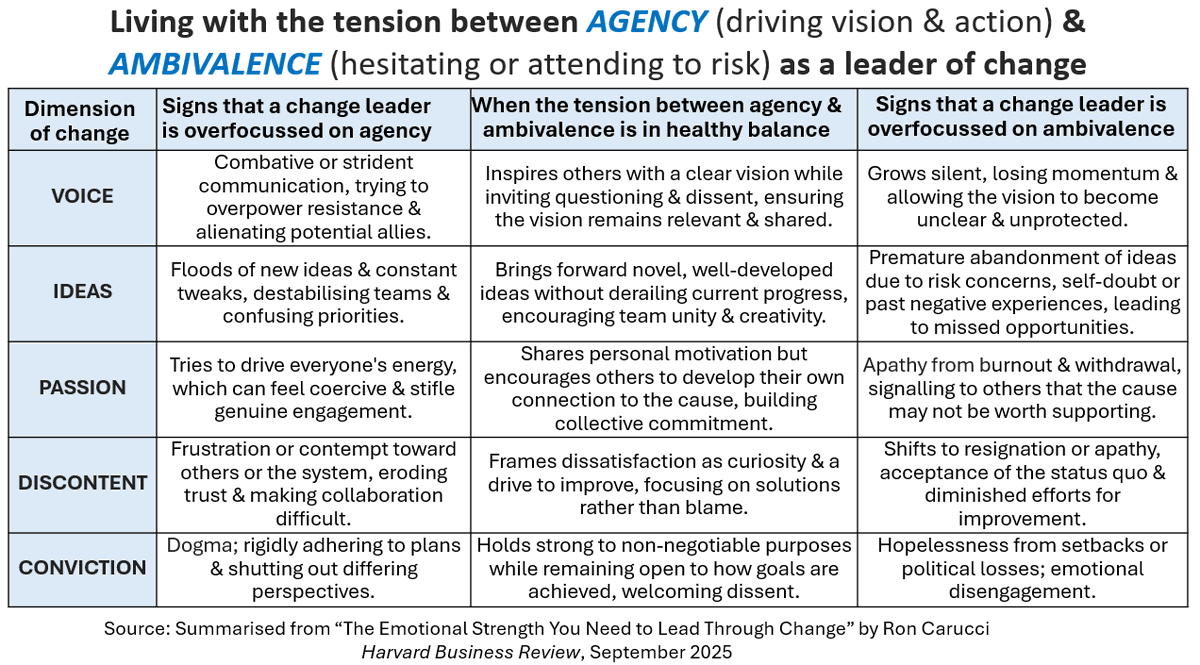
Leading change demands deep emotional strength & self-awareness. Leaders of change have to balance an “inner battle” between agency (the need to drive momentum & action towards the vision) & ambivalence (identify risks, invite reflection & apply caution before proceeding). Typically, agency vs. ambivalence isn’t a resolvable “either/or”; it’s a “both/&” tension that leaders of change have to constantly hold & manage. @RonCarucci says we have to consider this tension across five critical dimensions of inner conflict:
1) Voice: Inspiring others with a compelling picture of the future, yet inviting dissent.
2) Ideas: Reframing possibilities with imagination while fostering unity.
3) Passion: Emotionally fuelling the cause of change & encouraging others to make their own connection to the cause.
4) Discontent: Challenging the status quo productively.
5) Conviction: Believing in the need for change but being flexible about the approach.
The leaders who succeed at transformation are those who can live with the tension, read the conditions & repeatedly recalibrate that mix without overfocussing on either extreme for long.
The author sets out advice to recognise the dimensions, watch for signs that they’re out of balance & use “guardrails” for sustaining balance as a leader of change:
https://t.co/7GA7AwIjNx
It was an honour and a privilege to stand in for Val Jones at the Shoulder & Elbow Therapy Congress #SETC2025 today. Please help support her recovery by making a donation. https://t.co/v2VYz0StIV
Disruption doesn’t drive innovation. Safety does says @Digitaltonto. History shows that “disruptive transformation” (busting bureaucracy, slashing red tape, creating a more agile workforce etc), often does not deliver what is intended. There’s a significant risk of “transformation theatre” – a gap between the performance of change & genuine transformation.
Disruption & safety go hand in hand. The safer we make our organisations, the more we enable people to think boldly, take risks, & explore new territory. The more stress we create, the more we drain cognitive capacity, limit creativity & shrink the space for insight, collaboration & original thinking.
If we want bold action & radical change, we need to create a space in which trust, safety & wellbeing can thrive:
https://t.co/4eVKYls0SK
MG Taylor methodology is a structured approach to engaging large groups of people in collaborative problem-solving. It has had a significant impact on my practice as a change leader and I use aspects of it every day. What I like about MG Taylor the most is that it helps us to design really strong change processes which enable the participants to concentrate on the problem, the task at hand and on collaboration, which leads to the emergence of better outcomes.
The “Recode Cube” is an MG Taylor framework designed to support the design, facilitation and evaluation of complex collaborative processes. It guides practitioners to strategically align six critical dimensions (Purpose, Players, Field, Design, Facilitation, and Knowledge) to enable greater systemic impact from a change intervention.
When to use it:
1) In the design of workshops for complex change interventions: It helps change leaders to create the conditions for powerful, collective ways forward to emerge
2) As a real-time navigation tool during complex engagements: it supports adaptive planning, learn as we go and course correction
3) As a reflection tool for after-action reviews and “retrospectives”: It’s a great tool for reviewing decision making, learning and progress through the six dimensions.
More about the Recode Cube: https://t.co/1HMxwNzoj5
The Value Web, a global community of change leaders who work with the MG Taylor methodology, is hosting a free seminar including the Recode Cube on Wednesday 3rd Sept. Open to all. To register: https://t.co/XVnD3ICY1D.
How do we enable behaviour change? These authors synthesised findings from 147 meta-analyses to identify which determinants of behaviour are most impactful & which should be targeted for change interventions. Many of the studies focus on large-scale, health-related, environmental or consumer behaviours but the conclusions are also worth reflecting on for organisational change.
What leaders of change should do:
1) Remove barriers & make desired behaviour easy: Focus on changing the environment & systems so that the desirable behaviour is simple, convenient, & supported; e.g, provide direct access to resources, streamline processes & foster social support.
2) Build social structure: Facilitate a culture where positive behaviours are the norm. Engage peers & create opportunities for team encouragement & collective participation.
3) Enable habits & provide ongoing support: Support repeated practice & help people make the new behaviour part of their routine. Reinforce changes with reminders, prompts, & positive reinforcement.
4) Prioritise practical changes over persuasion: Rather than trying to shift attitudes or beliefs, invest in changes that directly enable & reinforce the desired actions.
What leaders of change should NOT do:
1) Don’t rely solely on information or education: Simply telling people what to do, increasing knowledge or launching awareness campaigns has limited impact on actual behaviour.
2) Avoid focusing mainly on changing attitudes or beliefs: Programmes that target broad mindset change, general skills or even trustworthiness are less effective than those that address practical barriers.
3) Don’t overlook structural support: Failing to provide the physical, social, or material support needed for people to act makes adoption less likely, even if people know it’s important.
The article reinforces the importance of creating the conditions for change: making the “right thing to do” the easy, supported, default option, across multiple dimensions: https://t.co/D7HgPB9Dzn
Original manuscript version: https://t.co/g8qfgWtRa4. By Dolores Albarracin (@socialactionlab) & colleagues.
I accessed this article via @ReubenRusk who also created the graphic.
Organisational change is happening at a scale & pace we've rarely seen previously in the health & care sector. It is stirring up profound anxiety within teams. For leaders, understanding the powerful psychological undercurrents at play in driving group behaviour in times of change is as least as critical as managing the operational aspects of transition.
How do we do lead this change process with our teams in evidence-informed ways? @heidipsychology suggests following a process based on Bion’s group dynamic theory. Bion sets out 3 typical behaviours—dependency, fight-flight, & pairing – that block teams from moving forward. "Dependency" means over-reliance on leadership for answers, leaving team members passive & hesitant to act. "Fight-flight" manifests in blaming, conflict, or withdrawal from the challenge at hand. "Pairing" leads to an expectation that a “saviour” or magical solution will emerge to solve the group’s problems, neglecting participation & collaboration in the team.
Bion’s insights can help us move beyond managing tasks to working with meaning & emotion. This can significantly reduce group anxiety during organisational change. Here’s what leaders might do, based on Bion’s framework:
•Don’t suppress anxiety but recognise the undercurrents of the group
•Openly discuss the dynamics of the team & facilitate dialogue
•Set clear goals, expectations & boundaries, reducing uncertainty fuelled anxiety
•Build trust by communicating transparently
•Encourage participation & ownership, encouraging people to take initiative
•Engage the wider group in problem-solving & decision-making
•Model emotional stability & help “hold” the team’s anxiety
•Encourage group reflection & diverse perspectives & discourage “groupthink”
An overview of Bion’s theory: https://t.co/mZA85VJgfq By @FLsociety
Another superb graphic from @heidipsychology.
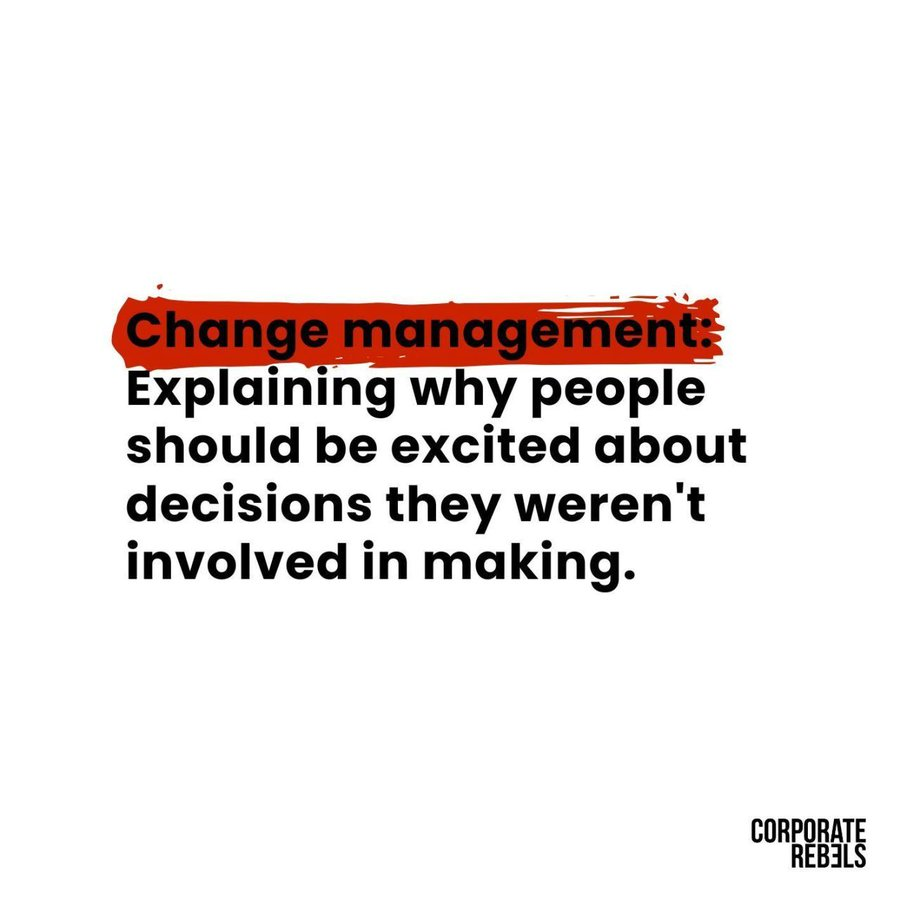
I typically do not use the term “change management” (unless I’m working with a partner who wants or needs to use it).
“Managing” change implies order, planning & stability; the ability to forecast, direct & deliver outcomes. Yet very few change or transformation plans deliver what they set out to deliver, in the predicted timescales. We no longer operate in a stable world where we undertake a change project and move back to equilibrium. Our environment moves faster, acts in more interconnected ways & is full of ambiguity. Change is relentless & continuous. We need to focus on building adaptive capacity & creating a collective process, not on "managing" change as a discrete, manageable task.
Michael Hudson talks about shifting from “change management” to “change fitness”. He sets out three core leadership practices for enabling change:
1. Continuous sensemaking: This involves incorporating five minutes of sensemaking into existing team routines, understanding what is different or changing. Over time, this practice builds "complexity capacity" & the ability to hold onto multiple, often contradictory realities without becoming overwhelmed.
2. Strategic energy management: Treating people’s energy as a finite resource that needs to be deliberately managed, like any other resource.
3. Learning from navigation, not just success: Shifting from an outcome-focus to process-focus builds the ability to prevail in situations where the path forward is unclear.
https://t.co/fBLzsTphOF Via @Forbes.
Graphic from @corp_rebels.
📢 We're launching a new series of webinars!
Designed to support AHPs working at (or towards) advanced levels of practice and those who manage them.
Please share with colleagues!
https://t.co/zEFs0bA25y
Most change plans don’t even consider or mention resistance to change. Yet it should be a primary focus in all our change interventions. Every change initiative starts out weak & vulnerable, without a track record of success. People are suspicious. They already have everyday struggles & don’t want these extra considerations to add to their burden.
We need to make wise choices about the stress we put on our teams & people. When we make the decision to pursue change, we need to anticipate resistance & build strategies to work with it, understanding that resistance is part of change & is often a positive thing. “Resisters” often have an important perspective, can point out important flaws & make the change stronger.
https://t.co/8H4mgvPptb. By @Digitaltonto. Graphic from @FLIMPstudios
When we are the leader or manager, there's pressure to be "the person who knows". If we cannot give confident advice or direction to our teams, we might look weak. Yet leaders who openly acknowledge what they don’t know often create superior outcomes. Much better to "lead like a scientist": This means approaching everything with curiosity, experimentation, collaboration & being comfortable with not knowing.
Three ways to lead like a scientist:
1) Learn in public: openly admit when we don’t know something, share failures & lessons learned, ask questions instead of always providing answers & document our thinking.
2) Unlock social flow: encourage team members to design their own experiments, make space for sharing insights & remove as many artificial barriers as possible.
3) Redefine "success": think beyond performance standards & treat unexpected results as valuable data. When everyone understands that learning is part of success, they take smarter risks, surface problems earlier & develop more interesting solutions to complex challenges:
https://t.co/F183TqUDHH. By @neuranne.
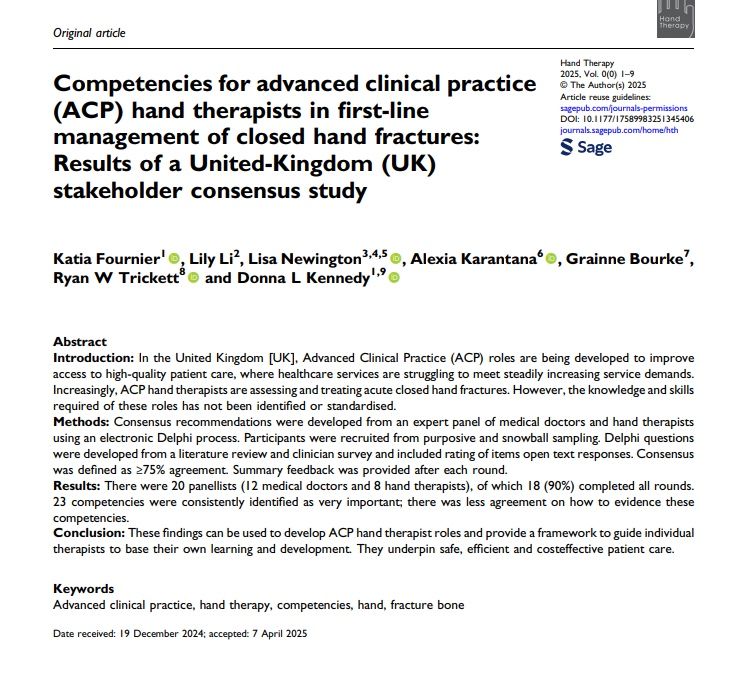
Hot off the press! Thanks to The British Association of Hand Therapists and to all hand therapists and surgeons who contributed to the survey and Delphi. It takes a village… 💪
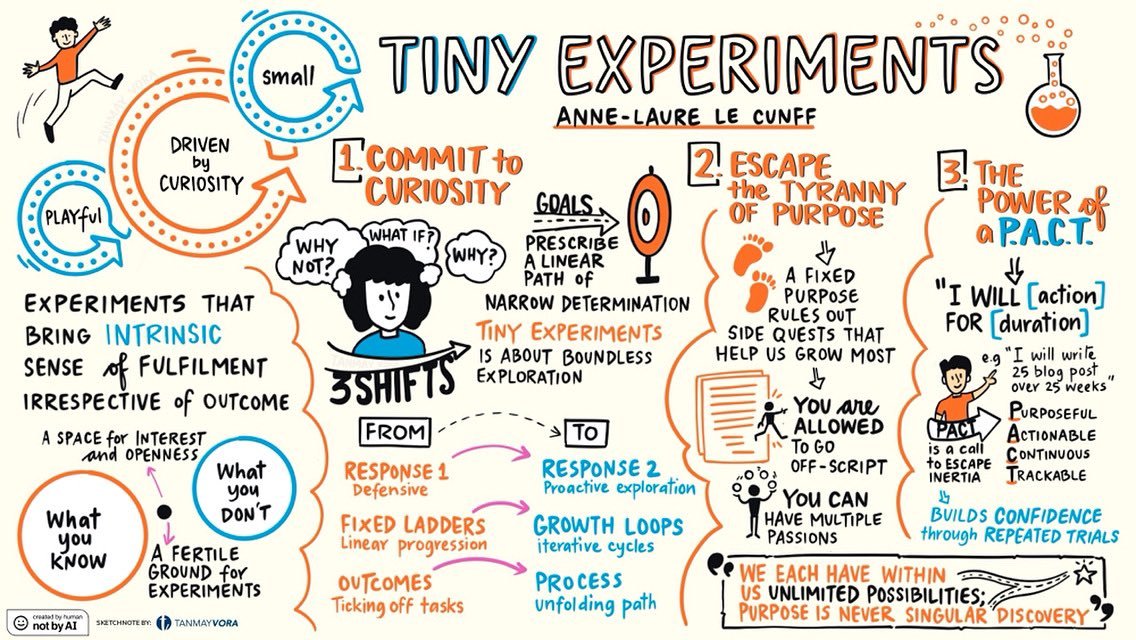
I have long been an advocate of the power of small tests of change, so I am reading "Tiny Experiments", a new book by @neuranne. Some of the key ideas:
1) Systematic curiosity over linear goals: We always have the potential for growth & learning even in uncertain situations. This approach contrasts with traditional goal-setting, which can be rigid & limiting.
2) Unlearning "cognitive scripts" (internalised patterns). By questioning these scripts, we can discover new possibilities & paths.
3) Designing tiny experiments: Small, manageable experiments that allow for flexibility and adaptation. This encourages continuous learning & improvement without the pressure of fitting into predefined notions of success.
Book review by Matt Rutherford: https://t.co/ZhyTGKmaJb
Summary by @sobrief_ : https://t.co/w6zPyoECAB
Sketchnote of key concepts by the brilliant @tnvora.
Workplaces where people are engaged do significantly better in productivity & performance. If we want to build better staff engagement, we need more conversations, not "engagement campaigns".
Too often, leaders who want to improve staff engagement build “campaign-style” interventions: analysing levels of engagement, having listening sessions, broadcasting messages & creating dashboards. Yet engagement isn’t a tool or a project - something you can "install" top down. It’s a daily, ongoing practice, rooted in the rhythms of conversation.
The single force that shapes day-to-day engagement more than any other is line managers. (In the NHS, it is the frontline leaders, around band 7 level, who line manage >60% of the NHS workforce & who have an outsized influence on NHS productivity & performance). Consistent, authentic dialogue between managers & teams creates the psychological safety people need to speak up, take risks & challenge the status quo.
If we want better engagement, we need to support front line leaders to develop skills for conversation-based leadership & build in routines that enable regular conversations to happen: https://t.co/54Wk1FfDXS. By Kyle Jones on @Medium, via @LauraJYearsley.
✨ LAST CHANCE TO BOOK ✨
Spinal Injections in APP
Tuesday 13th May 8.00-9.30pm
👉 https://t.co/MA5QME3jgI
Join us for an insightful webinar designed for focusing on the intricacies of performing spinal injections within the NHS. Led by an expert panel.