We’re almost 9 months into 2026, with just 3 months left.
I was going through my journal this morning and realized I’ve only made around 35 closed entries this entire year, outside of my current 13 holdings. A few years ago, that number could’ve easily been 200+.
Yet with far less activity, I’m sitting close to +90% YTD.
The biggest change has been learning to think longer term with more patience and discipline - find the right themes early, own the strongest businesses, get the technicals + fundamentals right, build a good cost basis, size appropriately, and then give the thesis enough time to play out.
I can’t emphasize enough how big of a role discipline has played in my journey. Finding a great stock is one thing. Having the discipline to sit tight and let it work is another.
Semiconductors were easily my biggest win this year.
I positioned in the theme early and gave those positions time to work:
$MRVL +173%
$ARM +155%
$MU +146%
I realized significant gains across several semiconductor names while continuing to hold a few leaders in the theme.
And another major lesson: position sizing matters.
Many of my winners started around 5% and naturally grew into 10-15%+ positions as the stocks appreciated. Most of my losing positions were around 2-3%, or generally less than 5% of the portfolio, so when I was wrong, the impact on the overall portfolio remained relatively small.
During the June/July pullback, I started positioning into software, crypto, newer semiconductor names and a few other themes that I believe have long-term potential.
The more I refine my framework, the more I realize: Less is more. I’ve evolved into a position trader and long-term investor. I’d rather own the right leaders, sit through normal volatility, let the fundamentals compound and give the bigger trend time to play out.
You don’t build outsized returns by making more decisions. You build them by making the right decisions and having the patience to sit tight.
@ProblemSniper I did read about it, it's moderately positive now for CRCL, not a nail in the coffin? Am I understanding it wrong? That's what I am asking
If you’ve ever felt something essential is missing in men’s lives today, this book names it and shows a path forward.
Taboo: The Lost Codes of Men by Martin Brossman
Advanced Node Equipment & Materials – backbone of AI chip manufacturing
One of the core themes behind HBM and advanced nodes, and not talked about often.
These companies supply the tools, subsystems, and materials needed to manufacture AI chips at 5nm, 3nm, and beyond. They don’t design chips - they enable their production.
Advanced AI chips require far more process steps, materials, and inspection than older nodes. This increases consumables, subsystems, and testing per wafer, driving higher revenue for suppliers.
Key drivers:
- More process steps means more tools, filters, gas delivery, and inspection
- Higher material intensity means more specialty chemicals and consumables
- HBM and advanced packaging means massive increase in inspection and packaging tools
- Global fab expansion means every new fab needs a full equipment stack
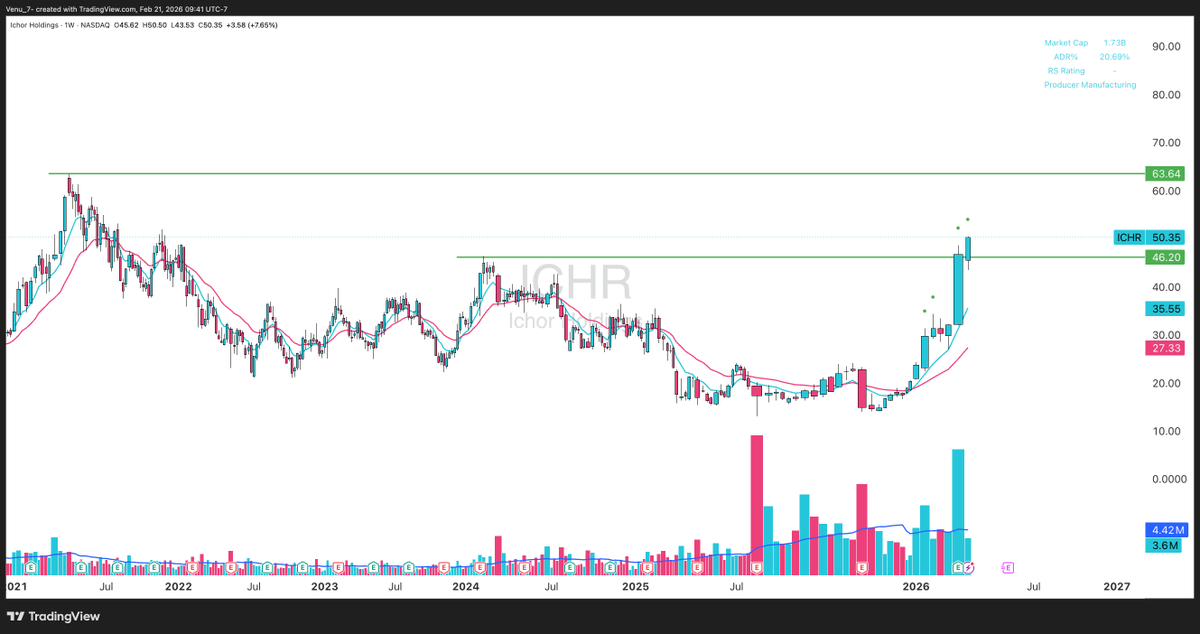
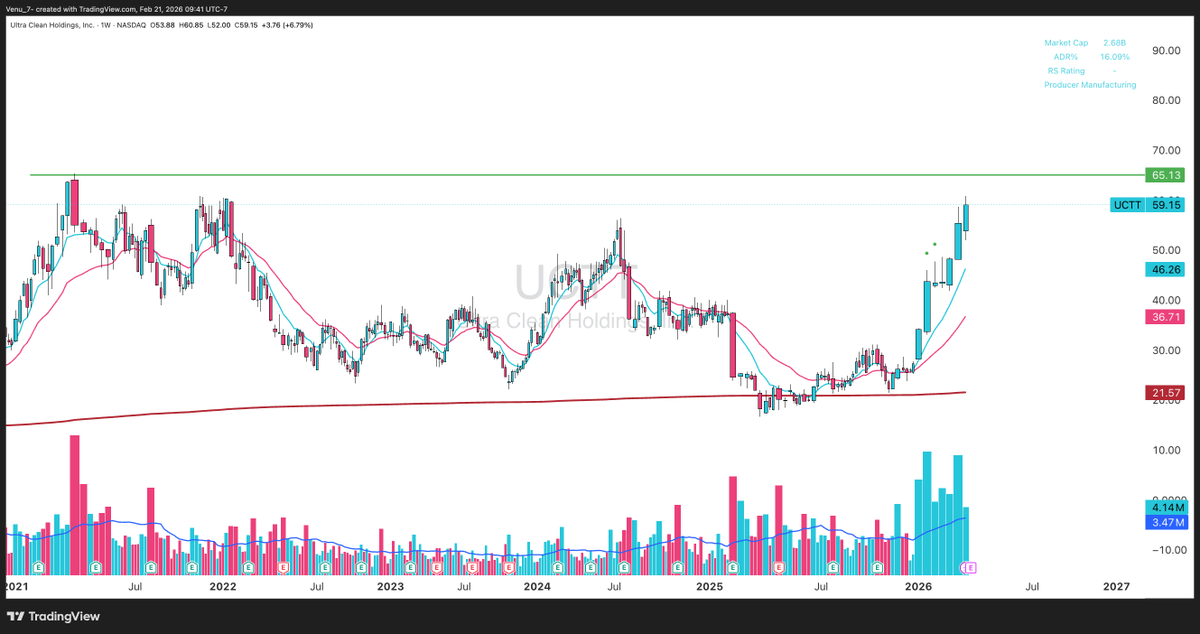
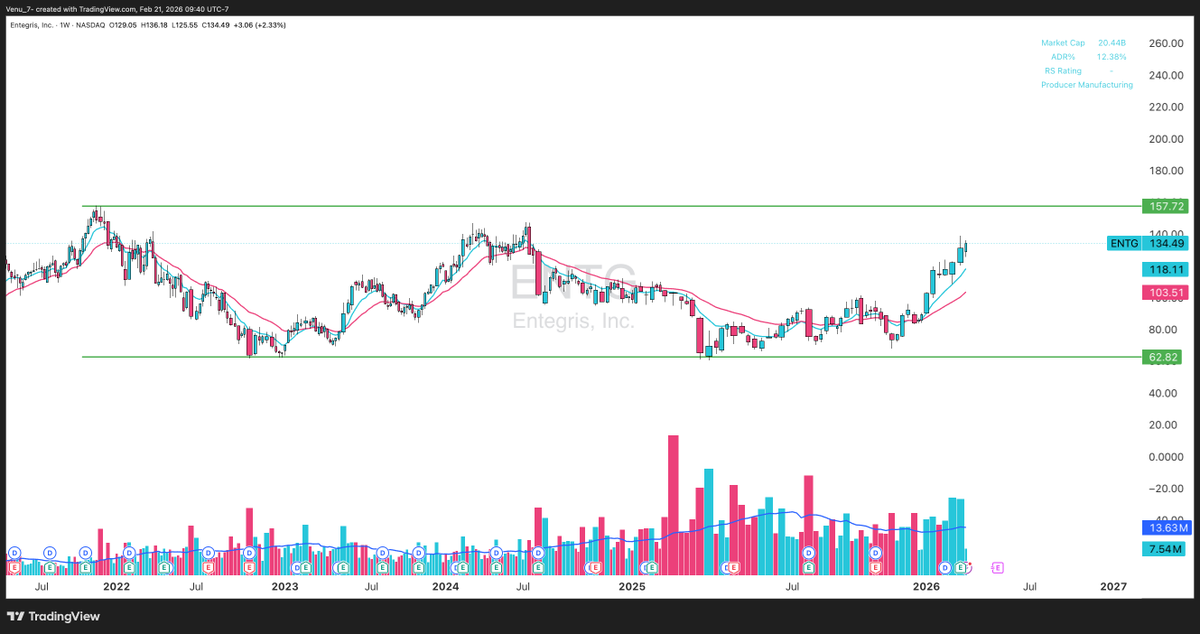
Companies like $ENTG, $UCTT, $ICHR, and $ONTO benefit regardless of which chip company wins, since all advanced chips rely on these suppliers.
Fun fact: all four of these names are setting up multi-year breakouts, and the real move hasn’t started yet.
Even though the markets have been incredibly choppy
New leaders and emerging themes continue to show through the cracks
Drones:
$UMAC
$KTOS
$ONDS
$RDW
$RCAT
Aerospace:
$AVAV
$LUNR
$GE
$LMT
$RKLB
$FTAI
Datacenter:
$NBIS
$WULF
$HUT
$CORZ
$CRWV
Fiber optics:
$LITE
$COHR
$AAOI
$GLW
AI Hardware:
$OSS
$LPTH
$FN
$ASML
$Q
Uranium:
$UUUU
$CCJ
$DNN
$UEC
These are the strongest sectors in the market...
Every pullback can be used as a buying opportunity.
From countless discussions, I see two camps forming around how disruptive and profound AI’s impact will be.
Those in complete denial, oblivious to what’s coming
Those who hype every development like it’s the end of jobs or entire industries
The truth is complicated. It’s somewhere in between, which deserves a deeper conversation. It’s not black or white.
The scale at which things are happening is beyond comprehension. I say that as someone in the industry, seasoned enough, yet I can barely keep up. And I can honestly say a ton of people in the industry are also feeling the same.
Nope, a 15-year-old some vibe-coder won’t be able to vibe code a Salesforce or ServiceNow.
But a couple of motivated, seasoned, and structured engineers who truly understand what "AI-native" means and are willing to move fast and break things, absolutely can.
An engineering leader who knows how to run an agent farm with 100s of subagents, orchestrating them via clear markdown specs, vetted test cases, then directing the agents to run for days if not weeks, iterate, and self-correct from failures can build what used to require a 50-person team.
This is the part people miss. The disruption isn’t "AI will be killing software", but the disruption is that the unit economics of building software are permanently getting reshaped.
It doesn't mean that smart people won't be needed anymore. Companies will always need bright minds. What changes is what those people spend time on and how much output a small, sharp team of humans and agents combined can ship. It's literally night and day.
If a strong engineer with the right tooling is 5-10x more productive (conservative number), then a team of 5 can do what a 30-member team did two years ago (heck, 6 months ago).
That doesn’t automatically mean 25 engineers immediately become unemployed. It means the surface area of what’s buildable explodes. Features that sat in backlogs for years can ship in weeks. Projects that were shelved due to cost and resource constraints will suddenly be getting re-prioritized.
We’re in the early stages of a shift as significant as the industrial revolution. Well, as corny as it sounds, it's just a fact. The way software gets built is reshaping at the foundation level from "Code-First" to "Objective-First"
The businesses that will win won’t be the ones with the most engineers or the most users. The winners will be the ones with staff who can break problems down into specifications, write precise guardrails, and design systems where humans handle tradeoffs, direction & judgment, while letting the agents handle throughput.
“Specification” becomes the product moat. The best engineering leaders are spending more time writing precise, modular & well-defined specifications using markdown than writing actual code. In many workflows, the spec effectively becomes the code.
This isn't toy code that sits in a sandbox, I mean production-grade, ready to click the "go live" button quality code. The people who win will be the ones who can define the work clearly, then apply their domain expertise and judgment to steer favorable outcomes.
Humans have evolved through several disruptions, and it's time to evolve once more.
If you’re an Investor, save this:
Here’s what you need:
- Weekly chart
- 21 Week EMA ( short term view )
- 50 Week SMA ( medium term view )
- 200 Week SMA (long term view )
- Market previous reversals/ highs with Horizontal support lines
It is that simple.
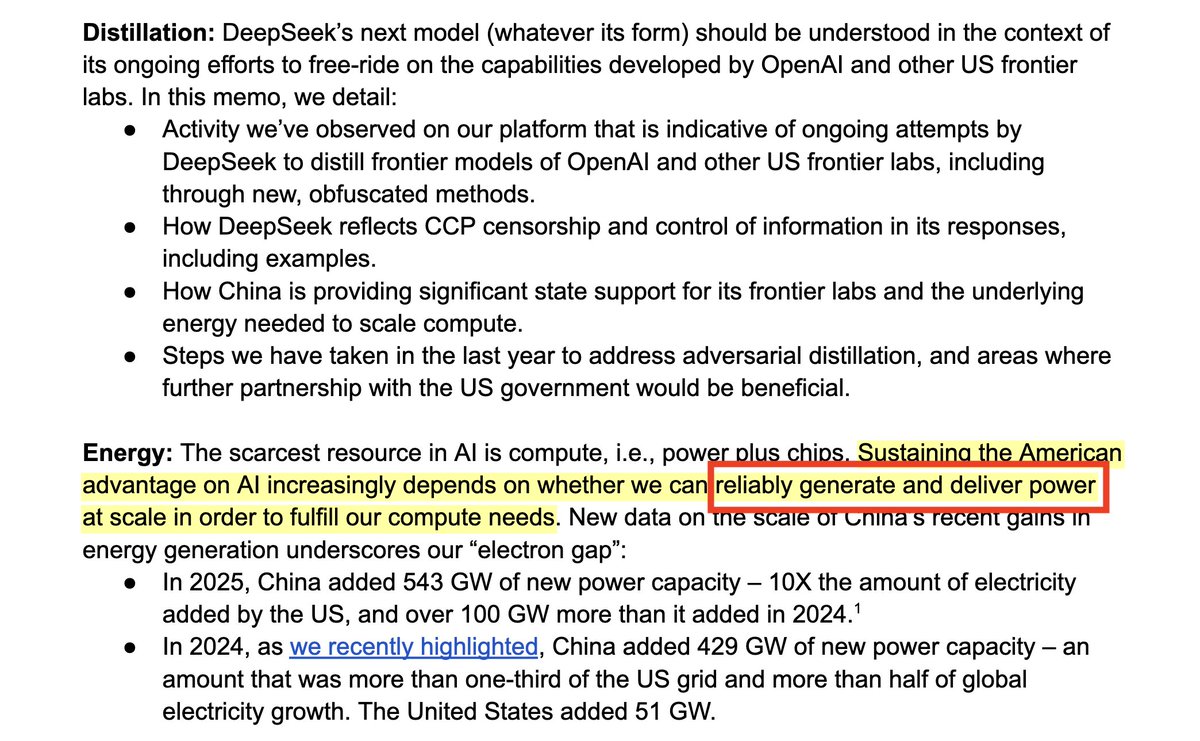
OpenAI sent a memo to congress regarding Deepseek distillation:
"Sustaining the American advantage on AI depends on depends on whether we can reliably generate and deliver power at scale."
Power Delivery - $VRT, $ETN, $PWR, $WMB, $KMI
Tier-1 Energy Providers: $CEG, $VST, $TLN, $GEV, $NEE, $BEPC, $D
Grid-Energy / Storage - $TSLA, $FLNC, $NRGV, $BE
Energy: $TE, $FSLR, $NRG
This is a tailwind reiterated for these companies.
And there's a second-order tailwind for companies that already secured GW capacity like $IREN, $NBIS, $WULF, and $CIFR.
The core issue of the memo was around IP theft and national security issues. But the largest warning about sustaining an advantage was Energy.
OpenAI warning Congress that in 2024, China added 429 Gigawatts (GW) of new power capacity, which was more than a third of the entire US grid and more than half of global electricity growth. Without a radical expansion of the American power grid, they believe China’s "brute force" energy buildout will eventually allow them to surpass Western AI capabilities.
Photonics, Advanced Packaging, and Memory are three fastest growing bottlenecks right now. However, OpenAI explicitly warned the U.S. government that whoever generates the most power wins the AI race.
Their message: Invest in American Energy.