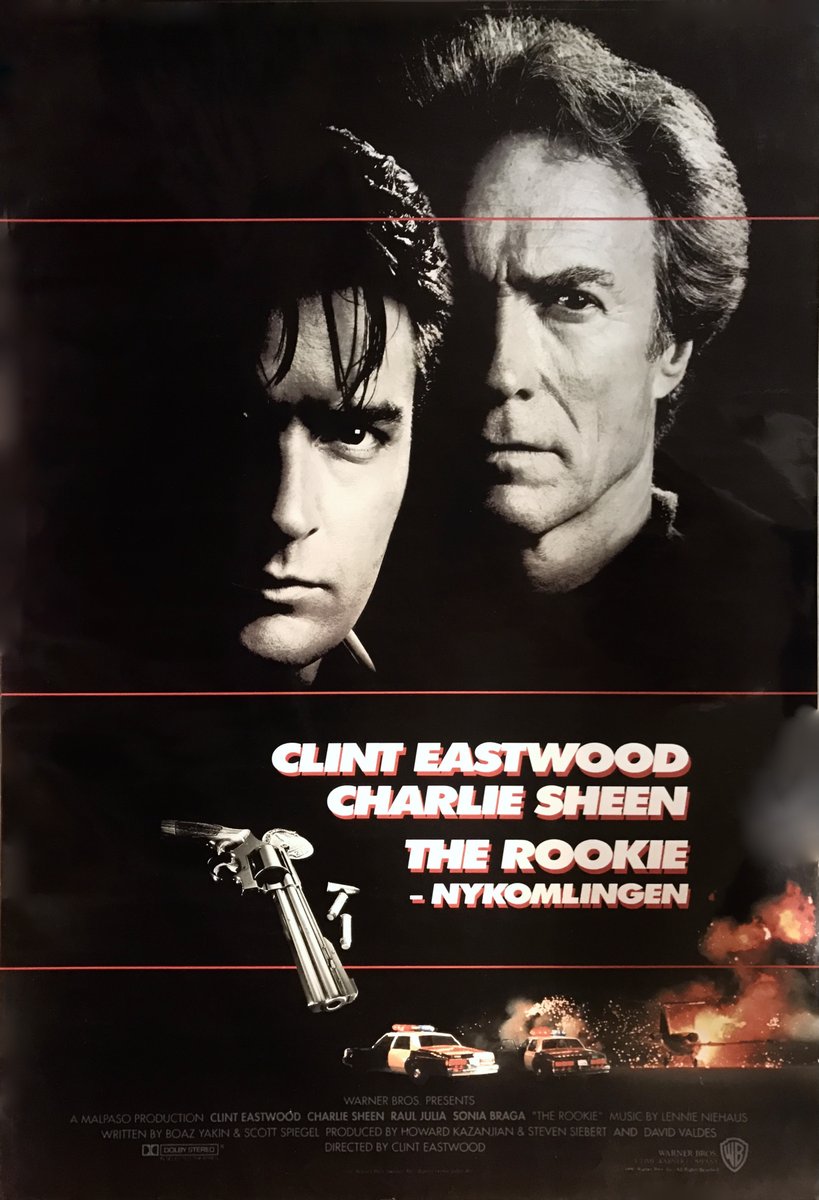
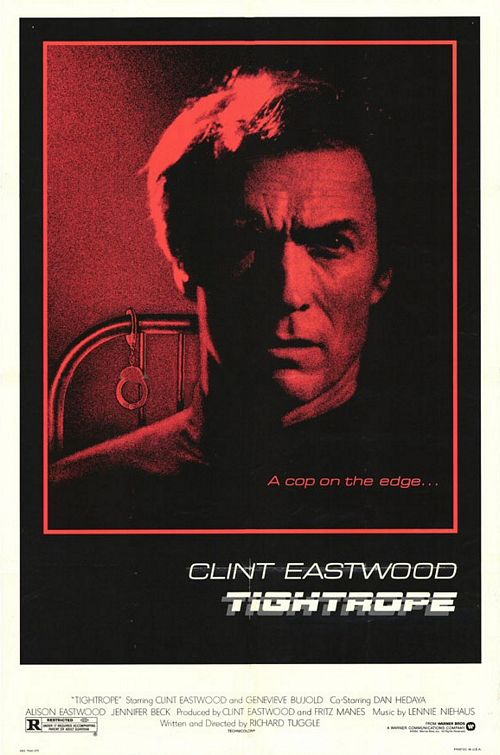
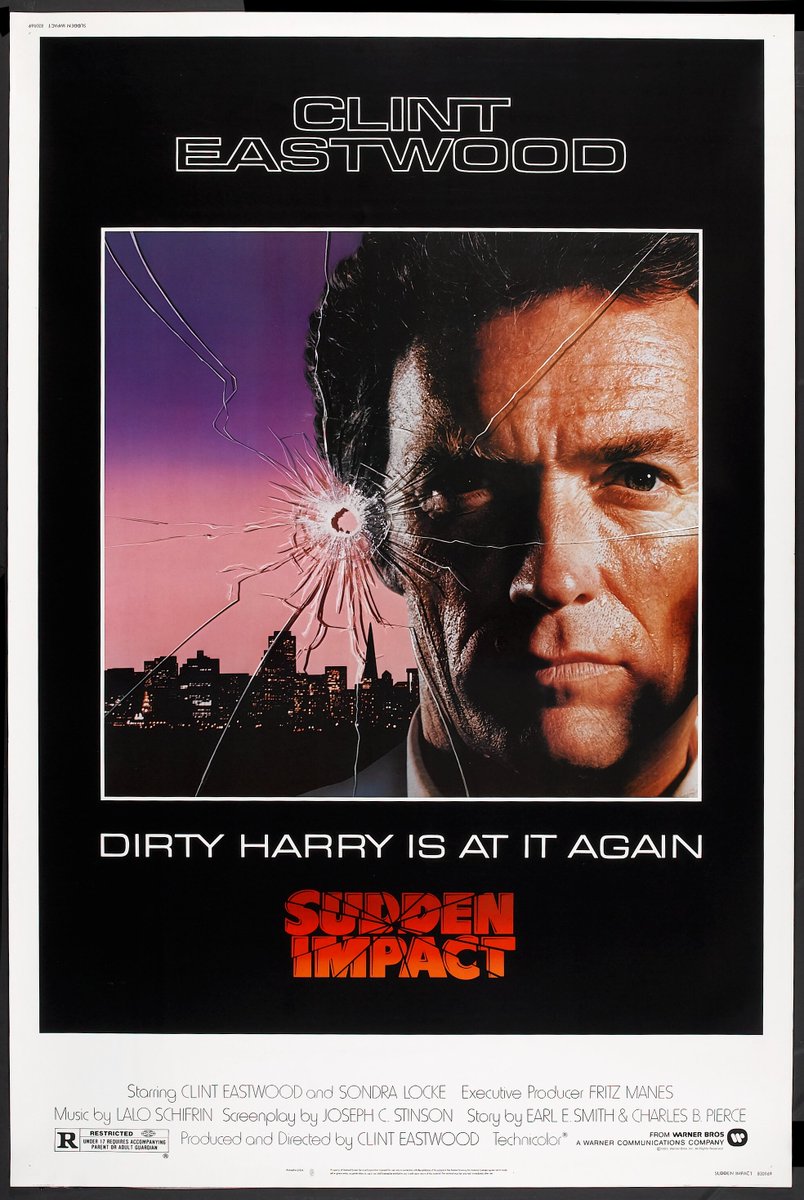
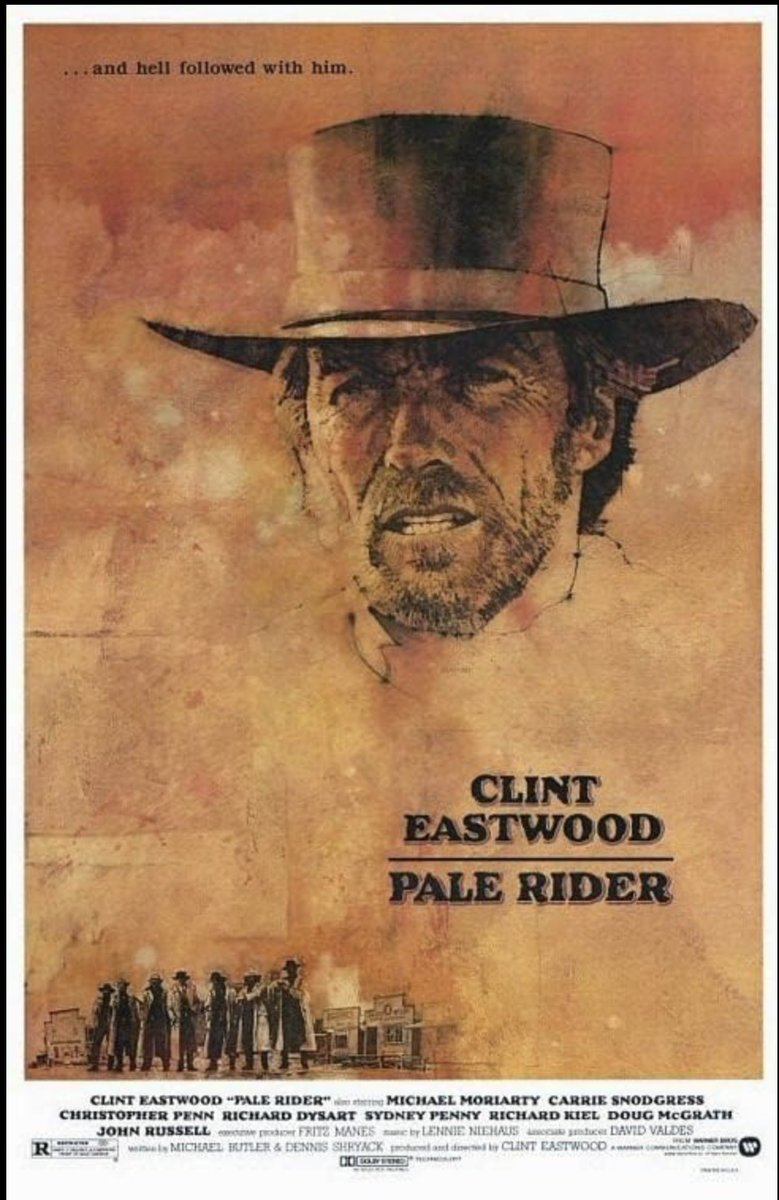
For a bunch of years, I did work for the famous movie poster designer Bill Gold. One of his clients was Clint Eastwood. I worked on a ton of posters for his movies during that time. Some below. Clint knew what sold his movies- his face big on the poster- and this was before computers so we would get stock shots of Clint and design posters around them- using paint, bleach and dye and stripping images and airbrushing effects and so on... when we did not just use illustrators like with Pale Rider. Part of the job was designing a bunch for different countries as well. Clint always hand picked the posters he liked best and they - again- were the ones with his head the main focus.
The Sudden Impact poster - I remember this one well- I had a shot of Clints head, cut it out, sanded the edges of the back of the photo, stripped it on a color airbrush background I did using paint, softened the edges of the hair by hand, then stripped a cityscape in the background and hand painted the bullet hole and crack working from a photo and then drew the cracks with black and white paint and colored dyes over Clint's head, indicating shadows. If you look close you can see the paint...but the illusion was there- again, before computers took that job away. The collar and jack are obviously airbrushed. The sweat and lighting on the face done with Dyes and a brush. The Tightrope one, we had a photo shot of the handcuffs on a bed post-stripped it to the background and so on- all of these are photo composite with some retouching except for pale Rider which was an illustration.
Paolo Sorrentino’s cinema, much like his characters, always navigates between contemplative melancholy and hedonistic joy.
To celebrate his 56th birthday, we’ve put together this visual tribute through the magic of 'The Great Beauty', 'The Hand of God', and ‘Parthenope’ 🇮🇹✨
Rewatching the movies you love is one of the best things you can do to improve your life. People seem perplexed by the idea of rewatching something. Imagine listening to a great song only once. Absurd.
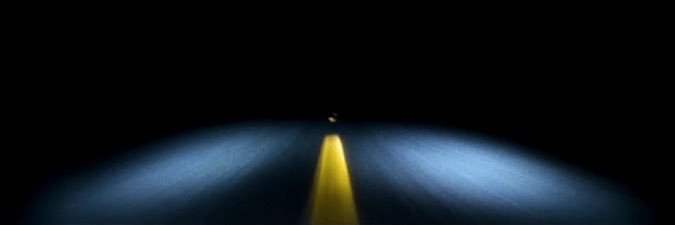
Michael Mann couldn't shoot Collateral on film. The cameras couldn't see Los Angeles at night the way he wanted. So he picked a digital camera no other major Hollywood movie had used. The crew was still building parts for it during the shoot.
Mann was chasing a specific look. Around 10 or 11pm in LA winters, a low cloud bank drifts in off the ocean and settles about 1,200 feet up. The orange sodium streetlamps below light up the bottom of those clouds and turn the whole sky into a soft, hazy glow. Mann said it looked like winter in England.
Movie film couldn't see that. To shoot a single downtown block clearly, the crew would have had to bring in massive lights and brighten up entire streets just to make the buildings visible. Even with the lens open as wide as it goes to pull in any available light, almost nothing outside the foreground would stay in focus.
The camera Mann picked was the Thomson Viper, brand new and not really ready for production. There was no memory card or storage inside the body. It had to be plugged into a separate hard drive with a cable.
About 80% of Collateral was shot digital. The other 20% on regular film was mostly the Korean nightclub shootout, where the bright club lighting gave the crew plenty to work with.
The coyote scene only exists because of the digital camera. Mann didn't plan it. A small pack of coyotes wandered across an empty street between takes, and because the camera could see in near-darkness, the crew just rolled. On film, that shot would have required lighting up the whole intersection first.
The helicopter shots over the city work the same way. Palm trees against the night sky, the downtown skyline lit only by the city's own light. On 35mm film, none of that would have shown up.
The movie cost $65 million to make and earned $220 million worldwide. It won Best Cinematography at the BAFTAs, the British version of the Oscars, and helped push Hollywood toward digital cameras for night shoots.
One catch. That orange light Mann chased is mostly gone now. Starting in 2009, LA began replacing its sodium vapor streetlamps with white LEDs. By 2013 the city had swapped out 141,000 of them. Today the lighting system is 98% LED. The Los Angeles you see in Collateral doesn't exist anymore.
Mikkelsen concedes it’s something “I won’t watch too many more times in my life” due to its raw power, but that didn’t prevent him from declaring 'Come and See' to be “an absolute masterpiece”. 🎥👇
The release of "The Long Good Friday" (1980) was delayed due to political fears. Having been made in 1979 for £900,000 with backing from Black Lion, a subsidiary of Lew Grade’s ITC Entertainment behemoth, the film hit festivals in 1980, but was delayed when Grade and others balked.
There were concerns that the IRA might blow up cinemas that screened it, and another version was prepared with the Irish references and violence heavily excised.
Additionally, out of fear that Americans wouldn't understand Bob Hoskins' accent in "The Long Good Friday" (1980) & as they thought Brummie accent would be better, an actor from Wolverhampton had dubbed Bob Hoskins' lines in the movie. Hoskins was incandescent when he found out about it.
Hoskins and others members of the crew threatened to sue. A great list of people including Richard Burton, Alec Guinness, and Warren Beatty were ready to stand as expert witnesses. According to John Mackenzie, Grade organisation feared the bad publicity and didn't want to annoy establishment figures like Guinness. So they agreed to sell it to Handmade Films. Because of this fiasco, the released of the film was delayed well over a year.
("Hanging around in the hood: the legacy of The Long Good Friday", The Guardian, 2000 & "The uncanny predictions of The Long Good Friday", Lou Thomas, BFI, 2015)
P.S: On this day, 46 years ago, "The Long Good Friday" (1980) premiered in Cannes, France.
Actor William Petersen telling the story how he and William Friedkin pulled off the famous escalator run in TO LIVE AND DIE IN L.A. after being told by the airport liasion they were forbidden to do the stunt 🔥 very cool - watch the clip at the end
Guillermo del Toro on Thomas Vinterberg's "Another Round" (2020):
"It’s extraordinary to see a movie that moves you, that affects you, the way this one did to me. I wanted to say something: The title in Danish [‘Druk’], and the title in English, both are very, very beautiful.
In English, it’s because ‘Another Round’ means all these characters are going to get another round at life, and the other is about binge-drinking, the original title, but it is the same thing: Can we get intoxicated with life? Can we take it again?
The final scene is one of the most extraordinary things I’ve seen on film ever. It truly captures something that is lightning in a bottle."
("Mads Mikkelsen Talks to Guillermo del Toro About Playing Drunk in ‘Another Round’", Ryan Lattanzio, Indiewire, 2021)
In 2001, Hugh Jackman delivered the most realistic computer hacking scene in film history. To this day, it is used for training at the Cybercrime Division of the FBI.
DePalma films are a perfect crash course on how a movie should look, how a camera should move, how scenes should be blocked. Its incredibly how fluid they feel compared to today's incredible stagnant Hollywood films.