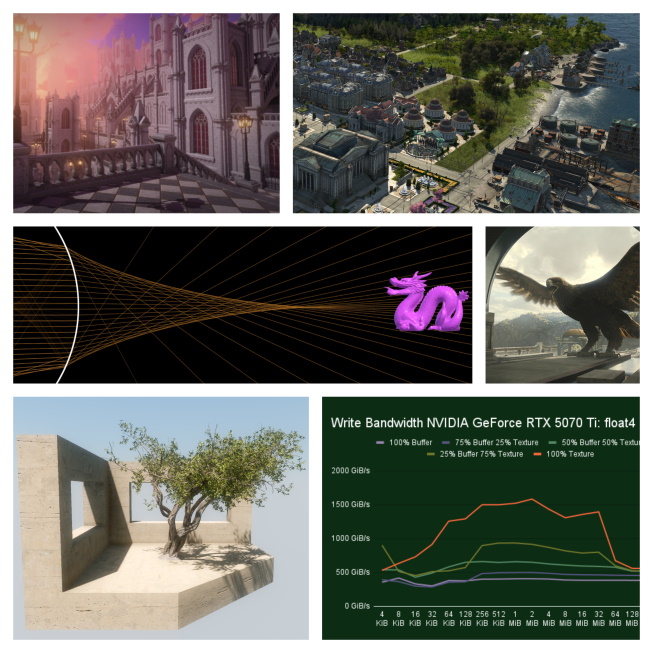
Disney Animation has a bunch of talks at #SIGGRAPH2026; each day I'll post a thread about our talks for the day! In total my coworkers and I are presenting a total of 10 talks. Here are the talks my coworkers are presenting Sunday/Monday:
(1/10)
https://t.co/yrXhNPJcbe
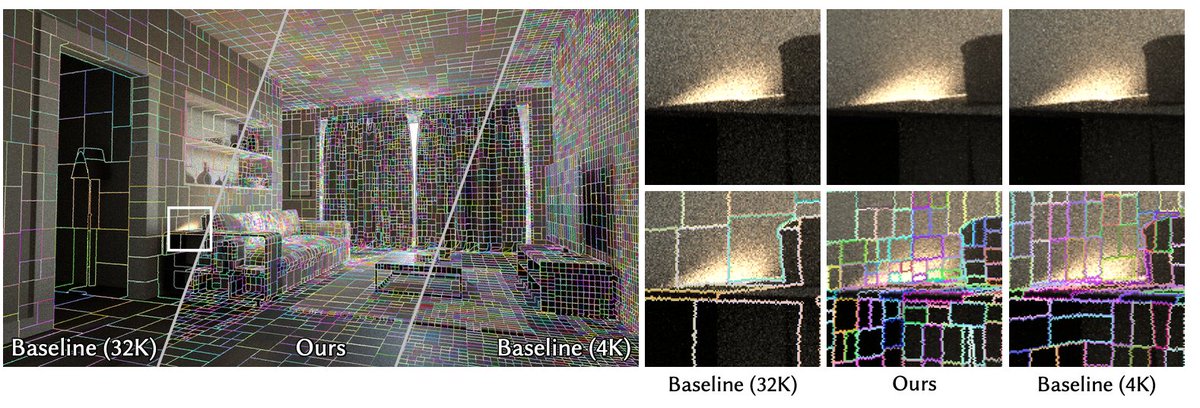
Third paper: "Illumination-Aware Spatial Subdivision for Path Guiding" by Zheng et al.
Path guiding is a technique where renderers learn indirect illumination distributions during a render and use that learned representation to continuously improve sampling... (12/17)
In this thread: three cool rendering papers that DisneyResearch|Studios is publishing at EGSR this week. The authors of these papers are peers that I get the privilege of working closely with frequently, and these are projects I've been excited to watch develop! (1/17)
It isn’t the point of this project, but looking at the triangulations made me think about some GPU optimization esoterica.
Everyone knows “triangle count” has an impact on performance. Graphics programmers also know that the ordering of the triangles can also make a significant difference, and integrate mesh optimization tools.
For the special case of planar figures like these, total triangle edge length can become the distinguishing performance characteristic. GPUs work with 2x2 blocks of pixels so they can generate derivatives for texture sampling and shaders. At triangle edges, they still usually have to do calculations for complete 2x2 blocks, regardless of whether 1,2,3, or 4 pixels in the block are actually needed. Long, skinny triangles can require over double the fragment shader invocations that area-maximizing triangles do.
Consider triangulating a circle: the obvious way is to make a single triangle fan, but you can reduce the total edge length by inscribing a polygon inside the circle and only fanning out from that to the circle. Slightly more vertex work, but less fragment work.
There probably isn’t any real world case where this would be a crucial optimization, but having an “optimization worldview” means always noticing the tradeoffs.
For context on the air conditioning debate between the US and Europe...one must consult the ancient texts:
1. Anything that is in the world when you're born is normal and ordinary and is just a natural part of the way the world works.
2. Anything that's invented between when you're 15 and 35 is new and exciting and revolutionary, and you can probably get a career in it.
3. Anything invented after you're 35 is against the natural order of things.
-- Douglas Adams
Here’s a cool talk from GPC 2025 on the architecture of Blender’s Cycles renderer. There is no one right answer to designing a renderer; as a rendering engineer, I really like seeing how different renderers choose different tradeoffs to meet user needs:
https://t.co/yPqsw2gP4u
Path tracing will save development costs, as traditional techniques require so much more engineering and (tech) artist effort. Iteration time will also improve as light baking is not required. I understand the advantages.
However, 80% of the gamers today don't have hardware capable of running path tracing well enough. It's not possible to abandon traditional techniques yet, since most of the gamers will need them.
This game is a perfect example of modern path tracing workflow. Developer saves costs and increases their iteration time, but the game looks very bad on older hardware when path tracing is disabled. Even basic features such as shadows (local lights) are missing. Only top 20% hardware sees the real game, 80% of the gamers see a massively downgraded version. I don't think this is the correct choice today. Devs switched to new tech too soon. Consumers don't yet have hardware to run this tech properly.
Hi Twitter... have a video update for once, after all my talk about tech, optimisations, bugs, etc.
Perfectly seamless portals with accurate physics, rendering and collision.
Long objects half sticking through double sided multi-entry portals... who needs that? Me, apparently!
I ranted a bit about 90s rendering tricks and techniques. Looking at Tomb Raider (III). Hat tip to the amazing developers behind this. Hope you all enjoy. :-) https://t.co/grsXXZALdq
This is a reminder that every diagram from my book Projective Geometric Algebra Illuminated is available on Wikimedia Commons under the CC-BY-4.0 license. They can be freely used in slides, papers, books, Wikipedia articles, etc., with proper attribution.
https://t.co/r9dUSDlr6n
EGSR'26 Call for Papers is out!
Doing research on rendering? Physics-based, neural, stylized... Submit your work to EGSR!
Papers deadline: April 8th 2026
https://t.co/FBsuahA1eP
Computer graphics community must be so weird to outsiders. Everybody is just posting literally the same image of the same scene, and everyone else is congratulating them
it has been 12 hours since openai announced o1 and it has so far failed to to solve
- Riemann hypothesis
- Quantum Gravity
- FTL (Faster Than Light travel)
- P=NP
- Grand Unified Theory
- Cure for cancer
clearly this shows ai has hit a wall and openai is about to go bankrupt