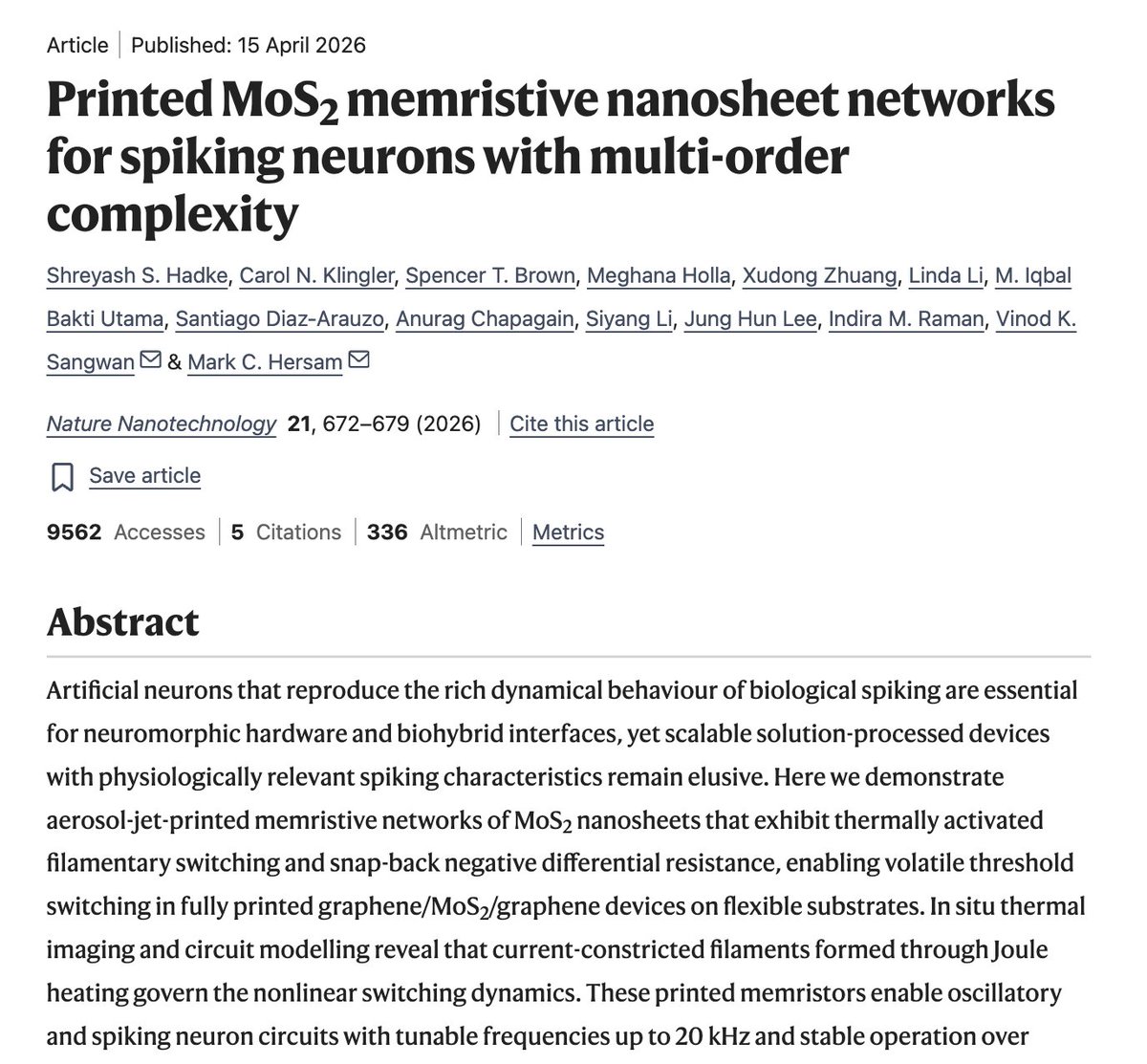
Scientists 3D-printed artificial neurons and plugged them into a mouse brain.
And real neurons responded like they were talking to each other.
Researchers at Northwestern University just published a paper in Nature Nanotechnology that sounds like pure science fiction.
For years, we’ve been trying to make AI mimic human brain cells in software.
These researchers did it in hardware.
Using MoS2 memristive nanosheets, they printed synthetic spiking neurons. These artificial cells process information with the same multi-order complexity as the ones inside your head.
Then, they ran the ultimate test.
They placed these synthetic neurons next to living, biological brain cells.
And they communicated.
The printed artificial neurons successfully sent signals back and forth with the living tissue. The biological cells couldn't tell the difference.
This changes everything we know about brain-computer interfaces.
Right now, technology like Neuralink relies on rigid electrodes to read brain signals.
This paper proves we don't need metal probes. We can print synthetic neurons on demand and seamlessly integrate them into the nervous system.
The applications are massive: Rebuilding damaged spinal cords. Curing neurodegenerative diseases. Direct cognitive upgrades.
But the implication is terrifyingly simple.
Uma estudante de 16 anos criou um aparelho que apaga o fogo usando SOM, sem água ou produtos químicos. A invenção conquistou uma medalha de ouro na Indonésia.