22 years technical SEO. Now AEO/GEO practitioner - getting brands cited
by ChatGPT, Perplexity, Google AI Mode, Claude. Reggio Emilia ◇ Italian-
Nigerian.
Andrej Karpathy spent 8 years at OpenAI and Tesla
Last week, he put everything he knows into one free 2-hour lecture
People pay $15K for bootcamps that teach half of this
You probably don't have 2 hours right now
Don't let this get lost in your feed
Watch it, then read the guide below and build your first loop.
Google just dropped a free 2-hour course on complete agent engineering
How to turn one prompt into a system that keeps running while you sleep:
38:46 - Build your first AI agent
54:46 - Connect agents to MCP tools
1:12:43 - Run four different agent loops
1:20:57 - Turn those loops into graphs
2:22:31 - Build the complete autonomous system
Most people are still building one agent and stopping there
Google is already teaching the entire stack:
Agents → Tools → Loops → Graphs → Autonomous Systems
Single agents are the old workflow
Systems that keep running without you are the new one
This free course is worth more than most paid agent engineering bootcamps
Bookmark and watch it today
Then read the full graph engineering playbook below
Ten million people have watched an MIT professor accidentally destroy the executive coaching industry.
He filmed the lecture once in January 2018 and died eighteen months later.
Executive coaches charge fifteen thousand dollars a session to teach a third of what he covered in one hour for free.
His name was Patrick Winston. He ran the MIT Artificial Intelligence Laboratory from 1972 to 1997 and wrote the AI textbook every computer science major in the world read for thirty years.
Every January for four decades, he gave a lecture called "How to Speak."
His entire framework fits on a napkin.
Do not read. Be in the image. Keep images simple. Eliminate clutter. Start with an empathetic connection. End with a punch line the audience can repeat over dinner. Never open with a joke. Never end with "thank you."
That last rule alone has probably cost the executive coaching industry a hundred million dollars.
"Your success in life will be determined largely by your ability to speak, your ability to write, and the quality of your ideas. In that order."
That is the actual opening line of the lecture. Winston believed it strongly enough to spend fifty years teaching computer scientists how to talk.
Founders spend $80,000 on an MBA and then hire a communications coach to teach them the same material Winston filmed once for free. Engineers write brilliant code and lose promotions to teammates who watched this lecture on the train.
The lecture is free on MIT OpenCourseWare. The textbook is free on his page.
Winston died in 2019. Almost none of the ten million viewers have actually implemented the four rules on the napkin.
The napkin is free. The willingness to actually use it in your next meeting is the entire edge.
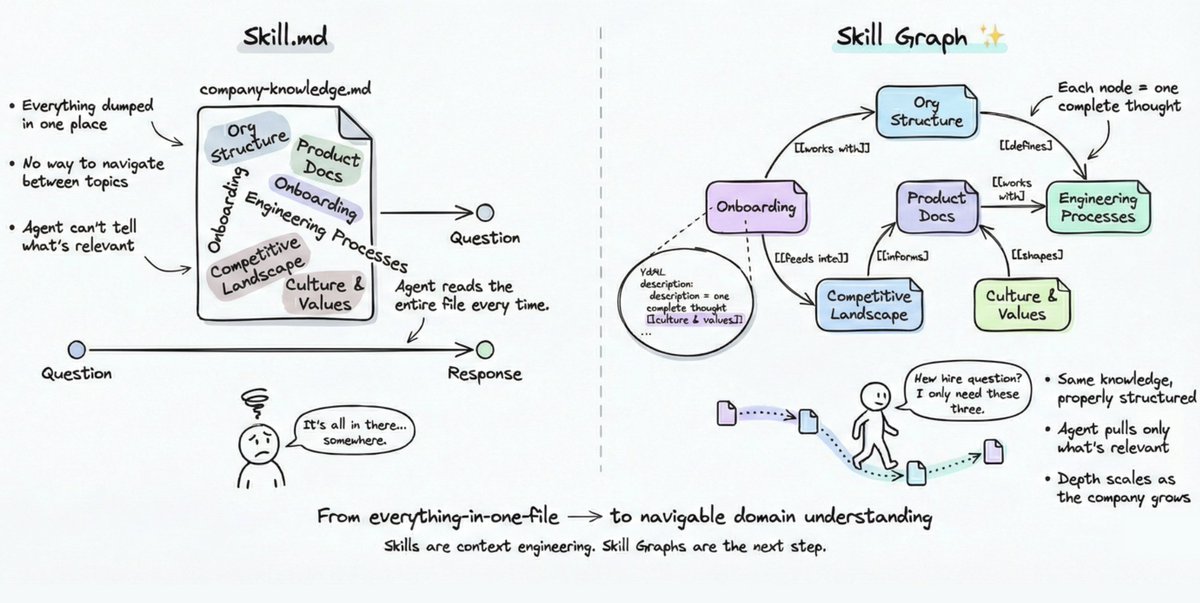
Skill Graphs > SKILL .md
Everyone's talking about skills for AI agents.
But almost nobody is talking about how to structure them.
Right now, the default approach is simple. You write one skill file that captures one capability. A skill for summarizing. A skill for code review. A skill for writing tests.
One file, one job, and it works.
But I recently came across an idea that made me rethink this entirely.
What if skills weren't flat files? What if they were graphs?
Let me explain what I mean.
Think about how a senior engineer onboards you to a large codebase. They don't hand you one giant document and say "read this." They give you a map. They point you to the right modules. They explain how pieces connect. Then they let you go deeper only where you need to.
That's the mental model behind a skill graph.
Instead of one big file, you build a network of small, composable skill files connected through wikilinks. Each file captures one complete thought, technique, or concept. The links between them tell the agent when and why to follow a connection.
Here's what changes with this approach.
The agent doesn't load everything upfront. It scans an index, reads short descriptions, follows relevant links, and only reads full content when it actually needs to. Most decisions happen before reading a single complete file.
Each node is standalone but becomes more powerful in context. A "position sizing" node in a trading skill graph works on its own. But link it to risk management, market psychology, and technical analysis, and now you have context flowing between concepts.
And suddenly, domains that could never fit in one file become navigable. Company knowledge. Legal compliance. Product documentation. Org structure. All traversable from a single entry point.
The building blocks are surprisingly simple.
Wikilinks embedded in prose so they carry meaning, not just references. YAML frontmatter so the agent can scan nodes without reading them. Maps of content that organize clusters into navigable sub-topics.
Markdown files linking to markdown files, and nothing more.
If you want to dig deeper or try building one yourself, check out arscontexta. It's an open-source plugin that sets up the structure and helps you build skill graphs with your agent.
I have shared the link in the next tweet.
Not all AI agents are built the same. So what sets them apart?
Here’s a breakdown of 10 core types of AI agents you’ll come across in real-world systems, from simple reactive agents to complex multi-agent systems.
1. Task-Specific AI Agent
Built for one focused task like summarizing or translating. It follows a fixed process with no learning or adaptation.
2. Reactive Agent
Responds to immediate input without using memory or history. Think of it like a reflex - it reacts, not plans.
3. Model-Based Agent
Builds an internal map of its environment. Simulates outcomes before acting to make smarter, context-aware decisions.
4. Goal-Based Agent
Starts with a goal and works backward. It plans steps, simulates paths, and selects the route that achieves the goal.
5. Utility-Based Agent
Chooses actions based on how beneficial they are. It weighs all options and picks the one with the highest value.
6. Learning Agent
Improves over time by learning from past actions. Adjusts its strategy using feedback and stores new knowledge.
7. Planning Agent
Focuses on long-term strategy. It defines a goal, maps out steps, and adjusts based on progress not just reaction.
8. Reflex Agent with Memory
Uses preset rules but with added memory of past inputs. Helps respond better when situations repeat or evolve.
9. Multi-Agent System Agent
Works with or against other agents. They share environments, negotiate roles, and coordinate to reach a bigger goal.
10. Rational Agent
Always selects the most logical option. It analyzes the full picture, predicts outcomes, and chooses the smartest path.
Save this if you're exploring Agentic AI or designing intelligent decision-making systems.
Agentic Context Engineering
Great paper on agentic context engineering.
The recipe:
Treat your system prompts and agent memory as a living playbook.
Log trajectories, reflect to extract actionable bullets (strategies, tool schemas, failure modes), then merge as append-only deltas with periodic semantic de-dupe.
Use execution signals and unit tests as supervision. Start offline to warm up a seed playbook, then continue online to self-improve.
On AppWorld, ACE consistently beats strong baselines in both offline and online adaptation. Example: ReAct+ACE (offline) lifts average score to 59.4% vs 46.0–46.4% for ICL/GEPA. Online, ReAct+ACE reaches 59.5% vs 51.9% for Dynamic Cheatsheet.
Paper: https://t.co/AZRZe0axlI
@karpathy In this era of AI, anything that cannot easily integrate with LLMs will rapidly disintegrate into irrelevance. Pay attention, devs! Keep this in mind when building software, especially those relying on complex UIs these days.
GitLab is offering IT courses for people looking to learn Git, DevOps, Agile Management, Technical Writing, Security, and more.
Open this to access them (save for later) 🧵👇