My faith is that Nigeria will succeed in my life time and I am committed to be a part of that success through my actions, encouraging and supporting everyone who is committed to making Nigeria work for every Nigerian.
I pray for the peace & wellbeing of Nigeria & Nigerians.
In nonreciprocal address, the TLN is used to the person of higher status and the FN to the person of lower status.
One form expresses both distance and deference; thr other form expresses both intimacy and condescension.
TLN --- Title Last Name goes with distance or formality
FM --- First Name goes with a slightly greater degree of intimacy.
TLN expresses both distance and deference
FN expresses both intimacy and condescension.
Thomas E. Murray
Communication risk management....
How did this video get to the public?
Did the Communications team review it first before sharing?
A lot to learn from a seemingly trending topic.
Hope we are taking lessons on why Africa struggles with Democracy.
Culture says leaders are not accountable to their followers.
Democracy says leaders are accountable to their followers.
So you have Democrats by system but Tranditionalist by Culture.
Internal conflict!
@_Mavericklad@ganXE@Oluwadunnii I worked there briefly 15yrs ago....I can't really remember the policy again but surely, we haven't read the last of this.
It is going to cause some institutional changes around --- the company snd country.
More to come.
True!
But it is confusion.
They have to address is in a manner where people are not using common sense to interpret the policy.
Do we want first-name or not?
This is partly why Africa struggles with Democracy.
Culture is stronger than strategy.
@ganXE@Oluwadunnii Could it have gone either way?
What if there is a first name basis
They were taught so in training school
She saw the Chairman and decided to manifest what she was taught
Because doing otherwise could also mean she didn’t learn anything.
Case of Culture eats Strategy!
@kennygee_70 Fair enough.
May be one of their teachings in training school is the principle of "First Name basis..."
But, I agree that it is better to err on the side of being too respectful than be put on the spot for being uncultured.
The difference between Culture and System.
Our Culture primes respect. Our System says we are flat and on a first name basis.
So there is conflict - both can't coexist.
We have to choose one - Culture or System.
Neither is good/bad.
Coexistence is a disaster.
One of the lady graduating from UBA banking school said “Good Morning TONY” and Tony Elumelu corrected her immediately
As much as I understand she was supposed to say Good Morning Sir without mentioning his name
But I think it was the training they gave them to address people with their first name
She was supposed to know when to draw the line
Organisations should realistically live within their culture.
If your Culture primes Respect as a critical factor in human relations, it is counterproductive promoting "First name basis".
As a professional, when in Rome, by all means be a Roman.
There are organisations that say we on "First name basis...."
The MD is cool with that and ever free, but there are a few that you dare not address by their first name.
That's Confusion!!!
The wise ones adapt and give to Caesar what is Caesar's --- but many run foul!
Nigeria Consumer Price Index
○ Urban National Index
○ Rural National Index
○ Headline Index
○ Food Index
○ Non-Food Index
○ Core Index
○ Imported Index
○ Goods Index
○ Services Index
○ Energy Index
○ All Items Less Farm Produce Index
○ Farm Produce Index
Nigeria’s tertiary institutions admissions crisis is bigger than just “not enough spaces.” Every year, millions of Nigerians compete for a place in tertiary institutions.
But even when spaces are available, many still do not make it through the admissions process. So who gets in? Who gets left out? And why?
Our inaugural policy brief, The Admissions Gap, takes a closer look at what is happening inside Nigeria’s tertiary admissions system and makes 5 evidence-based recommendations to @profsegunaina, Registrar of @jamb_hq, ahead of the 2027 UTME cycle.
We think Nigerians should read this.👇
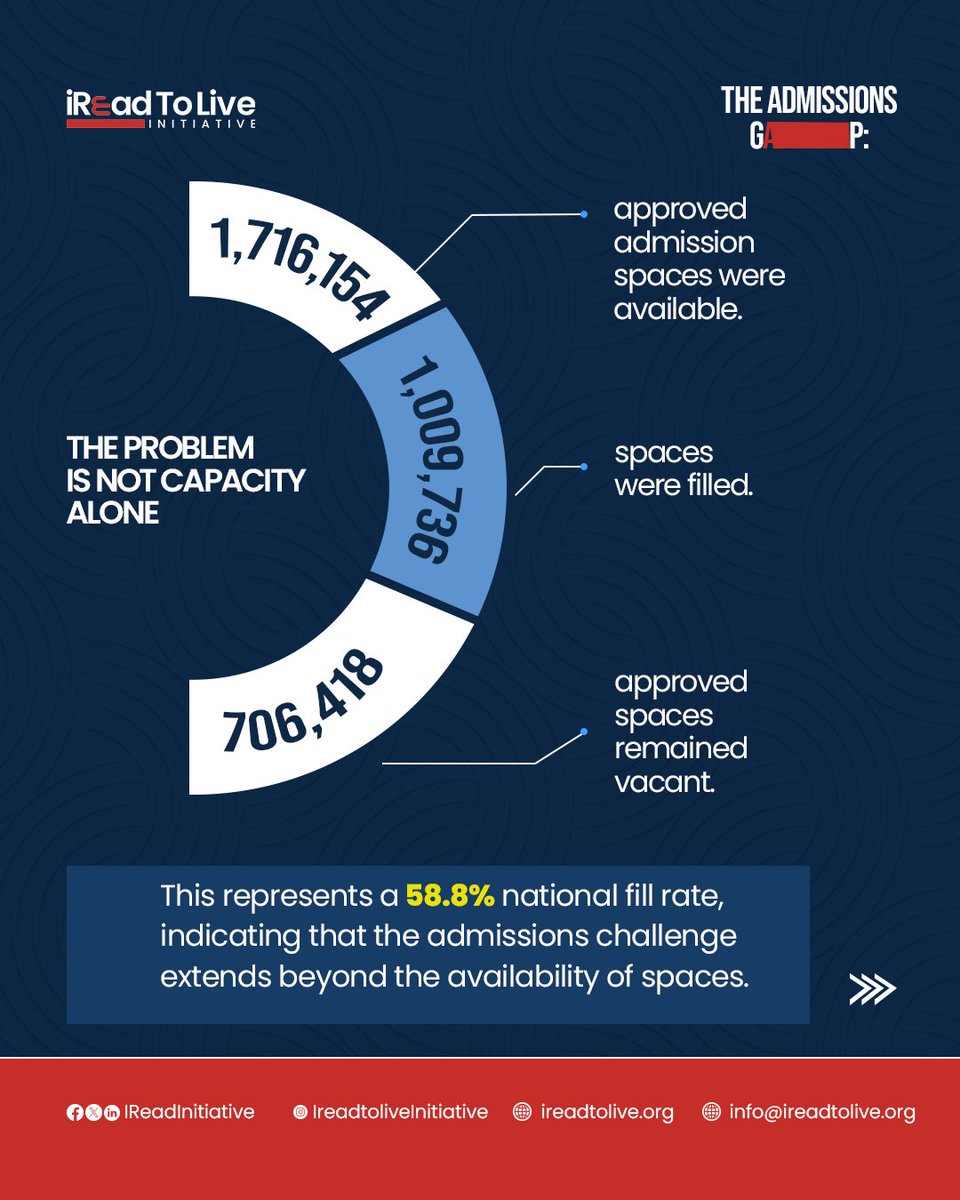
In 2025, 706,418 approved admission spaces went unfilled. Let that sink in!
While in 2026, 2.24 million candidates registered for UTME. Interestingly, Nigeria’s admissions challenge, therefore, may not simply be about a shortage of university spaces.
The 2025 data shows a 58.8% national fill rate. So the question we should be asking is: Why are available spaces not translating into admissions?
We examined the evidence in this brief…