@PersimmonTI Quite interesting to explore the FAERS data.
Everyone should draw their own conclusions, but seeing more death events than cumulative other adverse events for Rasonque one might think that they are rather due to the disease than the drug.
I think it is because discovery is the easiest to build a hypothesis of a scalable platform around.
A platform that churns out dozens of best in class molecules is closer to scalable tech business cases. Everything in clinical development and commercialization requires quite a lot of human interaction that seems harder to automate/scale with AI. (I cannot send my AI agents to ASCO to talk to the important KOLs in the field)
@EganPeltan I had the same feeling. Even in biostats which should be much easier to verify numerically I am often surprised about the kind of reasoning errors the models make for subgroup analyses, denominators for adverse events, or even survival analyses.
Absolutely. And I am not against virtual cells/digital twins in general. I just think that it is a cheap answer when people state it as the direct solution to solve the clinical trial bottleneck.
But there are lots of great companies working in that space that will move the field forward.
They just started and I agree, we still need to see what kind of data they will be able to offer and what kind of validation they will have for data quality.
And as with every startup there is also a chance that it will lead nowhere. But let's see what they will have to offer in a year.
Not too many people in the traditional biotech space are interested in building something in the CRO space. I think it's a good thing that newcomers are trying and I hope they will succeed.
@daphnezohar@gama_search Would be interesting to watch them moving from preclinical work to highly regulated clinical trials and suddenly having to deal with all those requirements.
Antropic. Please consider creating 100x value of DepMap/TCGA if you are serious about radically changing drug discovery. Or profile 10 million compounds for Tier 1 ADME.
The problem seems more in IP law that makes protecting anything but the molecule very hard and uncertain.
Already today we see plenty of me-too drugs as soon as a first-mover derisks a target in the clinic. AI will certainly exacerbate this problem but it is a failure of today's system.
We might think about whether the Amgen vs. Sanofi ruling that restricted broad genus claims covering a class of molecules for a given target will still be appropriate once AI gets to a point where one can easily design a me-too drug.
@AndrewE_Dunn Probably a bit harder to find those people, but getting insights from founders of previous successful virtual biotech (e.g., Alkeus) and how it was back then to run a virtual biotech would be very interesting as well.
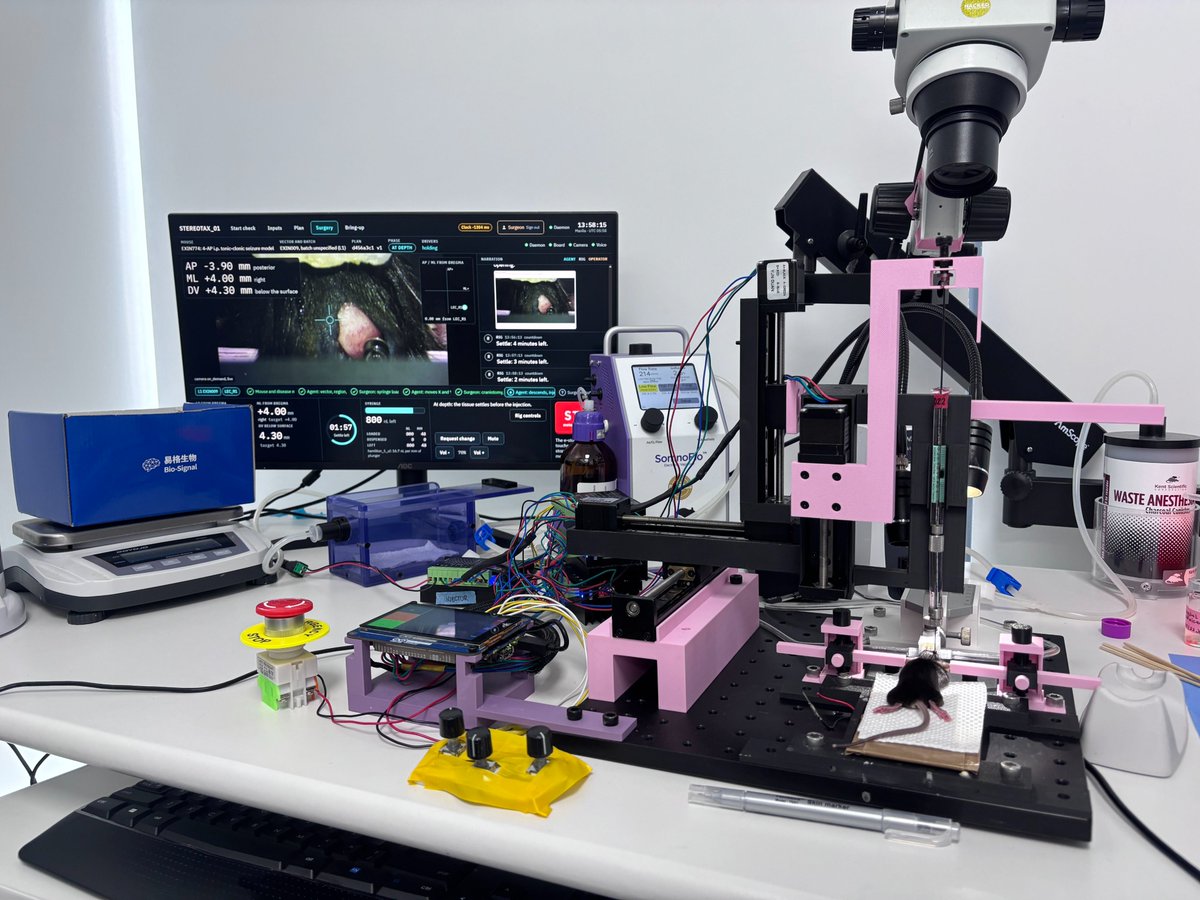
Last night an AI agent performed brain surgery on a mouse.
We gave it 19 gene therapy vectors in a spreadsheet, a mouse model of epilepsy, access to a motorize surgery rig with cameras and one goal: reduce seizures.
It picked the drug. It picked the brain region. It derived the coordinates from three papers. Then it drove the stereotaxic arms into the brain and injected 250 nanolitres while watching the entry site through the rig camera for bleeding.
A licensed vet gated every irreversible step and held a physical kill switch to stop the AI agent.
Thread on what it decided, what it saw, and the moment it refused to let me override it.
[Writing this on the spot out of excitement, but I've been 18hrs in front of my laptop coding and coordinating this, so keeping it brief and descriptive, more cohesive thoughts on this soon...]
@Sculpturatus The PD-1/PD-L1 hype in oncology already led to a similar situation in the past. Back then it was suggested that regulators might ask sponsors to share patients in their trials.
https://t.co/V2u73Ln5KV
https://t.co/9jxggkDhU5
Big pharma going after cheap Chinese copies, me toos, 2 less injection/year YTE and conditions that can be fixed with lifestyle changes or discipline to most extent. AI companies trying to find new molecules for new diseases. 🤷♂️