Walk-Off Labs builds tools that help baseball teams turn data into actionable insights. We combine statistics, ML, and game theory to give you the edge.
Manager Carlos Mendoza of the @Mets has taken some heat lately for platooning MJ Melendez against lefties by replacing him with the right-handed Austin Slater. In their series against the @Angels this last weekend, Slater pinch-hit for Melendez twice and struck out both times. I put our player projection model and the lineups for both of these games into our game-theoretic solver to see what it had to say.
The first scenario came in the top of the 6th inning with lefty Brent Suter on the mound. The Mets were losing by 3 runs, but Melendez was the tying run at the plate with no outs and runners on first and second. After considering all possible future plate appearances and substitutions for the rest of the game, the solver calculated that Slater for Melendez at this exact time was optimal (+0.5% win probability). The reasoning becomes clear when you look at their respective histories. Despite the fact that Melendez is off to a hot start (0.297 average and 0.906 OPS), he has yet to face a single left-handed pitcher this season. And his history against lefties over the last couple years is not pretty (13/81=0.160 average with 1 HR compared to 88/428=0.206 average with 19 HR against righties). On the other hand, Slater has a history of batting fairly well against lefties (especially in the HR category), despite being a below average hitter overall.
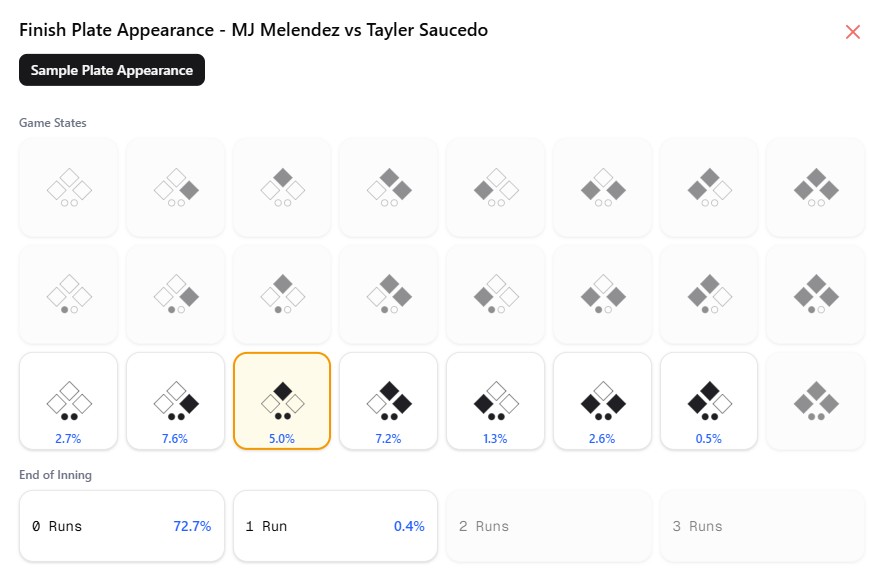
The second scenario came in the top of the 7th when the Mets had a 1 run lead. Melendez was up to bat with 2 outs, a runner on 2nd, and lefty Taylor Saucedo on the mound. Again, the solver preferred Slater over Melendez (+0.6%). However, the best option according to the solver was to actually bring in Francisco Alvarez for Melendez (+1.2%) followed by a defensive substitution / switch with Slater coming in for Luis Torrens. Here is what our player projection model believed about each of these players in this scenario:
Melendez - 27.3% chance of reaching safely, 17.0% chance of scoring the runner
Slater - 37.6% chance of reaching safely, 20.1% chance of scoring the runner
Alvarez - 39.8% chance of reaching safely, 21.5% chance of scoring the runner
In addition to the current plate appearance, the solver also took into account all possible future plate appearances. Despite being preferred over Melendez by the solver both times, Slater struck out twice. However, it is hard to look back and say that means Mendoza made the wrong decision. After all, all three of these batters had over a 60% chance of getting out because that is just what generally happens in baseball.
What would you have done?
#GameTheory #Mets #CarlosMendoza
The Ohtani rule (allowing the @Dodgers to have 14 pitchers on the roster) is a little strange, but it's not clear if or when @MLB will change it. In the meantime, should other teams use it to their advantage?
For a player to be able to pitch without counting as a pitcher on the roster, they need to meet these requirements in the current season or one of the previous two seasons:
• Pitched at least 20 Major League innings
• Started at least 20 Major League games as a position player or designated hitter, with at least three plate appearances in each of those games
The only thing preventing teams from designating all of their pitchers as two-way players is the second requirement. But if a team is already out of the playoff race, is there any reason to not have one (or two or three) of their pitchers start 20 games at DH in order to get extra pitcher roster spots for the next two years?
Think about it. A team who is already out of contention just has to send a pitcher out there to strikeout 60 times, and now they have a free extra pitcher spot for two full seasons. And there is nothing stopping them from doing this with multiple pitchers. Granted, you probably don't even want 15 pitchers on the roster because it means only 11 position players but think about what would happen to a pitcher's trade value if they didn't have to count as a pitcher.
That being said, if teams actually tried this, MLB would probably close the loophole. But at least then it would force MLB to address the advantage being given to the Dodgers. And if they don't fix it right away, you now have the same advantage for yourself.
What are your thoughts? Should someone be trying this?
#MLB #OhtaniRule #TwoWayPlayer #Counsell
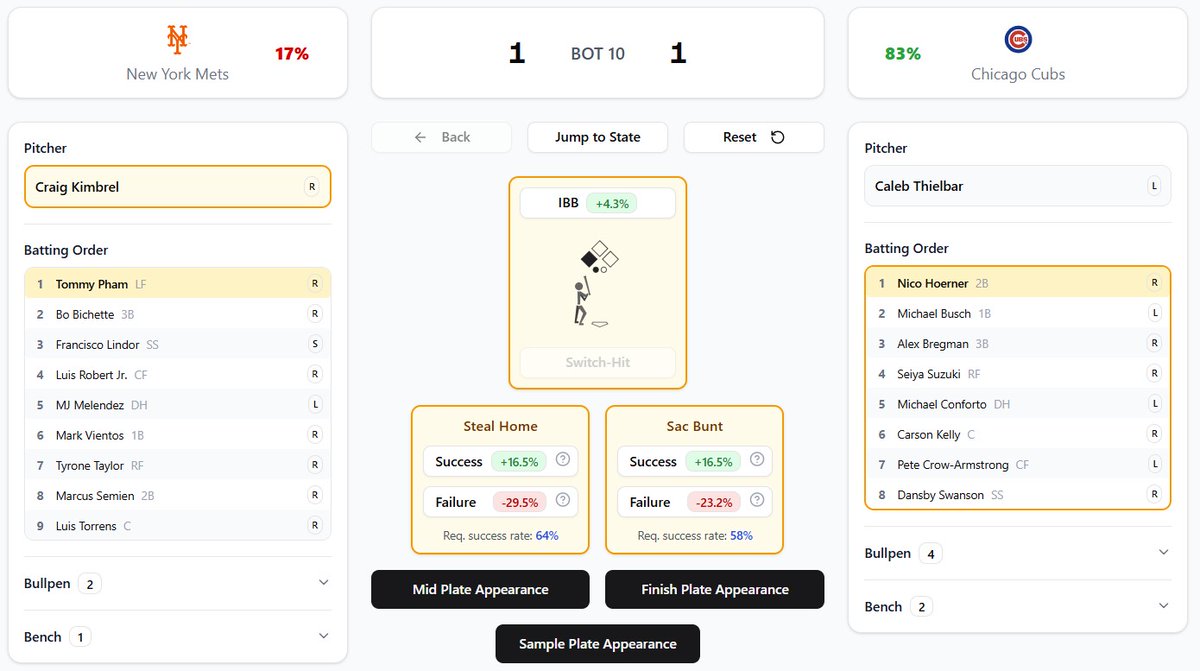
The @Mets lost their 11th straight in the series finale against the @Cubs yesterday. It was a well-fought battle from both teams, going into extra innings. With the game tied in the bottom of the 10th, one out, and PCA on 3B, Nico Hoerner hit a walk-off sacrifice fly. Many fans wanted manager Carlos Mendoza to intentionally walk Hoerner in order to face the struggling Michael Busch and create the possibility of a double play. In a post-game interview, Mendoza said he did not do this because if you put Hoerner on first, "they're gonna take second base." I entered our player projection model and yesterday's lineups into our game-theoretic solver to see how this logic holds up.
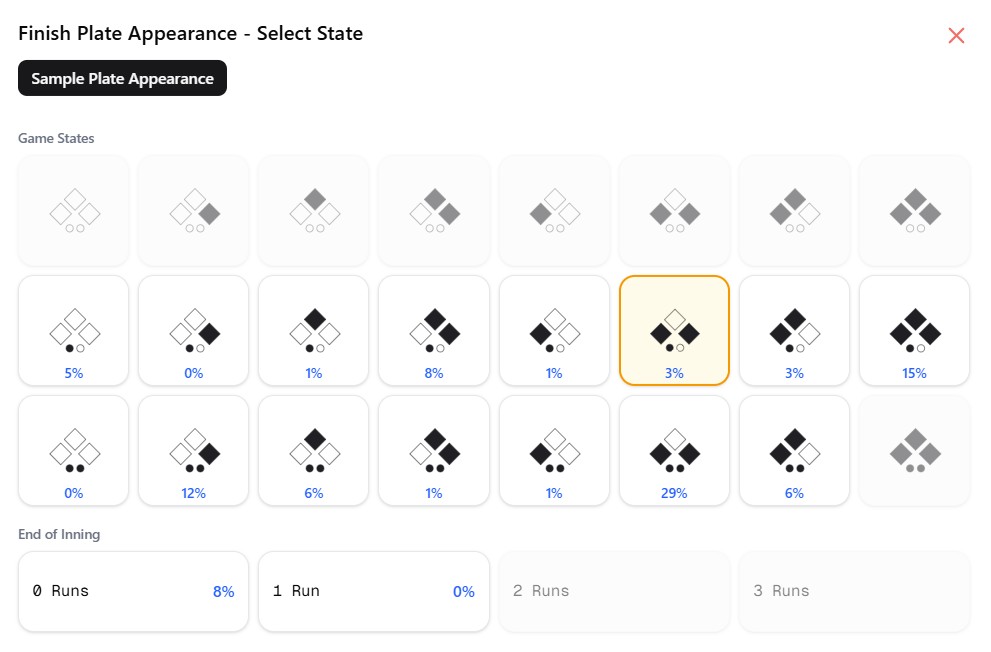
As many Mets fans suspected ... it doesn't. With Hoerner up to bat, there was a 53% chance that PCA was scoring on that play (25% that it came from a sac fly or ground out, which it did). The solver calculated that not walking him lost 4.3% win probability by deviating from the Nash equilibrium. No disrespect to Mendoza, but I have never seen the solver request an intentional walk so aggressively. For perspective, Shohei Ohtani led the league in win probability added last year, averaging +3.6% per game. So this single decision was more consequential than an entire game of having Shohei on your team.
To test the claim about Nico stealing second, I had the solver consider the hypothetical where they did walk him. It is true that Hoerner would have liked to have stolen second (+1.7% win probability). But if he had been caught stealing it would have been -19.0% win probability. This means he would need a 92% success rate for the attempt to be worth it (not likely).
But let's say he had a 100% success rate and that by walking Hoerner, you are guaranteeing that he will make it to second base. What's crazy, is the intentional walk would still have been worth +2.6% win probability (not as valuable as Shohei, but as valuable as Jose Ramirez). That's just how much more dangerous Hoerner was in that scenario than Busch. So as hard as it may be for Mets fans to hear it, there was zero excuse for letting him take that at-bat.
The attached images are the intentional walk scenario, the hypothetical stolen base scenario, the Nico Hoerner expected outcome distribution, and the hypothetical Michael Busch expected outcome distribution.
What are your thoughts?
Edit: I'm noticing a lot of discussion about loading the bases with a second intentional walk. The solver wanted to face Busch, not walk him. However, if Busch got out, it wanted to walk Bregman in order to make it to the pitcher slot in the order.
#Mets #GameTheory #CarlosMendoza #IntentionalWalk
The @Reds had some really cool management in their win against @Twins yesterday that I want to break down using our game-theoretic solver.
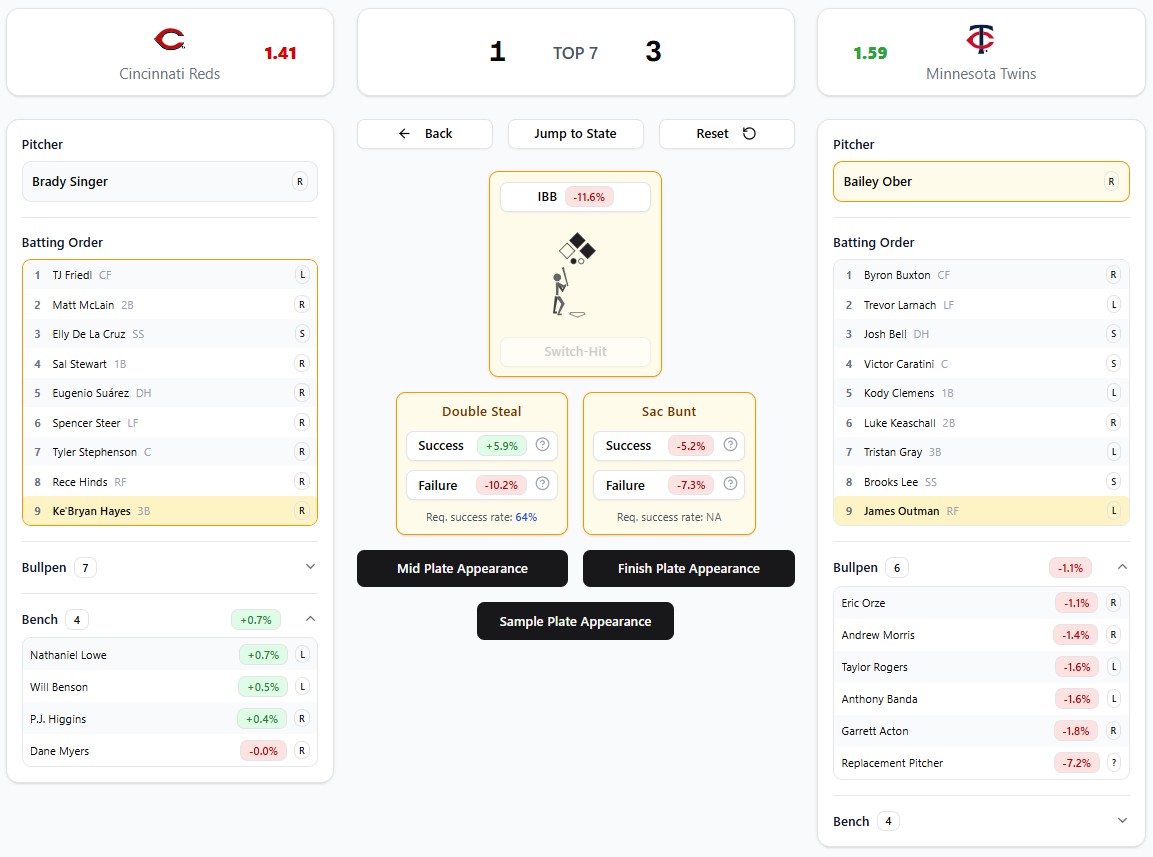
In the top of the 7th with one out and Spencer Steer on first base, Bailey Ober was on the mound facing Rece Hinds. Even though this was a right-on-right matchup that generally favors the pitcher, the solver requested to bring in lefties Taylor Rogers or Anthony Banda. This is probably because Hinds hasn't reached based against a lefty since 2024, despite performing fairly well against right-handed pitching. The Twins stuck with Ober (-0.5% win probability) and Hinds reached on a 4-pitch walk.
Now Ke'Bryan Hayes was up to bat and the solver computed that the Nash equilibrium was to bring in lefty Nathaniel Lowe for +0.7% win probability. The Reds did exactly that. At this point, the solver knew the Reds had more tricks up their sleeve and recommended that the Twins stick with Ober. If they had to make a substitution due to fatigue, it wanted right-handed pitchers Eric Orze or Andrew Morris. This seems confusing at first because Lowe does much better against right-handed pitching. Instead, the Twins went with top lefty, Taylor Rogers (-0.7% win probability). Temporarily, this actually increased the Twins' win probability by +0.1%.
However, the solver responded by recommending another pinch-hit, this time with righty Dane Myers for +0.8% (notice how this offsets the Rogers substitution for a net of -0.7%). Again, the Reds played it perfectly. Myers then hit a 104-mph line drive to center field, but it was caught by Byron Buxton. With lefty TJ Friedl up to bat, the solver actually requested yet another pinch-hit, asking for righty PJ Higgins. The Reds missed this last one (-0.4%), and the inning ended on a Friedl pop-out to third base.
This is a really cool example of how the solver uses game-theory to make robust decisions that take into account future opponent actions. On the surface, it looked Trevor Rogers was the right choice because lefties Lowe and Friedl were up next. However, the solver discouraged this action because it knew the Reds could respond by forcing Rogers to face three righties in Myers, Higgins, and McLain. Because of this risk, it preferred to save Rogers for a high leverage spot later in the game.
#Twins #Reds #GameTheory #BullpenUsage
@SleeperMets This situation has happened 27 times since the beginning of 2025 according to baseball savant. Only 11 of those resulted in stolen bases / advance to second on indifference. But even if you know he'll steal, the purpose of the walk is to avoid facing Hoerner more than anything.
The @Mets lost their 11th straight in the series finale against the @Cubs yesterday. It was a well-fought battle from both teams, going into extra innings. With the game tied in the bottom of the 10th, one out, and PCA on 3B, Nico Hoerner hit a walk-off sacrifice fly. Many fans wanted manager Carlos Mendoza to intentionally walk Hoerner in order to face the struggling Michael Busch and create the possibility of a double play. In a post-game interview, Mendoza said he did not do this because if you put Hoerner on first, "they're gonna take second base." I entered our player projection model and yesterday's lineups into our game-theoretic solver to see how this logic holds up.
As many Mets fans suspected ... it doesn't. With Hoerner up to bat, there was a 53% chance that PCA was scoring on that play (25% that it came from a sac fly or ground out, which it did). The solver calculated that not walking him lost 4.3% win probability by deviating from the Nash equilibrium. No disrespect to Mendoza, but I have never seen the solver request an intentional walk so aggressively. For perspective, Shohei Ohtani led the league in win probability added last year, averaging +3.6% per game. So this single decision was more consequential than an entire game of having Shohei on your team.
To test the claim about Nico stealing second, I had the solver consider the hypothetical where they did walk him. It is true that Hoerner would have liked to have stolen second (+1.7% win probability). But if he had been caught stealing it would have been -19.0% win probability. This means he would need a 92% success rate for the attempt to be worth it (not likely).
But let's say he had a 100% success rate and that by walking Hoerner, you are guaranteeing that he will make it to second base. What's crazy, is the intentional walk would still have been worth +2.6% win probability (not as valuable as Shohei, but as valuable as Jose Ramirez). That's just how much more dangerous Hoerner was in that scenario than Busch. So as hard as it may be for Mets fans to hear it, there was zero excuse for letting him take that at-bat.
The attached images are the intentional walk scenario, the hypothetical stolen base scenario, the Nico Hoerner expected outcome distribution, and the hypothetical Michael Busch expected outcome distribution.
What are your thoughts?
Edit: I'm noticing a lot of discussion about loading the bases with a second intentional walk. The solver wanted to face Busch, not walk him. However, if Busch got out, it wanted to walk Bregman in order to make it to the pitcher slot in the order.
#Mets #GameTheory #CarlosMendoza #IntentionalWalk
The @Mets lost their 11th straight in the series finale against the @Cubs yesterday. It was a well-fought battle from both teams, going into extra innings. With the game tied in the bottom of the 10th, one out, and PCA on 3B, Nico Hoerner hit a walk-off sacrifice fly. Many fans wanted manager Carlos Mendoza to intentionally walk Hoerner in order to face the struggling Michael Busch and create the possibility of a double play. In a post-game interview, Mendoza said he did not do this because if you put Hoerner on first, "they're gonna take second base." I entered our player projection model and yesterday's lineups into our game-theoretic solver to see how this logic holds up.
As many Mets fans suspected ... it doesn't. With Hoerner up to bat, there was a 53% chance that PCA was scoring on that play (25% that it came from a sac fly or ground out, which it did). The solver calculated that not walking him lost 4.3% win probability by deviating from the Nash equilibrium. No disrespect to Mendoza, but I have never seen the solver request an intentional walk so aggressively. For perspective, Shohei Ohtani led the league in win probability added last year, averaging +3.6% per game. So this single decision was more consequential than an entire game of having Shohei on your team.
To test the claim about Nico stealing second, I had the solver consider the hypothetical where they did walk him. It is true that Hoerner would have liked to have stolen second (+1.7% win probability). But if he had been caught stealing it would have been -19.0% win probability. This means he would need a 92% success rate for the attempt to be worth it (not likely).
But let's say he had a 100% success rate and that by walking Hoerner, you are guaranteeing that he will make it to second base. What's crazy, is the intentional walk would still have been worth +2.6% win probability (not as valuable as Shohei, but as valuable as Jose Ramirez). That's just how much more dangerous Hoerner was in that scenario than Busch. So as hard as it may be for Mets fans to hear it, there was zero excuse for letting him take that at-bat.
The attached images are the intentional walk scenario, the hypothetical stolen base scenario, the Nico Hoerner expected outcome distribution, and the hypothetical Michael Busch expected outcome distribution.
What are your thoughts?
Edit: I'm noticing a lot of discussion about loading the bases with a second intentional walk. The solver wanted to face Busch, not walk him. However, if Busch got out, it wanted to walk Bregman in order to make it to the pitcher slot in the order.
#Mets #GameTheory #CarlosMendoza #IntentionalWalk
The @Mets lost their 11th straight in the series finale against the @Cubs yesterday. It was a well-fought battle from both teams, going into extra innings. With the game tied in the bottom of the 10th, one out, and PCA on 3B, Nico Hoerner hit a walk-off sacrifice fly. Many fans wanted manager Carlos Mendoza to intentionally walk Hoerner in order to face the struggling Michael Busch and create the possibility of a double play. In a post-game interview, Mendoza said he did not do this because if you put Hoerner on first, "they're gonna take second base." I entered our player projection model and yesterday's lineups into our game-theoretic solver to see how this logic holds up.
As many Mets fans suspected ... it doesn't. With Hoerner up to bat, there was a 53% chance that PCA was scoring on that play (25% that it came from a sac fly or ground out, which it did). The solver calculated that not walking him lost 4.3% win probability by deviating from the Nash equilibrium. No disrespect to Mendoza, but I have never seen the solver request an intentional walk so aggressively. For perspective, Shohei Ohtani led the league in win probability added last year, averaging +3.6% per game. So this single decision was more consequential than an entire game of having Shohei on your team.
To test the claim about Nico stealing second, I had the solver consider the hypothetical where they did walk him. It is true that Hoerner would have liked to have stolen second (+1.7% win probability). But if he had been caught stealing it would have been -19.0% win probability. This means he would need a 92% success rate for the attempt to be worth it (not likely).
But let's say he had a 100% success rate and that by walking Hoerner, you are guaranteeing that he will make it to second base. What's crazy, is the intentional walk would still have been worth +2.6% win probability (not as valuable as Shohei, but as valuable as Jose Ramirez). That's just how much more dangerous Hoerner was in that scenario than Busch. So as hard as it may be for Mets fans to hear it, there was zero excuse for letting him take that at-bat.
The attached images are the intentional walk scenario, the hypothetical stolen base scenario, the Nico Hoerner expected outcome distribution, and the hypothetical Michael Busch expected outcome distribution.
What are your thoughts?
Edit: I'm noticing a lot of discussion about loading the bases with a second intentional walk. The solver wanted to face Busch, not walk him. However, if Busch got out, it wanted to walk Bregman in order to make it to the pitcher slot in the order.
#Mets #GameTheory #CarlosMendoza #IntentionalWalk
The @Mets lost their 11th straight in the series finale against the @Cubs yesterday. It was a well-fought battle from both teams, going into extra innings. With the game tied in the bottom of the 10th, one out, and PCA on 3B, Nico Hoerner hit a walk-off sacrifice fly. Many fans wanted manager Carlos Mendoza to intentionally walk Hoerner in order to face the struggling Michael Busch and create the possibility of a double play. In a post-game interview, Mendoza said he did not do this because if you put Hoerner on first, "they're gonna take second base." I entered our player projection model and yesterday's lineups into our game-theoretic solver to see how this logic holds up.
As many Mets fans suspected ... it doesn't. With Hoerner up to bat, there was a 53% chance that PCA was scoring on that play (25% that it came from a sac fly or ground out, which it did). The solver calculated that not walking him lost 4.3% win probability by deviating from the Nash equilibrium. No disrespect to Mendoza, but I have never seen the solver request an intentional walk so aggressively. For perspective, Shohei Ohtani led the league in win probability added last year, averaging +3.6% per game. So this single decision was more consequential than an entire game of having Shohei on your team.
To test the claim about Nico stealing second, I had the solver consider the hypothetical where they did walk him. It is true that Hoerner would have liked to have stolen second (+1.7% win probability). But if he had been caught stealing it would have been -19.0% win probability. This means he would need a 92% success rate for the attempt to be worth it (not likely).
But let's say he had a 100% success rate and that by walking Hoerner, you are guaranteeing that he will make it to second base. What's crazy, is the intentional walk would still have been worth +2.6% win probability (not as valuable as Shohei, but as valuable as Jose Ramirez). That's just how much more dangerous Hoerner was in that scenario than Busch. So as hard as it may be for Mets fans to hear it, there was zero excuse for letting him take that at-bat.
The attached images are the intentional walk scenario, the hypothetical stolen base scenario, the Nico Hoerner expected outcome distribution, and the hypothetical Michael Busch expected outcome distribution.
What are your thoughts?
Edit: I'm noticing a lot of discussion about loading the bases with a second intentional walk. The solver wanted to face Busch, not walk him. However, if Busch got out, it wanted to walk Bregman in order to make it to the pitcher slot in the order.
#Mets #GameTheory #CarlosMendoza #IntentionalWalk
@TheMetsX We are with you on this one. It was less about the double play and more about the matchups, right / lefty splits included.
https://t.co/nDGs5rYYKJ
The @Mets lost their 11th straight in the series finale against the @Cubs yesterday. It was a well-fought battle from both teams, going into extra innings. With the game tied in the bottom of the 10th, one out, and PCA on 3B, Nico Hoerner hit a walk-off sacrifice fly. Many fans wanted manager Carlos Mendoza to intentionally walk Hoerner in order to face the struggling Michael Busch and create the possibility of a double play. In a post-game interview, Mendoza said he did not do this because if you put Hoerner on first, "they're gonna take second base." I entered our player projection model and yesterday's lineups into our game-theoretic solver to see how this logic holds up.
As many Mets fans suspected ... it doesn't. With Hoerner up to bat, there was a 53% chance that PCA was scoring on that play (25% that it came from a sac fly or ground out, which it did). The solver calculated that not walking him lost 4.3% win probability by deviating from the Nash equilibrium. No disrespect to Mendoza, but I have never seen the solver request an intentional walk so aggressively. For perspective, Shohei Ohtani led the league in win probability added last year, averaging +3.6% per game. So this single decision was more consequential than an entire game of having Shohei on your team.
To test the claim about Nico stealing second, I had the solver consider the hypothetical where they did walk him. It is true that Hoerner would have liked to have stolen second (+1.7% win probability). But if he had been caught stealing it would have been -19.0% win probability. This means he would need a 92% success rate for the attempt to be worth it (not likely).
But let's say he had a 100% success rate and that by walking Hoerner, you are guaranteeing that he will make it to second base. What's crazy, is the intentional walk would still have been worth +2.6% win probability (not as valuable as Shohei, but as valuable as Jose Ramirez). That's just how much more dangerous Hoerner was in that scenario than Busch. So as hard as it may be for Mets fans to hear it, there was zero excuse for letting him take that at-bat.
The attached images are the intentional walk scenario, the hypothetical stolen base scenario, the Nico Hoerner expected outcome distribution, and the hypothetical Michael Busch expected outcome distribution.
What are your thoughts?
Edit: I'm noticing a lot of discussion about loading the bases with a second intentional walk. The solver wanted to face Busch, not walk him. However, if Busch got out, it wanted to walk Bregman in order to make it to the pitcher slot in the order.
#Mets #GameTheory #CarlosMendoza #IntentionalWalk
The @Mets lost their 11th straight in the series finale against the @Cubs yesterday. It was a well-fought battle from both teams, going into extra innings. With the game tied in the bottom of the 10th, one out, and PCA on 3B, Nico Hoerner hit a walk-off sacrifice fly. Many fans wanted manager Carlos Mendoza to intentionally walk Hoerner in order to face the struggling Michael Busch and create the possibility of a double play. In a post-game interview, Mendoza said he did not do this because if you put Hoerner on first, "they're gonna take second base." I entered our player projection model and yesterday's lineups into our game-theoretic solver to see how this logic holds up.
As many Mets fans suspected ... it doesn't. With Hoerner up to bat, there was a 53% chance that PCA was scoring on that play (25% that it came from a sac fly or ground out, which it did). The solver calculated that not walking him lost 4.3% win probability by deviating from the Nash equilibrium. No disrespect to Mendoza, but I have never seen the solver request an intentional walk so aggressively. For perspective, Shohei Ohtani led the league in win probability added last year, averaging +3.6% per game. So this single decision was more consequential than an entire game of having Shohei on your team.
To test the claim about Nico stealing second, I had the solver consider the hypothetical where they did walk him. It is true that Hoerner would have liked to have stolen second (+1.7% win probability). But if he had been caught stealing it would have been -19.0% win probability. This means he would need a 92% success rate for the attempt to be worth it (not likely).
But let's say he had a 100% success rate and that by walking Hoerner, you are guaranteeing that he will make it to second base. What's crazy, is the intentional walk would still have been worth +2.6% win probability (not as valuable as Shohei, but as valuable as Jose Ramirez). That's just how much more dangerous Hoerner was in that scenario than Busch. So as hard as it may be for Mets fans to hear it, there was zero excuse for letting him take that at-bat.
The attached images are the intentional walk scenario, the hypothetical stolen base scenario, the Nico Hoerner expected outcome distribution, and the hypothetical Michael Busch expected outcome distribution.
What are your thoughts?
Edit: I'm noticing a lot of discussion about loading the bases with a second intentional walk. The solver wanted to face Busch, not walk him. However, if Busch got out, it wanted to walk Bregman in order to make it to the pitcher slot in the order.
#Mets #GameTheory #CarlosMendoza #IntentionalWalk
The @Mets lost their 11th straight in the series finale against the @Cubs yesterday. It was a well-fought battle from both teams, going into extra innings. With the game tied in the bottom of the 10th, one out, and PCA on 3B, Nico Hoerner hit a walk-off sacrifice fly. Many fans wanted manager Carlos Mendoza to intentionally walk Hoerner in order to face the struggling Michael Busch and create the possibility of a double play. In a post-game interview, Mendoza said he did not do this because if you put Hoerner on first, "they're gonna take second base." I entered our player projection model and yesterday's lineups into our game-theoretic solver to see how this logic holds up.
As many Mets fans suspected ... it doesn't. With Hoerner up to bat, there was a 53% chance that PCA was scoring on that play (25% that it came from a sac fly or ground out, which it did). The solver calculated that not walking him lost 4.3% win probability by deviating from the Nash equilibrium. No disrespect to Mendoza, but I have never seen the solver request an intentional walk so aggressively. For perspective, Shohei Ohtani led the league in win probability added last year, averaging +3.6% per game. So this single decision was more consequential than an entire game of having Shohei on your team.
To test the claim about Nico stealing second, I had the solver consider the hypothetical where they did walk him. It is true that Hoerner would have liked to have stolen second (+1.7% win probability). But if he had been caught stealing it would have been -19.0% win probability. This means he would need a 92% success rate for the attempt to be worth it (not likely).
But let's say he had a 100% success rate and that by walking Hoerner, you are guaranteeing that he will make it to second base. What's crazy, is the intentional walk would still have been worth +2.6% win probability (not as valuable as Shohei, but as valuable as Jose Ramirez). That's just how much more dangerous Hoerner was in that scenario than Busch. So as hard as it may be for Mets fans to hear it, there was zero excuse for letting him take that at-bat.
The attached images are the intentional walk scenario, the hypothetical stolen base scenario, the Nico Hoerner expected outcome distribution, and the hypothetical Michael Busch expected outcome distribution.
What are your thoughts?
#Mets #GameTheory #CarlosMendoza #IntentionalWalk
@NjTank99 Exactly. The double play was only half of it. The other half was avoiding the Hoerner matchup and trying to make it to the pitcher spot in the order.
https://t.co/oYzSFufFPa
The @Mets lost their 11th straight in the series finale against the @Cubs yesterday. It was a well-fought battle from both teams, going into extra innings. With the game tied in the bottom of the 10th, one out, and PCA on 3B, Nico Hoerner hit a walk-off sacrifice fly. Many fans wanted manager Carlos Mendoza to intentionally walk Hoerner in order to face the struggling Michael Busch and create the possibility of a double play. In a post-game interview, Mendoza said he did not do this because if you put Hoerner on first, "they're gonna take second base." I entered our player projection model and yesterday's lineups into our game-theoretic solver to see how this logic holds up.
As many Mets fans suspected ... it doesn't. With Hoerner up to bat, there was a 53% chance that PCA was scoring on that play (25% that it came from a sac fly or ground out, which it did). The solver calculated that not walking him lost 4.3% win probability by deviating from the Nash equilibrium. No disrespect to Mendoza, but I have never seen the solver request an intentional walk so aggressively. For perspective, Shohei Ohtani led the league in win probability added last year, averaging +3.6% per game. So this single decision was more consequential than an entire game of having Shohei on your team.
To test the claim about Nico stealing second, I had the solver consider the hypothetical where they did walk him. It is true that Hoerner would have liked to have stolen second (+1.7% win probability). But if he had been caught stealing it would have been -19.0% win probability. This means he would need a 92% success rate for the attempt to be worth it (not likely).
But let's say he had a 100% success rate and that by walking Hoerner, you are guaranteeing that he will make it to second base. What's crazy, is the intentional walk would still have been worth +2.6% win probability (not as valuable as Shohei, but as valuable as Jose Ramirez). That's just how much more dangerous Hoerner was in that scenario than Busch. So as hard as it may be for Mets fans to hear it, there was zero excuse for letting him take that at-bat.
The attached images are the intentional walk scenario, the hypothetical stolen base scenario, the Nico Hoerner expected outcome distribution, and the hypothetical Michael Busch expected outcome distribution.
What are your thoughts?
#Mets #GameTheory #CarlosMendoza #IntentionalWalk
@TrueBallerBooks@StoolBaseball The game theory indicates you walk Hoerner and face Busch. It's a tough decision for anyone to make, but walking Hoerner is pretty well supported by the math.
https://t.co/yifMBF452p
The @Mets lost their 11th straight in the series finale against the @Cubs yesterday. It was a well-fought battle from both teams, going into extra innings. With the game tied in the bottom of the 10th, one out, and PCA on 3B, Nico Hoerner hit a walk-off sacrifice fly. Many fans wanted manager Carlos Mendoza to intentionally walk Hoerner in order to face the struggling Michael Busch and create the possibility of a double play. In a post-game interview, Mendoza said he did not do this because if you put Hoerner on first, "they're gonna take second base." I entered our player projection model and yesterday's lineups into our game-theoretic solver to see how this logic holds up.
As many Mets fans suspected ... it doesn't. With Hoerner up to bat, there was a 53% chance that PCA was scoring on that play (25% that it came from a sac fly or ground out, which it did). The solver calculated that not walking him lost 4.3% win probability by deviating from the Nash equilibrium. No disrespect to Mendoza, but I have never seen the solver request an intentional walk so aggressively. For perspective, Shohei Ohtani led the league in win probability added last year, averaging +3.6% per game. So this single decision was more consequential than an entire game of having Shohei on your team.
To test the claim about Nico stealing second, I had the solver consider the hypothetical where they did walk him. It is true that Hoerner would have liked to have stolen second (+1.7% win probability). But if he had been caught stealing it would have been -19.0% win probability. This means he would need a 92% success rate for the attempt to be worth it (not likely).
But let's say he had a 100% success rate and that by walking Hoerner, you are guaranteeing that he will make it to second base. What's crazy, is the intentional walk would still have been worth +2.6% win probability (not as valuable as Shohei, but as valuable as Jose Ramirez). That's just how much more dangerous Hoerner was in that scenario than Busch. So as hard as it may be for Mets fans to hear it, there was zero excuse for letting him take that at-bat.
The attached images are the intentional walk scenario, the hypothetical stolen base scenario, the Nico Hoerner expected outcome distribution, and the hypothetical Michael Busch expected outcome distribution.
What are your thoughts?
#Mets #GameTheory #CarlosMendoza #IntentionalWalk
@nysportshitpost@cooksings@StoolBaseball Probably, but that's not even the main reason why you should walk him. Hoerner was just a much worse matchup than Busch in that scenario.
https://t.co/yifMBF452p
The @Mets lost their 11th straight in the series finale against the @Cubs yesterday. It was a well-fought battle from both teams, going into extra innings. With the game tied in the bottom of the 10th, one out, and PCA on 3B, Nico Hoerner hit a walk-off sacrifice fly. Many fans wanted manager Carlos Mendoza to intentionally walk Hoerner in order to face the struggling Michael Busch and create the possibility of a double play. In a post-game interview, Mendoza said he did not do this because if you put Hoerner on first, "they're gonna take second base." I entered our player projection model and yesterday's lineups into our game-theoretic solver to see how this logic holds up.
As many Mets fans suspected ... it doesn't. With Hoerner up to bat, there was a 53% chance that PCA was scoring on that play (25% that it came from a sac fly or ground out, which it did). The solver calculated that not walking him lost 4.3% win probability by deviating from the Nash equilibrium. No disrespect to Mendoza, but I have never seen the solver request an intentional walk so aggressively. For perspective, Shohei Ohtani led the league in win probability added last year, averaging +3.6% per game. So this single decision was more consequential than an entire game of having Shohei on your team.
To test the claim about Nico stealing second, I had the solver consider the hypothetical where they did walk him. It is true that Hoerner would have liked to have stolen second (+1.7% win probability). But if he had been caught stealing it would have been -19.0% win probability. This means he would need a 92% success rate for the attempt to be worth it (not likely).
But let's say he had a 100% success rate and that by walking Hoerner, you are guaranteeing that he will make it to second base. What's crazy, is the intentional walk would still have been worth +2.6% win probability (not as valuable as Shohei, but as valuable as Jose Ramirez). That's just how much more dangerous Hoerner was in that scenario than Busch. So as hard as it may be for Mets fans to hear it, there was zero excuse for letting him take that at-bat.
The attached images are the intentional walk scenario, the hypothetical stolen base scenario, the Nico Hoerner expected outcome distribution, and the hypothetical Michael Busch expected outcome distribution.
What are your thoughts?
#Mets #GameTheory #CarlosMendoza #IntentionalWalk
The @Mets lost their 11th straight in the series finale against the @Cubs yesterday. It was a well-fought battle from both teams, going into extra innings. With the game tied in the bottom of the 10th, one out, and PCA on 3B, Nico Hoerner hit a walk-off sacrifice fly. Many fans wanted manager Carlos Mendoza to intentionally walk Hoerner in order to face the struggling Michael Busch and create the possibility of a double play. In a post-game interview, Mendoza said he did not do this because if you put Hoerner on first, "they're gonna take second base." I entered our player projection model and yesterday's lineups into our game-theoretic solver to see how this logic holds up.
As many Mets fans suspected ... it doesn't. With Hoerner up to bat, there was a 53% chance that PCA was scoring on that play (25% that it came from a sac fly or ground out, which it did). The solver calculated that not walking him lost 4.3% win probability by deviating from the Nash equilibrium. No disrespect to Mendoza, but I have never seen the solver request an intentional walk so aggressively. For perspective, Shohei Ohtani led the league in win probability added last year, averaging +3.6% per game. So this single decision was more consequential than an entire game of having Shohei on your team.
To test the claim about Nico stealing second, I had the solver consider the hypothetical where they did walk him. It is true that Hoerner would have liked to have stolen second (+1.7% win probability). But if he had been caught stealing it would have been -19.0% win probability. This means he would need a 92% success rate for the attempt to be worth it (not likely).
But let's say he had a 100% success rate and that by walking Hoerner, you are guaranteeing that he will make it to second base. What's crazy, is the intentional walk would still have been worth +2.6% win probability (not as valuable as Shohei, but as valuable as Jose Ramirez). That's just how much more dangerous Hoerner was in that scenario than Busch. So as hard as it may be for Mets fans to hear it, there was zero excuse for letting him take that at-bat.
The attached images are the intentional walk scenario, the hypothetical stolen base scenario, the Nico Hoerner expected outcome distribution, and the hypothetical Michael Busch expected outcome distribution.
What are your thoughts?
#Mets #GameTheory #CarlosMendoza #IntentionalWalk
The @Mets lost their 11th straight in the series finale against the @Cubs yesterday. It was a well-fought battle from both teams, going into extra innings. With the game tied in the bottom of the 10th, one out, and PCA on 3B, Nico Hoerner hit a walk-off sacrifice fly. Many fans wanted manager Carlos Mendoza to intentionally walk Hoerner in order to face the struggling Michael Busch and create the possibility of a double play. In a post-game interview, Mendoza said he did not do this because if you put Hoerner on first, "they're gonna take second base." I entered our player projection model and yesterday's lineups into our game-theoretic solver to see how this logic holds up.
As many Mets fans suspected ... it doesn't. With Hoerner up to bat, there was a 53% chance that PCA was scoring on that play (25% that it came from a sac fly or ground out, which it did). The solver calculated that not walking him lost 4.3% win probability by deviating from the Nash equilibrium. No disrespect to Mendoza, but I have never seen the solver request an intentional walk so aggressively. For perspective, Shohei Ohtani led the league in win probability added last year, averaging +3.6% per game. So this single decision was more consequential than an entire game of having Shohei on your team.
To test the claim about Nico stealing second, I had the solver consider the hypothetical where they did walk him. It is true that Hoerner would have liked to have stolen second (+1.7% win probability). But if he had been caught stealing it would have been -19.0% win probability. This means he would need a 92% success rate for the attempt to be worth it (not likely).
But let's say he had a 100% success rate and that by walking Hoerner, you are guaranteeing that he will make it to second base. What's crazy, is the intentional walk would still have been worth +2.6% win probability (not as valuable as Shohei, but as valuable as Jose Ramirez). That's just how much more dangerous Hoerner was in that scenario than Busch. So as hard as it may be for Mets fans to hear it, there was zero excuse for letting him take that at-bat.
The attached images are the intentional walk scenario, the hypothetical stolen base scenario, the Nico Hoerner expected outcome distribution, and the hypothetical Michael Busch expected outcome distribution.
What are your thoughts?
#Mets #GameTheory #CarlosMendoza #IntentionalWalk
@StoolBaseball We analyzed the scenario using game theory. Unfortunately, this may have been the single worst management decision of the year.
https://t.co/yifMBF452p
The @Mets lost their 11th straight in the series finale against the @Cubs yesterday. It was a well-fought battle from both teams, going into extra innings. With the game tied in the bottom of the 10th, one out, and PCA on 3B, Nico Hoerner hit a walk-off sacrifice fly. Many fans wanted manager Carlos Mendoza to intentionally walk Hoerner in order to face the struggling Michael Busch and create the possibility of a double play. In a post-game interview, Mendoza said he did not do this because if you put Hoerner on first, "they're gonna take second base." I entered our player projection model and yesterday's lineups into our game-theoretic solver to see how this logic holds up.
As many Mets fans suspected ... it doesn't. With Hoerner up to bat, there was a 53% chance that PCA was scoring on that play (25% that it came from a sac fly or ground out, which it did). The solver calculated that not walking him lost 4.3% win probability by deviating from the Nash equilibrium. No disrespect to Mendoza, but I have never seen the solver request an intentional walk so aggressively. For perspective, Shohei Ohtani led the league in win probability added last year, averaging +3.6% per game. So this single decision was more consequential than an entire game of having Shohei on your team.
To test the claim about Nico stealing second, I had the solver consider the hypothetical where they did walk him. It is true that Hoerner would have liked to have stolen second (+1.7% win probability). But if he had been caught stealing it would have been -19.0% win probability. This means he would need a 92% success rate for the attempt to be worth it (not likely).
But let's say he had a 100% success rate and that by walking Hoerner, you are guaranteeing that he will make it to second base. What's crazy, is the intentional walk would still have been worth +2.6% win probability (not as valuable as Shohei, but as valuable as Jose Ramirez). That's just how much more dangerous Hoerner was in that scenario than Busch. So as hard as it may be for Mets fans to hear it, there was zero excuse for letting him take that at-bat.
The attached images are the intentional walk scenario, the hypothetical stolen base scenario, the Nico Hoerner expected outcome distribution, and the hypothetical Michael Busch expected outcome distribution.
What are your thoughts?
#Mets #GameTheory #CarlosMendoza #IntentionalWalk