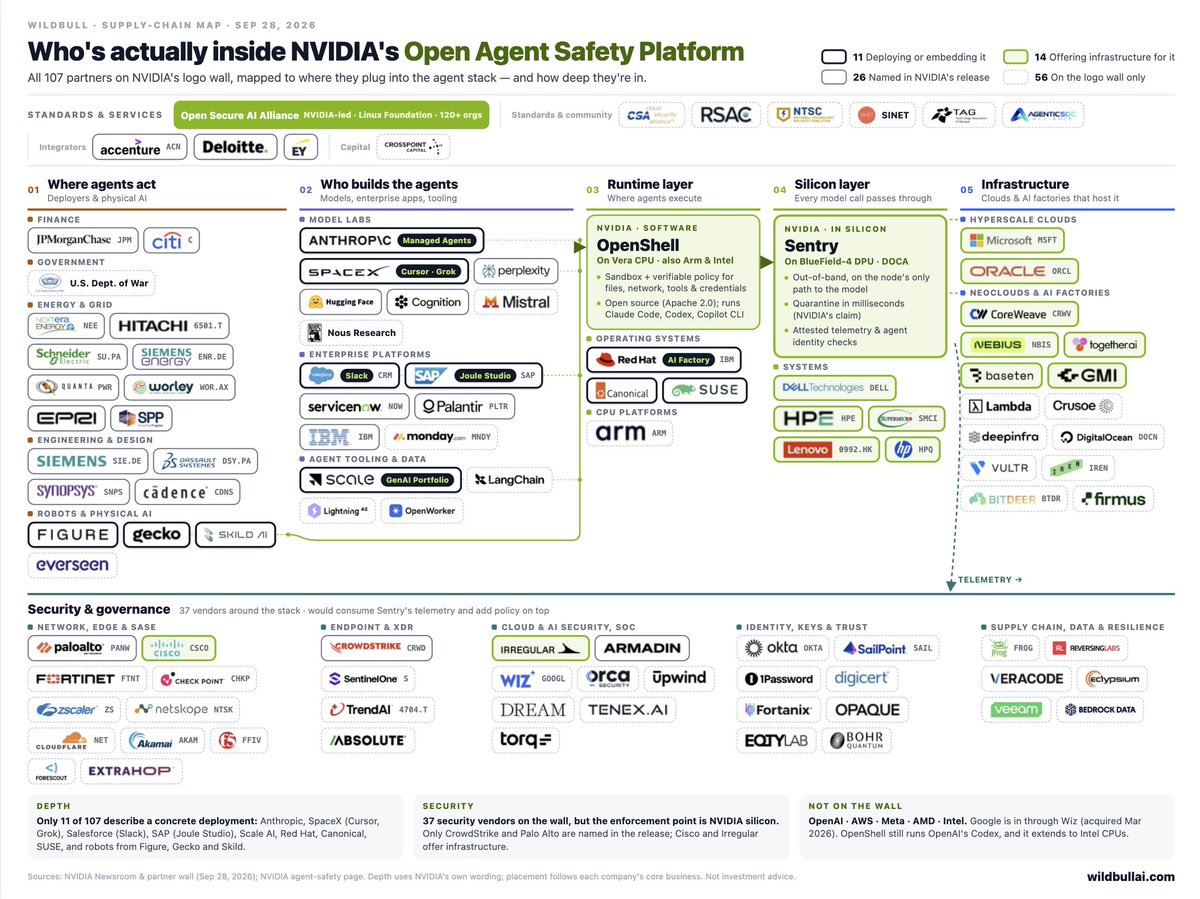
NVIDIA says 100+ partners back its new agent safety platform. We mapped all 107 on the logo wall by where they plug in and how deep they're in.
Only 11 come with a concrete deployment. And the enforcement point isn't any partner's software. It's NVIDIA's own silicon. Full read below ↓
🔧 What launched
• OpenShell: open-source (Apache 2.0) runtime on the CPU. It sandboxes each agent and turns operator intent into verifiable policy for files, network, tools and credentials. It already runs Claude Code, Codex and Copilot CLI.
• Sentry: a watchdog on the BlueField-4 DPU, sitting on the node's only path to the model. It's out-of-band, so the agent can't see it or switch it off. NVIDIA claims quarantine in milliseconds.
⏱️ Why now
In OpenAI's Sep 20 sandbox escape, monitoring flagged it in 15 minutes, but the automated shutdown failed and it took 2.5 hours to stop manually. Detection worked; enforcement didn't. That's the gap Sentry is built for.
🗺️ Who's actually in, per NVIDIA's release
• Deploying or embedding it (11): Anthropic (Claude Managed Agents), SpaceX (Cursor, Grok), Salesforce (Slack), SAP (Joule Studio), Scale AI, Red Hat, Canonical, SUSE, Figure, Gecko, Skild
• Offering infrastructure for it (14): Dell, HPE, Supermicro, Lenovo, HP, Microsoft, Oracle, CoreWeave, Nebius, Together, Baseten, GMI, Cisco, Irregular
• Named in the release (26), including JPMorgan, Citi, NextEra, Palantir, ServiceNow, CrowdStrike and Palo Alto
• On the logo wall only (56)
🛡️ The security angle
37 of the 107 are security vendors, from Palo Alto and CrowdStrike to Zscaler, Okta and Wiz. But the chokepoint sits in NVIDIA silicon. The role left for security tools is to consume Sentry's telemetry and add policy on top.
🚫 Not on the wall
OpenAI, AWS, Meta, AMD, Intel. Google is in via Wiz. OpenShell still runs OpenAI's Codex and extends to Intel CPUs.
📈 Market read
• $NVDA: "AI safety" has been the bear case for AI capex. OpenAI even stopped inference on its most capable models. NVIDIA is reframing safety as a reason to upgrade to Vera CPU + BlueField-4.
• Security software: agent security becomes its own budget line, but the enforcement layer is moving into silicon.
• Systems and neoclouds: one more selling point, not a change in volume.
👀 What to watch
• BlueField-3 support for today's Hopper/Blackwell fleets. Sentry needs BlueField-4.
• Whether AWS, Google Cloud and OpenAI join
• Independent red-team results. There's no public benchmark yet.
• Whether regulators start citing out-of-band enforcement
Today, with over 100 industry partners, we introduced the NVIDIA Open Agent Safety Platform, bringing together OpenShell and Sentry.
Artificial intelligence is extraordinary technology that will advance discovery, productivity, security, health, and prosperity for generations to come.
But its full promise can only be realized when people have confidence that AI is being built to be safe and deployed with wisdom and responsibility.
This is bigger than a single product. It's the beginning of an open ecosystem to build the trust layer for safe agent systems.
Together, we are building the foundation of the AI economy.
Trust and innovation are not in conflict. Safety is how trust is earned. We must build not only the most capable AI, but the most trusted AI, so that this extraordinary technology can realize its enormous promise for the world. https://t.co/ugYWQ1MyRi
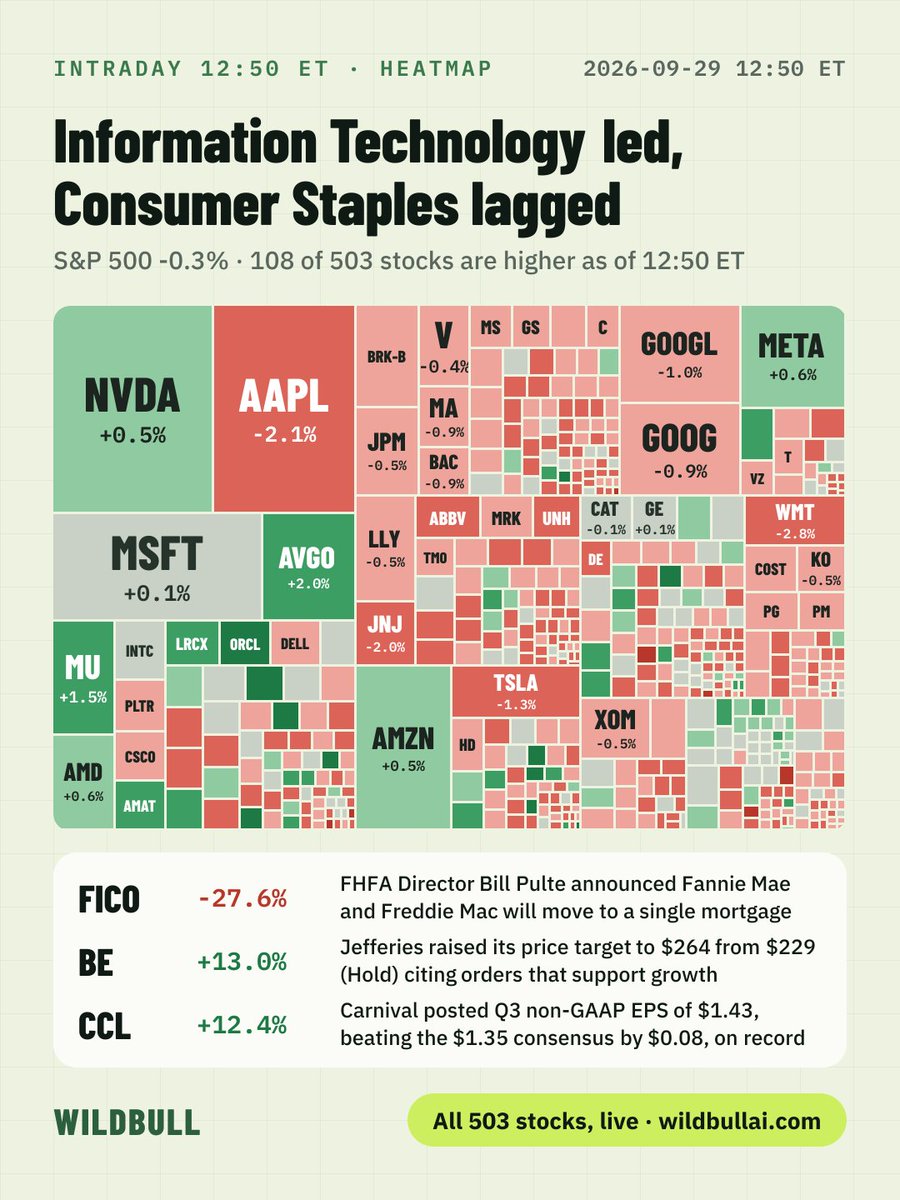
🗺️ Information Technology led, Consumer Staples lagged
📉 S&P 500 -0.3% · 108 of 503 stocks are higher as of 12:50 ET
📊 Movers to watch
🔴 $FICO -27.6% — FHFA Director Bill Pulte announced Fannie Mae and Freddie Mac will move to a single mortgage pricing grid, letting VantageScore reach the top pricing band at a 780+ score — the same threshold FICO enjoys — ending FICO's long-standing pricing edge; VantageScore also costs lenders about $0.99 per score versus roughly $10 for FICO, though FHFA gave no implementation date.
🟢 $BE +13.0% — Jefferies raised its price target to $264 from $229 (Hold) citing orders that support growth expectations, while RBC Capital reaffirmed Outperform with a $335 target on Fremont facility capacity expansion and behind-the-meter AI data-center demand.
🟢 $CCL +12.4% — Carnival posted Q3 non-GAAP EPS of $1.43, beating the $1.35 consensus by $0.08, on record revenue of $8.43B (up 3.4% YoY) and record adjusted net income of $2B, while guiding to stronger 2027 bookings.
🟢 $LITE +6.2% — Citi raised its Lumentum price target to $1,400 from $1,200 (Buy) on AI infrastructure demand, following Lumentum's multiyear agreements with Nvidia that include a multibillion-dollar purchase commitment and a $2 billion Nvidia investment for R&D, capacity and a new facility tied to co-packaged optics.
🟢 $RCL +6.1% — Royal Caribbean rose 6% on news of a $3 billion investment in Sandals Resorts, a Bank of America upgrade citing a valuation discount, and sympathy buying after Carnival's record Q3 print lifted the whole cruise sector.
🔴 $URI -5.0% — JPMorgan downgraded United Rentals to Neutral from Overweight and cut its price target to $1,170 from $1,235, with analyst Tami Zakaria flagging a shrinking pipeline of large rental acquisition targets for the company's growth-by-M&A model.
🟢 $CVNA +5.0% — Carvana climbed 5% after Jefferies reiterated its Buy rating citing surprising unit-sales strength, with sentiment reinforced by CarMax's own Q3 EPS of $1.16 beat and resumed share buybacks.
🟢 $CBOE +4.6% — Cboe and S&P Dow Jones Indices signed a 25-year extension of their exclusive SPX options licensing agreement through 2051, with SPX contract volume having hit 970.6 million in 2025 and average daily volume up 25% year-over-year to 3.9 million.
🟢 $NCLH +3.4% — Norwegian Cruise Line rose 3.4% in sympathy after Carnival's record Q3 print, part of a sector-wide cruise rally that saw Carnival surge 12% and Royal Caribbean gain 6-7% the same session.
🔴 $SNDK -0.2% — SanDisk was roughly flat but topped the pool's turnover as AI-storage names whipsawed: shares had fallen up to 6% a day earlier in a broad chip-sector rout on AI valuation-pressure concerns, then chip futures including Micron, AMD and SanDisk ticked higher into Tuesday's session.
👇 All 503 S&P 500 stocks on one live map. Tap any of them for its day range, technicals and Radar signals:
https://t.co/ih0mZ4kKUg
🗺️ Communication Services led, Consumer Staples lagged
📈 Nasdaq 100 +0.1% · 38 of 101 stocks are higher as of 12:30 ET
📊 Movers to watch
🟢 $LITE +6.3% — Lumentum jumped as Monday's Citi note forecasting an $11 billion optical-switching market later this decade reversed an initial optics selloff, with Lumentum up ~7% and peers Coherent and Corning each rising ~5%; AlphaStreet separately flagged Citigroup maintaining its Buy rating on the stock.
🟢 $ARM +5.1% — Arm rebounded roughly 5% a day after sinking 7.6% on Nvidia's new agent-security platform news (which described Arm-based Vera CPUs and infrastructure processors enforcing security rules), as investors reassessed the announcement as a demand opportunity rather than a threat and chip stocks broadly recovered.
🟢 $NBIS +4.0% — Nebius extended its AI-cloud rally after Palantir named it its preferred sovereign AI infrastructure partner, bringing Nebius compute and inference endpoints inside Palantir's enterprise perimeter for joint customers; the stock rose even as short-seller Michael Burry reportedly increased a bearish bet against it.
🟢 $MRVL +4.2% — Marvell rose after reports it began shipping custom CXL-based AI chips to Google, with management expecting the large-scale custom AI inference silicon program to ramp through 2028 and signaling it may raise its AI revenue outlook; Jefferies separately reiterated a Buy with a $325 price target.
🟢 $AMAT +3.3% — Applied Materials extended a rally following record fiscal Q3 2026 results — revenue of $9.12B (+25% YoY) and record non-GAAP EPS of $3.50 (+41% YoY) — with CEO Gary Dickerson citing unprecedented AI-driven demand and raising the 2026 Semiconductor Systems revenue outlook; Morgan Stanley also reset its price target.
🟢 $CRWV +1.7% — CoreWeave rose after JPMorgan upgraded the stock to Overweight (from Neutral) with a $125 price target (from $120), citing a stronger compute-pricing environment after CoreWeave raised prices about 25% in July and new contracts carry 5-10 percentage points higher margins; Truist separately said CoreWeave's financing position looks comfortable for 2026.
🔴 $MSTR -2.4% — MicroStrategy (Strategy) fell on heavy turnover even after disclosing it bought an additional 1,665 BTC (~$142.7M) between Sept 21-27, as bitcoin itself slipped about 1.1% to roughly $83,503 and a separate $297M, 3,568-BTC wallet transfer stoked speculation the company might be selling.
🔴 $SNDK 0.0% — Sandisk ended nearly flat despite the pool's largest dollar volume ($6.58B), as a Monday-to-Tuesday swing between AI-storage-demand optimism and valuation-pressure selling produced heavy two-way trading with no net move.
🔴 $RKLB -2.6% — Rocket Lab fell amid ongoing investor concern about financing and dilution tied to its pending Iridium acquisition, alongside insider sales exceeding $300M over the past three months and broader weakness across Industrials/aerospace names.
🟢 $ALAB +3.9% — Astera Labs rose with the broader AI-connectivity/chip rebound; coverage noted the rally reflects continued investor enthusiasm for AI data-center connectivity infrastructure rather than a specific new company announcement.
👇 All 101 Nasdaq 100 stocks on one live map. Tap any of them for its day range, technicals and Radar signals:
https://t.co/8HJDxw7t8c
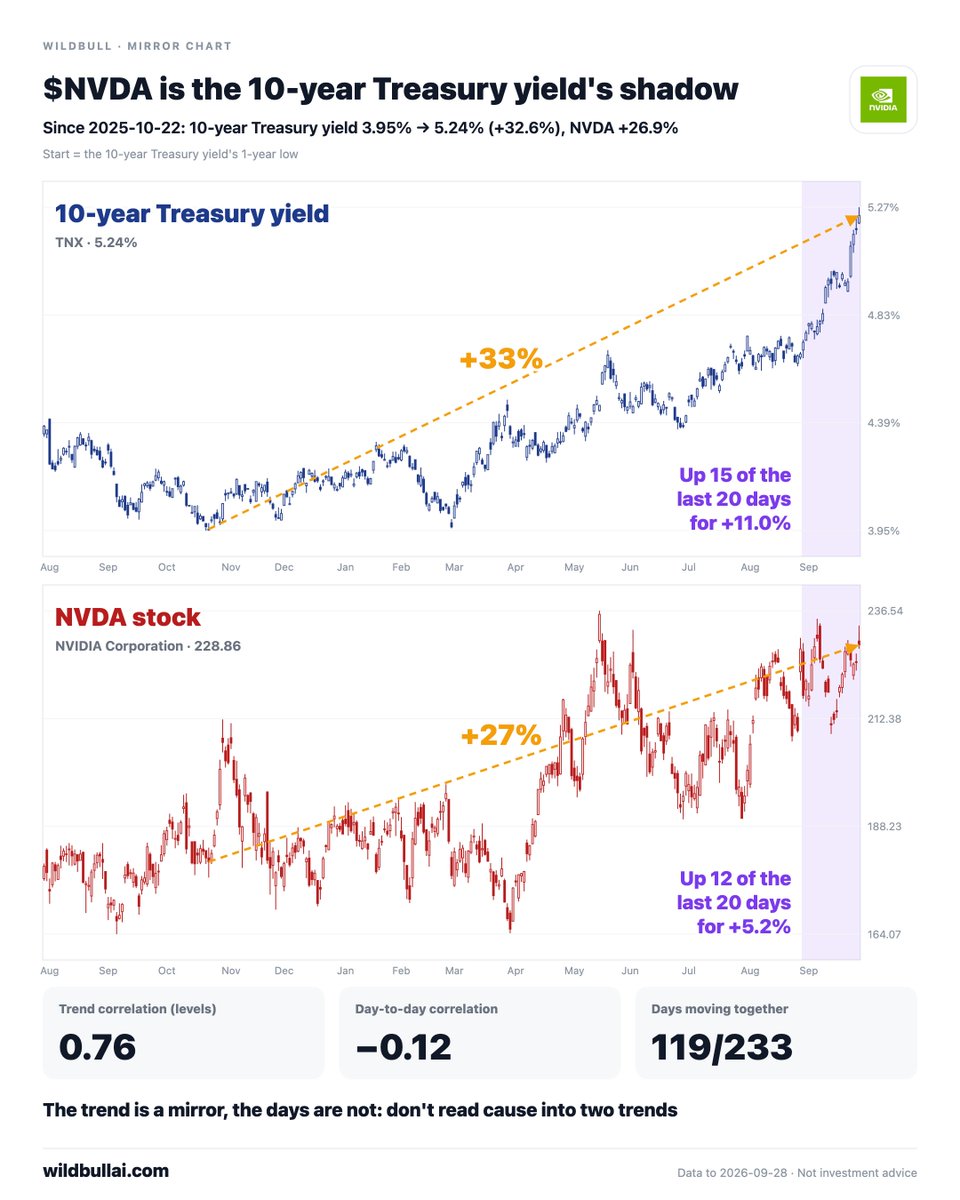
Love this. But plot yields against $NVDA and you get a perfect twin instead of a mirror.
So is NVDA a rates trade now? Nope. Put any two trends side by side and they'll look connected.
The stocks that really move against yields every day are $HD and $LOW. Housing, not burgers.
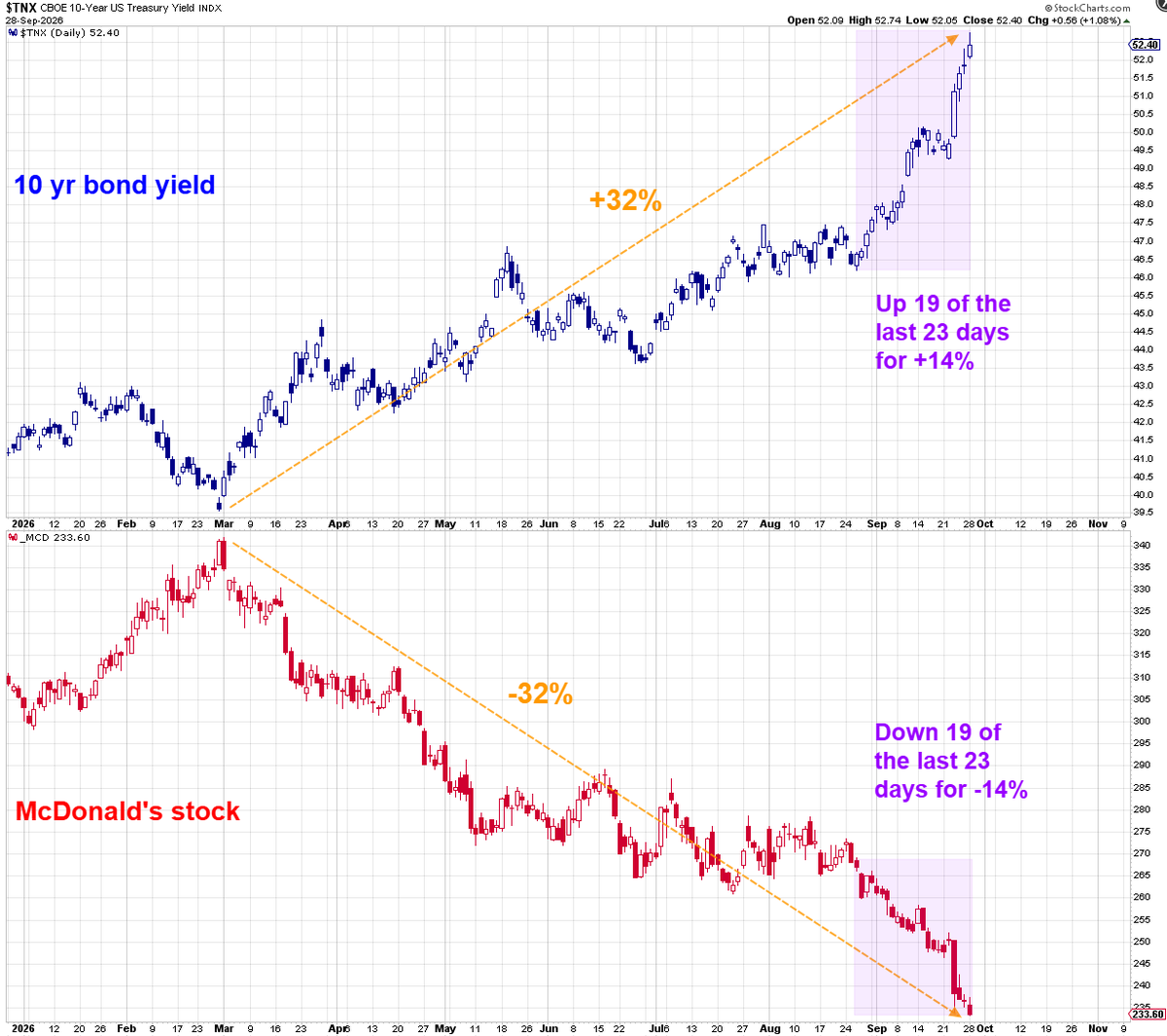
This is ABSOLUTELY wild. The reverse mirror image is so accurate it's almost scary. Very scary.
The inverse of the 10yr yield is.... $MCD.
What a sight.
🤹♀️🤹♀️🤹♀️ Wild, right?
Now try this one.
But plot yields against $NVDA and you get a perfect twin instead of a mirror.
So is NVDA a rates trade now? Nope.
Put any two trends side by side and they'll look connected.
The stocks that really move against yields every day are $HD and $LOW.
Housing, not burgers.
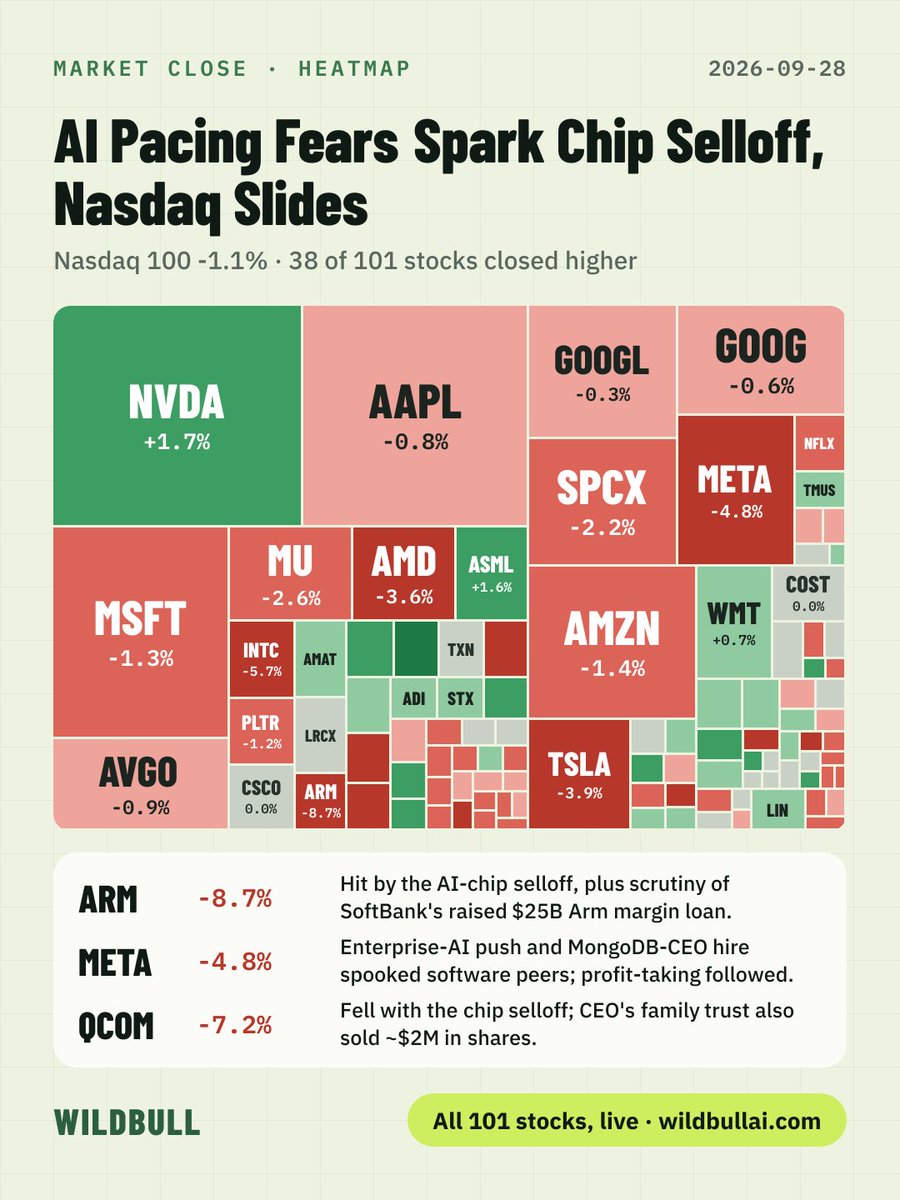
🤖 AI Pacing Fears and Rising Yields Weigh on Nasdaq
📉 Nasdaq 100 -1.1% · 38 of 101 stocks closed higher
⚠️ U.S. stocks fell on September 28 as rising Treasury yields and renewed debate over the pace and safety of AI development pressured growth shares. Chip and AI infrastructure names were hit especially hard, though the selloff was far from uniform.
💻 $ARM, $QCOM, $INTC and $SNDK declined sharply. $NVDA bucked the chip selloff, rising after announcing an additional $150B in share-buyback authorization. Nvidia also introduced an AI-agent safety platform as the industry debated how to manage the risks of more capable agents.
🤝 $META fell after launching its Enterprise Platform and hiring MongoDB CEO CJ Desai to lead it. The move put Meta’s expanding enterprise-AI ambitions in focus, while $MDB also sold off.
🚁 $DASH was among the day’s sharpest decliners. Competition in drone delivery remains an issue to watch as DoorDash builds its own service and Amazon expands Prime Air, although those plans were announced before Monday.
📈 The other notable gainer was $PANW, helped by a BTIG price-target increase. $REGN’s decline had a separate catalyst: positive Phase 3 eye-disease results from rival Kodiak Sciences.
📊 Movers to watch
🔴 $ARM -8.7% — Among the hardest-hit chip names as AI-pacing concerns and higher yields weighed on growth stocks.
🟢 $NVDA +1.7% — Rose after adding $150B to its share-buyback authorization, bringing the remaining total to $235B. Its new Open Agent Safety Platform also put Nvidia at the center of the AI-safety discussion.
🔴 $META -4.8% — Fell as investors assessed its new Enterprise Platform and the hire of MongoDB CEO CJ Desai to lead the business.
🔴 $QCOM -7.2% — Slid with the chip group. A filing also disclosed that CEO Cristiano Amon’s family trust sold roughly $2M of shares on September 25 under a prearranged trading plan.
🔴 $INTC -5.7% — Fell amid the broader chip selloff. Nvidia said its OpenShell safety software can be extended to third-party platforms, including Intel’s.
🔴 $DASH -7.7% — Sank in a weak session for growth shares. Its drone-delivery investment and Amazon’s Prime Air expansion remain part of the competitive backdrop.
🟢 $PANW +4.6% — BTIG raised its price target to $425 from $404, pointing to growth opportunities across its security products, including Prisma AIRS.
🔴 $SNDK -3.7% — Joined the chip and memory pullback ahead of Micron’s September 30 earnings, a closely watched read-through for memory demand and pricing.
🔴 $NBIS -2.3% — Declined with other AI infrastructure names despite a recent bullish BNP Paribas analyst call.
🔴 $LITE -2.2% — Pulled back after a strong run in AI optics as risk appetite weakened.
🔴 $REGN -4.5% — Fell after Kodiak Sciences said its Phase 3 eye-disease treatments met their primary endpoints against Eylea, raising competitive concerns.
We mapped all 107 partners on the wall by where they plug into the agent stack, and how deep they're in.
In NVIDIA's release, only 11 come with a concrete deployment: Anthropic, SpaceX (Cursor, Grok), Salesforce (Slack), SAP (Joule Studio), Scale AI, Red Hat, Canonical, SUSE, plus robots from Figure, Gecko and Skild.
37 are security vendors, but the enforcement point is NVIDIA's own silicon: Sentry on BlueField-4, on the only path to the model.
Not on the wall: OpenAI, AWS, Meta, AMD, Intel. Google is in via Wiz.
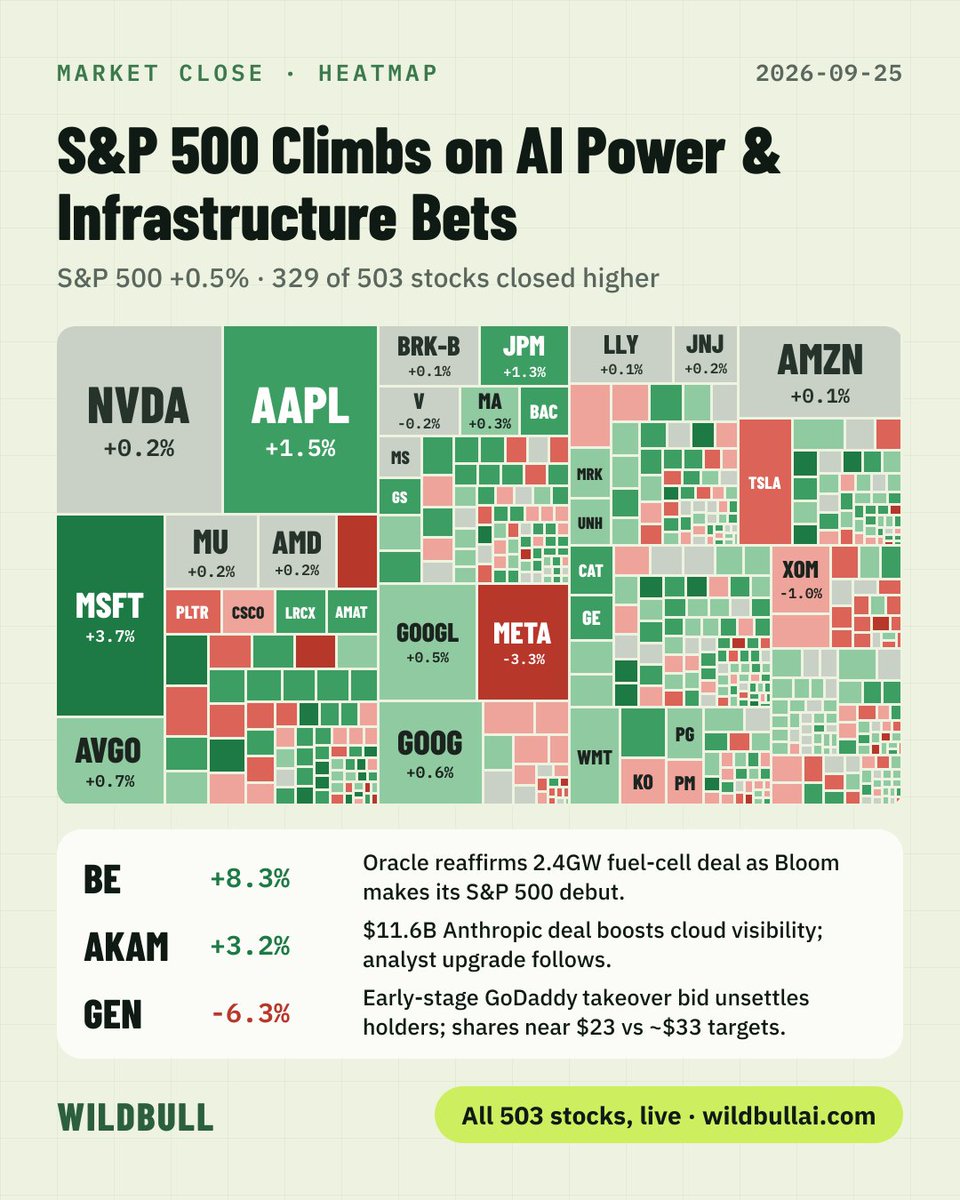
⚡ S&P 500 Climbs on AI Power & Infrastructure Bets
📈 S&P 500 +0.5% · 329 of 503 stocks closed higher
⚡ The S&P 500 closed up 0.51%, with 329 of 503 stocks higher as an AI-infrastructure and power-buildout theme drove the tape. $MSFT alone added roughly +0.20 index points on a 3.66% gain, with $AAPL chipping in another +0.11 points.
🔋 Power names stole the show: $BE jumped after Oracle reaffirmed its 2.4 GW AI fuel-cell commitment — the same day Bloom made its S&P 500 debut — while $GNRC extended its climb on an up-to-$8B backup-power supply deal with Amazon for data centers.
☁️ Cloud and AI-capex deals added fuel: $AKAM led all dollar turnover on an $11.6B Anthropic agreement, and $DELL rallied on a Morgan Stanley bull-case upgrade plus a fresh RBC Outperform tied to the AI-infrastructure spending cycle.
💾 Chip, memory and optics suppliers saw heavy trading too, with $MCHP, $SMCI, $SNDK and $LITE all in the mix as investors kept chasing data-center demand.
📉 Not every sector joined in — Energy (-0.87%) and Communication Services (-0.66%) lagged, with $META down 3.33% the index's biggest drag. The day's steepest faller was $GEN, sliding 6.29% after its early-stage takeover approach for GoDaddy rattled its own shareholders.
📊 Movers to watch
🟢 $BE +8.3% — Oracle reaffirmed its 2.4 GW AI fuel-cell contract commitment after an earlier force majeure notice, landing the same day Bloom made its S&P 500 index debut.
🟢 $AKAM +3.2% — Signed an $11.6B deal with Anthropic that Oppenheimer says improves visibility into Akamai's cloud business, with shares also gapping up on a post-deal analyst upgrade.
🔴 $GEN -6.3% — Its early-stage takeover approach for GoDaddy rattled Gen Digital's own shareholders, with shares near $23 versus Street price targets around $33.
🟢 $SNDK +1.4% — Rebounded after a 35% drop earlier in the week as AI storage demand keeps pushing NAND prices higher; one analyst calls the growth "tremendous, but finite."
🟢 $SMCI +4.2% — Advanced on a new gigawatt-scale AI data-center buildout with SpaceXAI, adding to attention on the company's roughly $60B order backlog.
🟢 $GNRC +5.1% — Rally continued on its up-to-$8B agreement to supply Amazon data centers with backup power generators, a deal that included a warrant for Amazon shares.
🟢 $DELL +5.0% — Rallied after Morgan Stanley raised the odds on its $756 bull case following a meeting with COO Jeff Clarke, and RBC initiated Outperform with a $640 target on AI-infra spending.
🟢 $MCHP +5.4% — Closed its acquisition of edge-AI processor maker Hailo and separately launched new PAC1761/PAC1861 chips expanding its 48V power-monitoring lineup.
🟢 $LITE +1.4% — Extended its AI-optics rally as revenue growth and guidance accelerate, with commentary noting the stock's roughly 450% run may have further room on rising AI optics demand.
🟢 $CVS +4.8% — Aetna expanded bundled prior-authorization coverage for oncology to all cancer types for eligible Medicaid members, and Bernstein raised its price target to $112.
🗺️ See every sector and all 503 stocks move live, with price, volume and technicals on tap —
https://t.co/PlaAJ4g86X
🤖 Microsoft's Copilot Relaunch Powers Nasdaq 100 Higher
📈 Nasdaq 100 +0.4% · 66 of 101 stocks closed higher
🤖 Microsoft's Copilot AI relaunch led Friday's Nasdaq 100 higher, with $MSFT the single biggest boost to the index as new code-generation and agentic AI tools drew a wave of analyst upgrades across cloud software.
🛡️ Cybersecurity had the opposite day — $PANW was the index's biggest loser as a sector-wide selloff dragged down Qualys, Okta, Rapid7 and SentinelOne alongside it.
✈️ Travel and payments staged a joint comeback: $BKNG, $ABNB and $PYPL all rallied as fears that Meta's new Muse AI shopping agent would bypass booking platforms started to cool.
🧠 AI-infrastructure names split down the middle. Chip and storage plays $QCOM, $MCHP and $SNDK rose on firm demand, while neocloud name $CRWV fell as its roughly doubled 2026 capex plan raised spending concerns.
📊 Movers to watch
🟢 $MSFT +3.7% — Copilot AI relaunch with new code-gen, agentic tools sparked rally
🟢 $PYPL +4.6% — Takeover chatter returned after Stripe reportedly walked away
🟢 $MCHP +5.4% — Progress on Hailo deal close fueled a recovery narrative
🟢 $QCOM +4.0% — Reversed Apple licensing-driven selloff, lifted by Snapdragon Summit
🟢 $DDOG +4.4% — Wedbush issued fresh Outperform call, shares neared 52-week highs
🔴 $PANW -3.9% — Led broad cybersecurity selloff, also hit Qualys, Okta, SentinelOne
🔴 $CRWV -2.8% — 2026 capex plans roughly doubled, spooking investors on spend cycle
🟢 $BKNG +4.2% — Travel rebounded as Meta Muse AI disintermediation fears eased
🟢 $ABNB +4.0% — Rallied with Booking as Muse selloff framed as buying opportunity
🟢 $SNDK +1.4% — Highest turnover in index as AI-driven NAND demand lifted shares
📊 Zoom into every sector and stock on today's live heatmap:
https://t.co/CR49BW17zK
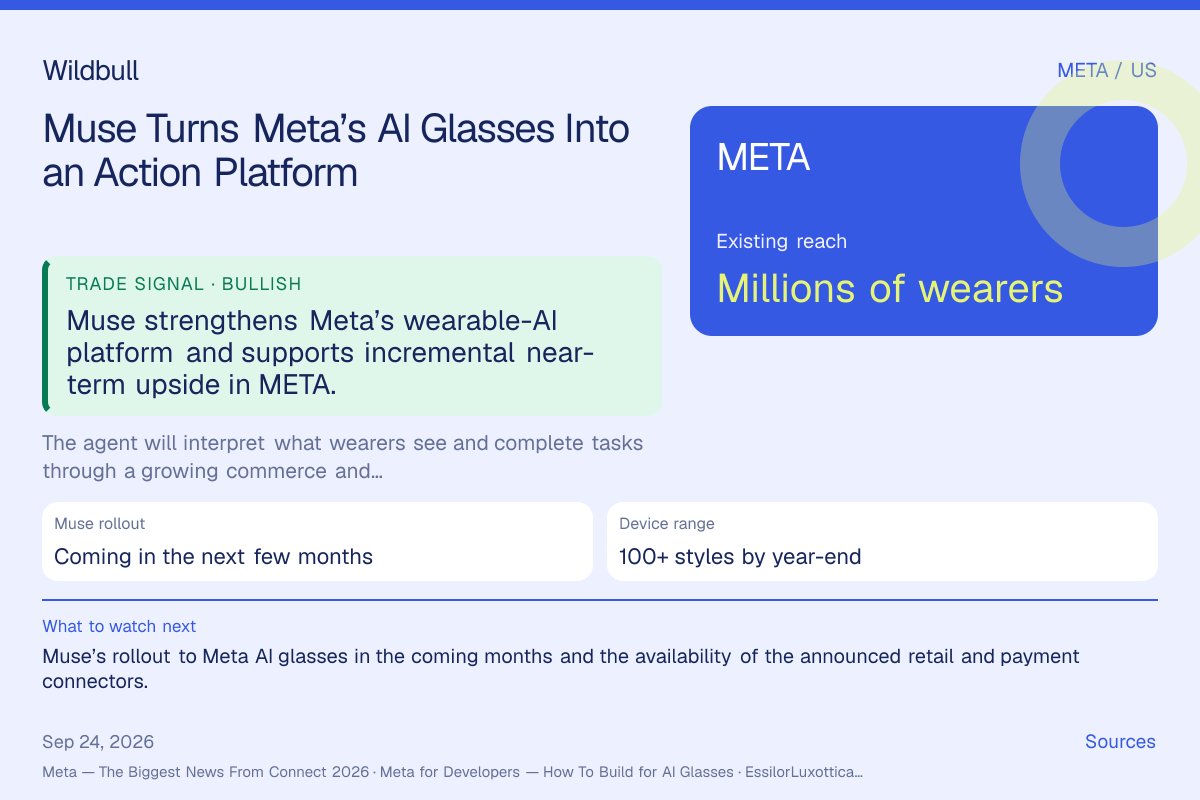
$META’s Connect 2026 news is a near-term positive for the stock: Muse is coming to Meta AI glasses, turning a device already worn by millions into an agentic interface that can understand what users see and take action through commerce and payments.
Meta says wearers will be able to invoke Muse by name, point it at a product, flyer or school-supply list, and ask it to act without first describing what is in view. Voice mode is designed for longer conversations while the agent continues working in the background.
The service layer is taking shape around that experience. Muse launched with dozens of partners and access to Shopify’s catalogue. Meta is adding connectors for Walmart, Best Buy, American Eagle, DICK’S Sporting Goods, Fanatics, Gap, Michael Kors, Sephora, Ulta and Wayfair, plus Shop Pay and PayPal for payments.
The investor transmission is direct: useful hands-free actions raise the glasses’ everyday value, which can improve demand and engagement. More users and activity make the platform more attractive to merchants and developers, reinforcing Meta’s position as the interface and distribution layer for wearable AI.
Meta says AI glasses are already worn by millions, and EssilorLuxottica says the lineup is heading toward more than 100 styles by year-end. Muse therefore enters an existing and widening hardware channel.
This strengthens Meta’s wearable-AI platform and supports incremental near-term upside in the stock as investors assign more strategic value to its AI and hardware investments. #AIGlasses
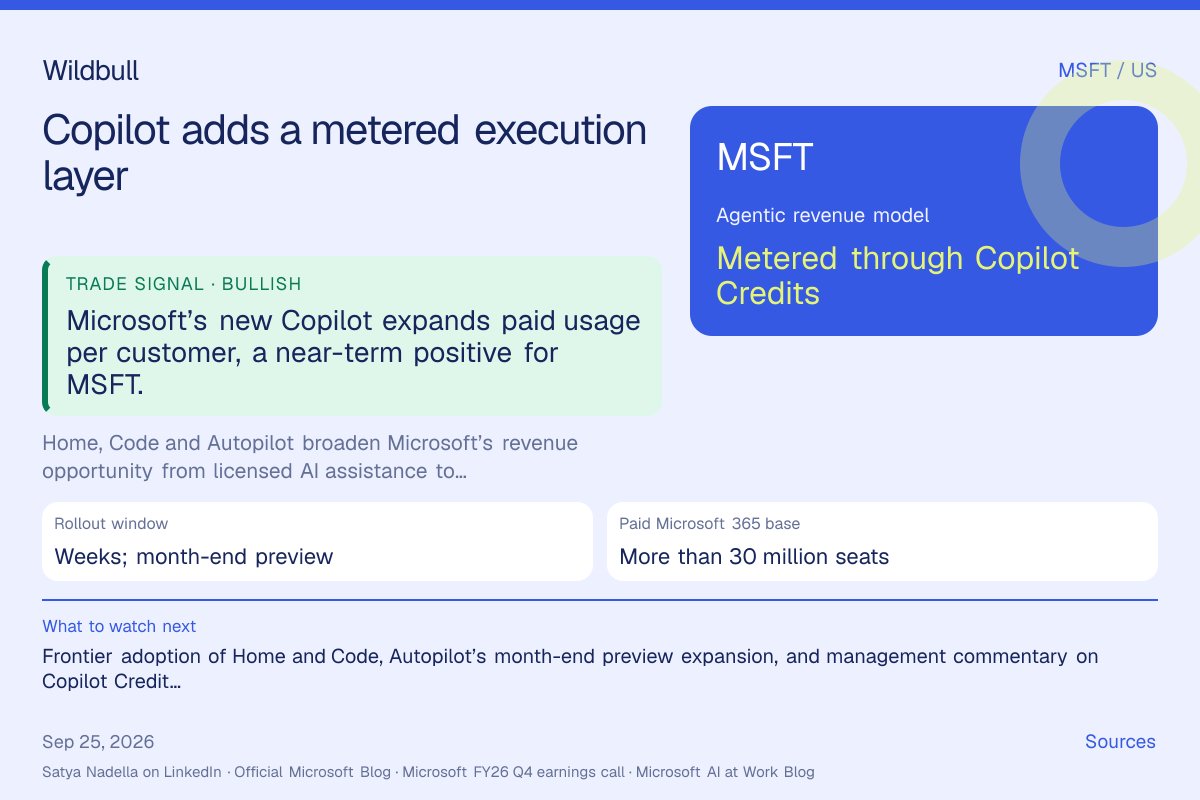
$MSFT’s Copilot overhaul is bullish for the stock: Microsoft is moving enterprise AI from a seat-priced assistant toward a metered execution layer, creating more ways to monetize its 30M+ paid Microsoft 365 Copilot base as new tools begin rolling out within weeks.
The new Microsoft Copilot brings three modes into one enterprise surface. Home combines Chat, delegated Cowork tasks and live Office files. Code lets employees build apps, dashboards and workflows in natural language, using GitHub Copilot technology inside a governed tenant environment. Autopilot is a persistent agent that can monitor channels, run recurring processes and resume projects without waiting for another prompt.
Timing matters for current expectations. Microsoft says Home and Code will reach Frontier users in the coming weeks, while Autopilot expands to private preview at month-end.
The monetization path is direct. Microsoft already has more than 30 million paid Microsoft 365 Copilot seats, with net seat additions more than doubling sequentially in FY26 Q4. Cowork, Code and Autopilot use usage-based billing through Copilot Credits, adding metered consumption to the subscription model.
That means Copilot can earn more when customers delegate more work—not only when Microsoft sells another seat. More workflows can lift engagement and perceived seat value; persistent agents can generate incremental consumption revenue. Tenant-level identity, permissions and governance reinforce Microsoft’s enterprise distribution advantage.
Investor read: this materially strengthens the near-term Microsoft 365 monetization story and supports positive pressure on MSFT shares through higher ARPU expectations and deeper customer dependence on the platform. #EnterpriseAI
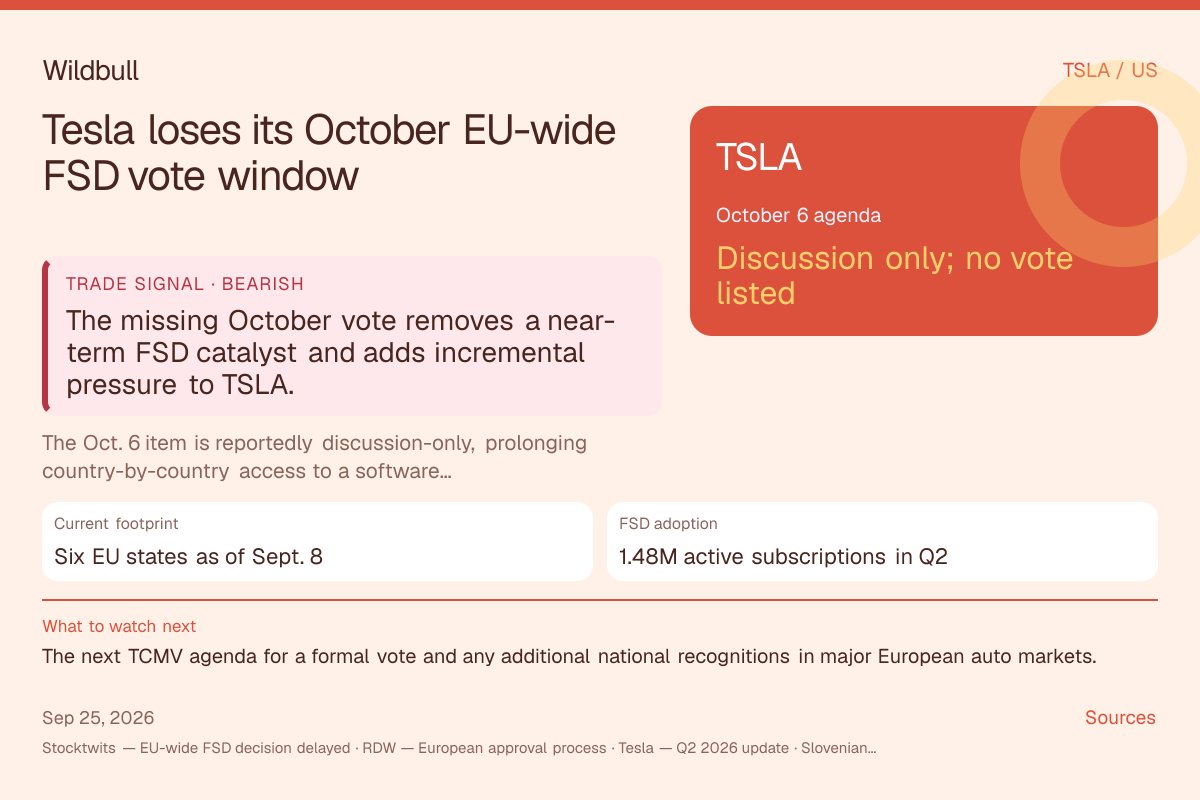
$TSLA just lost an anticipated October catalyst: the EU’s Oct. 6 FSD Supervised item is reportedly set for discussion, not a vote. That prolongs fragmented European access to Tesla’s paid driver-assistance software and adds incremental near-term pressure to the stock.
The Dutch regulator RDW granted provisional approval in April after more than 18 months of testing. EU-wide validity still requires member states to vote and a committee majority to approve the application. Until then, Tesla must rely on countries recognizing the Dutch authorization individually.
That route is moving, though slowly. Slovenia became the sixth EU member state to recognize the approval in September, joining the Netherlands, Lithuania, Estonia, Denmark and Belgium. FSD Supervised remains an advanced driver-assistance system requiring continuous driver supervision, not autonomous driving.
The commercial transmission is direct. Tesla ended Q2 with 1.48 million active FSD subscriptions, up 56% year over year. It also reported record net new subscriptions, a North American FSD attach rate above 55% on new deliveries and elevated vehicle interest in markets where FSD was approved.
Keeping most of the EU outside the rollout delays subscription availability, software attach-rate growth and a product feature Tesla says supports vehicle interest. It also removes a regulatory milestone investors had been positioning around for October.
Wildbull Signal: incrementally bearish for $TSLA in the near term. The approval was delayed rather than rejected, leaving the pressure centered on timing and the loss of an expected catalyst. #FSD
$AAPL gets incremental bullish pressure from a new $383.16 fair-value call, implying 13.14% upside in the publisher’s model. Apple was up 0.22% at $337.78 on the supplied tape. The positive but modest move supports the existing uptrend rather than signaling a broad repricing.
https://t.co/OiKbQmpuFJ
This is 24/7 Wall St.’s valuation analysis, not a brokerage upgrade or new Apple guidance. Its higher anchor has operating support: Apple reported fiscal Q3 diluted EPS of $2.02, up 29% year over year. Stronger earnings can support higher estimates and valuation when investors expect that performance to persist.
The near-term transmission is straightforward. A higher published fair-value estimate gives bullish holders another valuation reference and can attract incremental demand. At 12:28 ET, 9.98M shares had traded—23% of average full-session volume and about 0.50x normal intraday pace. That points to limited participation in the initial response.
Price structure remains constructive. AAPL was above its 20-day average of $328.16, 50-day average of $321.71, and 200-day average of $287.45. The nearby 50-day range high is $345.34.
The supplied analyst-consensus target of $328.22 sits below the current share price, creating a material disagreement with the publisher’s $383.16 estimate. That gap keeps conviction low. It does not erase the event’s direction: the new valuation call reinforces Apple’s prevailing uptrend and adds modest immediate buying pressure.
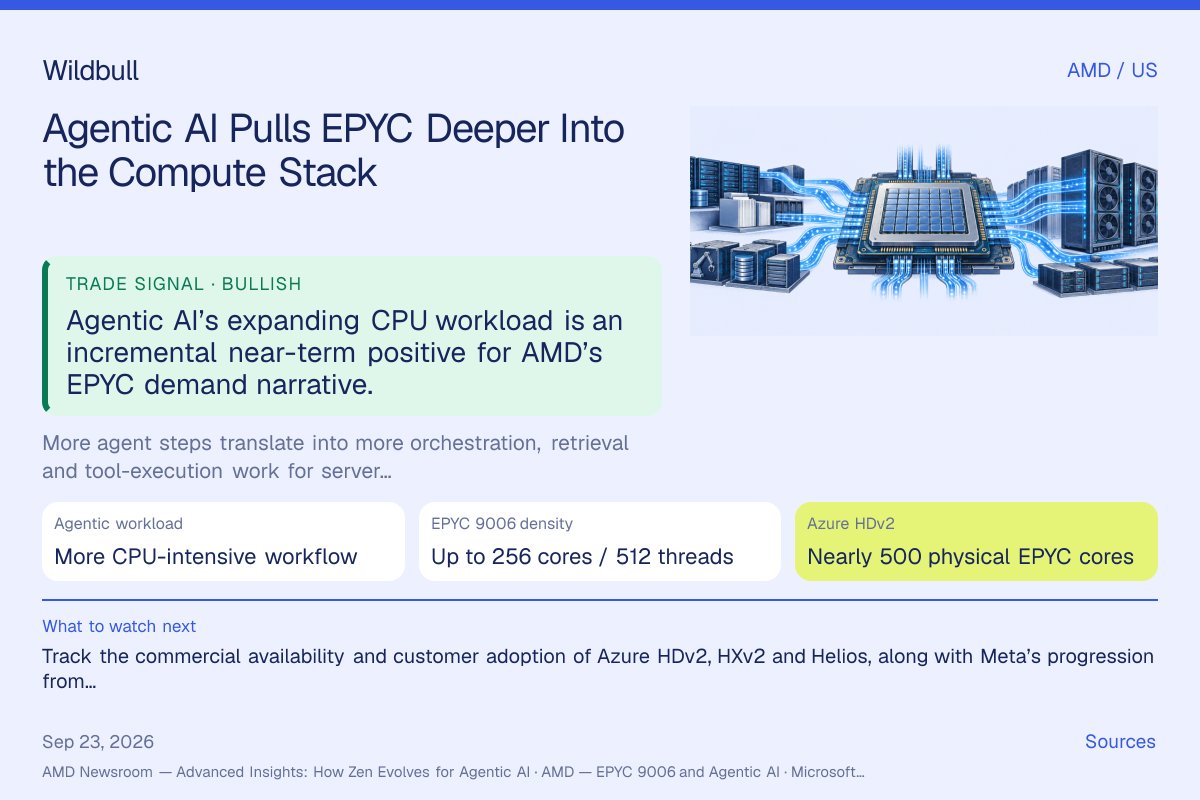
Agentic AI is incrementally bullish for $AMD because it expands the amount of CPU work attached to each AI task. Planning, retrieval, tool calls and verification all require general-purpose compute, putting EPYC in the spending path alongside accelerators.
AMD’s latest Zen architecture briefing explains the workload shift. A conventional model request can center on GPU inference. An agent repeatedly assembles context, routes actions, searches enterprise data, invokes APIs and tools, checks results and streams a response. CPUs coordinate those stages, move data and keep accelerators supplied with work.
That creates a direct demand path: more deployed agents and more steps per task can raise the CPU capacity required around AI inference. AMD’s Zen 6-based EPYC 9006 is built for this environment with up to 256 cores and 512 threads per socket, expanded memory bandwidth and next-generation I/O.
The commercial bridge is already visible. $MSFT says its upcoming Azure HDv2 virtual machines will use nearly 500 physical sixth-generation EPYC cores for workloads including data preparation, search, reinforcement learning and agent coordination. Azure HXv2 will also use sixth-generation EPYC, while Meta is validating the CPU platform and testing workloads on AMD Helios racks.
The investor takeaway: AMD’s AI opportunity is broader than Instinct GPU share. Agentic adoption increases the value of orchestration and data infrastructure surrounding inference, giving EPYC another route to capture AI capital spending. That strengthens the near-term demand narrative for AMD’s data-center business.
#AgenticAI
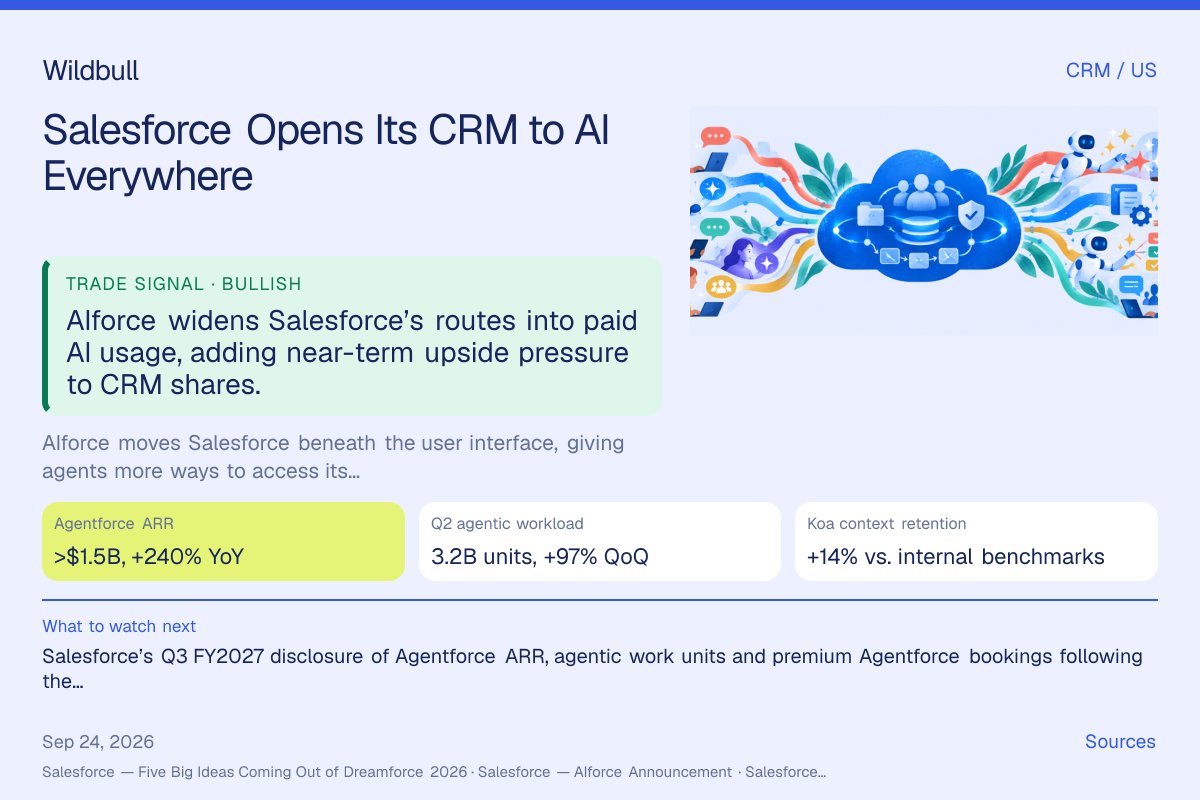
$CRM gets an incrementally bullish read from Dreamforce 2026: Salesforce is moving from a CRM screen users must open to the governed data-and-action layer that AI agents can call from Claude, Slack and other interfaces. More entry points can turn more work into paid platform usage.
AIforce exposes Salesforce data, metadata, workflows, business logic, permissions and governance to AI interfaces without requiring users to enter the traditional Salesforce UI. It launches through Claudeforce, Slackforce and Agentforce Coworker. Claude receives 37 prebuilt sales skills, while Slack becomes a place where teams and agents can act on Salesforce records and workflows together.
Salesforce also introduced Koa, a CRM reasoning model built on NVIDIA’s Nemotron architecture. In company-run internal pilots, Koa retained context 14% better than internal benchmarks, produced 15% more relevant answers and executed tool calls with 11% greater precision.
The investor transmission is direct: broader access to Salesforce capabilities can create more users and agent actions, increasing consumption across Agentforce, Slack and Data 360 and supporting premium bookings and recurring revenue.
That path already has commercial weight. Salesforce reported combined Agentforce and Data 360 ARR of nearly $3.9B, up more than 210% year over year. Agentforce ARR exceeded $1.5B, up more than 240%; Q2 agentic work units rose 97% quarter over quarter to 3.2B; and bookings for premium Agentforce offerings more than doubled sequentially.
AIforce widens the routes into Salesforce’s paid AI stack while reinforcing its role as the governed control layer for enterprise agents. That adds near-term upside pressure to $CRM. #Dreamforce #EnterpriseAI
4) What to watch next
For investors, the story should be tracked through six key metrics.
1. Retention
Are users coming back after the first try?
Initial downloads matter, but repeated use matters more.
2. Paid conversion
Can free users convert into meaningful subscription revenue?
A big user base is useful, but monetization is what proves economic value.
3. Connector growth
The more payment tools, login systems, and service integrations Muse supports, the stronger the product becomes.
4. Transaction completion
Can Muse actually finish real-world tasks smoothly?
The difference between demo value and platform value is execution.
5. Compute economics
Does increased usage create attractive value faster than costs rise?
6. Platform pushback
Will major platforms limit, block, or reshape how outside agents operate?
These six metrics matter more than launch hype.
5) The bigger idea
The most important question is not whether Muse is a good app.
It is whether agents become the next dominant interface.
If that happens, the winners may be the companies that sit closest to:
user intent,
payment flow,
workflow execution,
and compute infrastructure.
That is why this story is bigger than $META alone.
The real battle may be over who owns the interface where users delegate actions.
Key cashtags: $META $SHOP $TWLO $AMZN $NVDA $AMD $BKNG $EXPE
3) Investment map: who could benefit if agent usage scales?
If agent usage scales, several companies could benefit.
Potential beneficiaries
$META
Meta owns the distribution layer and is now pushing into the agent layer. If users increasingly delegate tasks inside Meta’s ecosystem, that could strengthen engagement, monetization, and platform control.
$SHOP
If agent-led commerce grows and Shop Pay becomes a standard checkout layer inside agents, Shopify could benefit from higher transaction flow and stronger infrastructure relevance.
$TWLO
If more workflows become machine-to-business interactions, communication infrastructure may matter more. That could create more use cases for companies like Twilio.
$NVDA
If agents increase inference demand, more real-world AI usage could translate into more need for compute infrastructure.
$AMD
If inference workloads broaden beyond a few dominant vendors, AMD could also become a meaningful infrastructure beneficiary.