They simultaneously acknowledge weak #demand conditions (neg output gap) while supporting a policy instrument designed primarily to suppress demand. If demand is already deficient, then the burden of proof lies with those arguing that further demand suppression is necessary.
@fcfinvest Vielleicht nicht notwendigerweise deutschsprachig, aber Europa-fokussiert? Das scheint mir eine Nische zu sein. Alles mir bekannte ist extrem US-lastig...
Konzept der #Opportunitätskosten nicht verstanden. Wenn sich #Energie durch #Importe günstiger erlangen lässt als durch heimische Produktion, wird kein „Geld“ verbrannt, sondern ein komparativer Kostenvorteil ausgeschöpft (= #Wohlstand gemehrt). Für heimische (Energie-) Produktion müssen heimische Ressourcen aufgewandt werden, für den Kauf ausländischer (Energie-) Produkte ebenfalls (nämlich für die Produktion derjenigen Exportgüter, die dafür eingetauscht werden). Ohne diese Einbindung in die internationale #Arbeitsteilung wäre Deutschland ein armes Land. @roberthabeck
Wir (https://t.co/GhtkgZ1qz8) verkaufen gerne in Europa. Und hören trotzdem damit auf.
Was kostet z. B. ein Paket nach Österreich? 14,50 € Porto.
Realität für uns als Gewerbetreibende: 135 € pro Paket bei gerade einmal zehn Sendungen pro Jahr nach Österreich 2025.
Dabei sind wir nur eine kleine GmbH aus Deutschland mit vereinzelten Kunden in Europa. Unser gesamtes jährliches Aufkommen für den EU-Export liegt bei etwa 100 Kilogramm Verpackung. Nicht Tonnen. Kilogramm.
Die Rechnung für Österreich allein: Wer als ausländisches Unternehmen nach Österreich verschickt, ist gesetzlich verpflichtet, die Entsorgung der Verpackung zu lizenzieren und dafür einen lokalen Beauftragten zu benennen, der die Einhaltung der Vorschriften garantiert und dafür haftet:
- Porto (10 Pakete à 14,50 €): 145 €
- Jahrespauschale Verpackungsbeauftragter: 450 €
- Notarkosten für die Vollmachtsbeglaubigung: 150 €
- Opportunitätskosten: 600 €
Und das ist nur Österreich. Frankreich verlangt z. B. ein eigenes Logo samt Anleitung auf jedem Versandkarton, sonst drohen empfindliche Bußgelder. Spanien, Italien, Polen: jeweils eigene Anforderungen, eigene Register. Ab Mitte 2026 kommen mit der EU-Verpackungsverordnung #PPWR weitere Pflichten hinzu.
Konzerne verteilen solche Fixkosten auf Millionen Sendungen. Für kleine Unternehmen und Selbständige wird daraus ein reales Exporthindernis. Das ist kein Versehen des Gesetzgebers, sondern ein struktureller Konzentrationsvorteil zugunsten großer Marktteilnehmer.
Dahinter steht ein System mit eigener Ökonomie: Wer Verpackungen in Verkehr bringt, muss deren spätere Entsorgung lizenzieren. Allein in Deutschland fließen dabei jährlich Milliardenbeträge an Lizenzentgelten an marktbeherrschende Entsorgungsunternehmen. Diese profitieren dabei mehrfach, über Lizenzgebühren beim Inverkehrbringen von Verpackungen über die Abholung und Verwertung der eingesammelten Rohstoffe. Komplexität ist dabei kein Fehler im System; sie ist Teil des Geschäftsmodells.
Besonders grotesk wird das im Vergleich mit Plattformversendern aus Fernost. Millionen Kleinsendungen fluten den europäischen Markt bei erkennbar geringerer Vollzugsintensität. Der europäische Mittelstand wird kontrolliert, weil er greifbar ist.
Der ursprüngliche Gedanke hinter der @EUCouncil war ein anderer: ein gemeinsamer Binnenmarkt, der Grenzen abbaut statt neue errichtet. Stattdessen: 27 nationale Compliance-Silos, die kleinen Unternehmen den Export systematisch verleiden.
Was sich ändern müsste:
1. Eine zentrale EU-Registrierung statt 27 nationaler Alleingänge
2. Eine De-minimis-Regelung für Kleinversender
3. Konsequenter Vollzug gegenüber Drittstaatsversendern statt Belastung des europäischen Mittelstands
Wir ziehen uns deshalb vorerst auf Deutschland und die Schweiz zurück, weil wir unsere Energie lieber in Produkte und Kunden investieren.
Die aktuelle EU-Bürokratiearchitektur erleben viele Unternehmen nur noch als Belastung.
Wir sind Unternehmer und keine Verpackungsjuristen, @vonderleyen , @DIHK_News, @MarkusFerber , @svenja_hahn , @nicolabeerfdp , @ANiebler
Gerne reposten - es betrifft den Mittelstand generell.
@SamanthaLaDuc AI: Short answer:
No — it is not true that the S&P 500 committee is broadly abolishing profitability requirements for all constituents. What is true is more nuanced: they are considering a targeted exemption for a very specific subset of companies (large, public “megacap” IPOs).
@BoringBiz_ Yes, but does this make the problem smaller if roughly 40% is held by pensions and insurers, or just "invisible" so far, because these entities mostly buy illiquid Funds?
1) You might have missed it but the EU just published the CMDI package – one of the most consequential pieces of bank regulation. It fixes something that has been really embarrassing about European banking regulation for more than a decade. And the impacts are huge.
Lohnsozialismus: Die EU zündet die nächste Bürokratiebombe
(Kommentar von @FranzSchellhorn)
Die EU will die Lohnschere zwischen Männern und Frauen schließen und drückt dabei der Privatwirtschaft das Gehaltsschema des Beamtenapparats auf.
Eines der größten Probleme im öffentlichen Dienst ist die Art der Entlohnung. Der leistungsscheue Kollege verdient genauso viel wie die fleißige Kollegin, was meist dazu führt, dass sich am Ende niemand mehr anstrengt. An dieser Art der Gleichmacherei sind sozialistische Imperien zugrunde gegangen, so gut wie jeder Beschäftigte in der Privatwirtschaft hält ein derartiges Entlohnungsschema für absurd. Doch genau dieses Modell drückt die EU nun allen Unternehmen aufs Auge.
Das glauben Sie nicht? Dann werfen Sie doch einmal einen Blick in die Entgelttransparenzrichtlinie, die bis zum 7. Juni 2026 in Österreich umgesetzt werden muss. Sie verpflichtet Unternehmen dazu, die Gehälter ihrer Beschäftigten offenzulegen. Das alles mit dem Ziel, den Gehaltsunterschied zwischen Männern und Frauen auf maximal fünf Prozent zu reduzieren. Das soll mit einer Reihe von Eingriffen in die Vertragsfreiheit sichergestellt werden: Arbeitgeber dürfen Bewerber nicht mehr fragen, was sie bisher verdient haben. Den Bewerbern hingegen muss offengelegt werden, was die künftigen Kollegen verdienen.
Wer mit einem Konkurrenzangebot in der Tasche mehr Gehalt herausverhandelt, macht sich nach der neuen Logik der Diskriminierung verdächtig. Scheidet jemand aus dem Unternehmen aus, darf die neu einzustellende Kraft nicht weniger verdienen als die Vorgängerin. Es sei denn, der Arbeitgeber kann dem Arbeitsgericht schlüssig erklären, warum der Job jetzt weniger wert sein soll. Dürfte nicht ganz einfach werden.
Was das in der Praxis bedeutet, liegt auf der Hand: Unternehmen müssen künftig ihre Vergütungssysteme bis ins kleinste Detail definieren, Vergleichsgruppen bilden, jeden Gehaltsunterschied akribisch dokumentieren und rechtfertigen, regelmäßig öffentlich berichten und das alles unter umgekehrter Beweislast. Wer als Arbeitgeber einen Gehaltsunterschied nicht lückenlos begründen kann, gilt als diskriminierend. Unschuldsvermutung? Abgeschafft.
Besonders interessant wird es für Konzerne, die in mehreren Ländern tätig sind. Legt die Konzernmutter oder eine zentrale Personalstelle das Vergütungsschema für mehrere Gesellschaften fest, gelten dieselben Regeln über Ländergrenzen hinweg. Eine Controllerin in der Bukarester Schwestergesellschaft wäre also dem Controller in der Wiener Konzernzentrale gleichzustellen.
Die Unternehmen werden individuelle Leistungsanreize streichen. Nicht, weil das vernünftig wäre, sondern weil sie nicht vor Gericht landen wollen.
Diesen bürokratischen Irrsinn hat das EU‑Parlament abgesegnet. Von österreichischer Seite haben die Abgeordneten von SPÖ, Grünen und Neos zugestimmt, jene der FPÖ und der ÖVP waren dagegen, nur Othmar Karas war dafür. Wir wären aber nicht in Österreich, würde das in Brüssel erfundene Problem nicht im Inland weiter verschärft.
Im österreichischen Gesetzesentwurf ist eine Mindeststrafe für Vergehen vorgesehen, die Rede ist von bis zu 50.000 Euro pro Fall. Die Verfahrenskosten hat das beklagte Unternehmen zu tragen, unabhängig vom Ausgang. Jede Klage kann also völlig risikolos eingebracht werden, der Arbeiterkammer und dem ÖGB soll Parteienstatus eingeräumt werden, womit sie jeden Bescheid anfechten können.
Wie werden die Unternehmen reagieren? Sie werden Jobprofile glätten, Gehaltsstrukturen vereinheitlichen und individuelle Leistungsanreize streichen. Nicht, weil das vernünftig wäre, sondern weil sie nicht vor Gericht landen wollen. Der Verkäufer, der 30 Prozent mehr Umsatz macht als seine Kollegin, verdient dann also nahezu gleich viel. Aber auch umgekehrt: Die Spezialistin, die man dringend braucht, bekommt nicht mehr als der Kollege, den man leicht ersetzen kann. Wohlstandszersetzende Gleichmacherei.
Die egalitären Schweden haben das erkannt, sie pochen auf eine Überarbeitung der völlig überzogenen Richtlinie. Österreich sollte sich dem anschließen. Wir leben schließlich in einem Land, in dem der vergleichbare Gender Pay Gap bei rund sechs Prozent liegt. Österreich ist also schon dort, wo die EU hinwill. Was auch daran liegt, dass 98 Prozent der Beschäftigten kollektivvertraglich abgesichert und damit vor Lohndiskriminierung geschützt sind. Die EU treibt also heimische Unternehmen mit einem bürokratischen Mammutaufwand auf ein Ziel zu, das sie längst erreicht haben. Wer beim nächsten Mal Lohntransparenz hört, weiß aber zumindest, was gemeint ist: Weniger Markt, mehr Amt. Weniger Leistung, mehr Formular. Sehr viel mehr Aufwand für sehr wenig Nutzen.
(Erstmals erschienen am 11. April 2026 in "Die Presse")
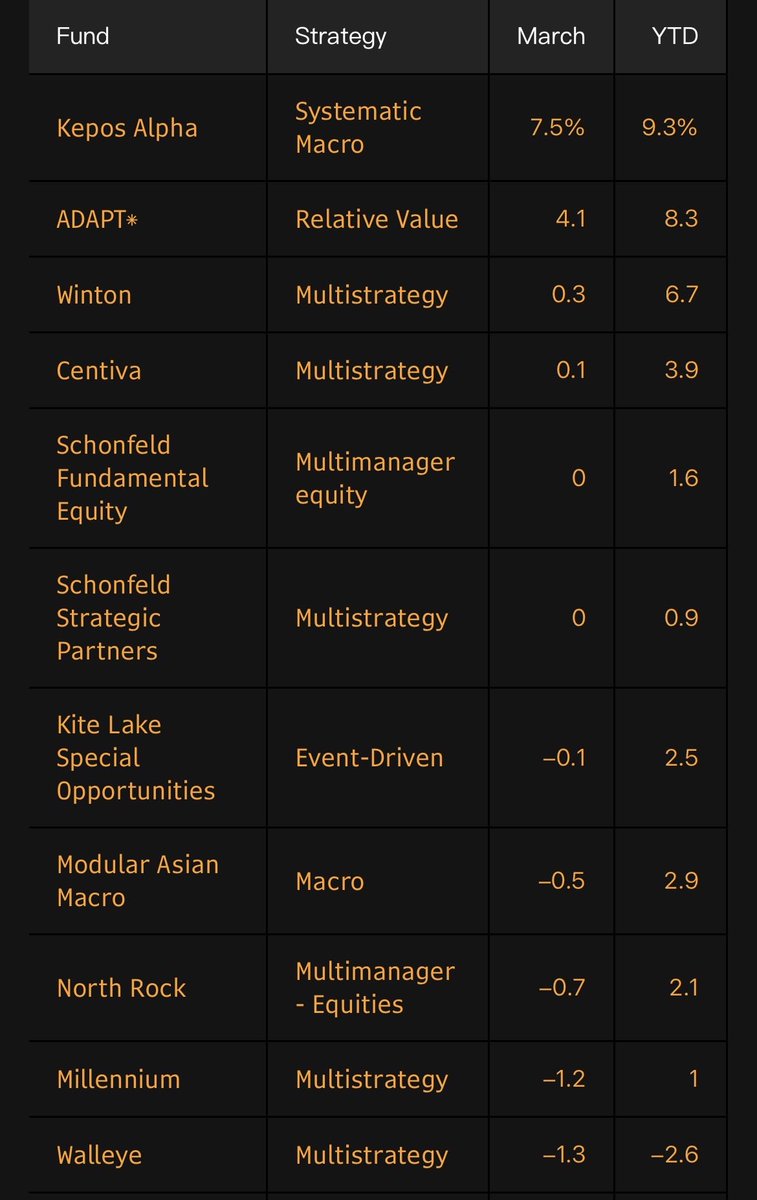
March was BRUTAL: Some of the world’s biggest hedge funds known for delivering steady returns lost money as the war in the Middle East roiled markets across energy, bonds and equities and forced traders to unwind crowded positions. Here are some confirmed initial estimates:
think this is worth reposting:
The NDFI-AI Infrastructure Complex:
Systemic Risk, the Legal Ecology, and Competitive Positioning
March 2026
I. The NDFI Structure
Bank NDFI loans: $271B (2015) to $1.3T+ (2025), 21.9% CAGR. Fastest-growing loan category. Excluding NDFI, aggregate bank loan growth is flat.
📷
Exhibit 1: H8 Bank Loan Asset Levels by Category, 2024-2026 (billions)
The regulatory arbitrage is structural. NDFI loans carry 20% risk weight vs. 100% for direct C&I. A $1B NAV facility to a private credit fund requires $16M in tier 1 capital; a direct loan to the same underlying borrower requires $80M. Risk weight is assigned at the entity level — the fund — not the asset level. Underlying portfolio quality is invisible to the capital calculation.
The FDIC finalized mandatory five-subcategory NDFI disclosure in May 2024: mortgage credit, business credit, private equity funds, consumer credit, other. Implementation deadline: Q4 2024.
JPMorgan — largest NDFI book at $237.85B (Q4 2025), growing 5.2% QoQ — filed its entire exposure as undifferentiated 'other.' Stated justification: 'organizational risk' of maintaining different subcategory distributions across FDIC and Fed filings. Every other G-SIB runs parallel regulatory reporting regimes. The actual constraint: JPMorgan's facility documentation, drafted by Cadwalader, uses contractual taxonomies that predate and do not map to the FDIC's five-category framework. Filing would make visible that loans internally classified as structured credit or C&I-adjacent appear as private equity fund facilities under the regulatory taxonomy. No enforcement action has been taken.
H8 NDFI series is contaminated. Apparent cross-category swings in Q4 2025 — NDFI decline concurrent with personal loan and C&I surges — reflect JPMorgan finalizing margin loan reclassification, not real credit flow changes. The charts below show the rolling annual change pattern and confirm that 'All Other Loans' is now the dominant driver of total loan growth, absorbing what was previously classified NDFI exposure.
📷
Exhibit 2: H8 Rolling Annual Change by Category, 2020-2026 (billions)
📷
Exhibit 3: H8 Rolling Annual Change by Category, 2024-2026 (billions)
Exhibit 3 isolates the reclassification event. The vertical step-change in 'All Other Loans' at Q4 2024-Q1 2025 — from ~$140B annual change to ~$500B — is JPMorgan's margin loan reclassification moving exposure from NDFI into adjacent categories. C&I and Consumer simultaneously go negative on an annual change basis. This is a reporting artifact, not a credit tightening event. The H8 NDFI series cannot be read as a pure flow indicator.
Industry-wide unfunded NDFI commitments: $987B (Q3 2025). These convert to drawn exposure simultaneously when NAV values decline and margin calls are issued across the system.
📷
Exhibit 4: H8 Rolling Annual Change as % of NGDP, 2024-2026
Exhibit 4 scales the flows against NGDP. Total bank loan growth is running at 2.6-2.7% of NGDP annually as of early 2026 — the highest reading in this window. 'All Other Loans' alone is contributing ~1.9% of NGDP on an annual change basis, entirely driven by the reclassification-inflated NDFI adjacent categories. Core bank loans excluding reclassification effects are running at approximately 0.4% of NGDP annual change, a fraction of the headline figure.
II. The Legal Ecology
Cadwalader, Wickersham & Taft is lender-side outside counsel on fund finance facilities for JPMorgan, Wells Fargo, Bank of America, Citibank, Deutsche Bank, HSBC, UBS, and 50+ additional banks simultaneously — often on the same syndicated transactions. Total lender commitments advised since 2018: $1.4T+. In 2024 alone: 1,142 transactions, $274.5B in lender commitments across 85 lenders.
This produces documentation standardization across the entire lender population simultaneously. Eligible investment definitions, concentration limits, NAV calculation methodologies, and cure mechanics are identical for every bank in each syndicate. Risk parameters are harmonized at the transaction level before any regulator reviews them.
Fund Finance Friday — Cadwalader's weekly newsletter — is the information coordination layer for the industry. When the FDIC issued its Q4 2024 Call Report guidance on NDFI subcategories, Fund Finance Friday published the regulatory interpretation. Banks' reporting decisions were informed by the firm drafting their loan documents.
JPMorgan's 'organizational risk' non-compliance is partly a Cadwalader documentation problem: the facility categories in existing loan agreements do not map to the FDIC taxonomy. The firm that created the documentation opacity is the firm interpreting the regulatory response to it.
On December 19, 2025, Cadwalader merged with Hogan Lovells — $3.6B combined revenue, 3,100 attorneys. The merger explicitly names two strategic rationales: fund finance dominance and AI innovation leadership. Hogan Lovells holds regulatory relationships with Google, Microsoft, Nvidia, Qualcomm across antitrust, IP, and transactional work. The combined firm now holds lender-side fund finance documentation for JPMorgan and Wells Fargo in one practice group while advising hyperscalers on AI regulatory matters in an adjacent group. The circuit between bank lender and AI infrastructure end-user is closed within a single partnership.
Cadwalader has held the CMBS issuer counsel top ranking for 26 consecutive years since 2000 — the same firm that documented the pre-GFC structured finance complex built the post-GFC NDFI fund finance infrastructure.
III. The Hyperscaler Transmission Chain
Big five hyperscaler capex 2026: $660-700B, up 36% from 2025. AI infrastructure share: ~75% ($495B). Combined capex equals ~90% of combined operating cash flow, up from 65% in 2025.
Amazon FCF: projected -$17 to -$28B in 2026. Alphabet FCF: projected -90% to $8B from $73B in 2025. Alphabet long-term debt quadrupled in 2025 to $46.5B. Morgan Stanley projects hyperscaler debt issuance exceeding $400B in 2026, more than double 2025's $165B. Total technology sector debt issuance projected at $1.5T over the next several years.
AI-related services revenue 2025: ~$25B. Annual AI infrastructure spend 2025: ~$400B. Revenue-to-spend ratio: 6.25%.
Goldman Sachs projects total hyperscaler capex 2025-2027 at $1.15T. At 20% annual depreciation, implied annual depreciation by 2030 on the planned $2T AI asset base: $400B — exceeding combined hyperscaler profits in 2025.
Three transmission channels into the banking system:
Channel 1 — IG corporate bond markets. Direct issuance by Microsoft, Alphabet, Meta, Amazon. Liquid, spread-priced. Credit risk visible and conventionally managed.
Channel 2 — Project finance and data center ABS. Hyperscaler-tenanted securitizations and Blackstone-structured CMBS flow through CLO and structured finance markets. Private credit fund holders of these structures are the NDFI borrowers at JPMorgan and Wells Fargo. Data center ABS is collateral inside NAV facilities underlying the NDFI book.
Channel 3 — Private financing. GPU-collateralized debt through CoreWeave SPVs, Nvidia equity investments in customers, bilateral credit facilities between hyperscalers and private credit funds. Outside public market reporting.
The circular structure: hyperscaler issues IG bonds or enters private credit arrangements — obligations held in private credit fund portfolios — funds borrow against portfolio via NAV facilities at JPMorgan and Wells Fargo — classified as NDFI loans at 20% risk weight. Hyperscaler credit risk is present in the banking system three steps removed. The risk weight applies to the NAV facility regardless of underlying asset quality.
Stress transmission mechanism: hyperscaler revenue disappointment reprices NAV of private credit funds — margin calls issued on NAV facilities — funds draw $987B in unfunded commitments simultaneously — funded exposure requires capital allocation — lending compression is the real economy transmission. Structurally identical to August 2007 ABCP market seizure.
Counter-argument (Paul Weiss, 2026 private credit outlook): hyperscaler-tenanted data center ABS is structurally insulated because offtake agreements are long-term and tenants are investment-grade. Lease payment default risk does not depend on near-term AI ROI. ROI risk runs through equity valuation and FCF compression, not lease default. This is a legitimate analytical position that weakens the deterministic version of the stress transmission argument.
IV. The VAR Failure and the Re-Correlation Mechanism
The Calibration Gap
The Fed's stress test capital allocation for NDFI uses historical loss distributions calibrated on 2008-2009 and the 2020 COVID shock. Neither episode contains a hyperscaler credit stress event. The private credit fund complex built on AI infrastructure ABS as NAV facility collateral did not exist in either period. The VAR model is calibrated on a loss distribution that structurally excludes the tail it is measuring. This is not a parameter estimation problem — it is a model specification problem. The loss-generating process for a NAV facility collateralized by hyperscaler-tenanted data center ABS during a hyperscaler revenue disappointment cycle has zero observations in the historical data.
For data center ABS backed by hyperscaler offtake agreements at current scale: the asset class has existed for approximately three years. The loss distribution is not estimated from a short history. It is not estimated from any history. The Fed's 7% NDFI loss rate under severely adverse conditions is produced by a model that cannot, by construction, generate the loss scenario that is the actual concern.
The Pre-GFC Parallel: Diversification as Documentation Artifact
Pre-GFC CDO tranching logic rested on statistical independence of mortgage defaults across geographies and originators. Diversification across pools was the mechanism by which subordination produced AAA ratings on subprime exposure. The VAR models were calibrated on periods when national house prices had never declined simultaneously. The correlation regime that would invalidate the diversification assumption had no historical representation.
When national prices declined simultaneously in 2007-2008, every tranche — AAA through equity — re-attached to the same root loss variable: correlated national mortgage default. The geographic and originator diversification that constituted the subordination no longer existed. The synthetic CDO layer compounded this: 100 reference entities across multiple originators appeared diversified. All 100 referenced the same root collateral type under the same macroeconomic shock. The diversification was a documentation artifact. No model operated at the system level asking what happens when the root variable moves and the independence assumption fails across every desk at every institution simultaneously.
The NDFI Analog
The diversification argument for NAV facility safety: private credit funds hold diversified portfolios across industries, geographies, and borrowers. A NAV facility against a fund holding 200 portfolio companies appears diversified at the facility documentation level.
Look through to root collateral: an increasing and unmeasured fraction of those portfolio companies are AI infrastructure businesses, hyperscaler vendors, or businesses whose credit quality embeds AI-driven productivity assumptions in their own borrowing capacity. The root variable is hyperscaler revenue materialization — the same variable across a growing fraction of the collateral pool regardless of company names in the documentation.
The Cadwalader documentation ecology is the mechanism by which this correlation is created and masked simultaneously. Standardized eligibility criteria and NAV calculation methodologies across 85 lenders were designed for genuinely diversified private credit portfolios. They were not designed to detect that an increasing fraction of eligible assets across all facilities are correlated to the same underlying AI infrastructure revenue variable. The documentation says diversified. The look-through says concentrated. No model is operating at the system level.
This is the pre-GFC error reproduced exactly: tranching and diversification documentation masking a single root variable exposure system-wide, with the correlation structure invisible until the root variable moves and re-attachment occurs simultaneously across all facilities at all institutions.
V. The Stress Test Problem
The Fed's June 2025 exploratory NDFI analysis modeled credit deterioration at leveraged NBFIs under the severely adverse scenario. Conclusion: 7% loss rate on NDFI exposures; large banks maintained minimum capital levels throughout.
The 7% figure is not analytically credible as a stress ceiling for three compounding reasons. First, it is calibrated on historical data with zero observations from an AI infrastructure stress event. Second, it took JPMorgan's undifferentiated 'other' categorization as given — a scenario cannot decompose exposure it cannot see. Third, it operated at the facility level, not the look-through level, and therefore could not detect the root variable re-correlation mechanism.
A 50% loss rate on the $1.3T book implies $650B in losses. At current G-SIB tier 1 capital levels this is not an isolated solvency crisis. The mechanism of loss materialization is a NAV facility liquidity seizure, not a gradual writedown process. Margin calls force simultaneous asset sales into a declining private credit market, accelerating NAV declines, triggering further margin calls. The $987B unfunded commitment drawdown is the transmission to the real economy — not the credit losses directly.
The Boston Fed (Fillat, Levin, Wang, May 2025) established that banks retain indirect exposure to private credit loan risk through the bank-BDC lending relationship even without direct origination — 'retained indirect exposure.' This is the Fed system's most precise articulation of the circular paper problem. It did not appear in the Board's June stress test methodology.
VI. Warsh Policy Transmission
Warsh formally nominated March 4, 2026. Blocked in Senate Banking by Tillis and unified Democratic minority. Powell chair expires May 15, 2026. Earliest Warsh leads FOMC: June 16-17.
Warsh's rate cut rationale: AI-driven TFP gains have shifted r* upward, making current rates restrictive. The argument frames cuts as normalization.
The NDFI-AI complex creates a specific policy transmission problem for this framing. Hyperscaler capex 2026: $660-700B. Debt-financed portion: $400B+. AI services revenue 2025: $25B. The productivity gains justifying r* reassessment are being borrowed against, not earned.
Primary beneficiaries of Warsh cuts: not the technology companies generating hypothetical productivity gains. The primary beneficiaries are leveraged private credit funds whose NAV facility costs are floating-rate and whose collateral is AI infrastructure assets priced at unvalidated revenue assumptions. Rate cuts extend the maturity runway for the circular paper structure without resolving ROI uncertainty.
The test of whether cuts are Fisherian or accommodative is sequencing: cuts fast then holds while drift completes vs. cuts gradually and indefinitely as the private credit complex requires continued floating-rate relief.
Signal fidelity is impaired at entry. Warsh was nominated while Powell is under criminal investigation and Cook was fired. Markets cannot distinguish genuine r* reassessment from political accommodation by an appointee whose primary financial beneficiaries are the private credit funds his cuts would relieve.
VII. Competitive Positioning: The JPMorgan GFC Template
JPMorgan's pre-GFC position was not accidental. In late 2006, internal risk managers conducted a look-through analysis of MBS and CDO exposure and concluded that the correlation assumptions embedded in tranche documentation did not reflect actual underlying pool behavior. They reduced exposure, tightened eligibility criteria, and hedged residual positions — not because they predicted the crisis but because their internal model produced a different answer when they looked through documentation to the root collateral variable.
The competitive payoff was not just lower losses. Preserved capital and balance sheet capacity allowed JPMorgan to acquire Bear Stearns and Washington Mutual at distressed prices and gain market share across every product category where competitors were retrenching. Analytical correctness translated into strategic optionality that compounded for a decade.
The NDFI-AI analog has the same structure. The look-through analysis is bounded and executable: for each NAV facility, identify top portfolio companies by NAV weight; classify as AI infrastructure direct, AI infrastructure vendor, AI-productivity-assumption-dependent, or uncorrelated; aggregate across facilities. Output: a root variable concentration number — the fraction of NAV collateral that re-attaches to hyperscaler revenue materialization under stress. Compare to what the 20% risk weight and internal VAR imply. The gap is the number that matters.
Three positioning options if the gap is material:
Capital reallocation. Reduce NDFI exposure where look-through concentration exceeds an internally defined limit, freeing capital before stress forces it. Competitors carrying inflated NDFI books at 20% risk weight through the re-correlation event will be capital-constrained precisely when acquisition and deployment opportunities peak.
Repricing. NAV facilities with high AI infrastructure look-through concentration should carry wider spreads than the standard Cadwalader eligibility criteria produce. Competitors using standard documentation are underpricing that risk. Correct pricing either wins the business at appropriate return or loses it to an underpricing competitor — the correctly priced book is the safer one either way.
Acquisitive optionality. Private credit funds that cannot refinance NAV facilities when collateral values decline will need capital. The institution that preserved balance sheet capacity is the counterparty with negotiating leverage.
The proactive supervisory variant: use the systemic argument — VAR calibration gap, re-correlation mechanism, Cadwalader documentation ecology — as the basis for a supervisory engagement framing it as an industry methodology problem. An institution that surfaces a systemic risk analytically to its regulator before the event has a supervisory relationship competitors who were silent do not.
The timing disanalogy with 2006: JPMorgan reduced exposure 12-18 months before crisis. The hyperscaler revenue validation question has a longer and less certain timeline — potentially three to five years if rate cuts extend the maturity runway. JPMorgan's answer was not full exit. They sized remaining exposure for the capital they were willing to put at risk, hedged the residual, and maintained market presence to stay informed. That is the available template: define an internal look-through concentration limit, size NDFI participation within it, reprice above the threshold, hold the capital that competitors are deploying into the unidentified tail.
VIII. Analytical Coverage
Boston Fed (Fillat, Levin, Wang): bank-BDC retained indirect exposure. Does not cover AI infrastructure layer or legal ecology.
Jill Cetina (Texas A&M, former Dallas Fed VP Supervision): board-level capital adequacy gap between 20% risk weight and economic substance. Does not cover hyperscaler channel.
State Street credit research: interconnectedness measurement and SRT reversion risk. Does not model AI capex ROI as collateral quality variable.
FDIC Risk Review 2025: documents NDFI growth and concentration facts. Does not model hyperscaler dependency.
Paul Weiss 2026 private credit outlook: hyperscaler-tenanted data center ABS structurally sound because offtake agreements are long-term and tenants are investment-grade. Legitimate analytical counter to the deterministic stress transmission argument.
Dimon, October 2025: 'When you see one cockroach, there are probably more. Everyone should be forewarned on this one.' Made in context of Tricolor loss. Dimon does not make that statement without a specific internal view of what the 'more' consists of.
No public analysis connects: hyperscaler capex ROI uncertainty as collateral quality variable inside NAV facilities — those facilities as operative instrument of the NDFI book — Cadwalader documentation ecology as mechanism standardizing risk across 85 lenders simultaneously — JPMorgan classification refusal as specific opacity preventing stress test penetration — VAR calibration on a historical distribution with zero AI infrastructure stress observations — re-correlation of NAV collateral to a single root variable under stress — Warsh AI productivity argument as policy framing extending maturity runway while ROI uncertainty remains unresolved.
IX. Analytical Limits
Each node in this chain has documented evidentiary support. The connections between nodes are analytical judgment, not documented consensus.
The Paul Weiss counter-argument on data center ABS lease structures is the strongest challenge to the deterministic version of the stress transmission chain. Long-term investment-grade leases may insulate NAV facility collateral from near-term AI revenue disappointment. The stress transmission is probabilistic. The precise probability weight depends on hyperscaler credit outlook over a 15-year lease horizon.
The factual substrate — NDFI growth figures, JPMorgan non-compliance, Cadwalader transaction volumes, Fed stress test methodology, hyperscaler capex and FCF projections, Hogan Lovells merger terms — is independently verifiable. The chain as a whole is synthesis. The synthesis is worth taking seriously. It is not as proven as the momentum of the analysis implies.
March 2026. Analytical synthesis from public sources. Not for distribution.
Ouch! Everyone’s distracted by the Iran headlines; meanwhile VW just announced profits halved, Porsche barely salvaged, tariffs wrecking margins, and 50,000 jobs on the chopping block. Germany is bleeding!
The @profplum99 piece really resonates and is going viral for good reason. But it’s appalling that the penny is only dropping now. This analysis I dare say will be replicable in most Western economies. Yes we may have more welfare in Europe but we have much less growth and salary growth. We also don’t have 401ks and so are equity poor, and in many countries there is very little worker housing equity. As for child costs, our labor laws now make it impossible to afford official help at all. Parents have to be “employers” responsible for maternity, pensions and all sorts of other variables. Fine if you’re a millionaire. Not fine if you have to have two incomes to get by.
Remember the likes of the FT and the Economist were convinced that the populists were all wrong. Globalisation was making us all richer, the Gini coefficient proved it. Voting against more globalisation was self sabotage.
But most people, especially the working classes didn’t feel that way at all. And understandably hit out. For which they got vilified by the elites at Davos.
I have for years argued about some other silent drivers of this growing cost of living struggle, which even now are not fully appreciated.
1) technology and the internet haven’t been the lifestyle boon many argue because many of the costs were disguised via two sided product structures or monopolies. Meanwhile, productivity was undermined by the fact that for every positive sum economic behavior tech accelerated it also accelerated the equal and opposite negative sum behavior. Outcome: a sisyphus economy.
2) The rising debt that we were told was sustainable came with the loss of govt seigniorage profit retention. This was either transferred to foreign countries or domestically to banks, and it was western workers who had to pay for it. So not only did the taxpayer bail out the banks in 2008, due to the post crisis collapse of banks’ return on equity, all of the seigniorage that was being transferred to banks wasn’t even making its way back into people’s 401ks, it was increasingly going to banker salaries.
3) as the cost of participation soared, elites consciously or unconsciously addressed the problem NOT by trying to address the above problems but by importing more people who were used to living below the poverty line and prepared to keep the unsustainable economics of the “unproductive globalised tech economy” going.
But these people - due to the lower costs of connectivity and access to local-language media even when abroad - increasingly didn’t need to integrate or adjust to Western values. They could live in Britain but be tuned out of local affairs and sensibilities, preferring to watch home country content instead. The result? The breakdown of the cardinal rule of healthy migration: “when in Rome”. And with that the rise of a local population perception that this wasn’t helpful migration but occupation, and life under a foreign yoke.
4) ESG was a far more costly and reflexively negative sum exercise than most people realized, and just magnified the above forces.
Now that the economic crisis the working class have been subjected to since 2008 is shifting with intensity to the middle classes - turning them into the Not Managing Anymores - the political blowback against luxury beliefs is going to get considerably more intense.