Some of my favorite ETA/search resources compiled from my bookmarks (1 of 16 posts):
1. SDE vs EBITDA vs Cash Flow - @guessworkinvest
https://t.co/arJtUCMSJD
Here are 35 non-SBA debt providers who look at deals as low as $2m of EBITDA:
Each attended the McGuire Woods Independent Sponsor conference last year and shared in their perferences that they were:
- open to backing first-time buyers/sponsors
- open to backing one-person buyers/sponsors
BANKS
Associated Bank, Cadence Bank, Dallas Capital Bank, First Merchants Sponsor Finance, Grasshopper Bank, Hancock Whitney Bank, InBank, Live Oak Sponsor Finance, Main Street Bank
SBIC, MEZZANINE & LMM FUNDS
Capitala Group, Chatham Capital, Convergent Capital Partners, Five Points Capital, Mizzen Capital, Northcreek Mezzanine, Plexus Capital, Providence Investment Partners, Resolute Capital Partners, Route 2 Capital Partners, Saratoga Partners, Seacoast Capital, SharpVue Capital, Stonehenge Capital, Walnut Capital Partners, Z2 Capital Partners
PRIVATE CREDIT & DIRECT LENDERS
Advantage Capital, BXR Group, Cortland Credit, Flatbay Capital, Ghost Tree Partners, Hestia Holdings, Ivy Asset Group, Silverview Credit Partners, STORE Capital, YEH Capital
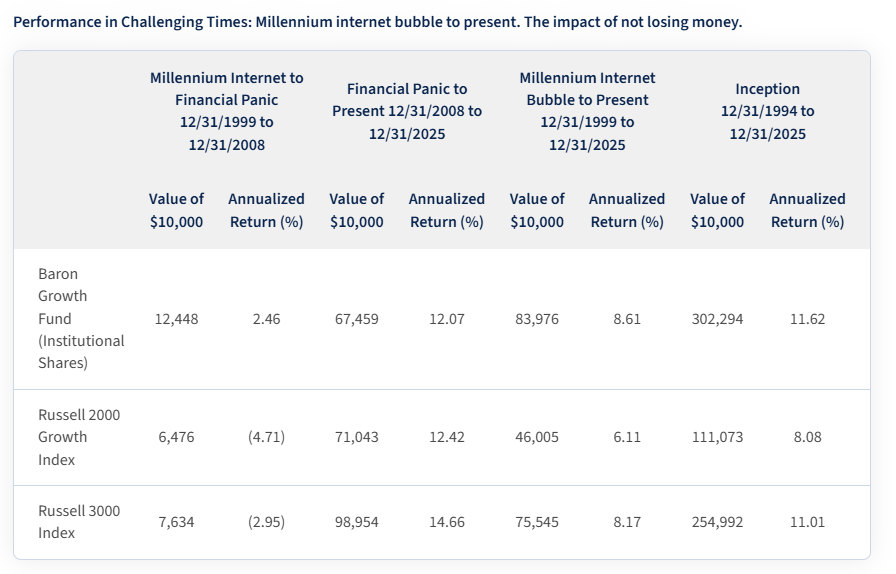
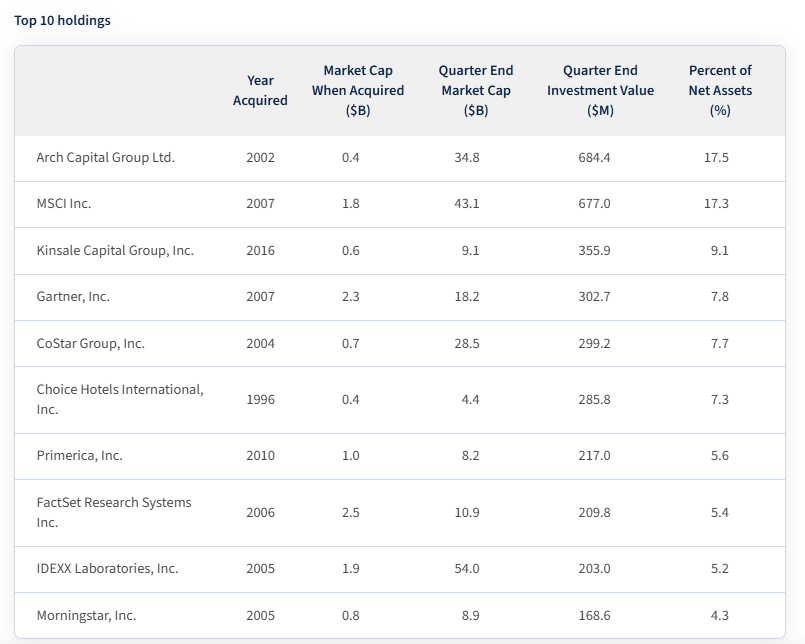
Ron Baron - Baron Q4 2025 Commentary - Baron Growth Fund
'We hold investments for the long term. As of December 31, 2025, our weighted average holding period was 18.6 years. This is dramatically longer than most other small-cap growth funds, which, according to Morningstar, turn over about 72% of their portfolios annually based on an average for the last three years.'
'As of December 31, 2025, we owned 19 investments. The top 10 holdings represented 87.2% of the Fund’s net assets, all of which have been held for a minimum of nine years. All were small-cap businesses at the time of purchase and have become top 10 positions through stock appreciation.'
'Our holdings in these stocks have returned 18.0% annually based on weighted average assets since our initial investment, exceeding the Benchmark by an average of 9.3% annually.'
'We attribute much of this relative outperformance to the superior growth rates and quality exhibited by these businesses relative to the Benchmark average.'
https://t.co/jafqh1IEzA
BREAKING: AI can now analyze stocks like Wall Street analysts (for free).
Here are 10 insane Claude prompts that replace $2,000/month Bloomberg terminals (Save for later)
BREAKING: AI can now do market research like McKinsey (for free).
Here are 12 insane Claude Opus 4.6 prompts that replace $5,000 consultant: (Save for later)
Great read. I was at Heinz when 3G acquired us in 2013. I worked my way up the org, then was part of the very small team who integrated Heinz and Kraft during the 2015 "merger" to create Kraft Heinz.
To give you a sense of the cuts, they gave me the ~$2B consolidated KHC condiments portfolio to run.
This group had ~75 people. Post merger I think I got 7.
I left in 2015, so my thoughts are probably obsolete now. But I was on the "inside" of 3G for a bit, so figured I'd add my 2 cents.
What 3G got right:
- Most big companies are shockingly bloated. Massive cuts can be made w limited actual business impact.
- The rigid "you have to be in X seat for Y years to be promoted" is ridiculous. 3G set a culture where the best would be promoted quickly - which actually rewarded high performance. It was competitive, but the top performers loved it.
- There's always $ to be found. 3G would set seemingly impossible cost cutting goals, which would routinely be achieved.
- A culture of cost efficiency. The double sided print and taking coffee from the break room stuff always got publicity, but it was more about sales people not flying first class and ordering $400 bottles of wine. I'll always remember representing Heinz Ketchup rolling up to an important Walmart Exec meeting in a shitty $25/day rental car. 😂 I forget the annual $ travel savings, but it was a staggering number.
- A more focused strategy on fewer, bigger bets. CPG has a tendency to maintain the status quo. Many companies half invest and half focus on a bunch of brands. 3G would divest resources (team and $) from non-focus brands to put towards higher potential brands.
- Heinz was a private co from 2013 until the KHC merger in 2015 and the 3G playbook was actually working from a financial perspective. Few know this bc it wasn't public.
What 3G got wrong:
- Related to the above bullet, their eyeballs were bigger than their wallets. They couldn't leave well enough alone. The financial structure didn't enable them to just focus on one business for an extended period of time. It was always predicated on the next big thing. There was a failed takeover attempt of Unilever (hilarious in hindsight) before the Kraft merger. The string of acquisitions over a ~5 year span was wild. It was aggressive, chaotic, and unfocused.
- Kraft was way bigger than Heinz. It was a bass trying to eat a shark. I don't sense they truly understood the implications of this.
- Lots of large egos at 3G who would routinely talk about massive empire building, crazy goals of industry market share, etc. Weird "take over the world" vibes, with seemingly little appreciation for what it would take to execute.
- The human side of business. For instance, the integration of KHC was a disorganized shit show. Everyone at Kraft knew exactly what was coming, but the human side was handled very poorly. Lots of talented people jumped ship right away, but if it was handled better I know some of them would've stayed/thrived.
- Post merger KHC was back as a public co and it was all about Wall St optics. We ran a Super Bowl commercial to show Wall St we were "investing in marketing", but in reality nearly all brands suffered massive marketing cuts.
- It's funny to me to see Zero Based Budgeting always get so much publicity. Yes, it was an internal process. And yes it helped set the cultural tone. But it was far from a finely oiled machine. It was mostly run by entry level employees who (respectfully) had little idea what they were doing and how decisions impacted the business. It was more of a charade than anyone was willing to admit.
- They went scorched Earth on suppliers in the name of cost cuts. Lots of multi-decade vendor relationships severed to hit short term profit goals. And yeah, that went as you'd expect.
I could write hundred of pages on this, but in sum, I think they fundamentally under appreciated the human element of business and the role of short term vs long term thinking.
Also, the (in my opinion excessive) financial engineering game has a lot of negative downstream impact. Much of which can be difficult to foresee in the moment. It's great until it's not.
I left in 2015 and sold all my stock bc it was obvious to me the KHC experiment wasn't going to work. Sadly a decade a later I was right.
I don't harbor any ill will though. I learned a ton during my time there and I still have friends at KHC (or whatever it is now). Truly wish them the best.
And I've still got Heinz Ketchup in my fridge.
I built an analysis of the 50 best and WORST industries for acquisition in 2025.
50 industries. 20 factors. one ranking per industry.
To get a copy of the analysis, RT and comment "industries"
I built an analysis of the 50 best and WORST industries for acquisition in 2025.
50 industries. 20 factors. one ranking per industry.
To get a copy of the analysis, RT and comment "industries"
Took a break from Twitter for a long time. Thought I'd come back to survey the universe for a provocative question I'm asking with some people close to me to see what people think ...
@DrBenjaminHardy At our upcoming offsite, we plan to use @DrBenjaminHardy's frameworks to think about fundamentally reconstructing what we do to achieve outrageously better outcomes in exceptionally faster times.