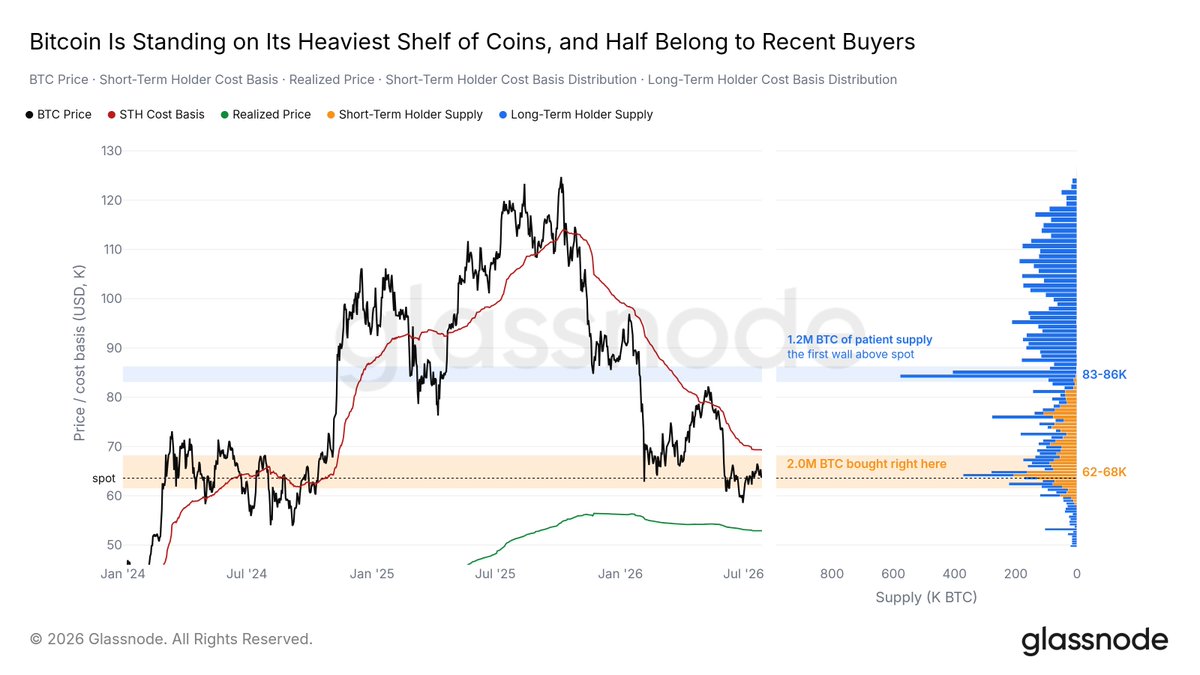
The market has gone very quiet: spot volumes, exchange flows, and vols are sitting at the extremes.
Meanwhile treasuries have out-yielded the crypto carry trade for only the second time on record.
Read the full Week on Chain Report "Paid to Wait" here
https://t.co/0N223k7Fgr
Kimi K3 can now be run locally! ✨
The 1-bit model retains ~78.9% accuracy after we shrunk it from 1.56TB to 594GB (-62% size).
Run on a Mac Studio + 128GB RAM device.
Kimi K3 is the strongest open model to date.
Guide: https://t.co/1mVwOMLpDW
GGUF: https://t.co/bt1c1ADdCZ
this is f**king insane
a free github repo by Jack Dorsey (Co-Founder of Twitter) with 14.4K stars just dropped the entire "ai-agent" framework for running businesses
here is how you set it up:
1.clone the repo
2. self-host the server : channels, search, git, automation all live there
3.add your agent to a channel like a teammate, scope its key, let the team steer it live
save and bookmark this no matter what
Anthropic engineer just released a 2-hour workshop on "Graph Engineering" for agentic systems:
“80% of our engineers are using self-improving loops. Now everyone is building agentic graphs.”
• 00:00 - Introduction to RAG & Graphs
• 06:39 - Core of "Graph Engineering" (state, nodes)
• 14:29 - 3 feedback loops of Graph agents
• 23:06 - Agent evaluation with Graphs
• 36:29 - Agent cycles in graphs
• 1:15:22 - Agentic RAG & agent context
• 1:41:20 - Evaluation datasets based on Graphs
This 2-hour workshop will replace 10 paid courses on agentic engineering.
Watch it today, then learn how to become a Graph Engineer in the article below.
this is worth more than most five figure courses
16 claude agents audit an entire repo at once, a second fleet re-checks every finding on fresh context, and the whole thing runs off one diagram instead of a prompt
i ran it against my own code and got back 11 endpoints where i never checked who was logged in, 3 of which the verifier threw out before they ever reached me
this is Graph Engineering, the layer above prompting, and it runs on the agent you already pay for:
- write your plan out, then ask one question at every "and then": does the next step actually read what the previous one produced
- the seams that fail that question were never dependencies, so those jobs run at the same time
- the arrows that survive are your real edges, and the longest chain of them is your floor that no number of agents shortens
- want it faster, cut a false edge instead of adding a worker
- fan the independent work out, one agent per item, no shared state between them
- send every finding to a separate agent on fresh context, because a model recognises its own writing 73.5% of the time and grades it kinder once it does
- make that verifier check a real signal like a passing test, never the worker's own word that it finished
- shard the fleet across worktrees so parallel workers stop overwriting each other, one rule frozen into every worker: never git stash, never git reset
- merge only what came back verified, into one report instead of twenty open chats
the catch is the ceiling. at 95% independent work 16 agents return 9.14x rather than the 16 you would guess, and even 256 only reach 18.6x, because the merge and the verify stay serial however wide you fan
coordination itself is free plain code and every agent underneath it is billed, so start at twenty files and widen once it works
bookmark this, the whole method with all six ready-to-run graphs is written out in the article ↓
an anthropic engineer just showed how they build agents that get smarter on their own
in 32 minutes, lamis mukta breaks down the exact memory system behind anthropic's self-improving agents
they call it graph engineering: you design how the ai works, and the agents rewrite their own memory overnight
the method:
memory is plain markdown files the agents read and write themselves, no vector database
the agents decide what to save and what to pull, right inside the task
an offline pass they call dreaming reviews past sessions and rewrites the memory where the agents keep failing
next run every agent is faster, cheaper, and more accurate, with zero retraining
i've sat through a lot of agent talks, this is the clearest breakdown of the memory part i've found
worth more than any paid agent course
watch and bookmark it, then read the full graph-engineering breakdown below ↓
Andrew Ng just dropped 8-page PDF on 4 agentic steps "from Loops to Graphs from scartch"
The twist: agent has amnesia without both: Loops let agents think - Graphs let agents remember
here's 4 workflows, step by step:
step 1 → reflection - agent writes, second prompt critiques, agent rewrites - one self-review loop beats a smarter model with none
step 2 → tool use - give it search, code execution, APIs - thinking without tools is hallucinating
step 3 → planning - break the task into JSON steps before running - Step fails? Agent replans around it
step 4 → multi-agent - stop running one agent - run a team - one codes, one reviews, one tests
how to wire this today:
step 5 → add one critique call after every generation - 10-30% quality lift, one day of work
step 6 → connect all 4 into a graph - agents share memory instead of transcripts - agent forgets, graph doesn't
the result: a weak model with 4 steps destroys a strong model without them - same cost, it's the architecture
this 8-page PDF is what comes after loop engineering
save this - then read the full build workflow in the article below ↓
WAIT... WHAT!!
Anthropic burned $3 million and 30 months running AI agents against real tasks in real companies and published everything in 12 pages and the people who read those 12 pages this week are going to make decisions about how they build and work that are fundamentally different from the people who scroll past it thinking they already understand what AI can do.
1,287 real tasks. 2.4 million lines of code. AI outperforming humans on their own projects. 63% of routine work automated. Engineer output multiplied three times with the right memory and the right cycles.
Someone paid $3 million so you could read that for free and most people are going to bookmark it and never open it again which is the most expensive free resource in the history of AI research.
But here is the gap that the 12 pages do not close.
Knowing that the right system multiplies output three times and knowing how to build that system are two completely different things and the second one is where everyone gets stuck and stays stuck while the people who figured it out quietly operate at a different level.
My article is the bridge between the $3 million research and the actual system build and it is the thing you read immediately after you bookmark those 12 pages.
Do not let this be another thing you meant to act on.
Full guide below.
Solana rotates block production to a new leader every 1.6 seconds.
This epoch, 67% of blocks are being produced in Europe.
Our dashboard helps users identify optimal connection points to minimize latency.
Frankfurt average: 72ms. US East average: 140ms
https://t.co/9e79bT86FR
Hedges are off, shorts are closed, and ETF flows have flipped positive.
What bitcoin:native needs now is confirmation at the Short-Term Holder Cost Basis at $69k; rejection there puts the lower demand shelf back in play.
Read the full Week On-Chain report👇
https://t.co/erjeVr0OYn
A guy just turned standard home Wi-Fi into a radar that sees through walls.
Over 62,000 stars on GitHub for a system that tracks humans without using a single camera lens.
It doesn’t just know you’re there.
Watch what happens when a person lies down on a bed in another room.
The AI instantly maps their exact posture, tracks their breathing, and calculates their heartbeat in real-time.
No optical surveillance, no privacy leaks - it just analyzes how your body disrupts ordinary radio waves.
The whole thing runs on a tiny $5 microchip.
Traditional security requires a direct line of sight and invades your personal space.
Now, your Wi-Fi router is a camera that sees through solid brick.
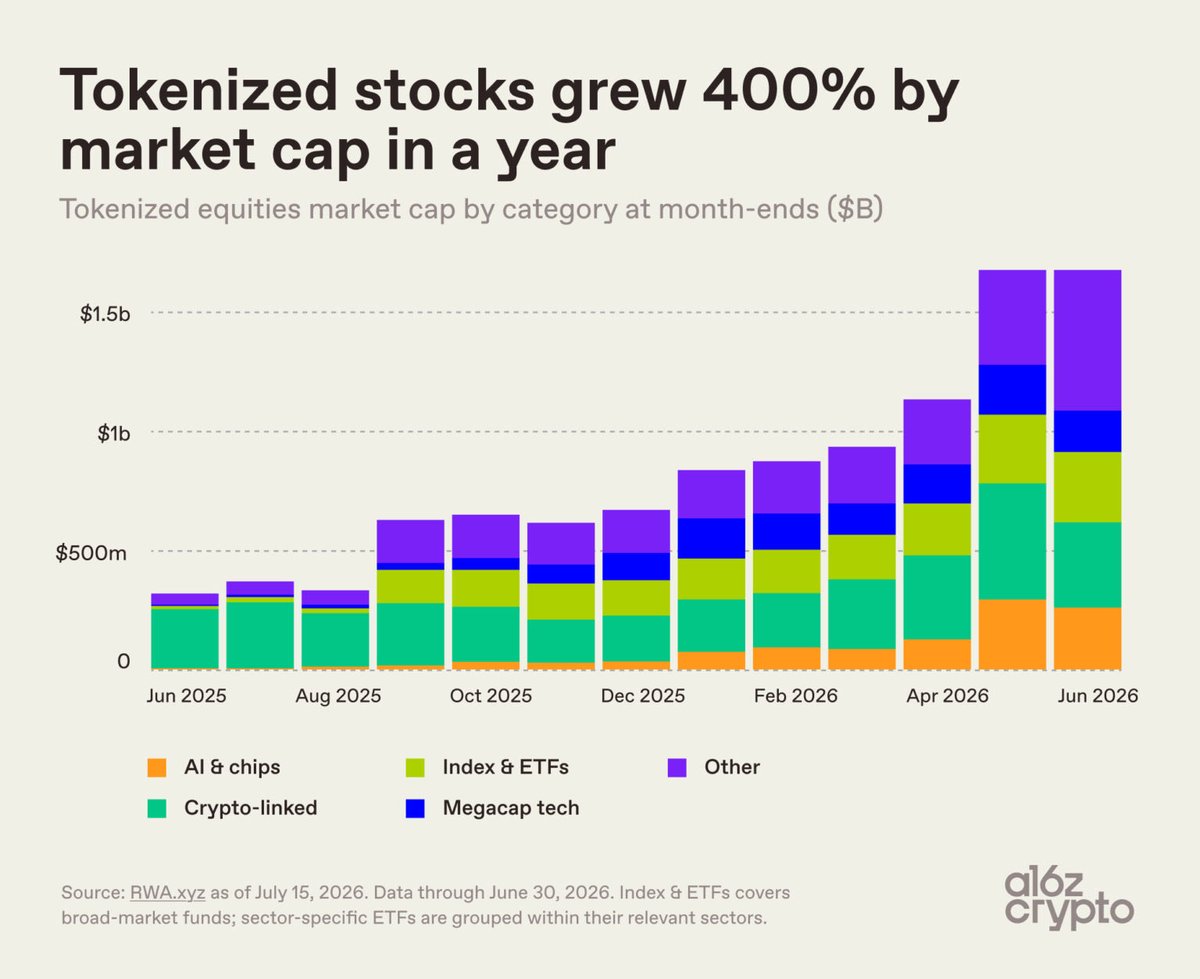
While the market for tokenized stocks is new, its composition has already changed greatly in the past year.
Crypto-linked products once dominated the market, but their share by market cap has dropped to 21% (as of June) from 79% a year earlier. They have lost the top spot to the "other" category — a long tail of hundreds of smaller listings — that now makes up 35% of the market, up from 15% a year earlier.
The rest of the market is climbing too. Megacap tech — tech companies with a market cap around $100 billion or more — now make up 10.6% of the market by market cap as of June, up from 0.6% a year ago. ETFs and indices grew to 17.3% of the market in that same period, up from 4.5% a year earlier.
The fastest riser has been, unsurprisingly, the AI and chips category. The category vaulted from less than $1 million in June 2025 — 0.3% of the market by market cap at the time — to 15.5% of the market as of a year later.
The latest from Michael Howell, Ray Dalio, and Jordi Visser suggests the market is still positioned for yesterday’s liquidity regime, while the next asymmetric opportunity may be in cash and long-duration bonds rather than commodities and broad risk.
Data from the following podcasts:
Michael Howell, Real Vision with @AshBennington (July 13, 2026)
“The Next Phase of the Liquidity Cycle.”
@RayDalio, @myfirstmilpod (July 17, 2026)
“The One Rule That Cuts Investment Risk by 80%.”
Jordi Visser, The @APompliano Podcast (July 18, 2026)
“The AI Trade’s Fireworks Show Is Over, and Bitcoin Is the Only Moat Left.”
Support your Thesis with podcast data, on Artemis
The market cap of tokenized stocks reached about $1.7 billion at the end of June, up from $329 million a year earlier — more than 5x growth. This makes tokenized stocks one of the fastest-growing categories of tokenized assets (which some refer to as real world assets).
Unlike stablecoins, whose circulating supply is a direct proxy for demand — one token, one dollar — tokenized stocks move with their underlying equities, so “market cap” does not cleanly separate the effects of new tokens minted and existing tokens repricing.
The evidence points to issuance though. More than half of today's market cap sits in assets that weren't onchain a year ago. And most of the remaining balances arrived mid-year — after much of the period's price movement in the underlying stocks had already occurred.
Crypto withdrawals in Thailand used to be a lot easier before regulations tightened.
A quick reminder for the OGs 🇹🇭
2014–2019
https://t.co/gjBrRDNbW7 made buying and selling BTC ridiculously simple with local bank transfers. You could even cash out at a bank branch without having a bank account, just a PIN code and your ID.
https://t.co/tbKVezHmqU was Thailand's largest Bitcoin exchange through this era too with KYC relatively light by today's standards long before today's stricter AML requirements. BX shut down in 2019.
https://t.co/NzDfwdOTj9 was the first widely used P2P marketplace.
2019–2021
Bitkub became the dominant local exchange after BX shut down. Binance P2P ran in parallel as the main unofficial route, you could even withdraw cash from an ATM without a bank card.
2021–2024
Bitkub went mainstream in Thailand. Binance P2P stayed widely used while OTC desks handled larger cash transactions off-platform.
2024–2026
Thailand launched Binance TH through Gulf Binance while enforcement against unlicensed crypto businesses ramped up significantly.
Today, if you want to stay fully within the rules, use a licensed Thai digital asset exchange:
- Binance TH
- Bitkub
- Upbit Thailand
- Orbix Trade
- WAAN Exchange
- KuCoin Thailand
The wild west days are over
$IOVA Biotech stocks are projected to extend rally amid innovation and M&A, says Goldman Sachs. https://t.co/twyk3lpsuq
Well, aren’t we fortunate to be backed by Wayne Rothbaum (billionaire, famous for his M&As deals) and Steven A. Rosenberg (considered the father of Cancer Immunotherapy).
Not to mention @IovanceBio has one of the deepest and widest pipelines for solid tumours on Earth, owning the only FDA approved TIL manufacturing centre in the world and potential best in class NSCLC.
#XBI #LABU #FIRE #NSCLC #sarcomas #cancer #biotech #biotechstocks