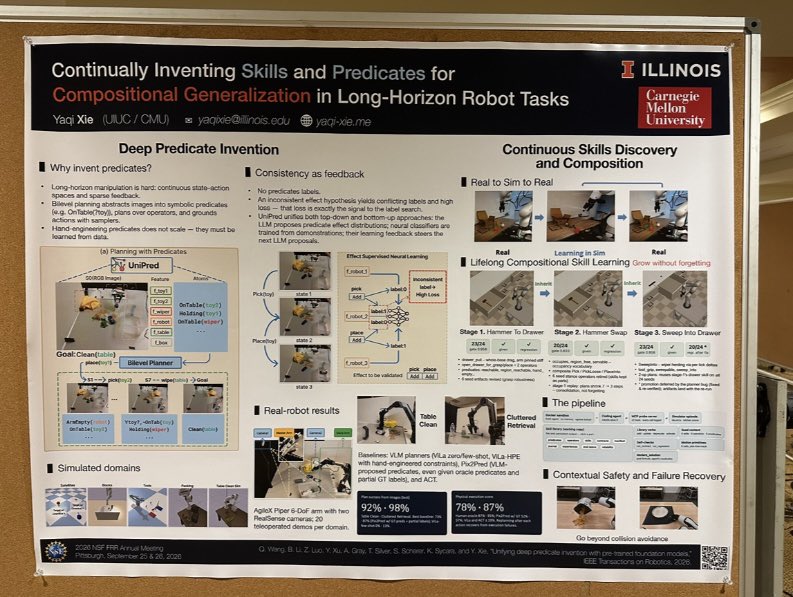
I'll be at #IROS2026 all week. Would love to chat! Happy to share what I've been excited about lately on continually inventing skills and predicates for compositional generalization in long-horizon robot tasks.
And glad to meet prospective students!
I’ve seen robots do plenty of unexpected things. That usually means it’s time to fix a bug. This new project is one of only a few times in my career where I’ve seen robots do things that are unexpectedly clever—that none of us on the project anticipated.
A few examples...
We put a lot of effort into making the experimental setup clean and relatively strict, and hope the sandbox can be useful for future agent evaluation. Also don’t miss the qualitative examples, where the agents came up with some pretty interesting strategies 👀
Hungry for more Astra robot videos? 🤖
How about a large-scale sandboxed evaluation to go with it? We ran 98,000 evaluations across 28 simulated environments and found some surprisingly clever physical reasoning along the way!
New preprint 🧵👇 (1/9)
Hungry for more Astra robot videos? 🤖
How about a large-scale sandboxed evaluation to go with it? We ran 98,000 evaluations across 28 simulated environments and found some surprisingly clever physical reasoning along the way!
New preprint 🧵👇 (1/9)
How should we build long-horizon manipulation systems? As coding agents become more capable, what interface should connect models to the physical world? We’ve been thinking about this since 2024.
Introducing Retriever, a programming framework for asynchronous, closed-loop robot systems, built over the past year at Stanford and Northeastern.
- Robot agents run in physical time with various feedback loops, currently lacking a good programming abstraction.
- Retriever introduces a time-aware building block, “Flow”, analogous to a PyTorch layer or a Ray Actor.
- Users connect Flows and specify when each runs and what inputs it reads. Retriever handles asynchronous execution.
- Agents are represented as directed graphs with temporal feedback loops for closed-loop, hierarchical systems, decoupling algorithm logic from execution.
We built Retriever-0 agent to demonstrate long-horizon, partially observable tasks combining perception, memory, reasoning, and manipulation.
Here's the system in action. Paper, code, and demos below.
We're excited to announce the 4th Workshop on Learning Effective Abstractions for Planning (LEAP) at #CoRL2026!
Previous LEAP papers have gone on to win awards at main conferences (SymSkill, Universal Visual Decomposer). Yes, we'll take all the credit!
Workshop link 👇
Thrilled to be bringing NERC to Princeton this fall!
Junior students: NERC is a great first conference (see the travel grants!)
Senior PhDs & postdocs: NERC is a great launchpad (see the Rising Stars track!)
Please help us spread the word 🙂
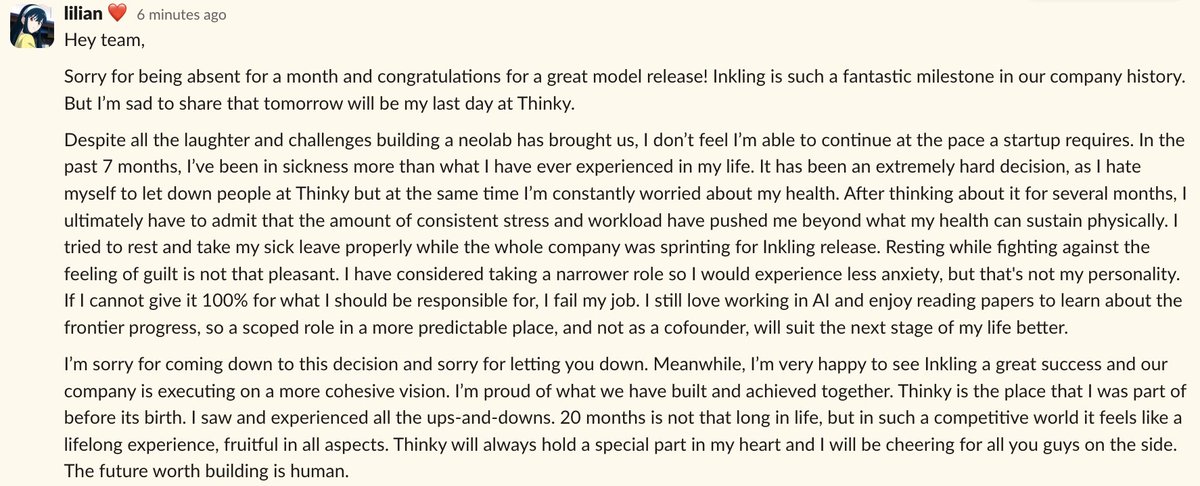
It is a hard and sad decision. I shared this message with folks at Thinky. Thank you all for the time together♥️ Just as the last sentence in my message: The future worth building is human.
Very excited to share that I'll be joining UIUC ECE and CS (affiliate) as an Assistant Professor @UofIllinois
I'm recruiting PhD students, interns, and postdocs to build trustworthy AI agents and robots that reason, learn, and grow alongside humans. If you're interested in joining my lab at UIUC, reach out at [email protected]
Many thanks to my advisors and collaborators for all their help and support! @haroldsoh @ Katia_Sycara @RamananDeva @ Alexander_Gray @ David_Hsu @ksmeel @ Mohan_Kankanhalli @joecampb@SimonStepputtis @ Woojun_Kim @yswhynot
Mondo's Beni (https://t.co/JAkuATnlS6) may look cute, but there is a serious learning stack inside. It can perform flips, navigate autonomously, and track moving subjects. The secret is reinforcement learning: Beni practices at massive scale in simulation, optimizing its controller through millions of virtual trials before entering the real world.
Here is a thread on some of the research ideas and tools used by Beni: 🧵
I thought I was done when the season ended. I wasn't ready to announce it, and I knew I needed some time to really decide, but I was pretty sure I played my last game. I was honest at that last press conference when I said I needed to look at myself and deicide if I still love
New blog post:
https://t.co/T29LEH7lpY
This is the second in a "series" of posts about how to define and work on research problems. (The first post was 3 years ago...)
This one addresses the agentic elephant in the room.
Monday thoughts:
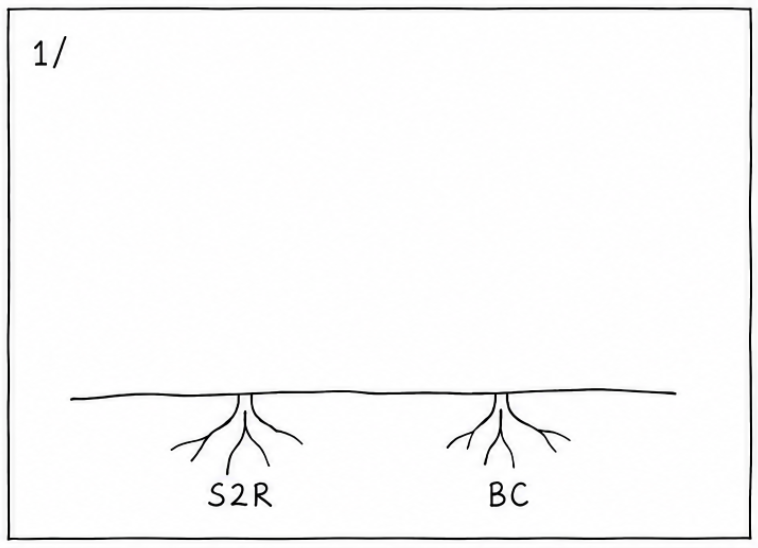
Since deep learning, there are two “root-level” paradigm shifts in robot learning: Sim2Real for locomotion and Behavior Cloning (BC) for manipulation. 1/
@YixuanHuang13 and I had three goals this year: build solid infrastructure, articulate the problem he wants to solve (KinDER, RSS 26), and clarify the SOTA (this survey). It took restraint not to chase flashy demos, but the groundwork paid off: we have a much clearer vision now!