@dan__rosenthal Completely agree. The title gets misunderstood when people reduce it to cold email automation. The valuable GTM engineer is really designing the revenue system: data in, triggers, activation, measurement, and handoff.
This is the real shift. The modern revenue team is less about stacking reps and more about building a system where RevOps, GTM engineering, and sellers share one operating layer.
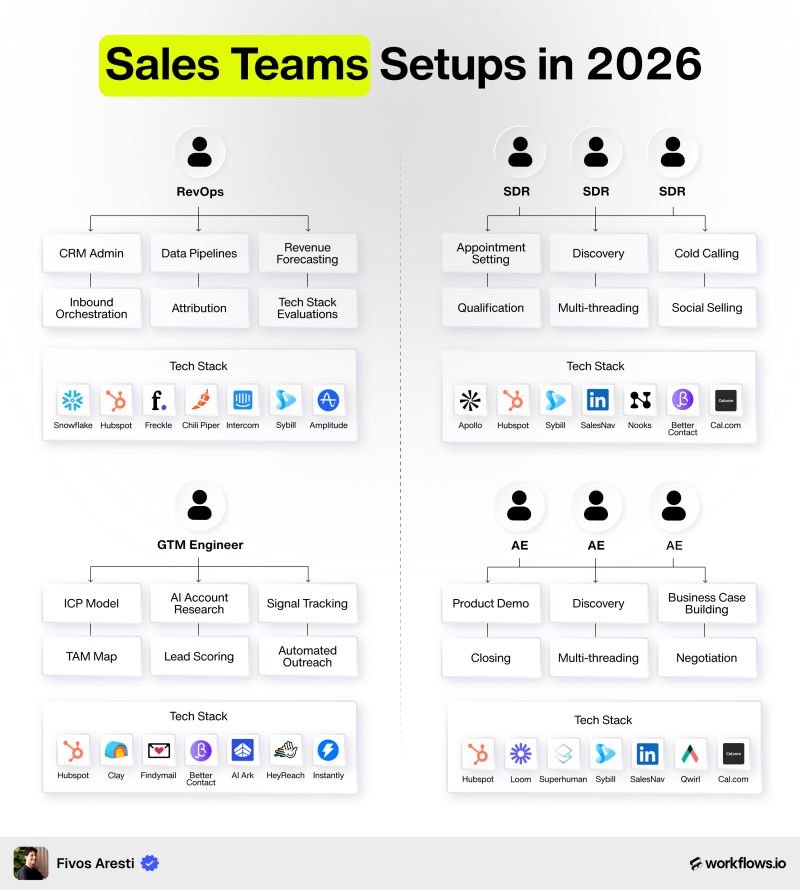
Sales team setups in 2026.
Old school:
• Simple team structure: AEs and more SDRs
• Overpaying for outdated tools
• Great sales fundamentals
New school:
• Often have RevOps and GTM engineers
• Consistently testing out new tools
• More time spent on selling
This was made possible ONLY with proper GTM engineering and RevOps infrastructure.
Here's the best sales team structure I'm seeing:
@itsalexvacca Exactly. Most teams overfocus on copy when the real edge is event timing plus signal quality. Better trigger logic usually beats another round of subject-line tweaks.
This category is getting interesting fast. The winner will not just find buyers and send outreach. It will keep signal, messaging, follow-up, and closing context inside one execution loop instead of handing the hard part back to humans.
this might be the craziest GTM tool i’ve seen
it literally:
> finds your buyers
> writes outreach
> sends it
> even helps you close
you just paste your website
This is where GTM infrastructure gets interesting. A page is not the moat. The moat is turning live signals, account context, and personalization into deployment at scale without creating another manual ops layer.
Easy to vibe-code a landing page. Hard to build a system where pages create themselves.
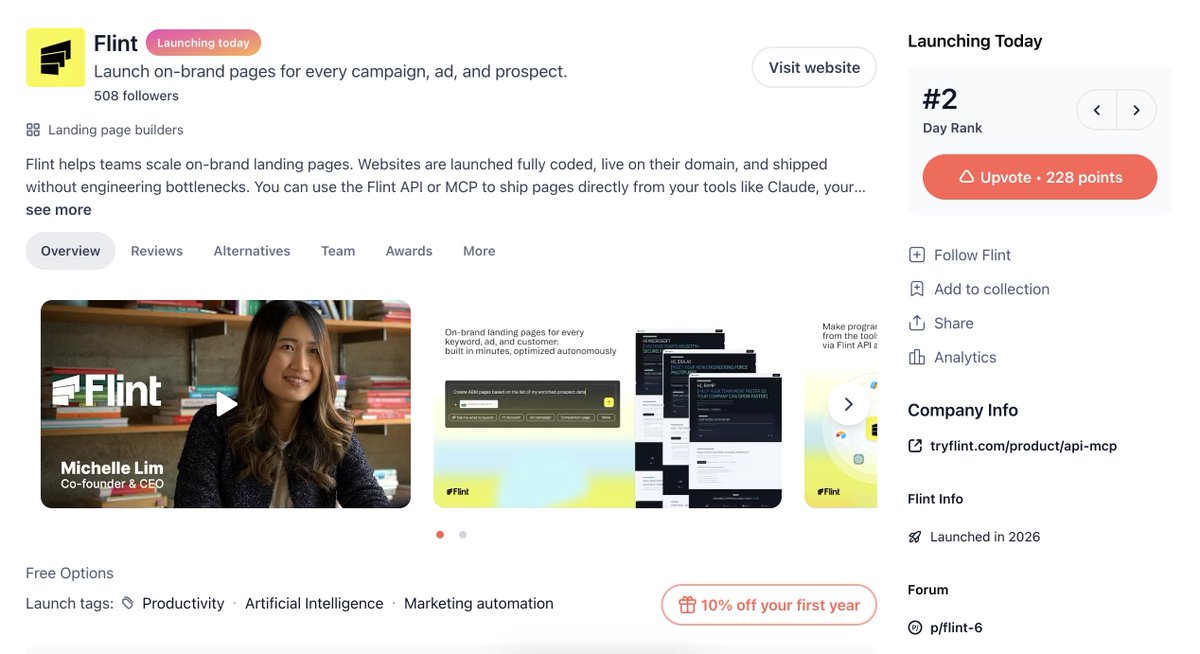
@tryflint is live on @ProductHunt.
→ Auto-generate pages from Reddit mentions
→ Personalize a page per sales prospect
→ 341 ABM pages in 15 minutes
@williamkast_ Exactly. A lot of paid teams diagnose performance too late because they treat creatives, audiences, and landing pages like separate knobs. The real gains usually come from seeing the account as one feedback system instead of isolated metrics.
@alexkehr This is a smart signal to capture. Preference is not just what people choose. It is how much certainty or hesitation sits behind the choice. That usually becomes useful once you feed it back into ranking, messaging, and next-step timing.
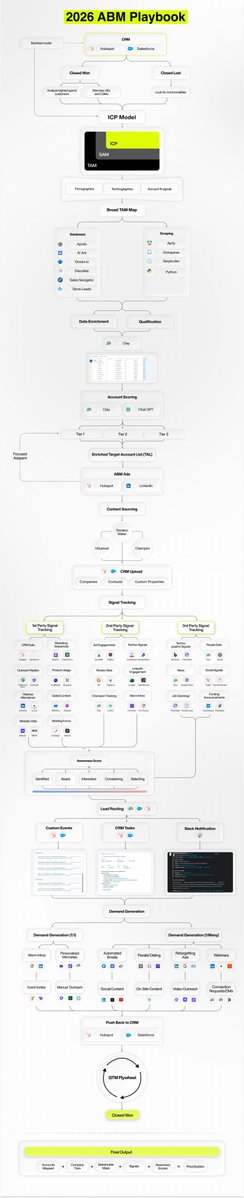
This is the shift a lot of teams still miss. ABM stopped being an enterprise-only budget game once signal tracking, enrichment, and execution became composable. The edge is no longer headcount. It is system design.
"ABM is only for enterprise teams with 6-figure budgets."
That was true when 6sense was the only option.
Now, with:
- Clay
- Claude Code
- Signal tools like RB2B, Findymail, Jungler
There’s no more excuse.
Anyone can build full ABM infrastructure with a lean team.
All you have to do is understand the 4 stages:
1. TAM mapping
2. Signal tracking
3. Awareness scoring
4. Demand generation.
The RevOps layer that used to need dedicated headcount and 6-figure contracts now runs on a lean stack.
Smaller teams with better infrastructure are outcompeting the ones who built ABM the old way.
PS
Comment the word "ABM"
And I'll send you a massive breakdown we did on the 8 steps you need to build your ABM system.
@SamJakAI This is where AI sales workflows get interesting. The call is only step one. The real leverage appears when qualification, CRM state, owner handoff, and next action all stay in one system instead of fragmenting after the demo.
This is the kind of workflow people underestimate. The moat is not the bot demo. It is the full loop from targeting to personalized asset creation to follow-up to booked call. Vertical execution beats generic AI theater.
this OpenClaw bot finds warehouse owners & books them solar deals on autopilot...
here's how solar business owners can use it to close $500k+ commercial installs:
- scans 1000s of warehouses via satellite imagery
- scores every roof by size, sun hours & payback
- pierces the LLC to find the actual human owner (not info@)
- renders their building with panels on it + 25-yr savings
- ships them a personalized microsite at their company name
- follows up across email, sms & linkedin
- books calls straight to the calendar 24/7
reply "SOLAR" + RT and i'll send you the full breakdown of how you can do it too (must be following so i can dm)
@JMellet77 Exactly. Process debt usually shows up where marketing is optimizing for captured interest while sales is still validating whether the interest was ever real. The leak is usually between signal, qualification, and handoff.
This is a strong wedge. The interesting part is not just tracking founders. It is turning founder activity into a warm outbound system instead of a spreadsheet full of names that never becomes pipeline.
Exactly. Buyers are not paying for founder heroics. They are paying for a machine that still produces outcomes when the founder is not manually carrying every decision and handoff.
8. The exit you want requires the systems you don't have yet
Buyers don't buy revenue
They buy businesses that run without the founder
Build accordingly from day one
This is the founder trap in one line. People obsess over product-market fit, then quietly get crushed by founder-system mismatch once complexity shows up. Growth breaks where context stops scaling.
A few years ago, I was deep in code.
Late nights.
Debugging for hours.
Then I met a founder who couldn’t code at all…
But was making more money than most developers I knew.
Because he understood something most people miss:
Coding is a tool.
But systems are leverage.
@DaveSmithAI Exactly. The interesting part is not just finding billing gaps. It is that the recovery signal feeds back into how the operating system allocates attention, ownership, and next action.
@mariusholzer That is usually the real win from building agents yourself. They expose where your workflow is pretending to be a system but is really just memory, habit, and manual glue.
This is where automation gets underrated. The onboarding workflow matters, but the real leverage appears when strategy, call context, and follow-up stop fragmenting across tools and owners.
With SEO services, you can automate almost the entire onboarding process. The only thing you really need to handle are the sales calls. You can record those calls and connect them to an automation, which takes care of the rest. Content creation can also be automated, including category pages, product pages and blogs. The only thing you truly need to focus on is the strategy. Even that is becoming easier, because AI can already do a lot when you provide it with the right information about your business and your competitors.
This is the right framing. GTM breaks when marketing, sales, and ops get described like separate departments instead of one moving system with shared context and consequences.
Business growth is often described in separate pieces.
Marketing gets attention. Sales closes deals. Revenue shows up later. Infrastructure supports the team. Capital is managed after the fact.
That language creates distance between things that are actually connected.
A clearer view starts with movement.
@SamJakAI Exactly. The interesting part is not the AI caller itself. It is the closed loop after the call — objections, outcomes, and next actions syncing back fast enough to improve the whole motion.
@DaveSmithAI The useful distinction here is tool vs operating system. Teams get real leverage when agent output feeds billing, pipeline, and follow-up as one continuous workflow instead of another isolated assistant.