The Princeton Macrofinance Conference, scheduled for October 2-3, 2026, is inviting submissions. All work at the intersection of macroeconomics and financial economics is welcome. https://t.co/u8mznb5Ylp
Organizers: @MarkusEconomist, Magnus Irie, Moritz Lenel, and Jonathan Payne
Just posted some new lecture slides:
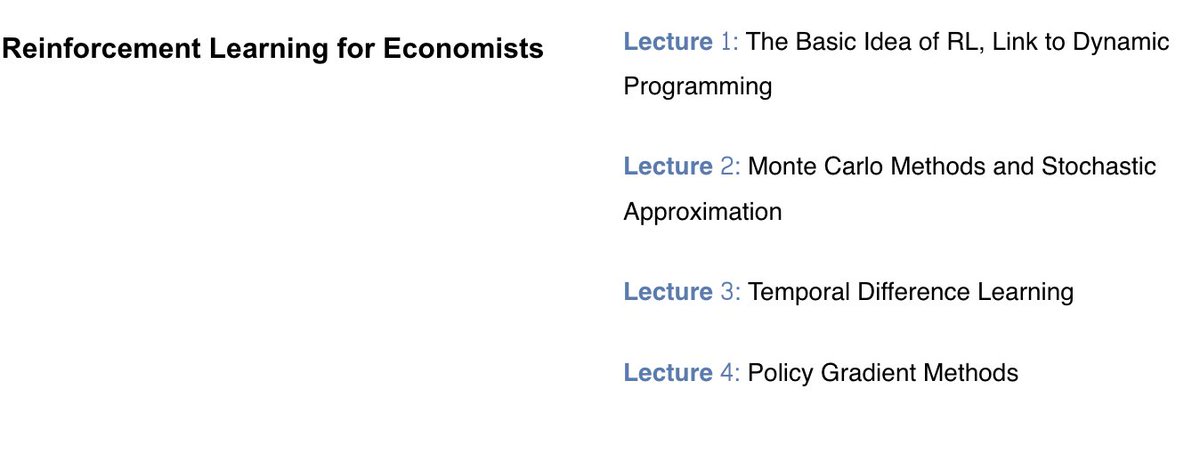
*Reinforcement Learning for Economists*
RL ideas are very powerful, yet criminally underused in economics.
I think mostly because RL is not typically taught in grad school -- let's change that!
All materials here https://t.co/Q9XP1l013r
A guide for economists writing a literature review who want to summarize evidence, incorporate covariates, and adjust for selectivity, from @p_ganong, Avik Garg, and @maxkasy https://t.co/hOZRcJ4gck
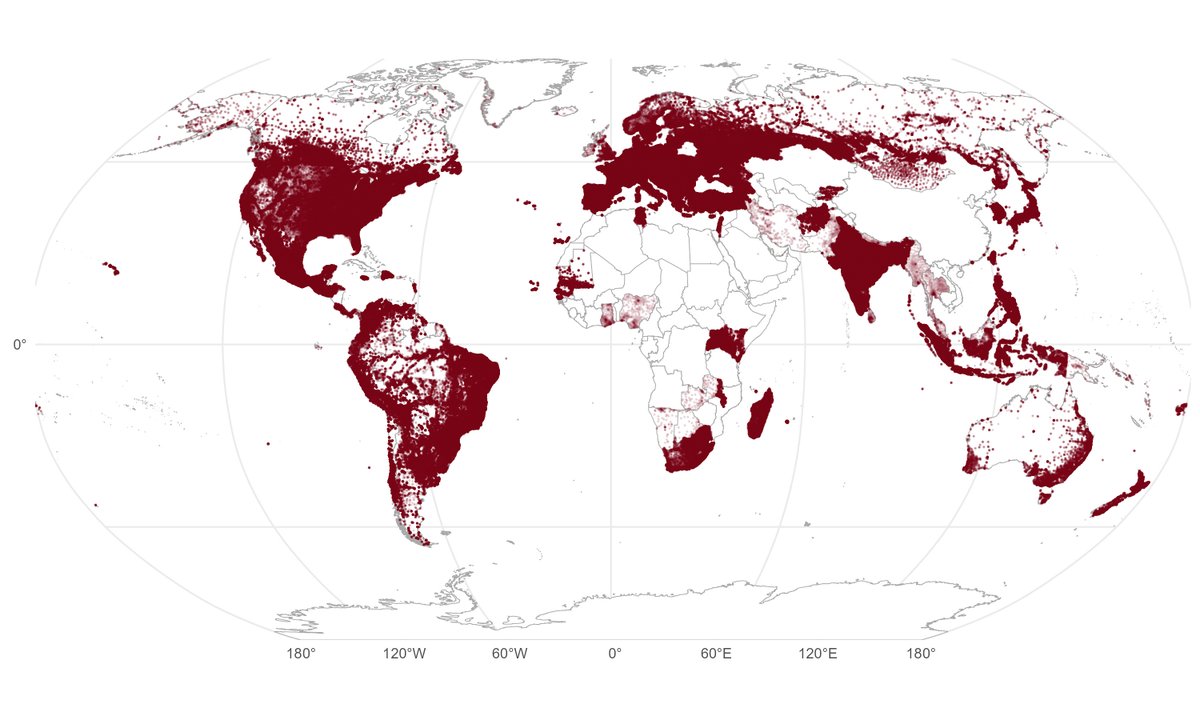
Version 1.1 (July 7, 2026) adds 2025 national elections to 15 countries and 2026 elections to 13 more, alongside various other minor fixes. All geocoded, most at the polling station-level! Explore on the map today: https://t.co/XMW9IqKbgx
Highly relevant!
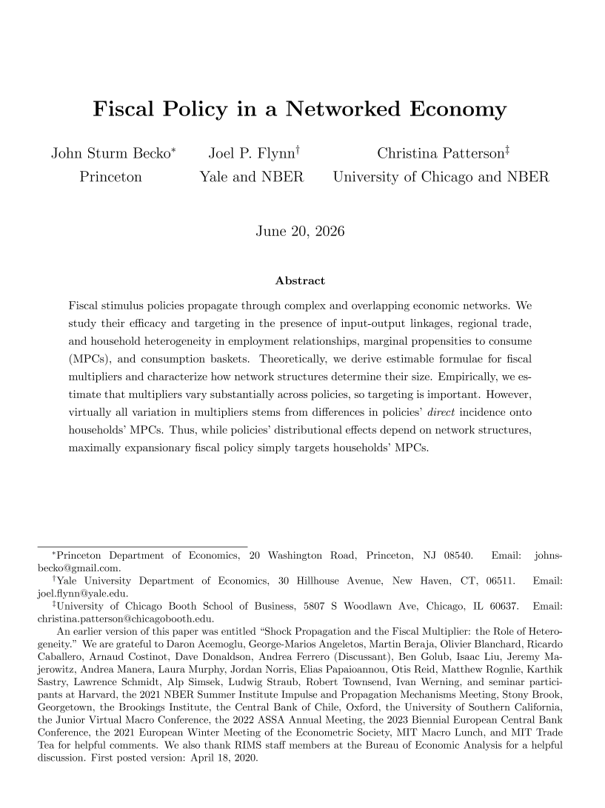
"Fiscal Policy in a Networked Economy" by John Sturm Becko, Joel P. Flynn, and Christina Patterson.
"Fiscal stimulus policies propagate through complex and overlapping economic networks. We study their efficacy and targeting in the presence of input-output linkages, regional trade, and household heterogeneity in employment relationships, marginal propensities to consume (MPCs), and consumption baskets. Theoretically, we derive estimable formulae for fiscal multipliers and characterize how network structures determine their size. Empirically, we estimate that multipliers vary substantially across policies, so targeting is important. However, virtually all variation in multipliers stems from differences in policies’ direct incidence onto households’ MPCs. Thus, while policies’ distributional effects depend on network structures, maximally expansionary fiscal policy simply targets households’ MPCs."
https://t.co/PsoHzXKgkP
Great news!
The Global Macro Database has been updated
"The 2026_06 update adds 39 new historical and country-level sources, bringing the database to 160 sources, extends automated error monitoring, resolves dozens of data-quality issues, and improves the Stata, R, and Python packages."
https://t.co/xBMXCjgnUW
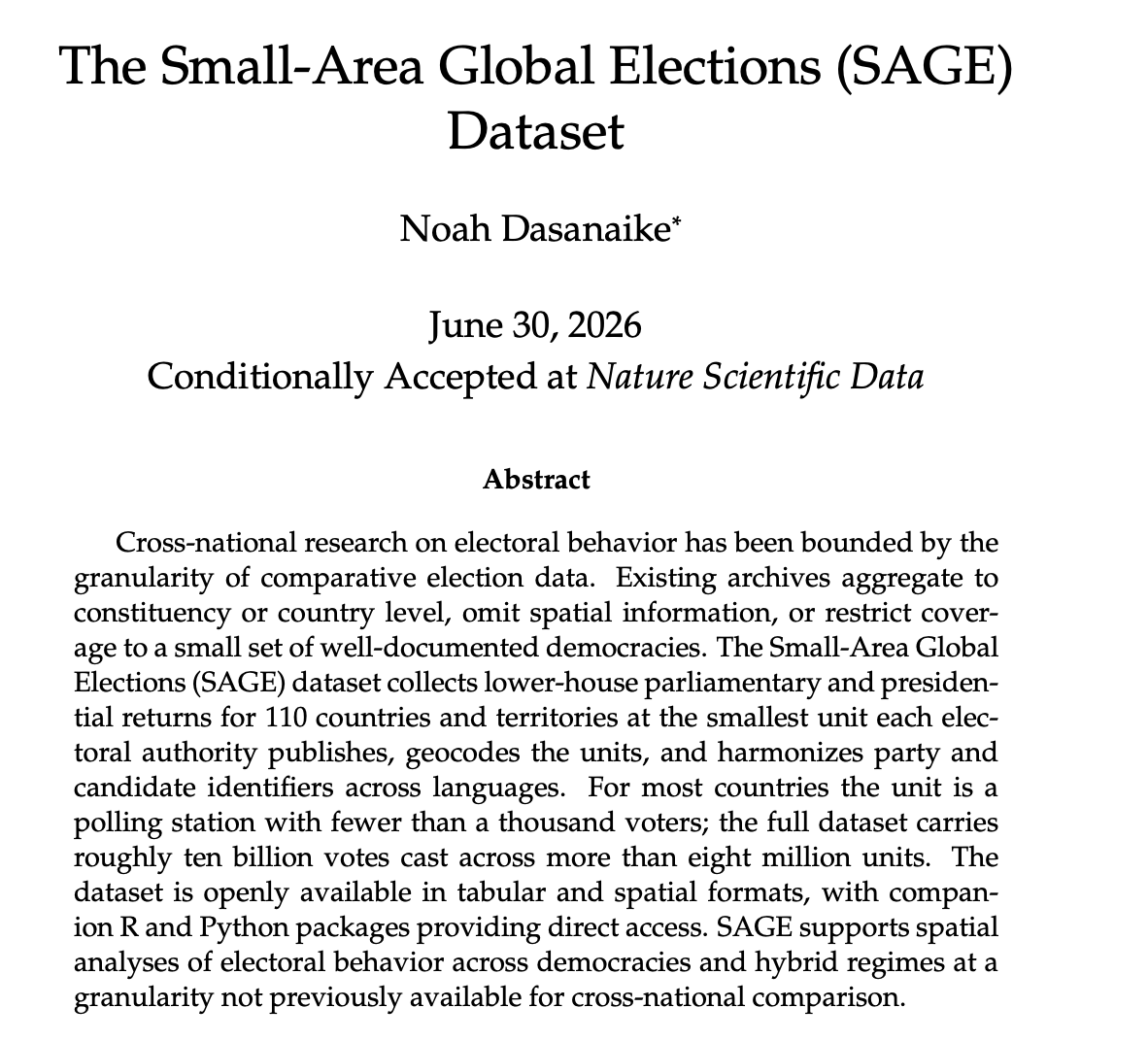
I'm proud to finally announce the first release of the Small-Area Global Elections (SAGE) dataset, encompassing global, granular, standardized, geocoded, polling station or equivalent-level election results for 110 countries, conditionally accepted at Nature Scientific Data. (1/n)
VAR Toolbox v4.0 is out 🚀
https://t.co/zPgvUmawwM
A collection of MATLAB codes for VAR analysis—estimation, identification, IRFs, variance and historical decompositions.
v4.0 is a major overhaul: new identification schemes, LPs now in the toolbox, and a long-promised handbook.
Short thread with details below 👇
China just open-sourced an OCR model that transcribes an entire book in a single pass.
It's called Unlimited OCR. Built on DeepSeek OCR with one key fix to attention, so memory stays flat no matter how long the document.
→ 93% on standard parsing benchmark (+6 over baseline)
→ <0.11 error rate at 40+ pages
→ Dozens of pages per pass
→ Steady speed where the old one slows 35%
100% Open Source.
Need help with Difference-in-Differences? Meet ChatDID: a GPT specialized in modern DiD methods and the de Chaisemartin–D'Haultfoeuille estimators and software packages.
Try it here:
https://t.co/nl2fiqBP7z
Some news: As of June 30, I'll be on leave from Stanford at Anthropic. I'm joining the Anthropic Institute, where I'll continue my research on AI and our economic future and give seminars and talks as always. 1/3
This Thursday 🤞
We already tested 5.6 pro a lot ( this model is special like with right prompt it can do anything)
GPT-Bidi-1 is what we were asking since gpt4o era it has august 2025 knowledge cut off
Gpt-5.6 other models were tested as kindle alpha but we expect new checkpoints
The Ronald Coase Workshop is a fantastic opportunity for young scholars interested in institutional analysis and political economy broadly defined.
Having participated as a graduate student (Beijing 2012) and later as faculty (Perugia/Florence 2025), I can say that it is a transformative experience and one of the very best mentorship opportunities for young scholars.
Applications for the December 2026 workshop in Mexico City are open until July 31, 2026:
https://t.co/uxVKGGY3V4
Please consider applying — and help spread the word!
In March, P and Ben told me that they had found an error in the implementation of an inferential method for IFE-EM in the gsynth package, which led to anti-conservative uncertainty measures.
Although the issue was addressed in the fect package after the merge in December 2025, it had affected several publications. See their just-released arXiv paper: https://t.co/JPVXUJcuSd
I investigated the issue and wrote a response note to them and the affected authors:
https://t.co/DGN75WEUVS
In the note, I examine the root cause and apologize for the costs imposed on the authors.
I did not post the link publicly because I did not want to preempt their critique or respond before the affected authors had a chance to do so.
I thank P and Ben for bringing this to my attention and to the attention of the other authors, so that we can fix the issue. This is how science should work.
I think the conversation is genuinely productive and methodologically interesting.
I will use more formal venues to write about issues that we now understand better, especially stationarity, overfitting, and inference in small-N panel settings.
🚨 Diff-in-diff imputation in Python 🚨
Excited to report that a package for estimation and and event study plots is now available. Similar syntax to the did_imputation and event_plot Stata commands
Available here: https://t.co/EtE0WGzM4e
Huge thanks to the author @gmarinichev