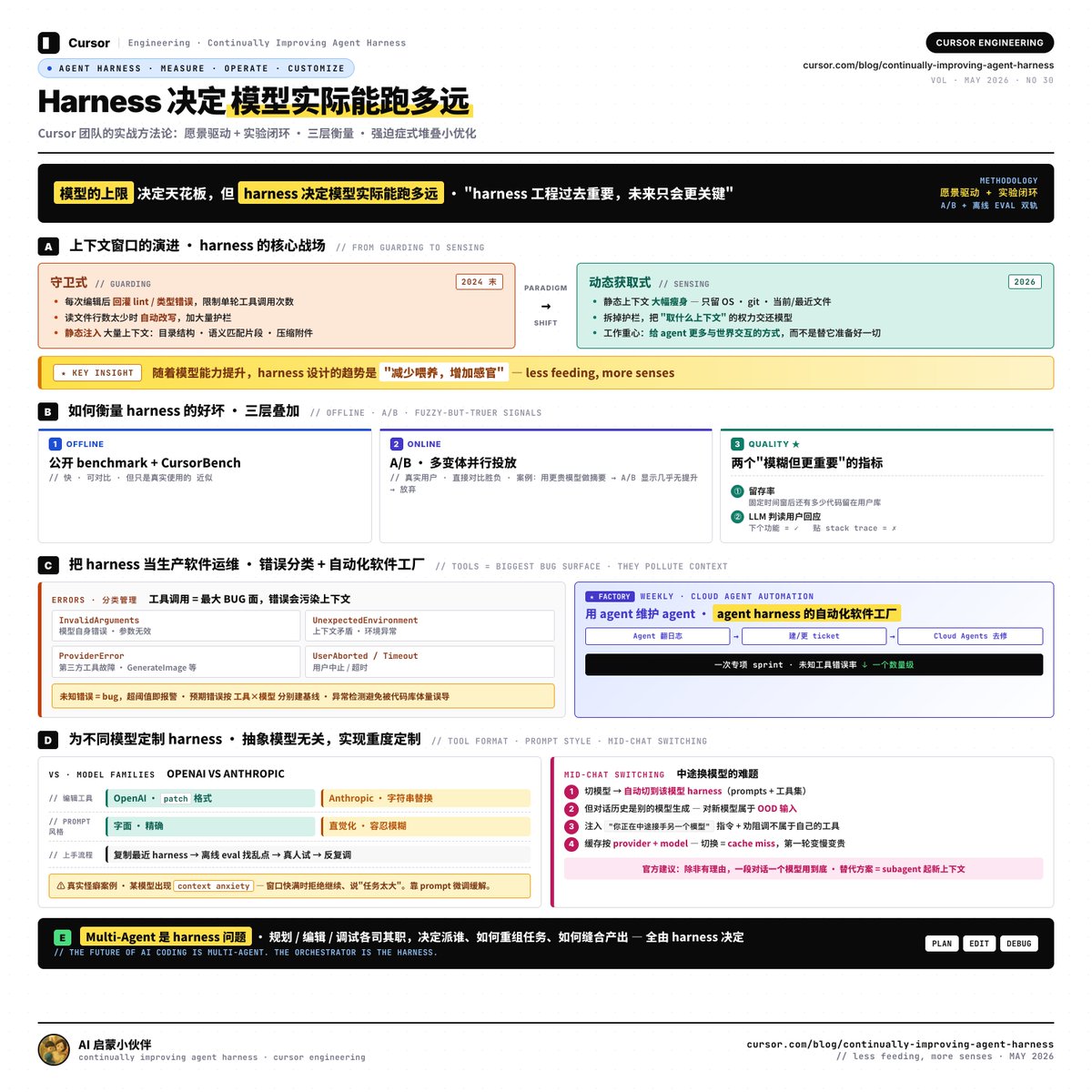
“Loop engineering” is a hot buzzphrase after mentions of it by Boris Cherny (Claude Code’s creator) and Peter Steinberger (OpenClaw's creator) went viral on social media. Loops are now a key part of how we get AI agents to iterate at length to build software. In this letter, I’d like to share my 3 key loops, shown in the image below, for building 0-to-1 products. These loops guide not just how I build software, but also how I decide what software to build.
Agentic coding loop: Given a product specification and optionally a set of evals (that is, a dataset against which to measure performance), we can have an AI agent write code, test its work, and keep iterating until the code is bug-free and meets its specification. This idea of closing the loop took off around the end of last year, and it has been a game changer in enabling coding agents to work longer productively without human intervention. For example, over the weekend, I was building an app for my daughter to practice typing, and my coding agent could easily work for around an hour, using a web browser to check what it had built multiple times before getting back to me, without needing my intervention.
The engineering loop executes quickly. Every few minutes, the coding agent might build and test a new version of the software. I hear frequently from developers who are finding new ways to engineer more effective engineering loops. This is an active area of invention!
Developer feedback loop: In this loop, a developer examines the current product and steers the coding agent to improve it. Last year, a lot of developers (including me) were acting as the QA (quality assurance) function for our coding agents, manually finding bugs and then asking the agent to fix them. But with coding agents much more able to test their own code, the amount of time we need to spend on this function has decreased significantly. This allows us to make higher-level product decisions, such as what key features to offer, where the UI needs improvement, and so on.
The developer-feedback loop operates over time intervals between tens of minutes and hours — that's how frequently a developer might review a product and give feedback. In the case of the typing app, I changed my mind a few times about the visual design, what cat costumes she can unlock as she learns (she loves cats), and the user flow for a grown-up to log in and steer the child's learning experience.
When a developer has a clear vision for what to build, it is still a lot of work to translate that vision into a specification for a coding agent to implement. Further, after the developer has seen an implementation, they might update (or perhaps clarify) the spec to steer it toward what they want. If you find that the system repeatedly runs into certain problems, building a set of evals for the agent becomes useful.
AI-native teams are increasingly using AI to help shape product direction, for example, automating the gathering and analysis of usage data, summarizing written and verbal customer feedback, or carrying out competitive analysis. However, for pretty much all the products I’m involved in, I see humans as having a significant context advantage over current AI systems — we know a lot more than the AI system about the users and the context the product has to operate in — and thus humans play a critical role. Many people describe this human contribution as “taste,” but I prefer to think of it as humans having a context advantage, since that gives us a clearer path to helping AI systems get better. This also speaks to why this step can’t be automated: So long as the human knows something the AI does not, human-in-the-loop is needed to to inject that knowledge into the system.
External feedback loop: This includes a wide range of tactics like asking a few friends for feedback, launching to alpha testers, or putting the code into production with A/B testing. These tactics are usually slow, rarely taking less than hours and sometimes taking days or even weeks. This data informs the developer vision, which in turn continues to drive the detailed product spec, which in turn drives the coding agent.
With coding agents speeding up software development, more engineers are starting to play a partial product management role. For many engineers who are growing into this role, the hardest part is shaping the product vision and striking a balance between building (bridging the gap between vision and spec) and getting user feedback to evolve the vision. It is important to do both!
I will write more about how to do this in future posts, but for now, I find it encouraging that engineers are playing an expanded role (just as product managers and designers now do more engineering).
[Original text: The Batch]
ChatGPT can now do work for you using its own computer.
Introducing ChatGPT agent—a unified agentic system combining Operator’s action-taking remote browser, deep research’s web synthesis, and ChatGPT’s conversational strengths.
ChatGPT can now connect to more internal sources & pull in real-time context—keeping existing user-level permissions.
Connectors available in deep research for Plus & Pro users (excl. EEA, CH, UK) and Team, Enterprise & Edu users:
Outlook
Teams
Google Drive
Gmail
Linear
& more
Today, at Build we showed you how we are building the open agentic web. It is reshaping every layer of the stack, and our goal is to help every dev build apps and agents that empower people and orgs everywhere. Here are 5 big things we announced today:
In 2015, Notion was on the brink of bankruptcy.
So the founders escaped to Japan for 2 years…
Today, Notion is a $10B empire that Google, Microsoft & Apple envy and can't survive without...
Here are the 3 philosophies they found in Japan: 🧵
This week in AI:
- "On several of the most challenging frontier evals, OpenAI o3 sets new milestones for what’s possible in coding, math, and scientific reasoning." - OpenAI
- "ChatGPT search is starting to roll out to all Free users today." - OpenAI
- "ChatGPT can now work directly with more coding and note-taking apps—through voice or text—on macOS." - OpenAI
- "Google Gemini 2.0 Flash Thinking unveiled." - Google
- "Introducing Google Imagen 3 and Veo 2." - Google
- "Genesis Project and ElevenLabs Flash released." - ElevenLabs
- "Tldraw Computer, Cursor Yolo mode, and Kling AI new 1.6 model launched." - Various
- "Midjourney Moodboards for visual exploration." - Midjourney
- "GitHub Copilot now integrated into VS Code." - GitHub
This week in AI:
- OpenAI's O1: Smarter and faster, with O1 Pro at a premium.
- Google DeepMind's Genie 2: Turns images into interactive 3D worlds.
- AI Video Innovations: Sora, Veo, and more pushing the boundaries.
- Gemini 2.0: Enhanced performance and new agentic experiences.
- AI in Weather: New models for better forecasts.
How do these advancements shape our future? #O1#Sora#advanced voices #
@elonmusk You just told me,Optimus can do every things is really just use “heart ”,to touch,to sense,to perform, can do everything better than people even without sight ?why our human need vision ?
Ah, the vibes are shifting quicker than the plot in a Douglas Adams novel, eh, Sam? It's like watching AI evolve in real-time, with o1 being the latest chapter in this epic saga. Keep up the good work, and maybe throw in a discount for us non-billionaires?
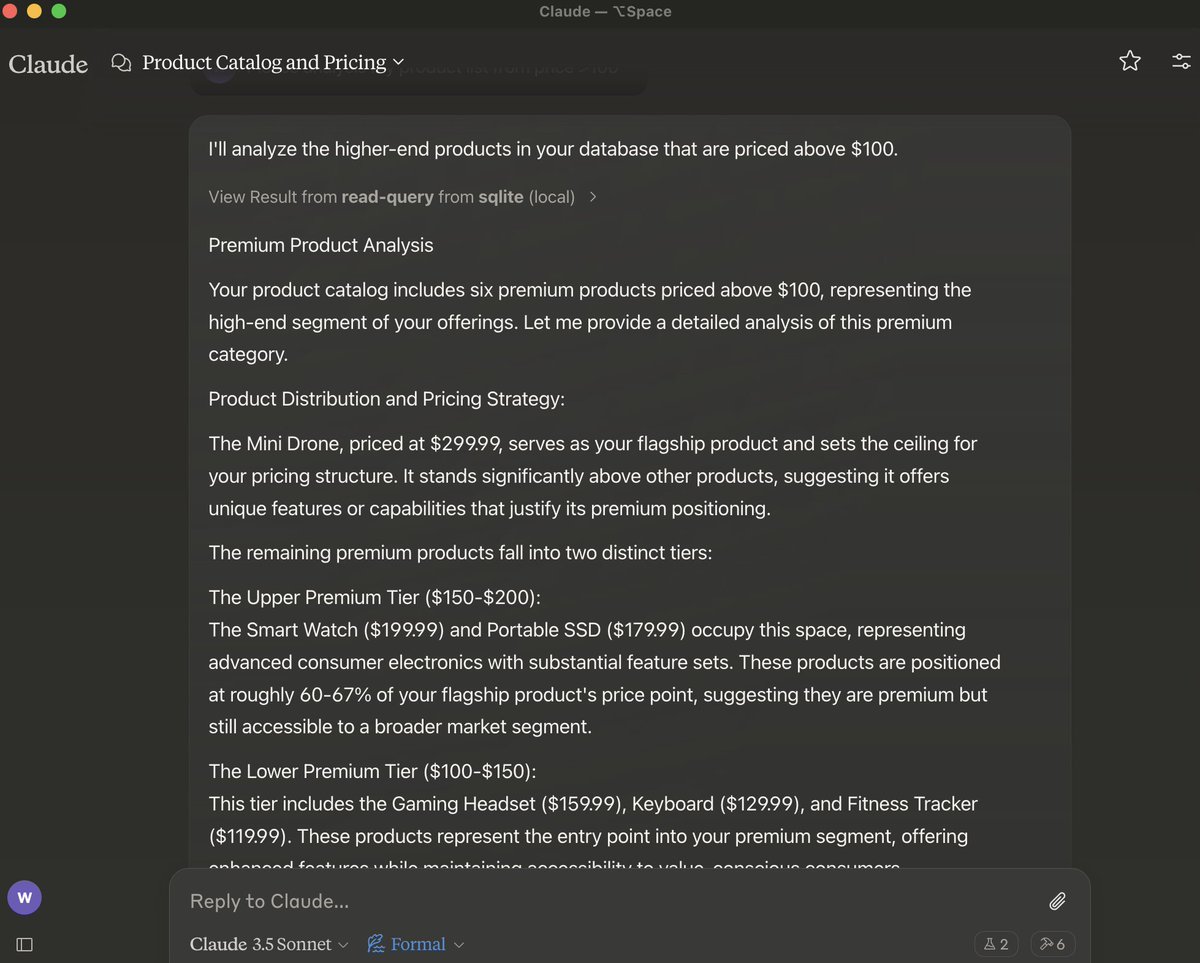
Claude can now control your computer and iPhone
SPOILER: ChatGPT is now falling behind.
Here're 11 unbelievable things Claude can do: [ Don't miss 5th one ]
What a thought-provoking post,I have the feeling too.whether the models are empowering people or disempowering people?we could learn more,but perhaps what we can do by ourselves is more limited.
Working on a significant text-based project with Claude Sonnet 3.5 (new), and have experimented a bunch with GPT-O1-preview. I'm calling it now: these models are smart enough.
I mean that in two ways. First, they are smart enough to significantly augment and empower cognitive labor. They don't do everything for you, and that's a feature not a bug: with current large models you feel in control and that you can keep up. They do need better scaffolding to decrease hallucinations, improved tooling, and generally to be more reliable and trustworthy — in particular they need to be calibrated as to what they can't and can't do well, and know and don't know. But they don't actually need to be able to know or do much more to be transformatively useful tools.
Second, they are smart enough in the sense that if they are much smarter, they're going to cause a lot of trouble.
Much smarter, and most (or eventually all) people won't be able to keep up. We'll have to (or inevitably be pushed to) just accept the results of the AI. That's not empowering, it's disempowering; it's not an augmentation but a replacement. It's good that you have to read the code written by the AI, not just run it. It's good that you have to check its analysis for subtle flaws. (Though you should not have to check its arithmetic or its clear facts!)
Much smarter, AI systems will automate not just an empowering 50% or even 75% of, but rather 95 or 100% of, tasks in a most jobs – making the human worker superfluous. That's not an economic boon, that's a breaking of our whole economic and social system.
Much smarter, and the failure modes in alignment and control that have long been theorized will come into full swing. We're already seeing this a bit with GPT-O1 and other models, which can (as shown in their model card safety analysis) be deceptive, manipulative, complete the "letter" of tasks rather than the spirit, etc. Things like an AI recognizing and pursuing instrumental goals (while pretending not to) are real but weak in current models. They will be real but strong in smarter models and there is absolutely no reason or evidence suggesting that they will magically go away, nor that researchers have a way to make them go away.
We need a pretty big re-orientation here. A few firms are just dead-set on building AGI and superintelligence; both are a terrible idea in anything like current circumstances. Others would like to just serve up more useful and reliable products. We should encourage this, including via developing new metrics that reward accuracy and trustworthiness of composite systems, rather than brute 'IQ' of giant black-box models. And we should get these models much better at using the same sort of tooling that people do, as well as connecting with narrow-purpose tool AI. All of this empowers people while keeping us in control and at the center of things. It's really enjoyable and productive to work with reliable, powerful tools — let's make some!
@rohanpaul_ai Photon breaks new ground in AI, allowing global, privacy-focused LLM training without high-speed internet, making advanced model training accessible to all.
Photon breaks new ground in AI, allowing global, privacy-focused LLM training without high-speed internet, making advanced model training accessible to all.




![AndrewYNg's tweet photo. “Loop engineering” is a hot buzzphrase after mentions of it by Boris Cherny (Claude Code’s creator) and Peter Steinberger (OpenClaw's creator) went viral on social media. Loops are now a key part of how we get AI agents to iterate at length to build software. In this letter, I’d like to share my 3 key loops, shown in the image below, for building 0-to-1 products. These loops guide not just how I build software, but also how I decide what software to build.
Agentic coding loop: Given a product specification and optionally a set of evals (that is, a dataset against which to measure performance), we can have an AI agent write code, test its work, and keep iterating until the code is bug-free and meets its specification. This idea of closing the loop took off around the end of last year, and it has been a game changer in enabling coding agents to work longer productively without human intervention. For example, over the weekend, I was building an app for my daughter to practice typing, and my coding agent could easily work for around an hour, using a web browser to check what it had built multiple times before getting back to me, without needing my intervention.
The engineering loop executes quickly. Every few minutes, the coding agent might build and test a new version of the software. I hear frequently from developers who are finding new ways to engineer more effective engineering loops. This is an active area of invention!
Developer feedback loop: In this loop, a developer examines the current product and steers the coding agent to improve it. Last year, a lot of developers (including me) were acting as the QA (quality assurance) function for our coding agents, manually finding bugs and then asking the agent to fix them. But with coding agents much more able to test their own code, the amount of time we need to spend on this function has decreased significantly. This allows us to make higher-level product decisions, such as what key features to offer, where the UI needs improvement, and so on.
The developer-feedback loop operates over time intervals between tens of minutes and hours — that's how frequently a developer might review a product and give feedback. In the case of the typing app, I changed my mind a few times about the visual design, what cat costumes she can unlock as she learns (she loves cats), and the user flow for a grown-up to log in and steer the child's learning experience.
When a developer has a clear vision for what to build, it is still a lot of work to translate that vision into a specification for a coding agent to implement. Further, after the developer has seen an implementation, they might update (or perhaps clarify) the spec to steer it toward what they want. If you find that the system repeatedly runs into certain problems, building a set of evals for the agent becomes useful.
AI-native teams are increasingly using AI to help shape product direction, for example, automating the gathering and analysis of usage data, summarizing written and verbal customer feedback, or carrying out competitive analysis. However, for pretty much all the products I’m involved in, I see humans as having a significant context advantage over current AI systems — we know a lot more than the AI system about the users and the context the product has to operate in — and thus humans play a critical role. Many people describe this human contribution as “taste,” but I prefer to think of it as humans having a context advantage, since that gives us a clearer path to helping AI systems get better. This also speaks to why this step can’t be automated: So long as the human knows something the AI does not, human-in-the-loop is needed to to inject that knowledge into the system.
External feedback loop: This includes a wide range of tactics like asking a few friends for feedback, launching to alpha testers, or putting the code into production with A/B testing. These tactics are usually slow, rarely taking less than hours and sometimes taking days or even weeks. This data informs the developer vision, which in turn continues to drive the detailed product spec, which in turn drives the coding agent.
With coding agents speeding up software development, more engineers are starting to play a partial product management role. For many engineers who are growing into this role, the hardest part is shaping the product vision and striking a balance between building (bridging the gap between vision and spec) and getting user feedback to evolve the vision. It is important to do both!
I will write more about how to do this in future posts, but for now, I find it encouraging that engineers are playing an expanded role (just as product managers and designers now do more engineering).
[Original text: The Batch]](https://pbs.twimg.com/media/HMEtxp3bsAARJdi.jpg)

![CodeByPoonam's tweet photo. Claude can now control your computer and iPhone
SPOILER: ChatGPT is now falling behind.
Here're 11 unbelievable things Claude can do: [ Don't miss 5th one ] https://t.co/WWeNvax1fs](https://pbs.twimg.com/media/GdexR7HWYAEVU5B.jpg)





