Short vs. long reads in 16S rRNA sequencing - what's the impact on shrimp pond microbes? 🔬 New study finds both offer value for disease surveillance. #Microbiome#ShrimpFarming
https://t.co/fPG09XPwcm
😯Sydney Brenner (Nobel Prize winner) was not a fan of Systems Biology.
Systems Biology: To study a drum in the next room, record the sounds and reconstruct the physical properties of the drum.
Experimental science: Get in, get hold of the drum, get its structure and play it.
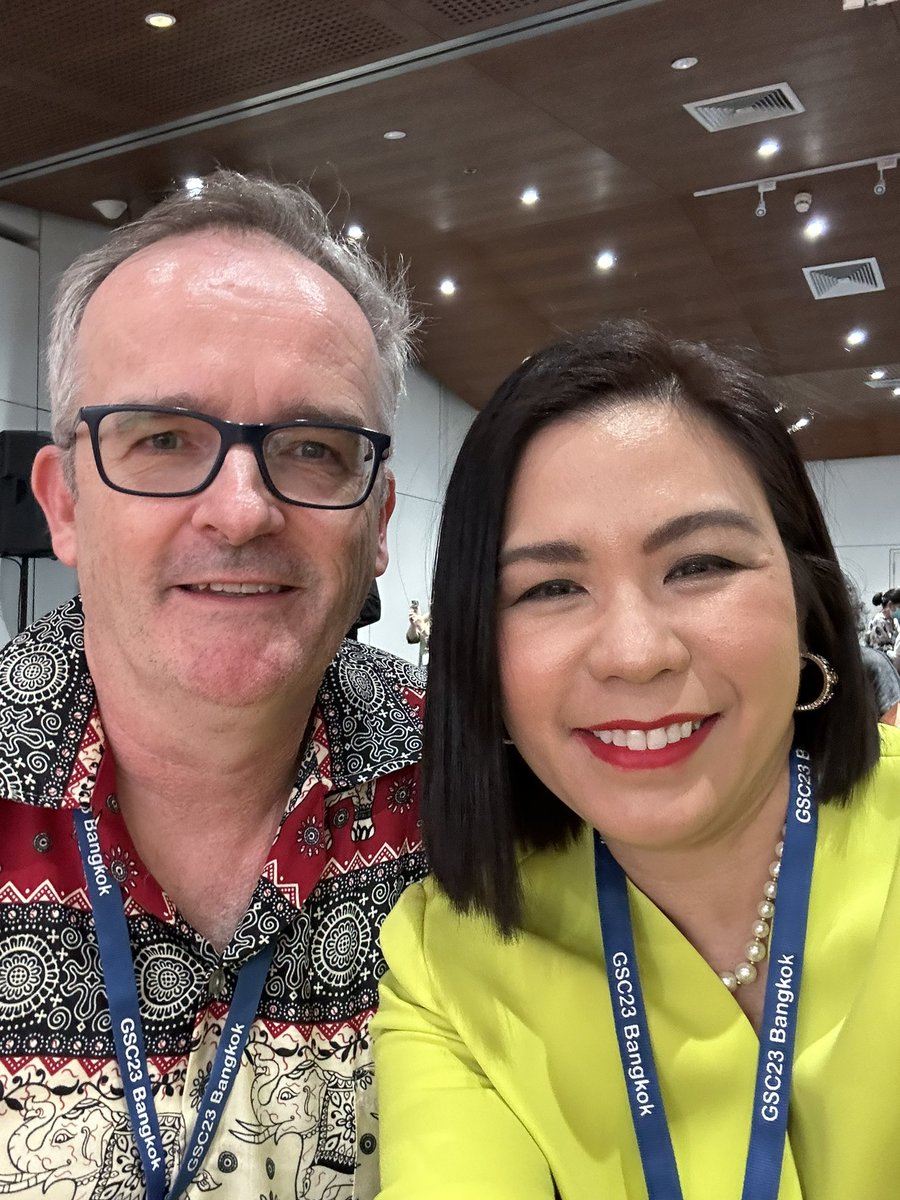
With Prof Phil With Prof. Phil Hugenholtz, the legend of “microbial dark matter”
Super excited to meet and to have such a fruitful discussion with him 🙏.
Note that there are three biological replicates of the selfies.
#gsc2023#genomicsstandardconsortium
Day 11 of great synthetic biology papers.
"BioBits™ Explorer: A modular synthetic biology education kit."
A child can learn about CS by writing an endless number of computer programs on a laptop. Code is cheap & modular. What will be the equivalent to teach biology?
****
There is a real need for modular, easy-to-use kits to teach synthetic biology in the classroom. This paper is a starting point toward that dream.
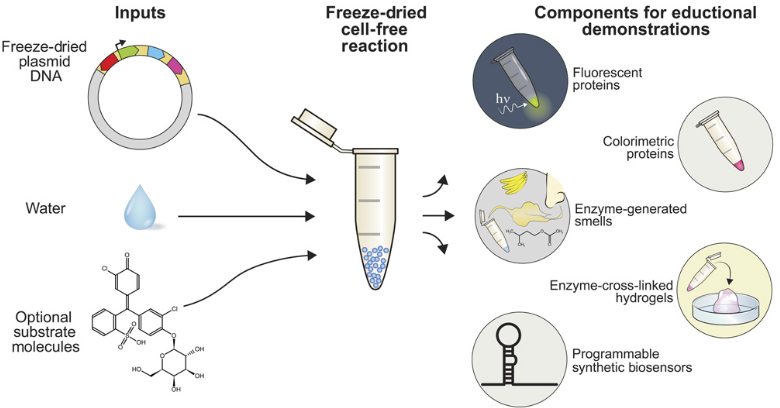
Cell-free systems are a simple way to teach biology. A cell-free extract is basically the "guts" from living cells, with their membranes stripped away. When these extracts are freeze-dried, they become stable at room temperature. And when you add back water, the components that were once inside the cells— enzymes, DNA, RNA—become active again.
Freeze-dried cell-free extracts were used to create lessons that "engage three of the five senses—sight, smell, and touch." Students add DNA, water, and optional molecules to the extracts, which then "activate" and produce fluorescent proteins, enzymes that make smells, or proteins that change colors. It costs about $200 for 30 kits. (https://t.co/ViXNqsXTcp)
A separate paper describes BioBits™ Bright, a kit to make bright, fluorescent proteins for K-12 students. An incubator, imager, and 30 kits costs under $100. (https://t.co/YIeeKCKtIm)
Another kit, BioBits™ Health, is designed to teach students about antibiotic resistance and genetic engineering with CRISPR-Cas9. (https://t.co/VAuEge9xfc)
Many others have also thought about the problem of synthetic biology education. @Aminobiolab sells kits and books that teach various experiments. @TheODINInc sells genetic engineering kits. And @theBentoLab sells a portable "DNA analysis lab," complete with thermocycler and gel imaging station to run PCRs on-the-go.
But the ingredients to engineer biology — cells, fancy equipment, amino acids, lots of chemicals — are expensive and difficult to work with. They also aren'tt modular. If you mix lots of chemicals together, then they get used up and you have to buy more. Biology is not like a computer, where you can use the same circuits to do different things in infinite ways.
So why don't we try to make a cheap, modular kit for biology education? By modular, I mean that a limited number of “ingredients” could be used across a wide range of practical exercises, much like a small number of logic gates can be rearranged to solve incredibly complex computational problems. Cell-free extracts might be a good place to start, but I wish there was also an easy (but safe) way for people at home to assemble DNA building blocks.
Or what if we could place a laboratory in a briefcase, and rearrange atoms again and again so that students didn’t have to buy molecules every time? This is a really hard problem to solve. But a solution would massively open up the bioeconomy and enable millions of students to learn about biology through hands-on exercises. And we need that if we really want to solve climate change, grow more food, make medicines and materials, or realize a solarpunk vision.
Who is thinking about this problem? @SofiasBio @4LOVofScience @gmofutures
Day 11 of great synthetic biology papers.
"BioBits™ Explorer: A modular synthetic biology education kit."
A child can learn about CS by writing an endless number of computer programs on a laptop. Code is cheap & modular. What will be the equivalent to teach biology?
****
There is a real need for modular, easy-to-use kits to teach synthetic biology in the classroom. This paper is a starting point toward that dream.
Cell-free systems are a simple way to teach biology. A cell-free extract is basically the "guts" from living cells, with their membranes stripped away. When these extracts are freeze-dried, they become stable at room temperature. And when you add back water, the components that were once inside the cells— enzymes, DNA, RNA—become active again.
Freeze-dried cell-free extracts were used to create lessons that "engage three of the five senses—sight, smell, and touch." Students add DNA, water, and optional molecules to the extracts, which then "activate" and produce fluorescent proteins, enzymes that make smells, or proteins that change colors. It costs about $200 for 30 kits. (https://t.co/ViXNqsXTcp)
A separate paper describes BioBits™ Bright, a kit to make bright, fluorescent proteins for K-12 students. An incubator, imager, and 30 kits costs under $100. (https://t.co/YIeeKCKtIm)
Another kit, BioBits™ Health, is designed to teach students about antibiotic resistance and genetic engineering with CRISPR-Cas9. (https://t.co/VAuEge9xfc)
Many others have also thought about the problem of synthetic biology education. @Aminobiolab sells kits and books that teach various experiments. @TheODINInc sells genetic engineering kits. And @theBentoLab sells a portable "DNA analysis lab," complete with thermocycler and gel imaging station to run PCRs on-the-go.
But the ingredients to engineer biology — cells, fancy equipment, amino acids, lots of chemicals — are expensive and difficult to work with. They also aren'tt modular. If you mix lots of chemicals together, then they get used up and you have to buy more. Biology is not like a computer, where you can use the same circuits to do different things in infinite ways.
So why don't we try to make a cheap, modular kit for biology education? By modular, I mean that a limited number of “ingredients” could be used across a wide range of practical exercises, much like a small number of logic gates can be rearranged to solve incredibly complex computational problems. Cell-free extracts might be a good place to start, but I wish there was also an easy (but safe) way for people at home to assemble DNA building blocks.
Or what if we could place a laboratory in a briefcase, and rearrange atoms again and again so that students didn’t have to buy molecules every time? This is a really hard problem to solve. But a solution would massively open up the bioeconomy and enable millions of students to learn about biology through hands-on exercises. And we need that if we really want to solve climate change, grow more food, make medicines and materials, or realize a solarpunk vision.
Who is thinking about this problem? @SofiasBio @4LOVofScience @gmofutures
Check out our work to understand host-gut microbial relationship in a non-model animal. https://t.co/iNIEdbcWMF We derived a model showing how the pathogen caused a disruption in gut homeostasis, such as the reduction of certain gut metabolites to facilitate the invasion.
Our paper shows why it is so important to actually evaluate dosages of "immunostimulants." Too much of overstimulation could actually have an adverse effect. Also, please consider the origin of LPS. Some can be very potent than others. https://t.co/QvfKW9fchH
#MyOAarticle "Transcriptomic analysis of the black tiger shrimp (Penaeus monodon) reveals insights into immune development in their early life stages" received 1679 downloads since its publication! Access the article here: https://t.co/TxRq0J0ZRQ