One of the best piece of (brand) content I’ve ever seen. Real tangibles, focusing on scale and timeliness. Smooth tie back to the product. Deliciously witty. Perfection. No notes. Bravo Apple.
"True transformation takes time — and happens through a series of phases. Skipping steps only creates the illusion of speed and never produces a satisfying result."
https://t.co/zqug5uYy4G
Excellent UX Research Cheat Sheet! 🚀🔖
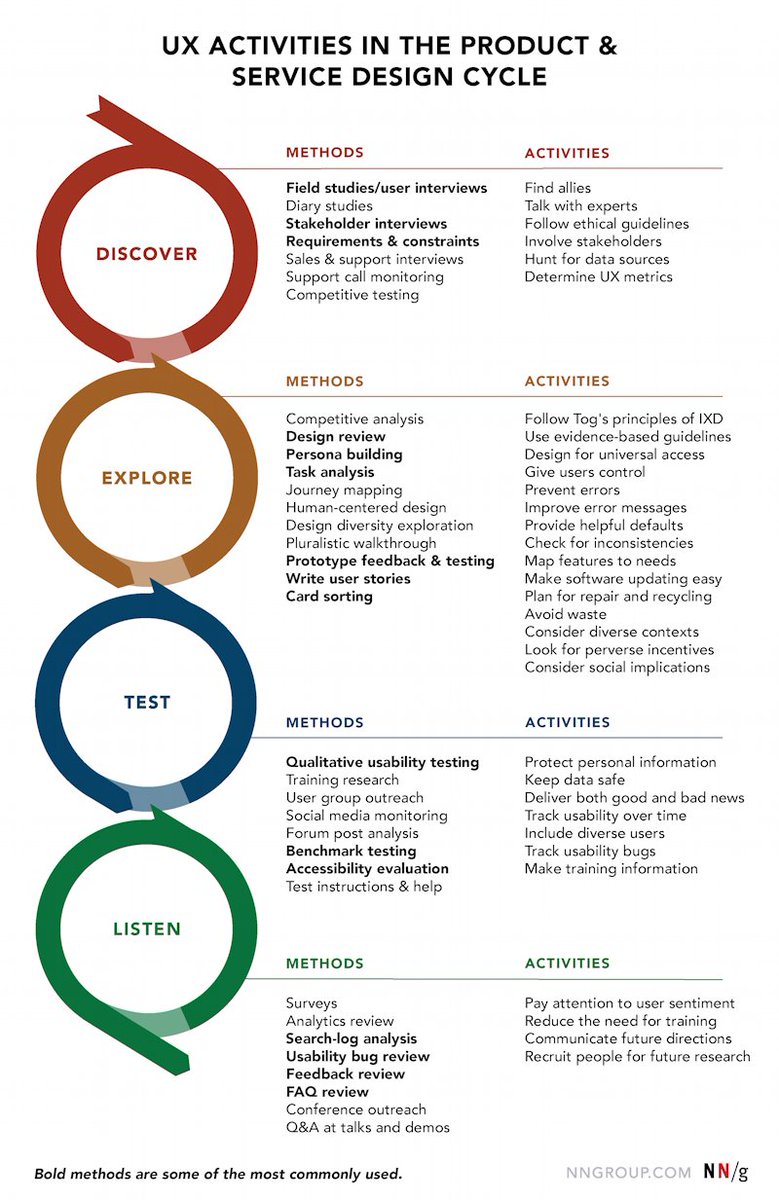
User research can be done at any point in the design cycle. This list of methods and activities can help you decide which to use when.
Overview:
User-experience research methods are great at producing data and insights, while ongoing activities help get the right things done.
Alongside R&D, ongoing UX activities can make everyone’s efforts more effective and valuable. At every stage in the design process, different UX methods can keep product-development efforts on the right track, in agreement with true user needs and not imaginary ones.
The chart below describes UX methods and activities available in various project stages.
UX ACTIVITIES IN THE PRODUCT & SERVICE DESIGN CYCLE
DISCOVER
METHODS:
- Field studies/user interviews
- Diary studies
- Stakeholder interviews
- Requirements & constraints
- Sales & support interviews
- Support call monitoring
- Competitive testing
ACTIVITIES:
- Find allies
- Talk with experts
- Follow ethical guidelines
- Involve stakeholders
- Hunt for data sources
- Determine UX metrics
EXPLORE
METHODS:
- Competitive analysis
- Design review
- Persona building
- Task analysis
- Journey mapping
- Human-centered design
- Design diversity exploration
- Pluralistic walkthrough
- Prototype feedback & testing
- Write user stories
- Card sorting
ACTIVITIES:
- Follow Tog's principles of IXD
- Use evidence-based guidelines
- Design for universal access
- Give users control
- Prevent errors
- Improve error messages
- Provide helpful defaults
- Check for inconsistencies
- Map features to needs
- Make software updating easy
- Plan for repair and recycling
- Avoid waste
- Consider diverse contexts
- Look for perverse incentives
- Consider social implications
TEST
METHODS:
- Qualitative usability testing
- Training research
- User group outreach
- Social media monitoring
- Forum post analysis
- Benchmark testing
- Accessibility evaluation
- Test instructions & help
ACTIVITIES:
- Protect personal information
- Keep data safe
- Deliver both good and bad news
- Track usability over time
- Include diverse users
- Track usability bugs
- Make training information
LISTEN
METHODS:
- Surveys
- Analytics review
- Search-log analysis
- Usability bug review
- Feedback review
- FAQ review
- Conference outreach
- Q&A at talks and demos
ACTIVITIES
- Pay attention to user sentiment
- Reduce the need for training
- Communicate future directions
- Recruit people for future research
View the full details: https://t.co/sAAmK0HxnJ
By @NNgroup
#ux #uxdesign #ui #uidesign #productdesign #userexperience #webdesign #psychology #research #uxresearch #usertesting #usability #uxmethods #prototype #designresearch #webdesign #mobile #users #uxstrategy #productmanagement #business #startup #agile #mvp
I see a lot of beautifully crafted products which fail to find users, and I see a lot of mediocre products which explode.
As such, I think good sales people need to focus more on product and good product people need to focus more on sales.
It frustrates me to see how product managers have complicated the simple process of creating a roadmap
Believe it or not, a product roadmap is nothing more than a 𝘵𝘰-𝘥𝘰 𝘭𝘪𝘴𝘵, where the items are sequenced based on some logic.
For me, creating a roadmap is a simple 3-step process
1️⃣ Ideation
2️⃣ Impact estimation (and normalization)
3️⃣ Sequencing
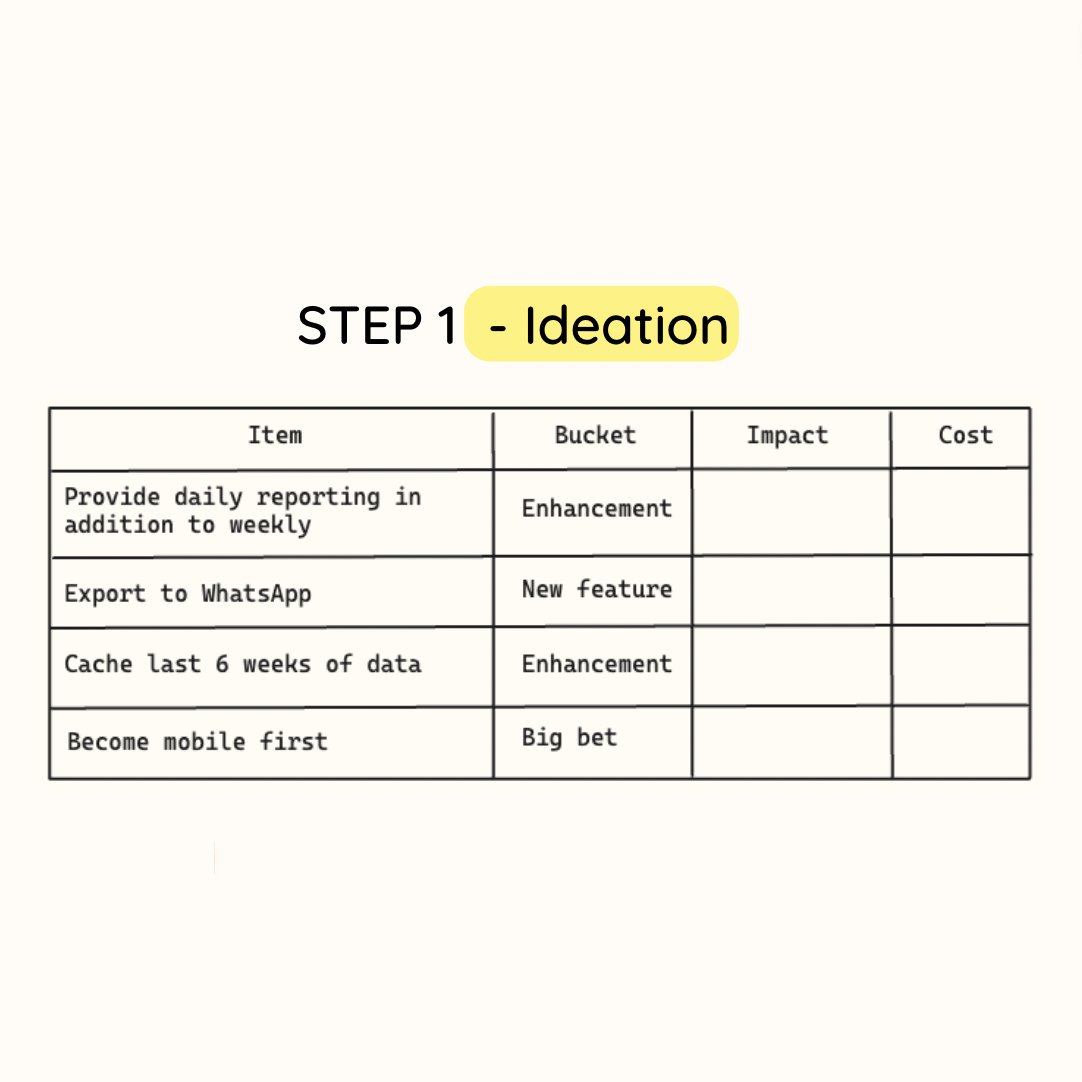
1️⃣ 𝗜𝗱𝗲𝗮𝘁𝗶𝗼𝗻
This step takes time. And it deserves it.
Therefore, product managers should do this 𝘵𝘩𝘳𝘰𝘶𝘨𝘩𝘰𝘶𝘵 𝘵𝘩𝘦 𝘺𝘦𝘢𝘳, instead of only until a few weeks before planning process
To increase quality/quantity of ideas
• talk to users
• read about competition
• know the market/industry
• evaluate past wins and failures
• analyse customer support tickets
• talk to experts in/outside of your org
(See image 1 below)
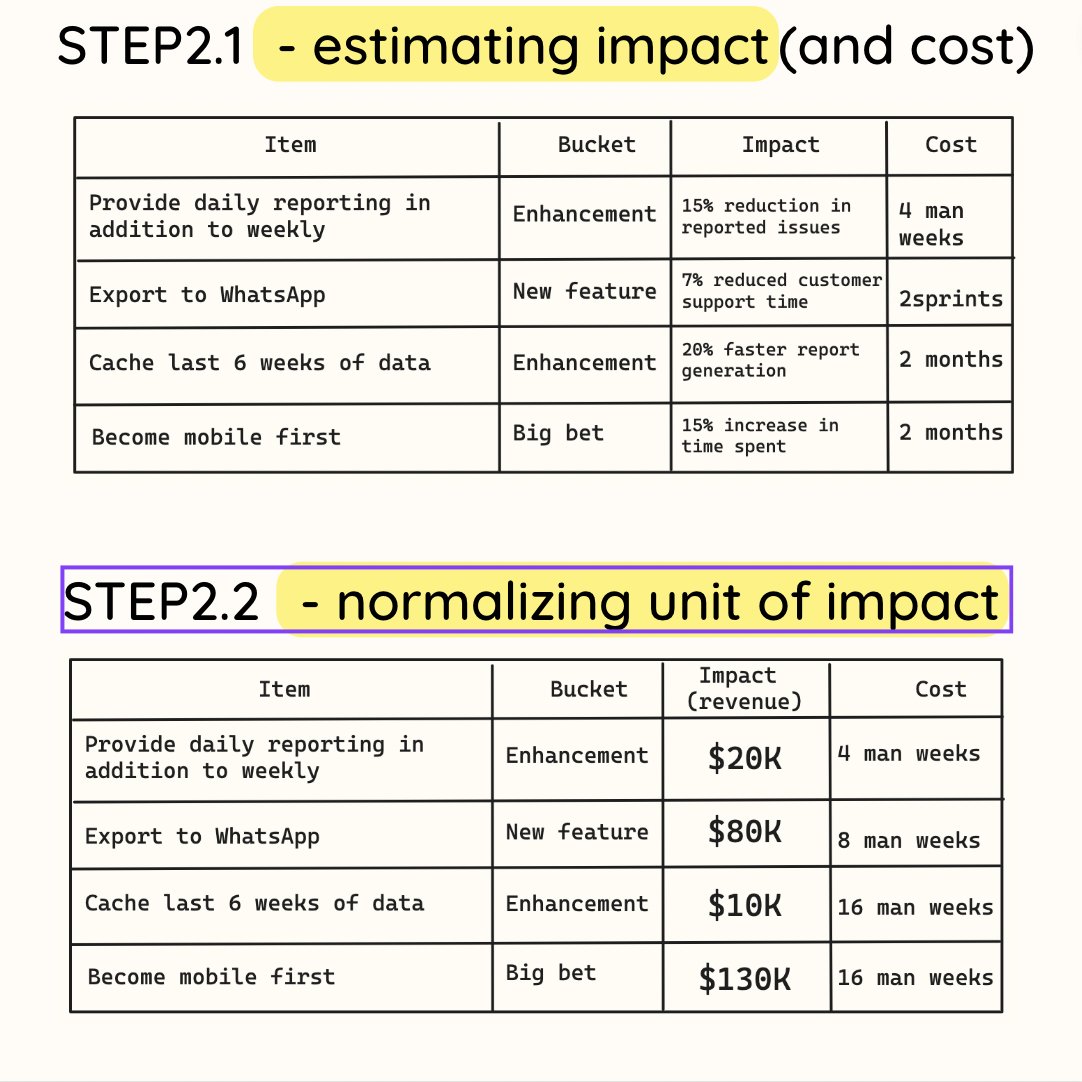
2️⃣ 𝗜𝗺𝗽𝗮𝗰𝘁 𝗲𝘀𝘁𝗶𝗺𝗮𝘁𝗶𝗼𝗻 (𝗮𝗻𝗱 𝗻𝗼𝗿𝗺𝗮𝗹𝗶𝘇𝗮𝘁𝗶𝗼𝗻)
Some product teams make this process overly-complicated. But, some keep it simple.
I am a fan of simple.
Remember: when you’re impact sizing, your goal is to create 𝘳𝘦𝘭𝘢𝘵𝘪𝘷𝘦 sizing and not 𝘢𝘣𝘴𝘰𝘭𝘶𝘵𝘦 sizing.
If feature A has an impact of X, and B has an impact of Y - the goal is not to accurately measure the values of X and Y, but to identify if X > Y or vice versa
But even this (simple) approach has a challenge. Imagine:
• A impacts 𝘙𝘦𝘷𝘦𝘯𝘶𝘦
• B impacts 𝘮𝘢𝘯-𝘩𝘰𝘶𝘳𝘴 𝘴𝘢𝘷𝘦𝘥.
In this case, you're comparing apple and oranges, therefore you can't create the X>Y equation
In such cases, you need to 𝗡𝗼𝗿𝗺𝗮𝗹𝗶𝘇𝗲: convert all 𝘶𝘯𝘪𝘵𝘴 𝘰𝘧 𝘪𝘮𝘱𝘢𝘤𝘵 into a common one.
(See image 2 below)
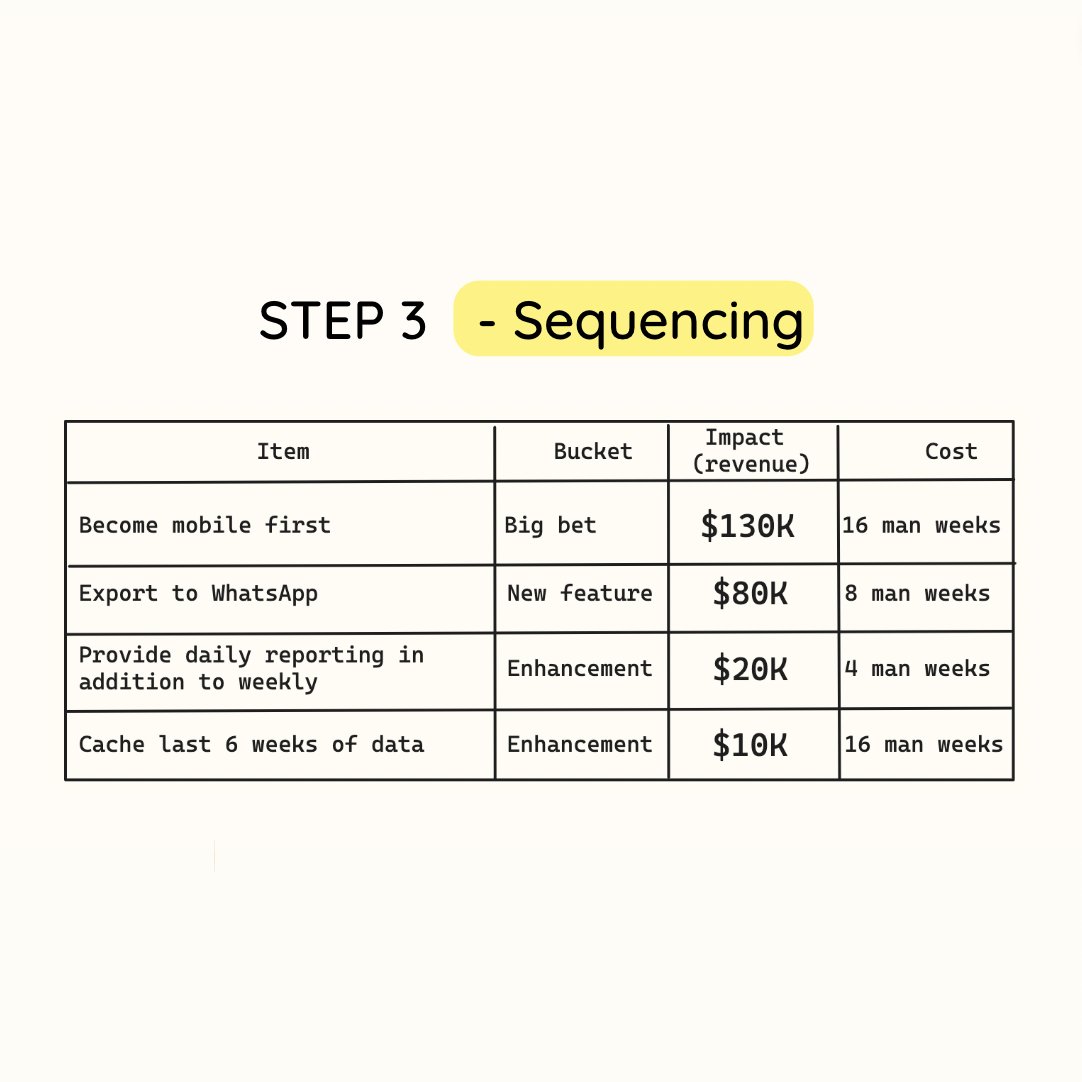
3️⃣ 𝗦𝗲𝗾𝘂𝗲𝗻𝗰𝗶𝗻𝗴
If you’ve completed step 1 and 2, this step is super simple. It is as simple as sorting by the impact column in your sheet.
And then you have your roadmap.
(See image 3 below)
--
Exceptions:
Some teams use another variable: Cost (aka effort to build)
That gives you more leverage. Introducing 𝘤𝘰𝘴𝘵 might unlock scenarios where:
• Impact: of feature A > B
• But, cost to build: A > B
In this case, you can focus on B before A, if the goal is to deliver 𝘷𝘢𝘭𝘶𝘦 𝘲𝘶𝘪𝘤𝘬𝘭𝘺.
OR
You could break A into smaller chunks in a way that allows you to deliver value in less time.
Both approaches are fine. I've used both. Which I choose depends on the focus of the team/company
For ex:
• Startups optimize for velocity
• More mature orgs: optimize for high quality
--
While the core roadmapping process is simple, it is imp. to understand there are many time-consuming activities happening in the background:
1. 𝗥𝗶𝗴𝗵𝘁 𝗺𝗶𝘅 𝗼𝗳 𝗶𝗱𝗲𝗮𝘀: I like to think of ideas in 3 buckets (big bets, new features, and bugs/small fixes/etc) and that takes time
2. 𝗔𝗹𝗶𝗴𝗻𝗺𝗲𝗻𝘁: for roadmaps to be successful, you need support from multiple teams. To have that, you need them to buy-in to your roadmap
3. 𝗜𝘁𝗲𝗿𝗮𝘁𝗶𝗼𝗻: roadmaps should not be set in stone. Your product (and roadmap) should respond to changes in user preferences, market conditions, competition. So, you should keep iterating when required
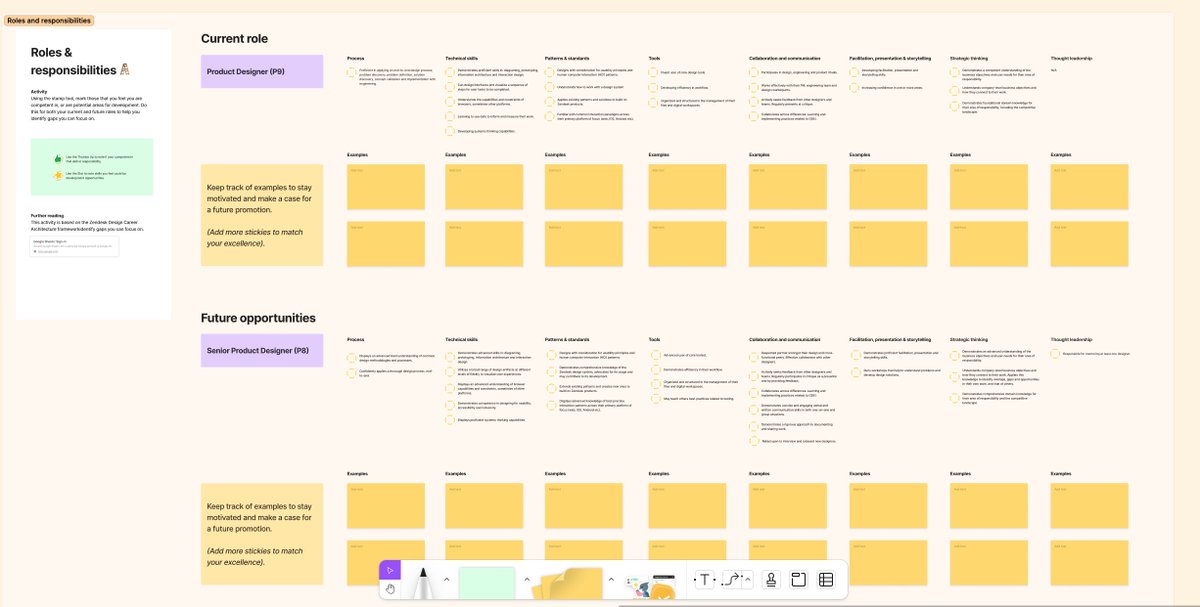
I have a template that I use when mentoring someone. The template outlines the responsibilities of their current role and their potential future role. I use yellow stickies to keep track of efforts that support those responsibilities. I am thinking of creating a template for the @figma community. Would you be interested in using it?
You're fortunate if you have a great manager who keeps track of your accomplishments. Ultimately, though we are our biggest advocates. No one else will put as much effort into our growth as we will. That's why I think it's essential that we track our accomplishments ourselves and not rely on others to do it for us.
What do you think?
Oh my goodness let the requests fly! Fix YOUR defect. Add a feature I want. Help me. Train us. Review that we used the system correctly. Link our library. On and on and on.
It's time to invest in a support process that's not handwavingly trivial.
https://t.co/7MAFgWIZRc
🗃️ How To Organize UX Research (https://t.co/UDWobKanNp), an interesting framework for structuring UX research as small signals leading to larger discoveries — experiments, facts, insights and recommendations.
Has it worked for you? How do you structure your UX research?
#ux
Interaction design separates good from great products.
The best way to learn it is with examples.
So I made this massive post with 43 original examples!
1) Remove friction with suggested options
Designers are often viewed as "difficult people" in their organisation, constantly asking challenging questions, ignoring the status quo, and pushing for better outcomes.
By contrast the "team players" get on and do what they're told. Often out of a desire for an easy life.
Just added Modes support to the EightShapes Specs plugin Pro subscribers. The section specs and shows artwork for variables bounded to layers that (a) have multiple modes and (b) differ by mode.
https://t.co/qfI5g6nuEc
Edge cases are the bain of every PM's existence.
They pop up even when you think you've planned for everything.
For your next feature, run through this table of the most common edge case types and mitigation strategies.
Your future self will appreciate it 😉