Super proud to announce AlphaGenome 2 - our new DNA sequence model! 🧬 It predicts the impact of DNA variants in different specific cell types - unlocking crucial information for understanding complex diseases. Available for academic research via our API: https://t.co/dEyrvpTxIl
AlphaGenome 2 is helping uncover the cellular drivers of disease, giving scientists a powerful tool to predict how DNA variants impact specific cell types.
Every cell in our body shares the same DNA blueprint, but different cell types (like heart muscle cells vs. immune cells) read that blueprint differently. This new @GoogleDeepMind model predicts how these specialized cells interpret DNA, turning genetic code into biological insights.
Building on AlphaGenome 1 this makes it significantly easier for researchers to link genetic findings to the root causes of disease in the specific cells where they actually unfold.
I’m very pleased to introduce AlphaGenome 2, @GoogleDeepMind’s next-generation genomics model that deciphers how DNA changes affect cells.
Cells are the basic units of life and key to our understanding of biology. It is an ongoing challenge to predict how DNA changes affect the functioning of different cells, such as for a heart muscle cell or an immune cell fighting an infection, and to uncover cellular drivers of disease.
To make progress on this challenge, we needed to design the architecture of AlphaGenome 2 so its predictions were conditional on cell types and states. This new design enables AlphaGenome 2 to predict variant effects across hundreds of human cell types and adapt to unseen cell and disease states without retraining.
When evaluated on the TenK10K immune cell dataset, AlphaGenome 2 demonstrated a major leap in accuracy over its predecessor. It reliably identified nearly twice as many causal variants (30% vs. 16%) and directional gene effects (43% vs. 23%) compared to the original AlphaGenome. This step-change improvement in precision helps researchers pinpoint previously overlooked disease-relevant variants with high confidence.
Using analysis on retrospective case studies, we were able to show AG2’s real world utility in disease understanding. A landmark study had previously shown that a variant in a distant regulatory switch drives irritable bowel disease by overactivating the ETS2 gene in gut macrophages. When used to make predictions across various immune cell types in the gut, AlphaGenome 2 singled out the exact causal variant and showed that it selectively boosts the ETS2 gene in gut macrophages, leaving other cell types and genes largely unaffected.
I would like to thank my colleagues Adam Gayoso @adamgayoso, Žiga Avsec @Avsecz, and our entire genomics team for their incredible contributions and dedication to bringing this model to life.
We are making AlphaGenome 2 available for non-commercial academic research via the AlphaGenome API, and soon we will release AlphaGenome 2 Skills in Google Antigravity. I’m incredibly excited to see how scientists around the world use this model to make progress on biological understanding and treating disease.
Read more on our blog here:
https://t.co/87sB9oKRaK
Single-cell atlases continue to map the diversity of cell states, but how can we use them to interpret non-coding genetic variants?
Excited to share AlphaGenome 2, our model for predicting cell-type-specific regulatory activity and variant effects from DNA sequence.
https://t.co/Sc2srWbTIe
By predicting how the same DNA is read differently from cell to cell, AlphaGenome 2 opens up entirely new possibilities for understanding human genetics.
It’s available now for non-commercial research via our API and interactive Colab tutorials. Find out more → https://t.co/cPOPD3cWYB
Looking at a whole tissue at once is like looking at a blurry image: you get the visuals, but miss what’s happening inside individual pixels.
Trained on 100M+ profiles across 68 tissues, AlphaGenome 2 focuses on one cell type at a time, spotting nearly twice as many mutations that turn genes on and off as our previous model.
Your heart, brain, and immune system share the same DNA sequence. So how can a single-letter change affect disease in some cells, while sparing the rest?
AlphaGenome 2 is our new AI model that zooms in on specific cells to help scientists understand what drives disease. 🧵
With AlphaFold we mapped the protein universe - now with AlphaGenome Atlas we’re charting the human genome. It can predict the impact of all 9 billion possible single-letter DNA variants, helping scientists better understand disease. Freely available for academic research: https://t.co/Gsy6lW3z6O
AlphaGenome Atlas is an interactive resource, mapping the predicted impact of all 9 billion DNA variants.
It works in a regular web browser, without any coding required, and is free for academic researchers. Excited for the discoveries to come.
We believe foundational biology tools should be accessible to everyone.
AlphaGenome Atlas resources are available to the global scientific community via the Atlas website, our AlphaGenome API, as a skill in Google Antigravity, and coming to @GoogleCloud soon → https://t.co/XsutJJwfnE
We’re launching AlphaGenome Atlas: an AI-powered searchable database mapping the predicted impact of all 9 billion possible single-letter DNA changes.
Here’s how it could help researchers better understand our biology 🧵
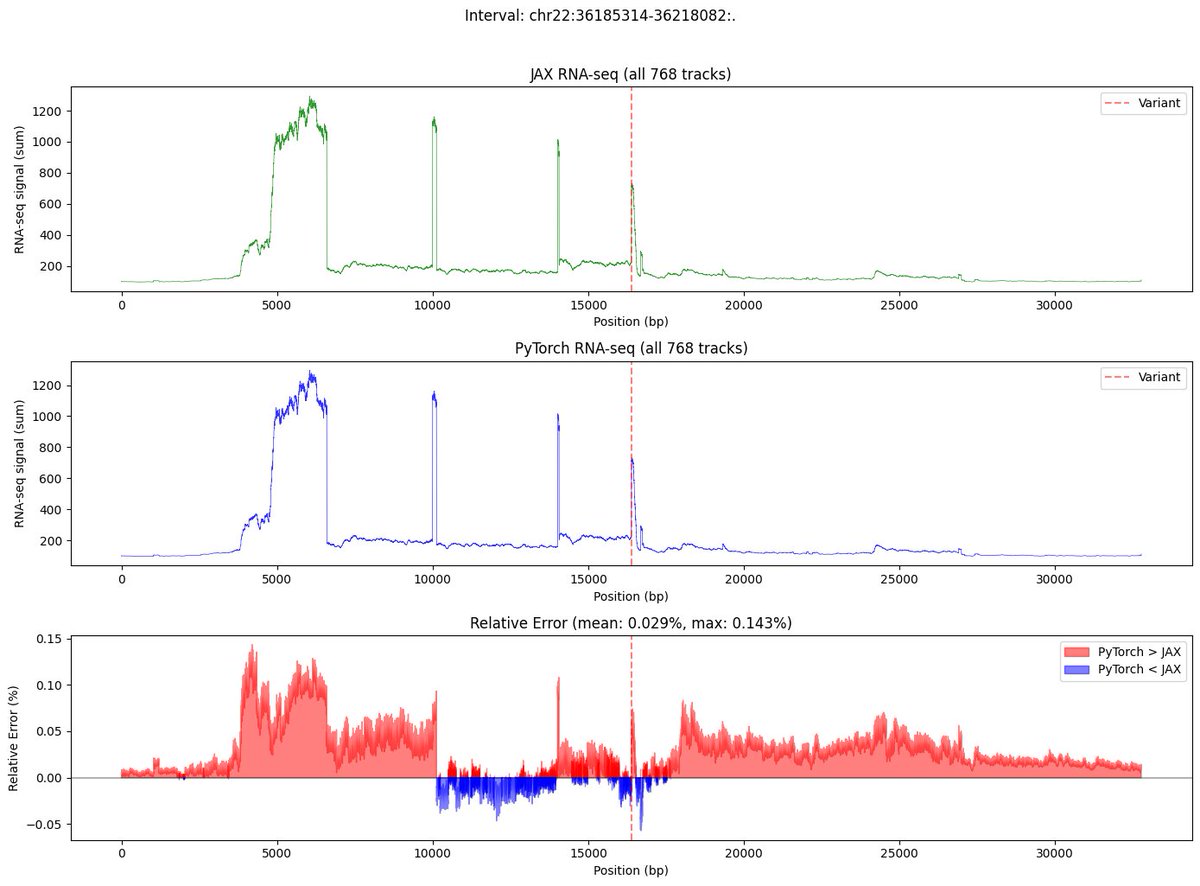
🤯 Okay, the future of coding is wild.
Just spent the last 24h pairing with Claude Code @claudeai & Codex @OpenAI port @GoogleDeepMind official AlphaGenome (JAX) weights to PyTorch.
It actually works. Hit strict numerical parity (Max Rel Error < 0.2%) against the official repo.
We got immersive world simulations before we got GTA 6.
I always wanted to revisit the iconic GTA London and now I can put myself in it!!
Here’s how I imagine it would look in 2026, built with Genie 3 from @GoogleDeepMind.
AlphaGenome is our latest & most advanced genomics model published in @Nature today including making the model & weights available to academic researchers. Can’t wait to see what the research community will do with it. Congrats to the team on our newest front cover! #AI4Science
Happy to see our AlphaGenome model published in @Nature today and on the cover of this week’s issue. 🧬
AlphaGenome is an AI model for understanding the non-coding genome – the 98% of DNA that's crucial for health and disease but doesn't code for proteins.
Our breakthrough AI model AlphaGenome is helping scientists understand our DNA, predict the molecular impact of genetic changes, and drive new biological discoveries. 🧬
Find out more in @Nature ↓ https://t.co/rnZCJivxwe
Our AlphaGenome paper and models are out today! https://t.co/T1FCsakz48. We have seen great community engagement since we released the API. We hope to open more use cases with the model weights! https://t.co/0t82VLVdYk
This is Gemini 3: our most intelligent model that helps you learn, build and plan anything.
It comes with state-of-the-art reasoning capabilities, world-leading multimodal understanding, and enables new agentic coding experiences. 🧵