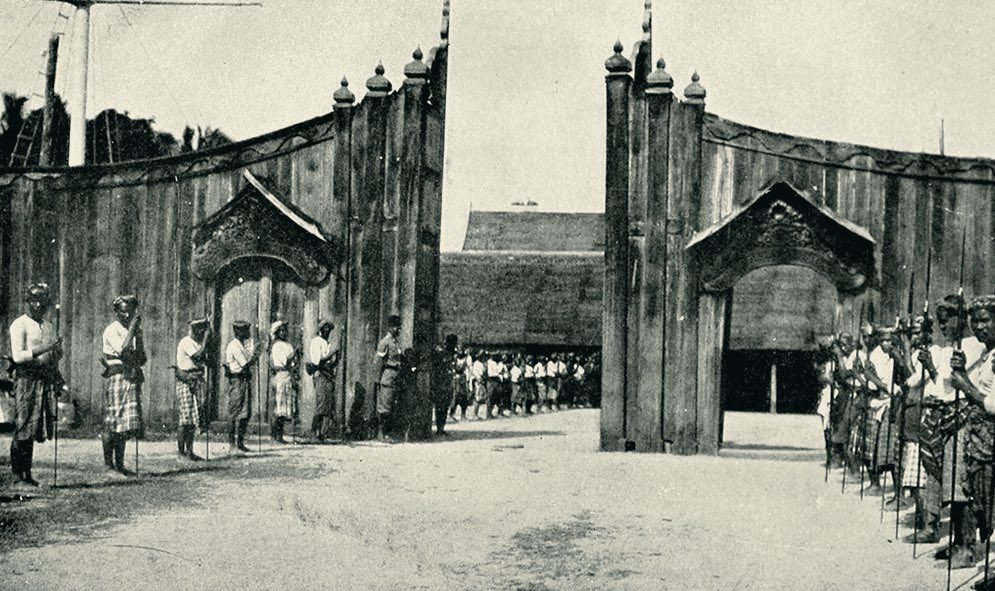
Just a reminder of Negeri Sembilan’s traditional socio-political structure:
The kadim elects the besar, the besar elects the buapak, the buapak elects the lembaga, and the lembaga elects the Undang (or penghulu).
Assalamualaikum, mohon pencerahan daripada ilmuan dalam X ni.
Selama ni saya dengan isteri saya solat bersebelahan sampai saya sedar tentang posisi solat jemaah yang sebenar macam ni.
Jadi, apa yang saya dengan isteri saya perlu buat? Dah setahun kami solat jemaah macam tu
Van Gogh died broke because nobody wanted his paintings. He sold maybe one during his entire life. The art world thought his style was too immature. His brother Theo, an art dealer, kept him alive by sending money constantly.
When Van Gogh passed in 1890, his brother, Theo died just six months later. That left Theo's wife Jo as a 28 year old widow with a baby and about 900 paintings nobody wanted, plus hundreds of letters.
Here's what actually mattered. Van Gogh had written hundred of letters letters to Theo and Jo explaining individual paintings and his life as an artist. He told them the stories behind each work, what he was trying to express, what each one meant to him.
After both brothers died, Jo remembered these letters and published them.
That's what made him famous. People could read Van Gogh's own words about each painting. The works stopped being random art and became stories he had experienced. The paintings got context directly from him explaining what he was doing. Jo gave the world Van Gogh's voice attached to his work.
By the time she died in 1925, he had gone from total unknown to art historical icon.
For those who do not understand the image. The cartoon image is a meme that depicts a man in traditional Arab attire (thobe and ghutra) holding a stack of five large books labeled Qalun, Hafs, Warsh, Al-Duri, and Khalaf.
What the meme is referring to
These labels are not different "books" or separate versions of the Quran. They are names of authentic canonical recitations (Qirā'at) of the same Quran:
1. Hafs (full: Hafs 'an 'Asim): The most widespread recitation today, used in about 95% of printed Qur'ān worldwide (including most Muslim countries outside North Africa).
2. Warsh (Warsh 'an Nafi'): Commonly used in parts of North Africa (e.g., Algeria, Morocco, Tunisia).
3. Qalun: (Qalun 'an Nafi'): Another transmission from the same reader as Warsh, popular in Libya and parts of Tunisia.
4. Al-Duri; (Al-Duri 'an Abu 'Amr): Used in some regions of Sudan and West Africa.
5. Khalaf (Khalaf 'an Hamzah): One of the less common ones today but still authentic.
There are traditionally 7 or 10 canonical Qirā'at (depending on scholarly classification), all tracing back through unbroken chains of transmission to the Prophet Muhammad (peace be upon him). These are different styles of recitation, primarily in pronunciation, intonation, vowel lengthening, and minor word forms similar to regional accents or dialects in a language.
Why the differences exist (Islamic perspective)
The Qur'ān was revealed in classical Arabic, which had various tribal dialects. Authentic hadiths state it was revealed in seven ahruf (modes/dialects) to make recitation easier for different Arab tribes. Over time, these developed into the standardized Qirā'at, all considered fully authentic and divinely permitted. The skeletal text (rasm) of the Qur'ān remains identical across all; differences are mostly in how words are vocalized or minor synonyms that complement rather than contradict the meaning.
The meme plays on a common criticism (often from non-Muslim polemicists) suggesting these Qirā'at prove "multiple Qur'ān" or textual corruption. In reality:
a. All Qirā'at convey the same core message and doctrines.
b. Differences are subtle (e.g., pronunciation of a word like "maliki" vs. "maaliki" in Al-Fatihah, or minor grammatical forms).
c. They enrich understanding by providing layered meanings, not conflicts.
d. The vast majority of Muslims recite in Hafs today, but switching to another authentic Qira'ah is perfectly valid.
The "confusion" portrayed is satirical exaggeration, there's no genuine doubt among scholars that all these are the one Qur'ān, perfectly preserved in its authentic forms.
Take every attack they throw against Islam as an opportunity to teach Muslims about Islam. In a way, they are helping to spread Islam but they do not know it because they are not different from the beasts, unable to think, research or see things properly. In fact, they are even more astray than the breasts.
Kerja mendidik anak ini patutnya kerja mak bapak. Kau sikit-sikit nak suruh cikgu didik anak kau dari A-Z.
Anak seekor dua dah mengeluh penat, main fon malas layan bila anak nak perhatian. Cikgu kena hadap 30+ murid satu kelas. Baru satu kelas. Kalau 6-7 kelas? Kadang nama pun tak ingat.
Anak kau tak ada pensel, tak ada buku, stokin koyak pun cikgu kena keluar duit belikan. Kau pun tak tahu.
Anak buat masalah, ponteng kelas, cikgu laporkan, kau tak caya. Anak tak nak mai sekolah, cikgu yg kena pujuk. Kau buat ikut dan je.
Sekolah patutnya jadi tempat nak salurkan ilmu je. Bukan tempat asuhan.
Cikgu ni walaupun cuti ikut kalendar, depa takda cuti tahunan (AL) tau. Nak minta cuti susah. Kena ikut kalendar je. Itu pun bukan takda kerja. Kena panggil, kena datang sekolah jugak.
Kau semua rasa nak cuti, kau boleh mohon cuti ikut tekak. Cikgu mana ada kemudahan begitu.
Cikgu tunjuk kereta sikit dah merentan. Jaga anak sendirilah.
On normal days, you can easily find malays wearing baju melayu/baju kurung in the crowd in Malaysia but then I dare you to find one chinese wear samfoo/cheongsam in the crowd.
“Kenapa Hanya Anak Kelantan Boleh Beli Tanah Di Kelantan?”
Kenapa susah sangat nak beli tanah di Kelantan?
Tak kisah la kau orang KL, Penang, Sabah, Sarawak, hatta Johor sekalipun, asal bukan “anak jati Kelantan”, jalan nak beli tanah kat negeri Serambi Mekah tu memang payah.
Lmao young gen indo don’t know about Sukarno’s ganyang malaysia? Or just conveniently forgot? Literally tried to invade Malaysia like how Zionist did with Palestine.