I can control your balance
I made a device that sends DC current through my head to stimulate my vestibular nerve (called galvanic vestibular stimulation or GVS) and, in doing so, can make me feel completely destabilised. By changing the direction of the current, it can make me fall in that direction.
Hook that up to keyboard controls or a joystick, and suddenly you could have your own remote control human.
Naturally, my first thought was man I wanna play trackmania with this. What else should I do?
I do not have enough self-preservation, clearly lol
#gvs #technology #science #trackmania
@tom_doerr Note: Voice cloning from raw audio is not supported in this open-source release. Only the pre-encoded voices listed in voices/voices.json are available.
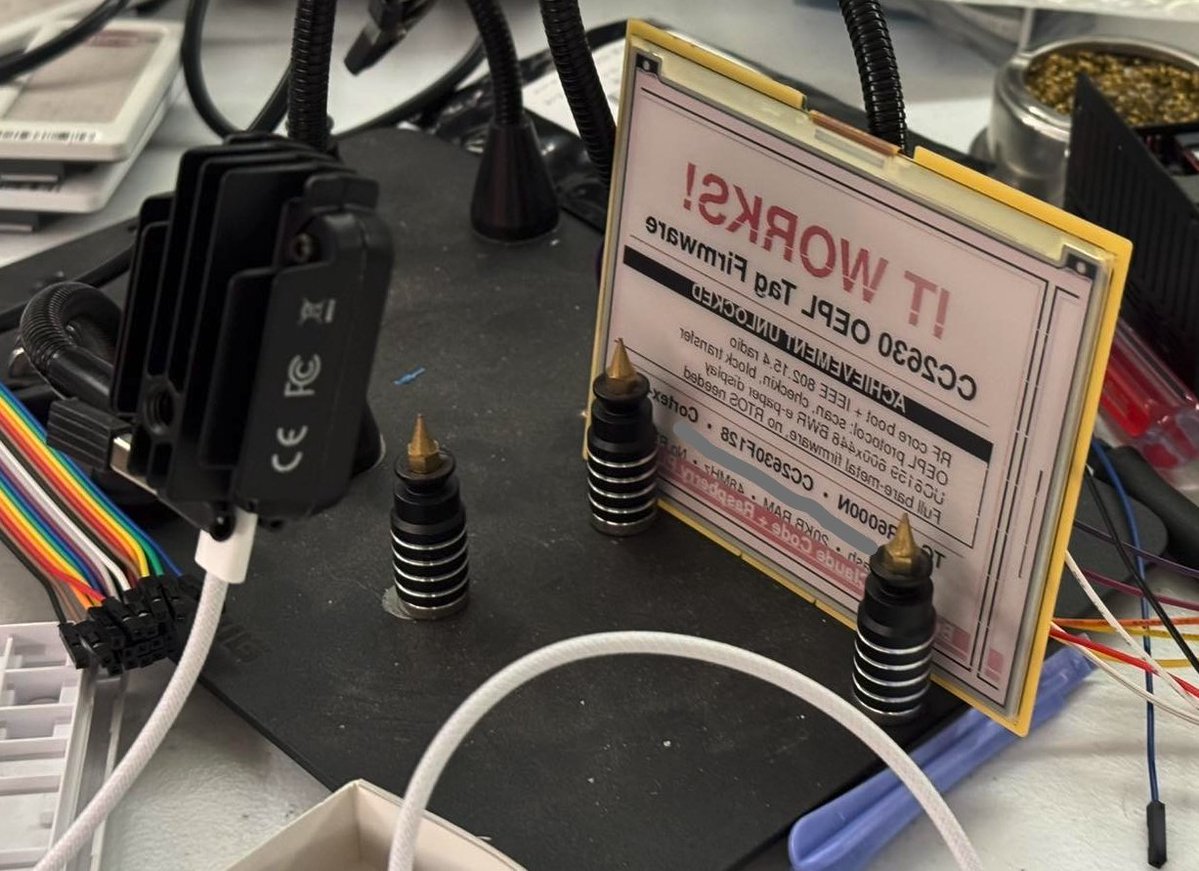
A friend had Claude spend all night trying to hack into an e-ink display, and gave Claude camera access so it could verify whether an attempt worked. He told Claude to show him a message if it won.
My friend woke up to this victory lap, which Claude didn't realize was backwards
Kubernetes killed more startups than server crashes ever did
You don't have Spotify's scale. You have 8 engineers and a single server that's running fine
But you watched a KubeCon talk, and now you've got 23 YAML files, a Helm chart nobody fully understands, and engineers debugging pod evictions instead of buildinga product
Your "cloud-native infrastructure" is just a cloud bill with extra complexity
A $50/month VM can handle millions of requests. Your startup will run out of money debugging networking issues long before you need horizontal pod autoscaling
The best infrastructure decision is often the simplest one
Scaled from 1,000 to 100,000 users. Here's what broke.
At 5,000 users:
- Single database became the bottleneck
- Added read replicas
At 20,000 users:
- Session storage overwhelmed Redis
- Switched to JWT tokens
At 50,000 users:
- File uploads killed our servers
- Moved to S3 with presigned URLs
At 75,000 users:
- Search became unusable
- Implemented Elasticsearch
At 100,000 users:
- DNS became single point of failure
- Multi-region with Route53 failover
Every stage felt like the final architecture.
None of them were.
Scaling isn't a destination. It's a continuous series of bottleneck discoveries.
2021: it can’t even autocomplete a line
2022: it can’t even write a whole function
2023: it can’t even pass a coding interview
2024: it can’t even build an app
2025: it can’t even handle complex projects
2026: oh no
I hate that maintaining and running a company is so fucking hard in Germany. It makes sure only those with some financial can even try.
There are two popular types of companies: GmbH and a mini-Gmbh ( UG: Unternehmergesellschaft) . A GmbH is kind of legally equivalent to a US LLC . To start a GmbH you need a minimum share capital of 12500 Euros.
This is really really difficult for most people. Bear in mind German tech salaries are rarely over 100K and the median is around 75K .
In comparison, US LLCs don’t require a starting share capital.
There is a work around though. This why the UG structure was created-it requires no minimum starting capital.
But Germany still functions like the 1800s, so even if you want to sell an online SaaS, you have to pay notary fees ( a notary reads out loud the formation documents to the founders), be a member of the chamber of commerce, and pay a ton of legal and tax advisory fees. So still formation + maintenance can cost up to 2500 Euros in the first year.
For people without any generational money, and who have only been salaried all their lives, spending 2500 Euros just to try an idea, feels like a lot. Because most ideas don’t pan out.
Traditionally German companies have been family run businesses. And the legal tax structure is not optimized for startups.
It sometimes feels so unfair and frustrating. I have received exasperated messages from fellow immigrant founders who swore they would never again bother opening a German company and exclusively do US LLCs from the get-go. The German bureaucratic system chewed them up and spat them
out.
I am afraid this won’t change. This affects a tiny fraction of the people. People who want to try and test multiple ideas but don’t have any starting capital.
And I didn’t even get started about the fucking slow the process. I have friends who still don’t have their VAT number and they registered their companies in July.
It feels like the system almost wants to punish you wanting to start something. Don’t dream big, put your head down, work for Siemens and Bosch,
collect your paychecks and be content.
AI is causing a new dev pattern: I heard this yesterday: I show my stakeholders a demo, we generate 10-12 exciting ideas, and by end of next day, 80% are already in production. Then I let them know: 'It's live — what do you think?"
People who fret about AI replacing dev jobs are missing the point. When you can create value 10x or even 100x more quickly, you get more headcount, not less.
Another example: I paired with someone two days ago who made a circa-2005 Google Analytics clone in less than 30 minutes. (One JavaScript snippet, sending events to Google Cloud Run, PubSub, and BigQuery.). It will eventually ingest 20MM events/month, way above the 1MM Google Analytics limit. (We wrote the reporting engine in Python Streamlit today.)
The longest part of the process? Getting permission to create PubSub subscribers. Not coding.
These types of obstacles are what @steve_yegge and I called "barbed wire" in our Vibe Coding book. But I never saw as vividly as how critical it is to have someone from infosec or admin rights on the team — all your wildest dreams are blocked by waiting to get access rights.
Another heartbreaking form of barbed wire? People stuck in protracted sprint planning processes, endless backlog grooming meetings about what features should work on next and which need to be pushed into next quarter...
The new bottlenecks are organizational, not technical — let's go fix them!
just discovered my best friend has been vibe coding for the last 2 years
i was horrified
he’s been shipping full products with no specs, no diagrams, no architecture reviews, just “trying things until it feels right”
i invited him over for an intervention
we opened his metrics
apps in production: 3
paying customers: 1,200
monthly downtime: 0 minutes
it was worse than i imagined
millions of lines of undocumented intuition, completely non-compliant with any serious engineering framework
i did the only thing a real friend could do
we spent the entire weekend rebuilding his workflow
introduced jira, quarterly architecture councils, rfc templates, raci matrices and a strict “no code without diagram” policy
his shipping pace collapsed overnight
but now every button change requires a 9-page design doc, a risk analysis and a future scalability assessment for when he “hits 10 million users”
revenue growth stalled
but his confluence space has never looked more enterprise-ready
i’ve never been more proud of him
he’s no longer some chaotic vibe coder
he’s finally a blocked, over-process senior engineer
The problem with vibe-coding is that it opened the floodgates to a certain kind of person (myself included) who now pushes the idea that you can vibe-code an app in a few days and start printing life changing amounts of money.
It’s turning into the same fake and lame energy of the info-guru world where the lifestyle becomes the product by setting unrealistic expectations to lazy people who want to get rich quick.
In case I misled people: my belief is you can vibe-code an MVP. You can get interest, a waitlist, even early revenue. If the product is simple or you have basic engineering instincts, sometimes you really can build and scale something meaningful fast. It happens.
But most of the time building real software still takes months. It needs iteration, debugging, new features, and actual users so you can test and fix. Non-engineers often misunderstand that software is a living, breathing organism. It needs maintenance, it needs oxygen (distribution and growth), and none of that is instant or finitely required.
Anyone claiming you can fully automate marketing is lying. Anyone promising thousands of paying users overnight is selling an edge case. These outcomes happen, but they’re rare and treating them as the standard is how people end up disillusioned and angry.
A lot of the “software fell off” narrative comes from comparing today to the 2000s/2010s, when (I believe) companies were built with decades in mind. Too many founders now (again, myself included) fantasize about quick wealth instead of lasting impact, largely due to social media and very largely due to every VC jamming the Cursor, Lovable, etc narrative down our throats (see: the fastest company to 100M ARR charts).
I’m not saying you shouldn’t want to get rich, even quickly. That’s actually exactly what I want to do. I’m saying you may see more success by aiming to build something enduring because the opposite is a very unlikely-to-hit gamble where survivorship bias the only thing you see on your feed.
To be completely clear (and TLDR): for selfish reasons alone, you should want to build for long-term impact. Do not let social media convince you that you can no-code a $10M ARR SaaS or raising $50M at 22 and exiting in 2 years are normal.
The reason “vibe coding” continues to grow and be successful is that the alternative to vibe coding is not “elite engineering”.
It’s: the project wasn’t born, the idea didn’t get communicated, the app didn’t ship.
Elite engineering is very scarce and will continue to be in extremely high demand. (We’re hiring elite engineers!) The gap between what top engineers and agents can do still exists. Not just that.. when those people use AI, they also gain superpowers.
<rant> A periodic reminder that Sprints, Backlogs, Daily Scrums, Scrum Boards, Scrum Masters, Product Owners, Points, Velocity, PIs, etc., have NOTHING AT ALL to do with "Agile." Agility comes from working small, delivering frequently for feedback from actual customers, and adapting based on that feedback. It has to do with teams working in whatever way they see fit to get stuff into the customer's hands as quickly as possible and acting on the feedback without bureaucratic obstacles. Any way that you can accomplish that is fine. All that garbage I listed in the first sentence just gets in your way.</rant>