A new clinical trial at UT MD Anderson Cancer Center will test using low-dose radiation therapy to ease knee/hip osteoarthritis in people who have arthritis flares as a side effect of immunotherapy treatment for #breastcancer
https://t.co/4CARcIzwsg
Thanks for spreading the word! We have seen very promising early results (case report coming soon) and are excited to see if this will help enable cancer patients to resume their immunotherapy! Immune arthritis flares are very underreported and can be persistent. Diving deep on the immunobiology as well. @ShalinJShahMD@ChidinmaMDMPH@SpeedofLightFdn
Brilliant work Dr. Kim. We look forward to the opportunity to collaborate with you further soon on our upcoming clinical trials in this and related spaces!
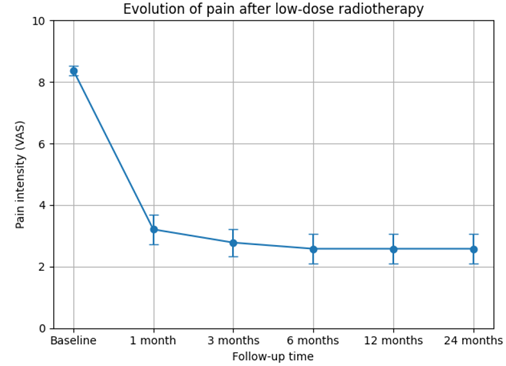
Excited to share the updated long-term (12-month) results of our LoRD-KNeA trial! Building on our initial 4-month data, it is encouraging that significant clinical benefit was maintained up to 8 months following just a single course of LDRT 3 Gy/6 fx, even with a small patient cohort.
We originally aimed for a more impactful general scope journal, but the review process turned out to be quite a long and challenging road. We look forward to addressing various discussion points at a future ASTRO webinar and/or in our subsequent analyses. While LDRT is not yet covered by insurance in South Korea, it is actively utilized in the US, and we anticipate more follow-up evidence emerging! 🇺🇸🇰🇷 #Osteoarthritis #LDRT
Stay tuned for a upcoming review on this topic, as well as for other reports on our work expanding treatment for immune checkpoint inhibitor mediated arthritis and active bone marrow mri monitoring to quantify and reduce exposure dose and risk for patients in the pelvis and spine.
That’s now three separate randomized controlled trials in a row showing benefit from LDRT for osteoarthritis. Does anyone know of any negative RCT vs no treatment control at modern doses (less than 1 Gy per fraction)?
Strong evidence to point to with insurance companies. I’ve seen hundreds of patients benefit and think we need to strongly advocate for our patients to maintain access to this care option.
Since we launched the first decision model in July, we've been concerned that models like ours (and now Jev) can't answer basic logic that a 12yo can solve.
A ball is under cup A. Swap cups A and B. Swap cups B and C. Swap cups A and B. Swap cups A and C. Which cup is the ball under?
Do you really care about a 200ms answer if it gets basic stuff confidently wrong?
Today @levantolabs releases Sage1:
– It's multimodal: it can see!
– It reasons, but only when needed. So it knows where the cup is :)
But there are downsides.
A lot of us dedicate our lives to just that outcome (curing cancers), I can personally say that I don’t personally know a single radiation oncologist who wouldn’t make that trade in a minute. Hard to feel differently than that when you work so closely with patients and care for them and their families during the most challenging time in their lives. Bring all the firepower you can to this fight, please.
I thoroughly enjoyed reading this recently published article led by @TroyKleberMD. It pulls back the curtain on how the largest cancer center in the US selects and manages patients with stage III NSCLC with induction chemoimmunotherapy. The framing is excellent, the results are unbiased, and the discussion is full of excellent pearls. The results also include a nice analysis of different RT strategies delivered after chemoimmunotherapy, including RT alone (without concurrent chemotherapy). #WCLC26 https://t.co/86t6SzCPRN
I’m canceling my Claude subscription today- I find it burns through the subscription way too quickly and has not updated its model in quite some time.
I expect with the current trajectory of improvement, Grok and Codex will be competing with each other at the Pareto frontier for at least the next year for the type of work I find useful.
Incredibly privileged to work with these brilliant scientists! Huge congratulations on this essential research.
I am excited to see this applied in our upcoming grant/phase II clinical trial studying low dose radiotherapy as a treatment option for patients with immunotherapy mediated arthritis flares. This work will be led by Dr. Chidinma Anakwenze and was recently funded by the ASTRO-BCRF Emerging Investigator Award. @ShalinJShahMD@SpeedofLightFdn@ASTRO_org@ChidinmaMDMPH
New research from UT MD Anderson suggests recurrent inflammatory arthritis after immunotherapy may be driven by immune cells that persist between flares.
The findings could help identify patients at higher risk and inform targeted treatments to reduce this side effect while preserving immunotherapy’s benefits.
Read more: https://t.co/xxjJYXjAW5 #EndCancer
New research from UT MD Anderson suggests recurrent inflammatory arthritis after immunotherapy may be driven by immune cells that persist between flares.
The findings could help identify patients at higher risk and inform targeted treatments to reduce this side effect while preserving immunotherapy’s benefits.
Read more: https://t.co/xxjJYXjAW5 #EndCancer
I’ve treated over 1,000 patients with low-dose radiation for benign musculoskeletal conditions. Effective this November, EviCore will classify the treatment as not medically necessary for nearly all of them.
Some context on how EviCore got here.
In 2019, EviCore’s own published criteria stated: “Policy: Radiation therapy is medically necessary” for plantar fasciitis and osteoarthritis, citing response rates near 80% with durability at 48 weeks. That position held through early 2026. The new guideline describes the same literature as a “paucity of evidence.” No reconciliation of the two positions has been published.
The cited sources don’t support the reversal either. The DEGRO guideline EviCore references recommends LDRT for refractory Kellgren 2–3 knee OA and grades plantar fasciitis radiotherapy at evidence level 1b, recommendation A. The 2024 VA evidence review found uncertainty on specific outcomes, not nonnecessity, and its literature search ended April 2023. The review is currently being updated as you are reading this.
Since that cutoff: a randomized, multicenter, sham-controlled trial presented at ASTRO 2025 showed 70% response with 3 Gy versus 42% with sham (p=0.014) in knee OA — the study design the earlier skepticism specifically called for. And the American Radium Society published multispecialty Appropriate Use Criteria, developed with rheumatologists and orthopedic surgeons, defining when LDRT is and isn’t appropriate.
I’ve applied strict evidence standards in my own AUC work, including voting against favorable ratings when randomized controlled data was lacking. This isn’t a plea for blanket coverage. It’s a request for basic consistency: an evidence review should account for the strongest available trial, accurately represent its cited sources, and explain what changed.
The patients affected are refractory with failed conservative care, often not surgical candidates. Categorical noncoverage removes even individualized review for the exact population every cited guideline identifies as appropriate.
Comment and appeal pathways are open through the November effective date. Our societies are engaged. If you treat these patients, now is the time to document and submit.
Encouraging to see such a positive signal from prospective data, and also happy to see the integration of MRI - more data from MRI has the potential to help us identify imaging biomarkers of response to low dose radiation therapy.
We need more studies like this, so our patients and colleagues can see the potential benefits low dose radiation therapy has for those suffering from functionally limiting and painful disease. Thanks for sharing @PDBrownOnc !