So basically, today PHP got two critical bugs that let anyone run code on your server without even logging in, which is bad, and then the details leaked before the patch was even out, which is worse, and it works on WordPress and MediaWiki and Magento and Joomla and Laravel, and Censys says like 1.5 million servers are running a version with no fix, so the NSA was like "take your system offline," and the FBI was like "take your system offline," and CISA and the UK and CERT-EU were all like "take your system offline," and then the Prime Minister of Japan, the actual Prime Minister, posted at 5:55 in the morning telling 48.8 million people to take their system offline, so everyone took their system offline, like the Dutch cybersecurity agency took its own website offline, and the Dutch parliament went offline, and the Port of Rotterdam went offline, and Finland and France and Denmark started pulling government sites, and Wikipedia went down, and https://t.co/QlOXb3COq3 went down, and Asana and GOG and Something Awful went down, and the University of Vienna's webmail went down for some reason, and that's just PHP. Because GitLab also dropped a CVSS 10.0, which is the highest score they give out, for a bug that's been there since 2014, so that's every self-hosted GitLab for twelve years, and then LiteLLM 1.107.0 got hijacked and shipped a credential stealer and a remote access trojan in every single wheel and the Docker images, including latest, and you didn't even have to import it, just installing it was enough, and it's the second time this year, and then Railway paused every deployment on the entire platform because someone got into the environment variables, so now everyone has to rotate every secret they've ever stored there, and TiDB Cloud said someone was walking around inside with stolen credentials for basically a month and an extortion group says they took 10.6 terabytes, and Zeabur got breached for the second time in two months and is just shutting down, like the whole company, and Node.js patched remote code execution and a TLS bypass, and CISA says Plex is being actively exploited, and someone took over 300 Tor exit relays to steal SSH passwords, and SafePay ransomware has hit over 600 critical infrastructure orgs, and India's biggest bank filed a data loss incident, and Japan has been in an official state of emergency in cyberspace since October 9, which honestly explains the 5:55 AM post. Oh, and eMudhra, a certificate authority that's issued over 60 million certificates, whose entire job is proving websites are who they say they are, was supposed to be using private keys that are random numbers over a hundred digits long, and one of them was 4. Just 4. And the others were like 66 and 237. Anyway, it's Wednesday.
best rebrands of this era
public beta --> Research Preview
sales engineer --> FDE
engineer --> Member of technical staff
gambling --> Prediction Markets
what did I miss?
Against my will, I have been forced to learn about the Bun / Zig drama. Here's my understanding:
- Bun == thing that crashes OpenCode & Claude Code
- Rust == artisanal programming language for furries
- Zig == even more artisanal programming language for devs who think Rust is too mainstream
- Anthropic acquires Bun because machine god says so
- Bun uses machine god to rewrite from Zig to Rust
- Zig creator accuses Bun of selling out, going mainstream, or something
- Bun still crashes Claude Code and Open Code
I vibe coded something like this for simulating custom scenarios. You can pull in old tx data or submit your own with the ability to spoof account data, balances, and slot numbers. It also simulates rpc/grpc, making it easy to hook up to other apps (like mintech) for testing
got bored last week during accelerate while y'all were at e11even, so I worked on a limited-lookback (1 month) historical account state service:
getTransactionFixture(signature) -> TransactionFixture
which returns everything you need (pre/post accounts, feature set, sysvars, txn status, rpc client version/hash, etc) to re-execute the transaction. very helpful for debugging and trying out changes. i think main use cases are something along the lines of:
1. how would this trade have gone (as a maker or a taker) if program commit B was deployed instead of A?
2. how many cus would this txn have used if some other commit was live?
3. what was the pre/post execution state of some account? why was some special branch hit?
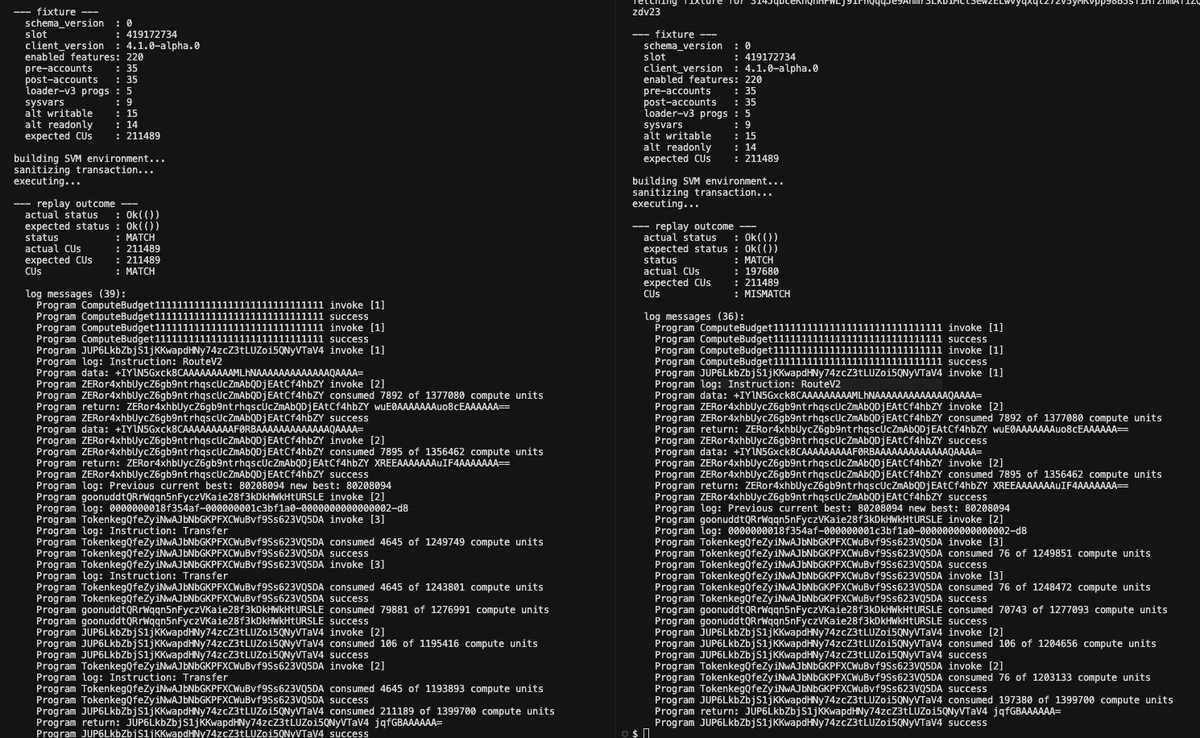
in fact, 2. is exactly what i show in Figure 1 to compare p-token vs current tokenkeg. I took a random swap that went through zerofi and goonfi with my nifty client...
the left shows all results matching (successful replay). the right shows me adding the flag --replace-program=TokenkegQfeZyiNwAJbNbGKPFXCWuBvf9Ss623VQ5DA:https://t.co/woC9jdexN8, which replaces the current token program with the p-token program. we get a match in status, but a mismatch in CUs (and logs... p-token does not log "Instruction: Transfer"!).
we will be using this internally (it has already come in handy bigly twice), but we also want to try to offer this to external users. if there's enough interest we may do a pilot. dm me if you want to try it.
@pxtvr@ShaShaPlsStop This is not true. Given the proper environment current models are extremely good at reversing. They definitely would have out performed the average 2020 sneaker bot dev
the sneaker reseller —> sim swapper —> onchain trader —> vibecoder rotation must go hard if you’re 68 IQ and incapable of doing anything productive for society