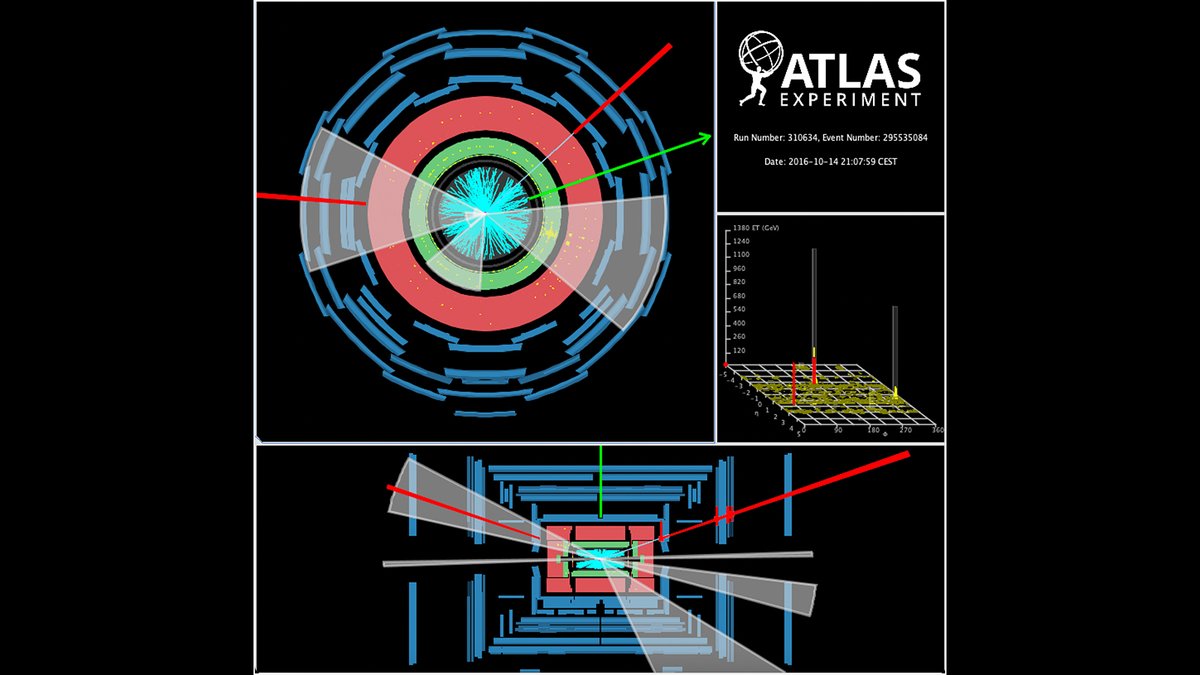
With an experiment that produces a billion particle interactions per second, scientists have their work cut out for them. As part of the ATLAS collaboration @CERN, scientists @argonne used a machine learning approach to search the data for new particles: https://t.co/CM0zNJaXOs
Happy to share, a work I presented at LeptonPhoton2025 is now available: https://t.co/qkpevTRJnP. With @svchekanov and Nicholas, we explored how unsupervised ML and event-level anomaly detection can expand LHC new-physics searches & ADFilter tool enables reinterpretation studies.
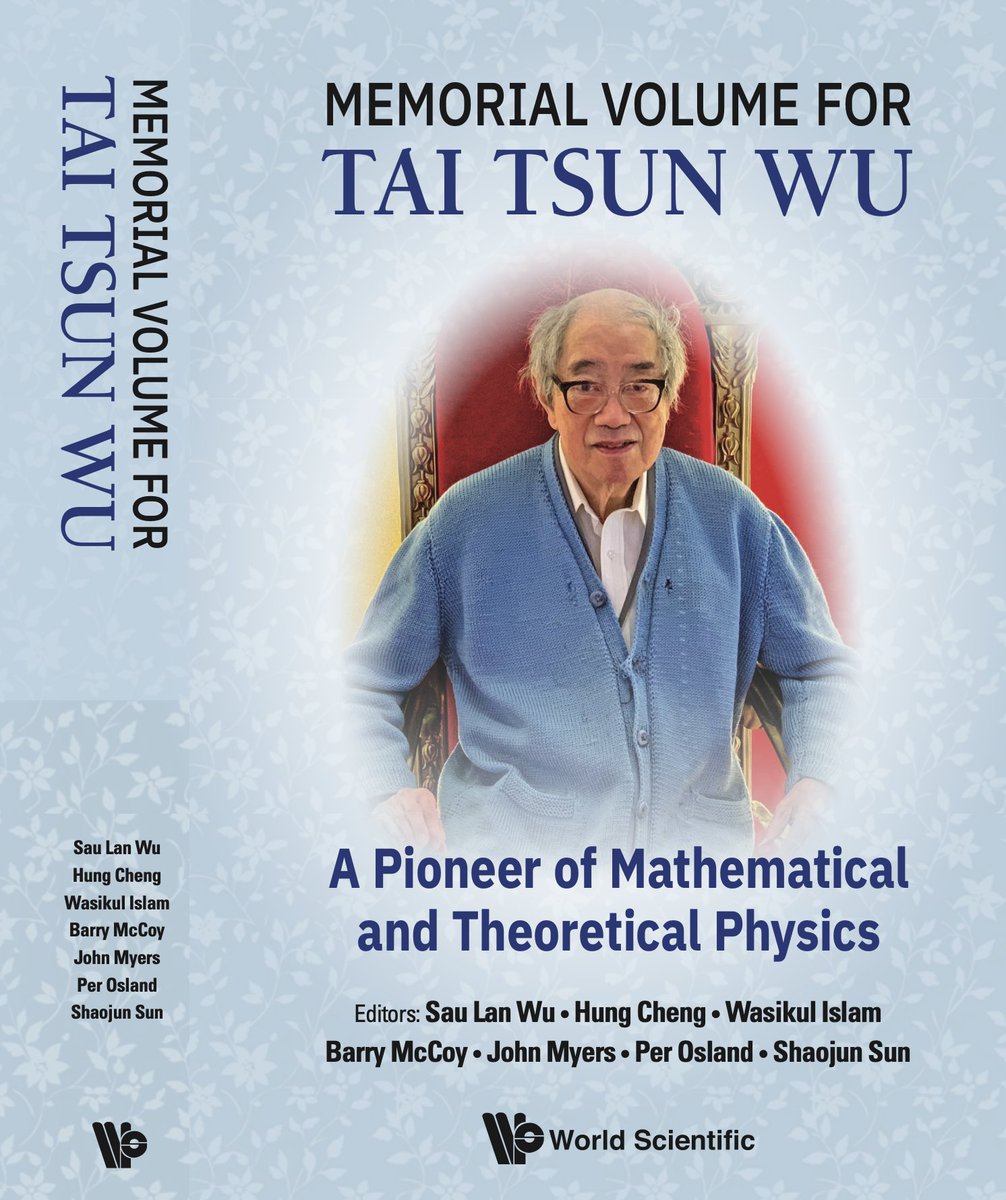
Tai Tsun Wu, a longtime Harvard professor, made many pioneering contributions to mathematical & theoretical physics. I was honored to be a co-editor of the book with Profs. Sau Lan Wu(Wisconsin), Hung Cheng (MIT), John Myers(Harvard), Barry McCoy(Stony Brook), Per Osland(Bergen).
Happy to share that our new book “Memorial Volume for Tai Tsun Wu”–honoring the life & legacy of theoretical physicist Prof. Tai Tsun Wu–has been published by World Scientific (@worldscientific) today!
Publisher's webpage: https://t.co/s1QTwxeixQ
Amazon: https://t.co/wVlZXRHhry
It’s truly inspiring to learn about the extreme hardships that Omar M. Yaghi endured during his childhood as a refugee, only to go on to conduct groundbreaking research, become a professor at UC Berkeley, and later win a Nobel Prize in Chemistry! 🙏
This year’s chemistry laureate Omar Yaghi was born in Amman, Jordan, in 1965 to parents who were refugees from Palestine. When we spoke to him he shared his story:
“I grew up in a very humble home, we were a dozen of us in one room, sharing it with the cattle that we used to raise. I was born in a family of refugees, and my parents could barely read or write. My father finished sixth grade and my mother couldn’t read or write. It’s quite a journey. Science allows you to do it. Science is the greatest equalising force in the world.
Smart people, talented people, skilled people exist everywhere. That’s why we really should focus on unleashing their potential through providing them with opportunity.”
Today Yaghi shared the 2025 Nobel Prize in Chemistry with Susumu Kitagawa and Richard Robson for their work developing metal–organic frameworks.
Learn more about the prize: https://t.co/4nmszg1ZIR
In a fun study, I took some ideas from particle physics pileup mitigation and applied them to image denoising problems in computer vision—turns out it actually worked & physics priors boost performance! 🚀 Just uploaded a proof of concept study to arXiv: https://t.co/178wurO4d9
Saddened by the passing of Prof. Rainer Weiss, Nobel Laureate of Physics, famed for the discovery of gravitational waves with LIGO. I was excited to meet him in 2018. And as an experimentalist, I found immense inspiration from many of his talks & interviews. Photo from APS-2018.
Here is the one of the rare papers https://t.co/D9UwqioDAr we did where a supervised event classifier is compared with an unsupervised #autoencoder using exactly the same input and a similar neural network architecture for the hidden layers. The example uses double-#Higgs models for the Large Hadron Collider at @CERN . CC @wasikul_islam #AI
"UW–Madison scientists part of team awarded Breakthrough Prize in Physics" — A news article by @UWMadPhysics on the 2025 @brkthroughprize in Fundamental Physics, awarded to members of both our ATLAS and CMS groups at Univ. of Wisconsin-Madison @UWMadison.
https://t.co/zCkdJnb4m8
Honored to be part of the ATLAS Collaboration at CERN, which has just been awarded the “2025 Breakthrough Prize in Fundamental Physics”! Congratulations to all my colleagues in @ATLASexperiment & the other 3 experiments!
https://t.co/pB5yhk4ZXZ
@TylerJBurch They have put a "List of the ATLAS prizewinners" on the website: https://t.co/pB5yhk4ZXZ ... And I could find your name 😀 @TylerJBurch
P.S.: I heard LHC Run 2 contributors are in!
In an article published today in @Nature, the ATLAS collaboration reports how it succeeded in observing quantum entanglement at the LHC for the first time, between fundamental particles called top quarks and at the highest energies yet. ⤵️ https://t.co/oayHIBA2hv
Introducing AD-Filter, our new web tool for reinterpreting BSM models (with updated limit calculations) using published event-based anomaly detection search results from LHC (ATLAS for now).
Our paper: https://t.co/1APYH3OdMO
Web tool: https://t.co/e81xygGTC0
Feedback welcome!
@PratitiTiyas I am totally surprised to see my name in this news article... Though I know him well and I am very happy for him. Best wishes to him for both Quantum Physics & life ... Thanks for sharing @PratitiTiyas 😊
With an experiment that produces a billion particle interactions per second, scientists have their work cut out for them. As part of the ATLAS collaboration @CERN, scientists @argonne used a machine learning approach to search the data for new particles: https://t.co/CM0zNJaXOs