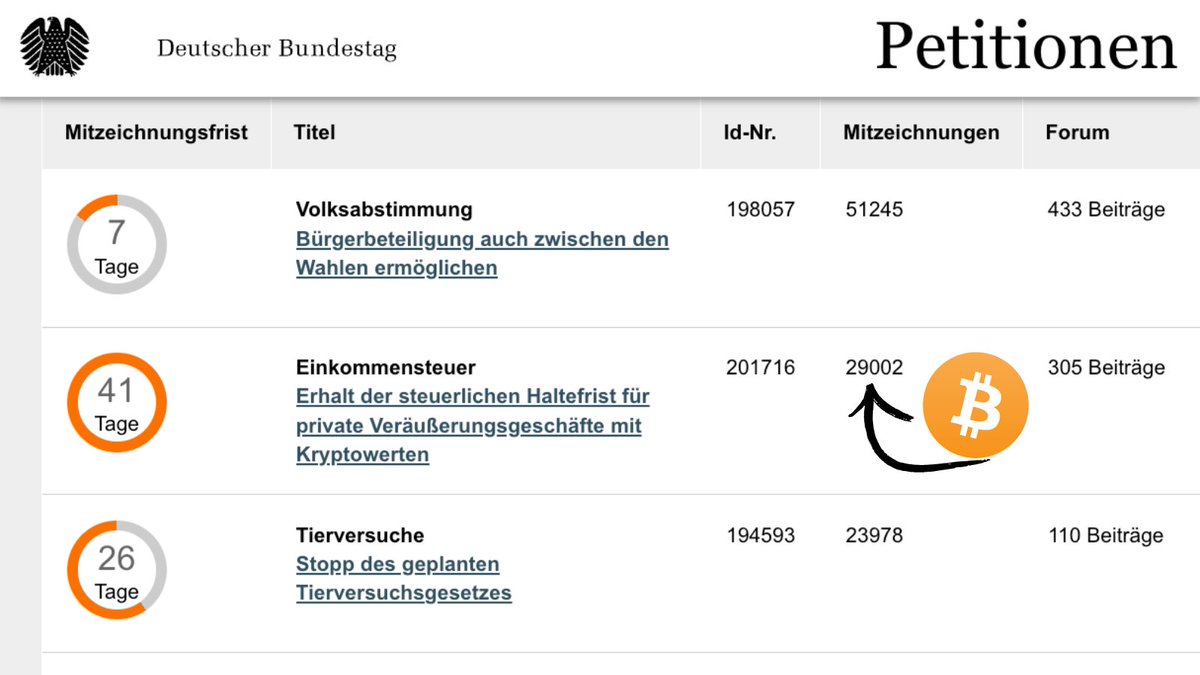
29.000 Menschen sind schon dabei! Unglaublich! Noch 1.000 Stimmen bis zum großen Meilenstein 🏆
Die erforderlichen 30.000 für das parlamentarische Verfahren sind zum Greifen nah – aber nicht das Ende! Danach nehmen wir gemeinsam Platz 1 der aktiven Petitionen ins Visier.
Denn je mehr Menschen mitzeichnen, desto deutlicher wird die Botschaft an Politik und Bundestag: Dieses Steuerthema lässt sich nicht übersehen!
Teile die Petition bitte noch einmal mit allen, denen das Thema ebenfalls wichtig sein könnte – in deiner Familie, im Freundeskreis, bei der Arbeit oder in deiner Community.
Erst 30.000. Dann Platz 1.
Die Haltefrist muss bleiben!
#ProHaltefrist
Damit niemand verwirrt ist. Dies war die Abstimmung über einen Antrag zur ABLEHNUNG der Chat Kontrolle und daher stimmte @MartinSonneborn (wie ich auch) mit JA (grüne Taste).
Eine Mehrheit der anwesenden Abgeordneten war zwar für die Ablehnung bzw. gegen die Chat-Kontrolle.
Aber: Da es sich um einen Vorschlag des Rates der EU handelt waren 360 Stimmen (Mehrheit ALLER Abgeordneten und nicht nur der anwesenden Abgeordneten) erforderlich. Daher hat man Abstimmung auf den letzen Abstimmungstag vor der Sommerpause gelegt weil dann viele Abgeordnete fehlen!
BREAKING:
The European Parliament just passed Chat Control 1.0
A proposal to stop the new law, which will allow big tech companies to voluntarily scan all private messages, needed an absolute majority of 361 voted but received only 314 votes.
As it was the last day before summer recess, many MEPs had returned to their home countries and didn’t take part in the surprise vote. Chat Control 2.0 is still being prepared. That law will make it mandatory to scan people’s private messages.
The European Parliament voted AGAINST Chat Control. 314 to 276.
And it passed anyway.
Let me tell you how: they needed 361 votes to say no. On the last day before vacation. Every empty seat counted as a yes.
They lost the vote. They won the law.
That’s not democracy. That’s a trick. #ChatControl
"We spent a generation teaching people the first rule of the internet: never give out your real identity to strangers. We have a word, doxxing, for inflicting that exposure on someone against their will. And now the same governments and platforms are asking every citizen to do it to themselves, voluntarily, as a condition of logging in."
https://t.co/X6mzofcBgA
Here’s your chance at not only winning a #pokemon pack but also a limited edition @saylor card and other #bitcoin trading #cards as well. Like, retweet, and comment your best Saylor line for a chance at receiving this #giveaway.
UPDATE: WIR SETZEN DAS UM!
Die Bundestagspetition zur Beibehaltung der Haltefrist kommt. Ein Team aus @btcverband und externen Unterstützern bringt sie auf den Weg. Der Zeitplan steht!
Jetzt heißt es: KRÄFTE BÜNDELN!
Denn wir wollen ALLE erreichen.
Hilf uns, die richtigen Multiplikatoren zu finden: Wer muss davon erfahren? Welche Firmen, Bitcoin-YouTuber, Krypto-Influencer, Verbände, Medien, Interessengruppen oder politischen Stimmen können helfen, 30.000++ Stimmen zu sammeln und Druck auf die Politik auszuüben?
Nennt Namen. Erwähnt Kontakte.
Spread the word! 🪐👇🏻
Die Steuerfreiheit für private Bitcoin-Verkäufe nach einem Jahr muss bleiben!
Deutschland braucht Anreize für Vermögensaufbau, Standortvorteile und Reformen – keine neuen Steuerlasten.
Bitcoin und ein Goldbarren stehen im selben Steuerparagraphen.
Wortwörtlich. Im selben Satz.
Trotzdem will die Politik offenbar nur einen davon härter besteuern.
Das ist juristisch nicht so einfach, wie sie tut.
Der entscheidende Paragraph heißt § 23 EStG.
Dort sammelt der Staat alles, was Privatleute kaufen und später
verkaufen können. Edelmetalle. Schmuck. Antiquitäten. Kunst.
Fremdwährungen. Münzsammlungen. Bitcoin.
Eine einzige Regel für alle:
Wer länger als ein Jahr hält, zahlt keine Steuer auf den Gewinn.
Diese Regel ist über 90 Jahre alt. Sie galt für Goldbarren genauso wie für Bitcoin.
Jetzt will die Bundesregierung die Regel kippen. Aber nur für
Bitcoin. Nicht für Gold. Nicht für Kunst. Nicht für die
Münzsammlung.
Genau hier liegt das Problem.
Das Grundgesetz hat einen Artikel 3. Gleiches muss gleich
behandelt werden. Wer in derselben Schublade liegt, darf nicht
willkürlich anders besteuert werden.
Bitcoin und Gold liegen in derselben Schublade. Beides wird
gekauft, gehalten, verkauft. Beides wirft keine Zinsen ab.
Beides ist knapp. Beides schützt vor Geldentwertung.
Der Bundesfinanzhof hat 2023 ausdrücklich entschieden: Bitcoin
ist ein Wirtschaftsgut wie jedes andere. Deshalb gilt § 23 EStG.
Genau wie bei Gold.
Die Politik hat jetzt drei Möglichkeiten.
Möglichkeit eins: Nur Bitcoin besteuern. Eine Klagewelle ist
vorprogrammiert. Verfassungsbeschwerden landen in Karlsruhe.
Möglichkeit zwei: Alle anderen Wirtschaftsgüter mitbesteuern.
Dann zahlt auch der CDU-Wähler aus Düsseldorf Steuer auf seinen
Goldbarren. Und auf den Picasso im Wohnzimmer.
Möglichkeit drei: Bitcoin künstlich aus § 23 EStG herausschneiden
und wie eine Aktie behandeln. Juristisch fragwürdig. Aber
politisch der bequemste Weg.
Niemand spricht offen über diese drei Optionen.
Stattdessen wird so getan, als sei die Sache einfach.
Sie ist es nicht.
Wer Bitcoin hart besteuern will, ohne die deutsche Mittelschicht
am Goldbarren anzufassen, muss tricksen.
Und Tricks fallen vor Gericht selten gut aus.
Wenn dich solche Insights interessieren und dir helfen,
interagiere gerne mit dem Post. 🧡
1. Adam Back
Why he could be Satoshi:
Back invented Hashcash, and Satoshi explicitly described Bitcoin as using “Hashcash style proof-of-work” and cited Back’s paper in the whitepaper. On top of that, the fresh 2026 investigation argued that Back fits unusually well on the technical, ideological, linguistic, and timing dimensions, including alleged overlap between Back’s disappearance from crypto forums and Satoshi’s active period.
Why he probably isn’t:
The case is still circumstantial. Back has repeatedly denied it, and a big part of the pro-Back theory requires you to accept that the apparent correspondence between Back and Satoshi was either misleading or deliberately staged, which is possible but a big assumption. No cryptographic proof has surfaced.
Back currently has one of the strongest single-person cases, but it is still nowhere near proven.
2. Nick Szabo
Why he could be Satoshi:
Szabo’s Bit Gold is the closest famous pre-Bitcoin design: proof-of-work, timestamping, scarcity, and digital-gold framing are all there. The Aston University linguistic work also identified Szabo as the closest stylistic match to the Bitcoin whitepaper among the common suspects.
Why he probably isn’t:
The strongest objection is Wei Dai’s account of his private emails with Satoshi. Dai said Satoshi seemed unaware of Szabo’s Bit Gold until Dai mentioned it, and Dai explicitly said that was one reason he thought Szabo was not Satoshi. Dai also added that Szabo wasn’t known as a C++ programmer, which matters because Bitcoin’s original client was written in C++.
Szabo has one of the best conceptual ancestry cases, but the Dai emails are a serious problem for the “Szabo = Satoshi” theory.
3. Hal Finney
Why he could be Satoshi:
Finney had the exact kind of background you would want: PGP, cypherpunk work, anonymous remailers, and his own precursor system RPOW. He was also the first known person besides Satoshi to run Bitcoin, received the first Bitcoin transaction, and corresponded with Satoshi while helping debug the software.
Why he probably isn’t:
The strongest countercase is that Hal and Satoshi look like two different people in time-stamped evidence. Jameson Lopp assembled evidence that Hal was physically in a race while Satoshi was sending emails and making a transaction, and also pointed to differences in coding habits and persona. Hal himself wrote that at the time he thought Satoshi was a young Japanese man, which would be a strange thing to say if he were Satoshi.
Hal is incredibly plausible as an early collaborator / closest peer, but the case for him being the sole Satoshi is weaker than many people think.
4. Len Sassaman
Why he could be Satoshi:
Sassaman was a serious cryptographer, privacy advocate, PGP contributor, and remailer expert — exactly the kind of cypherpunk profile people imagine for Satoshi. The “Len theory” got traction because his skill set lines up very well with the privacy-first, anti-surveillance ethos around Bitcoin’s origins, and because of the timing around Satoshi’s disappearance.
Why he probably isn’t:
The biggest problem is the lack of any direct Bitcoin-specific artifact linking him to the design or code. Also, his widow Meredith Patterson has publicly said she does not think he was Satoshi, and told DL News that early Bitcoin had some “newbie mistakes” she did not think Len would have made.
Len fits the mythic profile very well, but compared with Back, Szabo, or Finney, the case is much more about fit than evidence.
5. Jack Dorsey
Why he could be Satoshi:
The pro-Dorsey camp argues he had early cypherpunk exposure, technical ability, strong anti-establishment instincts, later deep Bitcoin commitment, and a pile of timing / symbolism / St. Louis coincidences. That theory was pushed hard in 2025 by Seán Murray and Matt Sigel.
Why he probably isn’t:
The strongest objection is that Dorsey’s life was too public and too busy. Lopp’s rebuttal points out that Jack posted over 6,200 tweets in 2009–2010, was running Twitter and Square, and there are multiple timestamp clashes where Jack was visibly at lunches, meetings, or presentations while Satoshi was posting or committing code.
This is an interesting modern theory, but it is much weaker than the classic cypherpunk-cryptographer suspects.
6. Paul Le Roux
Why he could be Satoshi:
Le Roux clearly had the technical horsepower: he was an encryption coder, built E4M, knew C++, and had the operational paranoia and pseudonym habit that people associate with Satoshi. Wired found the case compelling enough to investigate deeply, and Ratliff noted many striking parallels; later speculation also leaned on the “Solotshi” alias, rumored interest in digital currency in 2007–2008, and the rough timing of his disappearance from public life.
Why he probably isn’t:
The strongest counter is from the same investigation: Ratliff spent years on Le Roux and still found no hard evidence. He ended up saying there was no document, IP trace, service use, or business behavior that actually tied Le Roux to Satoshi, and Maxwell’s code comparison did not produce a meaningful match. Ratliff basically concluded the theory remained a fascinating 2% theory, not a solved case.
Le Roux is one of the better wild-card candidates, but the case still feels more like a brilliant thriller plot than a proven identity.
7. Wei Dai
Why he could be Satoshi:
Wei Dai proposed b-money in 1998, one of the most direct ancestors of Bitcoin, and Satoshi cited it as the first reference in the whitepaper. Dai also had the exact kind of cryptographic background and C++ ability that would make him technically capable, and even Dai himself said very few people had the needed combination of money-thinking and crypto skills.
Why he probably isn’t:
The strongest objection is direct: Satoshi emailed Dai asking for the publication year of b-money and said Bitcoin “expands on your ideas into a complete working system.” Dai later said Satoshi likely had not even read b-money before building Bitcoin, which strongly suggests they were separate people unless you assume very elaborate preplanned misdirection.
Wei Dai absolutely belongs in the shortlist of people who could have built Bitcoin, but the surviving emails are strong evidence that he was not Satoshi.
A crime ring out of Tennessee was just busted for running wrench attacks on bitcoin holders across California, San Francisco, Sunnyvale, San Jose, and Los Angeles.
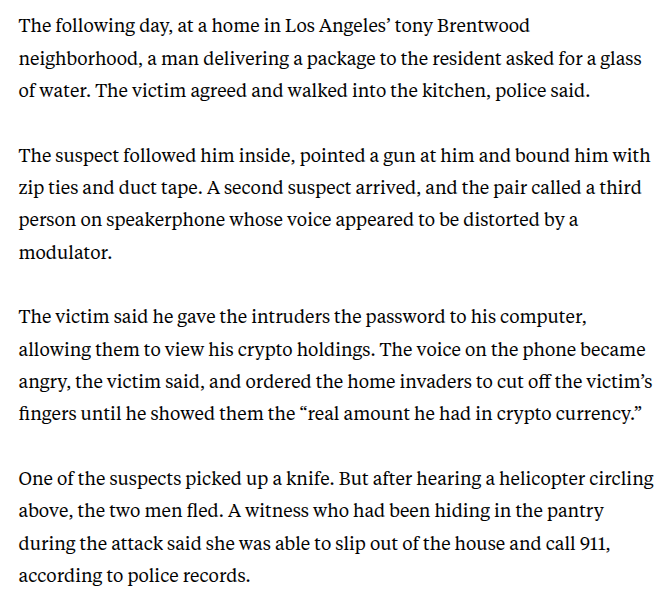
They hacked into victims' DoorDash and UberEats accounts to figure out where they lived, then showed up posing as delivery drivers. Once inside, they zip-tied and duct-taped victims at gunpoint while a remote operator, using a voice modulator, directed them through draining the wallets.
In one case they stole $13 million. In another, when the victim's wallet didn't show the amount the attackers expected, the voice on the phone ordered them to cut off the victim's fingers until he revealed the "real" account.
A duress wallet won't necessarily save you. These attackers came in with specific intel about how much their targets held. If the number they see doesn't match the number they expect, the situation escalates. Physical attacks on bitcoin holders jumped 75% in 2025, with confirmed losses topping $40 million.
A few things worth thinking about if you hold any meaningful amount of bitcoin.
Don't talk about how much you hold. Not online, not at meetups, not to friends of friends. Operational security starts with not making yourself a target in the first place.
Be skeptical of unexpected deliveries. This ring used real food delivery apps to build trust before showing up at the door.
Multisig and time-locked transactions are worth looking into, not just for security against hackers, but because they make it physically impossible to hand over funds under duress. If the coins literally can't move for 48 hours, there's no point in holding someone at gunpoint.
Self-custody is a responsibility. The tradeoff for being your own bank is that you're also your own security team.
This is central banking in a nutshell:
A group of rich guys go to the king and say: "Hey, you need money for your war. We'll give you all the money you want."
The king says: "Great, where's the money?"
They say: "We're going to make it up. We'll write numbers in a book and that's your money now."
The king says: "What do I owe you?"
They say: "You pay us back with interest."
The king says: "Where do I get that money?"
They say: "You tax your citizens."
The king says: "What if I can't pay it all back?"
They say: "That's fine. We'll lend you more. Same deal."
The king says: "And what do you do with the IOUs I gave you?"
They say: "We use them to prove we have money, so we can lend even more money to other people and charge them interest too."
The king says: "So you made up money, lent it to me, I tax my people to pay you back, and then you use my debt to make up even more money and lend it to everyone else?"
They say: "Yes."
The king says: "What did it cost you?"
They say: "Nothing."
That's literally how the Bank of England started in 1694. The Bank was formed to finance King William's war with France. The king gave the Bank a charter, granting it a monopoly on money.
The king could have as much money as he wanted. The bankers could always earn interest. Taxpayers covered the bill.
Now replace "king" with "United States Government" and you have the Federal Reserve in 1913. Same story, different country.
It doesn't end there.
185 central banks exist in the world today.
Across the globe, the governments get as much money as they want, the bankers load their pockets with interest, and the taxpayers pay for it all.
Oh, and if you don't pay your taxes, they'll fine you, penalize you, or throw you in jail.
The ONLY way out of this is to STOP USING THEIR MONEY.
As long as you're using the money that central banks control, the central banks will have control.
You have to stop giving them energy.
Use a different form of money that they can't control.
This is why Satoshi Nakamoto created Bitcoin.
Bitcoin Core has no CEO, no board, no formal hierarchy.
But between 2019 and 2025, a small network of developers, funders, and institutions came to control who got in, who got funded, and what got merged.
I am working on a four-article series documenting how informal power over Bitcoin Core was built, exercised, and defended.
Article one scheduled to drop next week.