Yet another striking illustration of just how ideologically rigid the West has become compared to what we used to be.
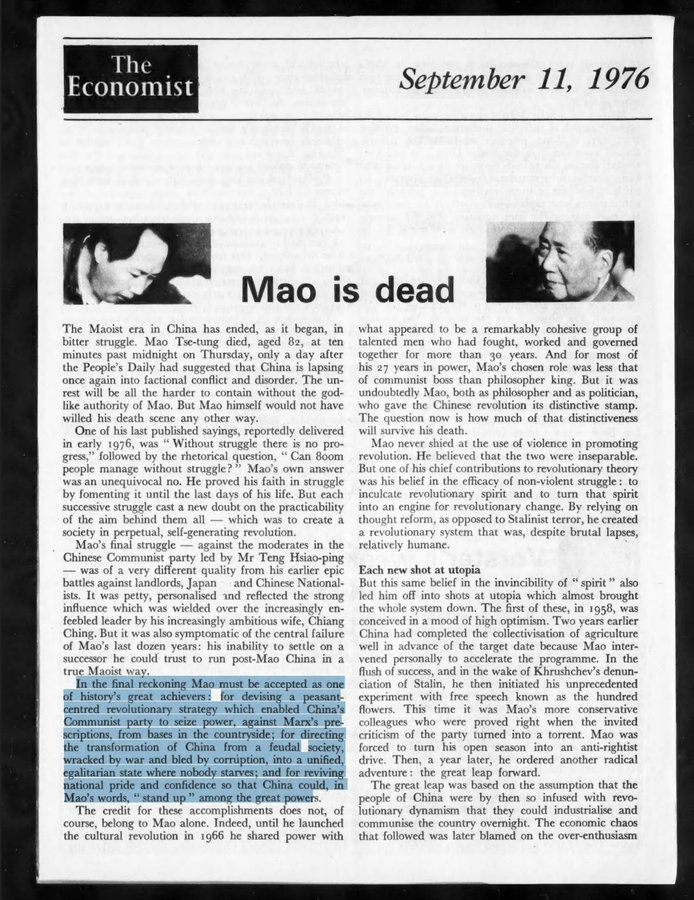
This was the obituary The Economist published for Mao in 1976 - at the height of the Cold War.
Read this part:
"In the final reckoning Mao must be accepted as one of history's great achievers: for devising a peasant-centred revolutionary strategy which enabled China's Communist party to seize power, against Marx's prescriptions, from bases in the countryside; for directing the transformation of China from a feudal society wracked by war and bled by corruption, into a unified egalitarian state where nobody starves; and for reviving national pride and confidence so that China could, in Mao's words, 'stand up' among the great power."
Show this text to any Economist "journalists" today - without telling them it's from their own paper - and they'd reply: surely it's "CCP propaganda" 😏
Yes, incredible as it may sound, there used to be a time when Western journalists could assess a geopolitical rival honestly and respectfully without being accused of being a traitor. And this honesty was in no small part a key factor why the West won the Cold War.
Today we call honest assessment "propaganda," and we harass, smear, and blacklist people for it. And we're puzzled why the West is in steep decline.
Truth matters.
Tiresome whingers fail to take down Laura Tingle’s truthtelling.
ABC ombudsman declares Laura Tingle’s Israel analysis ‘duly impartial’ as complaints campaigns gain traction | The Weekly Beast https://t.co/iU5l4gL4g9
🇯🇵 Japanese Wall Street Journal Reporter Leaves China After 8 Years: Blames “Suspicion of Outsiders” While Ignoring Imperial Japan’s Record
WSJ’s Yoko Kubota has published her “I’m leaving China after 8 years” essay blaming rising suspicion of outsiders.
She is Japanese, a former Tokyo auto reporter who has now moved to Washington DC as the paper’s National Security Correspondent. This was a standard career rotation after serving as deputy bureau chief in Beijing, not a flight from hostility. Her own LinkedIn post described the eight years as “unforgettable” and a “privilege.” The dramatic framing serves Western readers who expect “China turning nasty” narratives.
Consider the details she highlights. The BYD driver calling a map a national secret and lecturing her on Taiwan was not random xenophobia. That reflects a Chinese citizen whose family lived through Imperial Japan’s invasion, an estimated 14 to 20 million Chinese dead, the Nanjing Massacre of 200,000 to 300,000 civilians and POWs in weeks and Unit 731’s horrific biological experiments including live vivisections and plague attacks.
Japan has never delivered the full reckoning Germany did. Yasukuni Shrine still honours war criminals, textbooks soften the record and current Tokyo policy aligns with US containment, sailing warships and framing Taiwan as a survival issue for Japan.
The anti-espionage campaign she portrays as paranoia is a defensive response in Cold War 2.0. US chip bans, export controls, talent recruitment drives, public CIA spy ads and dual-use tech operations prompted Beijing’s measures. Raids and sentences target genuine risks to sovereignty, not blanket distrust of foreigners.
School decisions on Christmas or news apps highlighting overseas incidents represent cultural self-assertion after decades of Western soft power, the same Western media that frame Chinese achievements as threats and Chinese setbacks as systemic collapse. In Chinese cities, Africans, Russians, Koreans and others continue to live, trade and study with opportunity. Occasional caution, such as the Samurai Blue fan hiding his jersey, stems from bilateral tensions rather than everyday hatred. That the fan loved Japan enough to wear the jersey but felt unsafe showing it publicly tells you something has gone wrong in the relationship and Kubota frames the symptom as the disease.
The 2024 Shenzhen incident was a tragedy. A child died. No contextualisation erases that. Chinese authorities caught, tried and executed the perpetrator, an outcome that would be called swift and decisive if it came from a Western capital, but is largely ignored in Western coverage. It was also, by every available measure, an isolated act that does not reflect how millions of foreigners live and move through China without incident.
What Kubota also doesn’t address: the source-drying-up she describes is the predictable reality for any journalist covering sensitive topics for an American newspaper in a period of active US-China confrontation. Companies and individuals limiting contact with a US national security reporter is not evidence of a closing society, it is the entirely rational self-protection of people navigating geopolitical pressure from Washington. She conflates her beat-specific professional constraints with a broader social trend and the distinction matters.
What Kubota underplays is China’s continued opening. The visa-free policy now covers dozens of countries including Japan, with millions of entries recorded in early 2026 and inbound tourism rebounding strongly. Foreign businesses remain active in large numbers. Daily life for most expatriates is stable.
This is not the end of reform and opening. It is the next phase: strategic self-reliance in energy, semiconductors and critical minerals when interdependence has been repeatedly weaponised. The CPC is not anti-foreigner. It is prioritising China’s development and security in a contested world.
Kubota experienced wariness because of her Japanese background, American newspaper affiliation and coverage of sensitive technology topics at a time of heightened tensions. That is understandable. Framing it as China fundamentally changing for the worse is another Western misreading of a civilisation that remembers its historical scars and now defends its rise on its own terms.
From the ground in China today, most people focus on building the future rather than resenting outsiders. They simply refuse to pretend history began yesterday or that sovereignty is negotiable.
Exit essays like this reveal more about the discomfort of a changing global order than about China itself. When will Western correspondents stop treating their professional access constraints as evidence of a country’s moral failure?
@Kubota_Yoko@WSJ
Wow, this is huge, after months of speculation and the U.S. running a massive pre-emptive discreditation campaign (https://t.co/OYg0rNn9MN), DeepSeek-V4 is finally out!
I haven't studied it in depth but here are the most striking aspects as far as I can tell:
- Fully open sourced with open weights (available for download on huggingface: https://t.co/YMvgMTErcr)
- Zero CUDA dependency anywhere in its stack, which is probably the biggest deal of all. For those who don't know, CUDA is Nvidia's software layer - the foundation nearly every frontier AI model in the world is built on. Except, as of today, DeepSeek V4, which can run entirely on Huawei Ascend chips via Huawei's CANN framework (https://t.co/YLL7kJEYq5). Very concretely it means that China now not only has its own frontier AI models, but its own domestic AI stack, top to bottom.
- The prices are insanely low. V4-Pro is roughly 3x cheaper than GPT-5.5 on input and 8.6x cheaper on output. And V4-Flash is an order of magnitude cheaper still, at $0.14/$0.28 per million tokens vs OpenAI's $5/$30 - so 30-100x cheaper than GPT-5.5 (!). And remember, these are the prices DeepSeek charges on its own API - anyone can download the weights and run them for "free" on their own server.
- It is at or near the frontier on most benchmarks that matter. V4-Pro-Max matches or beats GPT-5.4 and Claude Opus 4.6 on competitive programming (Codeforces rating 3206), coding (LiveCodeBench 93.5), and math (HMMT 95.2, IMO AnswerBench 89.8). It trails the very newest GPT-5.5 and Opus 4.7 on a handful of the hardest agentic and knowledge benchmarks, but it's in the same league.
In effect the value proposition is: "Same league as frontier US AI, at a fraction of the price, open-source and freely modifiable, and hardware-agnostic - you can run it on whatever infrastructure you choose."
Which is insanely good. I now understand the need for a preemptive discreditation campaign: they had every reason to be worried. For the vast majority of use cases, you'd have to be a literal idiot to keep paying OpenAI or Anthropic's prices when this exists.
This is just pure unadulterated propaganda by The Economist, as is so often the case with their coverage of China (reminder that, if you read The Economist, the Chinese economy should have collapsed more or less every year for the past 20 years).
I actually come from a country - France - where our minorities did actually get squashed, so I have a pretty decent understanding of what that concretely means.
For instance in France our regional languages (Basque, Alsacien, Corsican, Breton, Occitan, etc.) have ZERO official status, cannot be used in government, and - under French law - were prohibited in classrooms under threat of punishment (kids at school were made to wear a necklace of shame around their neck if they spoke their regional language: https://t.co/n6HeZ8hSKK).
The first line of Article 2 of the French constitution (https://t.co/MEvaIKy8MV) - as amended in 1992 - specifies that French is the exclusive language in France and constitutionally excludes every other language from any official role whatsoever.
There was, in France, an official policy of linguicide. The net result, according to official French statistics (https://t.co/G7QTqkNLK9), is that regional languages like Corsican or Breton went from being spoken in 70%-80% of local families at the end of WW1 down to sub-10% numbers by the end of the 20th century. Even Alsacien, the most resilient regional language, still saw its transmission rate collapse from 70% to 18% in just 2 generations.
That, folks, is "squashing."
Same thing, incidentally, in the UK - The Economist's own country: a reminder that in Wales schools used the "Welsh Not" (https://t.co/Lp0ps5rXq2), a token of shame that a child would need to wear around their neck if they were heard speaking Welsh.
Compare and contrast this with this new Chinese law.
First of all, fact is that if you look at minorities with their own language in China, the immense majority of them still speak it and use it in their daily life.
For instance, a 2017 survey conducted by 国家语委 (the National Language Commission, the authoritative Chinese body on language policy), only 30% of people in Tibet had functional Mandarin proficiency (https://t.co/c345I6oVs0). In other words, Tibetan, not Mandarin, remains the dominant working language of daily life for the overwhelming majority of the population in Tibet.
Same story with Mongolian: according to China's Sixth National Census (2010), 85.25% of ethnic Mongols still used Mongolian in daily life (https://t.co/pBaRmyphOb).
Which means, as a starting point, that China already did a far better job than virtually any Western country at protecting their minority languages. Important context when we're speaking about Western media lecturing China on the topic...
Heck, a good case could be made that they did TOO GOOD a job given that - among some ethnic minorities - most people speak ONLY their regional language, and can't even speak Mandarin, which is actually one of the main points of the new law.
So let's look at this new law (full text here: https://t.co/sVFbcaN5qA).
Does it officially recognize and protect minority languages? Yes, the law literally says "The state respects and protects the learning and use of minority languages and scripts, promotes the regulation, standardization, and digitalization of minority languages."
Does it ban minority languages in schools? No. The new law does tilt education further toward Mandarin - requiring nationally unified textbooks and designating Mandarin as the basic language of instruction - but it does not abolish minority-medium schools (民族语授课学校 in Chinese, literally "minority-language-instruction schools") which can continue to operate with state funding in their respective regions.
Does it ban minority languages from government? No. Article 15 explicitly states that "where relevant laws require documents to be issued in minority languages, both the national common language version and the minority language version shall be provided" (依照有关法律规定需要使用少数民族语言文字发布文书的,应当同时提供国家通用语言文字版本和少数民族语言文字版本).
Does it ban minority languages from public signage? No. The law requires Mandarin to be displayed "prominently" alongside minority scripts in public settings - not instead of them.
Does it undermine autonomous regions? No. Article 8 of the new law explicitly reaffirms "upholding and improving the system of ethnic regional autonomy" (坚持和完善民族区域自治制度). Which means that the 1984 Regional Ethnic Autonomy Law remains in force, with their local regions' legal authority to adopt regulations suited to local ethnic conditions.
So all in all, what you CAN say is that the new law does indeed promote Mandarin and pushes to ensure every Chinese citizen can speak a common national language - which is, frankly, a pretty normal thing for any country to expect.
What you CANNOT say - unless you are writing propaganda rather than journalism - is that this law "squashes" 55 ethnicities. Actual squashing is hanging a wooden clog around a child's neck for speaking his mother tongue. Actual squashing would be making minority languages or culture anticonstitutional.
A law that funds minority-language preservation, preserves minority-medium schools, reaffirms regional autonomy, requires bilingual government documents and operates under a Constitution whose Article 4 guarantees all ethnic groups "the freedom to use and develop their own spoken and written languages and to preserve or reform their own traditions and customs" is not "squashing" anything.
It's a level of minority-language and cultural protection that the French Republic - or the UK - has never offered its own citizens in its entire existence.
This 👇 is pretty funny and, I checked, it's real: the title of the Princeton study is "Political Discontent in China Is Associated with Isolating Personality Traits" (https://t.co/tQfBU7lnkb).
In a nutshell, Princeton University found that those who dislike the Communist Party of China are predominantly socially awkward "losers", meaning people defined - in the study - as "fearful, anxious, introverted, disagreeable, disorganized, unable to forgive, and suffering from low self-esteem."
Those who like the CPC, conversely, score high on confidence, sociability, conscientiousness, and work ethic - what the study calls "traits associated with personal and professional success."
Interestingly, the first group (the disagreeable and low self-esteem "losers" who dislike the CPC) only make up roughly 5% of the Chinese population according to the study, which completely inverts the stereotype one might expect: "dissidents" in China aren't charismatic, cosmopolitan, open-minded intellectuals rebelling against conformity - those guys are overwhelmingly supporters of the Party.
This, the study argues, is one of the quiet reasons the CPC is so durable. Its critics are, by personality, precisely the people least equipped to build coalitions, mobilize others, or persuade anyone of anything. Dissent in China isn't so much suppressed as it is, statistically, the weirdo muttering on his own at the back of the bus.
If governments were actually doing their job, this Palantir document 👇 wouldn't be a manifesto they proudly boast about, but a clear sign of the urgent need to purge its software from the public institutions it has infiltrated.
What are they saying, essentially?
They basically promote a clash of civilization worldview in which there exists a "they" - the supposed enemies of Western civilization, whose cultures the document codes as inferior - and a "we" who must stop indulging in decadent restraint and invest massively in AI weapons and defense software (which conveniently makes Palantir's product catalog the civilizational cure).
Look at point 4 for instance. They write that "the limits of soft power, of soaring rhetoric alone, have been exposed. The ability of free and democratic societies to prevail requires something more than moral appeal. It requires hard power, and hard power in this century will be built on software."
It all rests on a pretty massive assumption: that coexistence is impossible. Why would "free and democratic societies" (by which they obviously mean Western-style liberal-democracies) need to "prevail"? Why can't they simply coexist with other civilizations or political systems out there?
Nowhere in the document do they defend this assumption: it's simply asserted as the starting condition of the argument.
But it's the entire ballgame: if civilizations and political systems can coexist - as they largely have, imperfectly but recognizably, throughout history - then the entire case they make in the document evaporates.
In fact one can argue that, studying history, the big problem was not that civilizations couldn't coexist: it was that, from time to time, one of them decided that others were inferior, threatening, or standing in the way of its rightful expansion - and acted accordingly.
So many catastrophes and so much human suffering in history trace back not to the fact of plural civilizations, but to one of them deciding it could no longer tolerate the others.
The problem, in other words, has almost always been exactly the worldview Palantir is now selling. Their manifesto isn't warning against the cause of some of the worst periods in history: it's arguing for reviving them!
Or take point 15: they explicitly call for the re-armament of Germany and Japan, and an end to "Japanese pacifism". Basically undoing one of the foundational settlements of the post-WW2 order.
I mean, think about the insanity of this for a second: a private company - unelected, answerable only to its shareholders - is casually proposing to overturn the security architecture of two continents. A settlement that took a world war, and tens of millions of dead to establish.
Why do they propose this? There is obviously a commercial motivation: a remilitarized Germany and Japan are massive new defense-software markets.
But the more troubling answer is that point 15 fits into the ideological project the rest of the manifesto lays out - a civilizational contest requires a consolidated Western bloc, and pacifist members are a liability in such a contest.
So taking a step back we now have what's the most influential defense-software company in the world, with its code deeply embedded in all the machinery of Western states - intelligence agencies, militaries, police forces, welfare systems, border controls - openly outing itself as an ideological project.
They're effectively saying "our tools aren't meant to serve your foreign policy. They're meant to enforce ours."
Because, worryingly, that's what they CAN do. Palantir software is all about basically telling states: "these are your threats, these are the people and groups to watch, these are the patterns that matter, these are the targets that warrant action."
For instance the DGSI - the French intelligence services - use Palantir (see: https://t.co/3YJk88k4QY): do you honestly think the software is warning them about, say, the NSA tapping the phones of French government officials? About the weaponization of US extraterritorial law against French companies? Did it warn them about the AUKUS ambush that cost France a sixty-billion-euro submarine contract? Obviously not.
And that's exactly what the manifesto is saying. They've positioned themselves as advocates of Western civilizational unity, so their software can't undermine it. The ideological position and the product roadmap have to align, or the whole project falls apart.
This makes their software not only deeply dangerous for the world as a whole but also, almost by definition, for any country using it. When it comes to your security as a state, it is primordial you base yourself on truth as opposed to ideology. The entire point of an intelligence agency is to tell its government what is true, not what your so-called "allies'" defense contractors would like you to see.
A state that outsources its threat assessment to a company with an explicit ideological agenda is not gathering intelligence, it is essentially subscribing to propaganda.
The conclusion couldn't be more obvious. Every government still running Palantir software in its intelligence, security, or public-service infrastructure needs to start ripping it out, now! Lest they want to be embarked on the delusional and deeply destructive clash-of-civilizations crusade Palantir has now openly committed itself to.
When did disagreeing with someone become grounds for destroying their life's work? The Grace Tame Foundation is closing. Not because protecting children stopped mattering. Because a small, powerful, organised group pressured sponsors and event bookers until the funding collapsed. No court. No law broken. No democratic process.
That is not a debate. That is a veto.
Grace Tame is still standing. Her foundation isn't. We should all be asking why.
Debate is democratic. Defunding is not. Know the difference.
Cowardice dressed as conviction fools no one.
Read the full piece and decide for yourself. 👇
https://t.co/Bv6EXzJGi2
#auspol
@deniseshrivell@aaronsmith@TheNoisyTrunk
Jensen Huang just called the exact top of the pharmaceutical industry.
Not a pivot. Not a disruption.
An extinction event.
Huang: “Where do I think the next amazing revolution is going to come? And this is going to be flat out one of the biggest ones ever. There’s no question that digital biology is going to be it.”
The medical establishment has spent centuries playing a chaotic game of trial and error.
We’re about to mathematically engineer the human operating system.
Huang: “For the very first time in human history, biology has the opportunity to be engineering, not science. When something becomes engineering, not science, it becomes less sporadic and exponentially improving.”
Biology is no longer the dark art of random discovery.
It’s a predictable, compounding execution loop.
Translate the chaotic variables of chemistry into the laws of computer science and you stop waiting for accidental breakthroughs.
You simply compute the cure.
That line should terrify every pharmaceutical executive alive.
Huang: “It can compound on the benefits of the previous years. And every researcher’s contributions compound on each other.”
For decades, drug discovery has been an isolated, artisanal process.
One lab. One team. One molecule. Years of blind iteration.
The algorithm just shattered that entire bottleneck.
Every failed protein fold, every successful synthetic molecule instantly trains the foundational model.
Makes the next iteration mathematically smarter.
Huang: “We’re going to have incredible tools that bring the world of biology, which is very chaotic and constantly changing and diverse and complex, into the world of computer science. And that is going to be profound.”
Incumbent pharma looks at the human body and sees an unmanageable wall of variables.
Engineers look at that exact same body and see raw data waiting to be compiled.
No longer guessing how a molecule will react in the physical world.
Running millions of zero-cost simulated iterations before a single test tube is ever touched.
Rip the chaotic friction out of the physical lab and drop it directly into a massive GPU cluster?
The timeline to map, edit, and optimize the biological machine doesn’t shrink.
It collapses.
I don't know if people understand just how insanely egregious this is.
First of all, 1) not only are NATO spending targets NOT legally binding (nothing in any NATO-related legal text mandates a specific GDP-based threshold for defense spending), but on top of this 2) Spain requested AND RECEIVED an exemption from the 5% target at the 2025 Hague Summit - NATO changed the declaration's language specifically to allow Spain to sign while publicly declaring it would not comply (https://t.co/q3VE2Je3TS)
This means that, legally speaking and according to NATO's own rules, Spain is doubly within its rights: there is no binding obligation to begin with, and Spain was excused from even this non-binding obligation.
That's the first point: Germany's chancellor just endorsed - from the Oval Office - the U.S. punishing a fellow EU nation for refusing to comply with an obligation that doesn't exist in law, under a political pledge Spain was excused from at a NATO summit.
The second point is that this 5% target has nothing to do with "defense", quite the contrary in fact: it is pretty explicitly an imperial tribute to the U.S. that will actually **weaken** European defense.
That was Spain's main argument for refusing to comply: Prime Minister Pedro Sánchez said that "committing to 5% would not make us any safer" because it "would only reinforce our dependence" on the U.S. (https://t.co/QUMDyfvWDP)
That's the insane thing about EU defense spending: in recent years, the more it has spent on defense, the more that spending has flowed to American contractors as opposed to European ones, making the EU defense industry weaker (https://t.co/XHGLW71tX0). Increasing spending to 5% doesn't strengthen European defense: it accelerates exactly this transfer.
All the more insane given the well-documented production backlogs in the U.S. defense industry and its inability to produce at scale: US defense analysts - including from Trump-adjacent think tanks like AEI (https://t.co/c3DobMYpru) - openly acknowledge that European customers would be deprioritized behind U.S. ones in any real conflict.
AND, critically, a defense industry from a country that's increasingly hostile to Europe - explicitly so in its National Security Strategy - and whose weaponry has "kill switches" that allows for remote disabling.
I mean, the sheer madness of it: anyone with an ounce of common sense can see that DOUBLING your defense spending to enrich a foreign arms industry that has kill switches on your weapons, can't meet its own military's needs, and increasingly treats you as an adversary, is not even remotely a defense strategy - it's suicide.
That's why having Merz - in the oval office, sitting next to Trump - endorse economic coercion against the one EU country that's still sane enough to see through this madness is so egregious, and frankly straight-up traitorous.
For those who know Asterix and Obelix, Spain is the "one small village still holding out against the invaders" and Merz is Cassius Ceramix, the self-described "gallo-roman" Gaul village chief who's the incarnation of all sycophants after his tribe were conquered by the Romans.
I'm with Asterix, and all Europeans should be too.
I'm more shocked that many people who should know aren't upset at the WWII atrocity denialism that is now rife in Japan's ruling party.
Supposedly patriotic Aussies are giving Japan a free pass on insulting our war dead because they now hate China, which has never harmed us.
Does Mr Trump have a right to help himself to Greenland? Of course he does not. Yes, he is right to say that Denmark’s only claim to Greenland is that some of its ships disembarked centuries ago there and took that land. But, how exactly did the Europeans take North America, Australia, New Zealand? Legally? It is never advisable for the pot to call the kettle black.
And now onto a delicious twist to the Greenland story:
Europeans claim that it is unprecedented and a violation of NATO's charter for the leader of a member-state of a defensive alliance to be threatening another NATO member-state. That NATO is about solidarity, about defending its members’ territory. Not so!
Since 1952, when Greece and Turkey entered NATO in tandem, successive Greek governments have been desperately struggling to get NATO to commit to coming to Greece’s defence if Turkey invades.
NATO has STEADFASTLY refused to make such a commitment. Why? The official answer has been that NATO is committed to defending member states from belligerent non-member states – but not from each other, not from other member states, like Turkey or, now, the... United States!
Want to know why Greece is perhaps the only member-state that consistently spent a lot more on weaponry than the bare minimum? That’s why! Because NATO has unwaveringly refused to defend its borders in case of a skirmish or war with Turkey.
So, Denmark welcome to the club – and remember your governments also argued that it is not NATO’s job to defend any member-state from another NATO member-state.
https://t.co/bRTY8iieMV
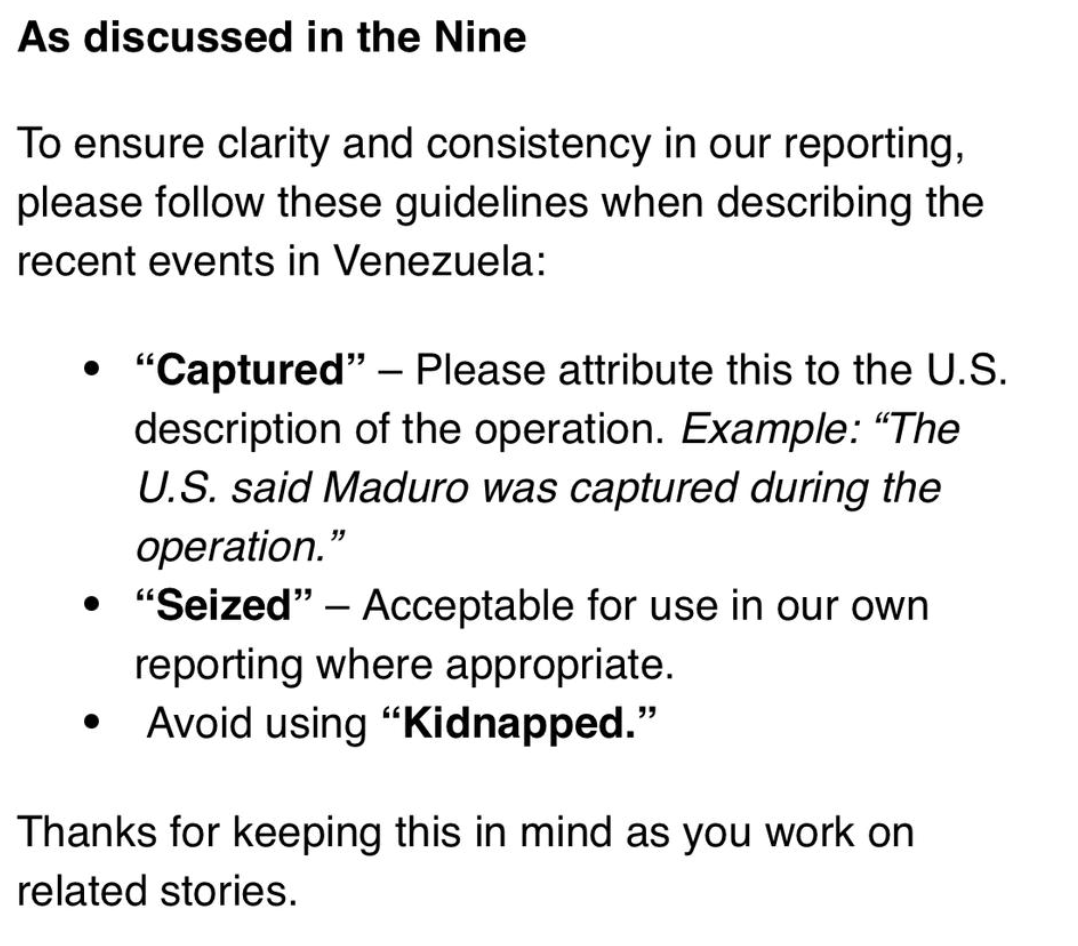
BBC journalists have been banned from describing the kidnapped Venezuelan leader as having been kidnapped.
The BBC News Editor has sent this to BBC journalists.
Palestinian journalists reporting to the world from Gaza were murdered. ABC legend Kerry O'Brien's speech was cut in SMH published extract. Here it is in full. https://t.co/uhu9Rr1slZ