When your working life rewards you, it’s easy to ratchet up the complexity: homes, cars, travel, possessions etc.
I have found that all that complexity comes at the sake of your most fleeting asset: your time. Instead of building things, all of a sudden you’re dealing with minutiae and logistics. Instead of talking mostly to engineers, you’re talking mostly to non-engineers. The building stops…the business of managing self inflicted complexity begins.
It’s worth noting that the best players in the game (Buffett, Elon) have kept their life extremely basic, almost monastic/nomadic, as success ratcheted them ever higher.
I think it’s the biggest secret hiding in plain sight:
When the world upgrades your status, downgrade your complexity.
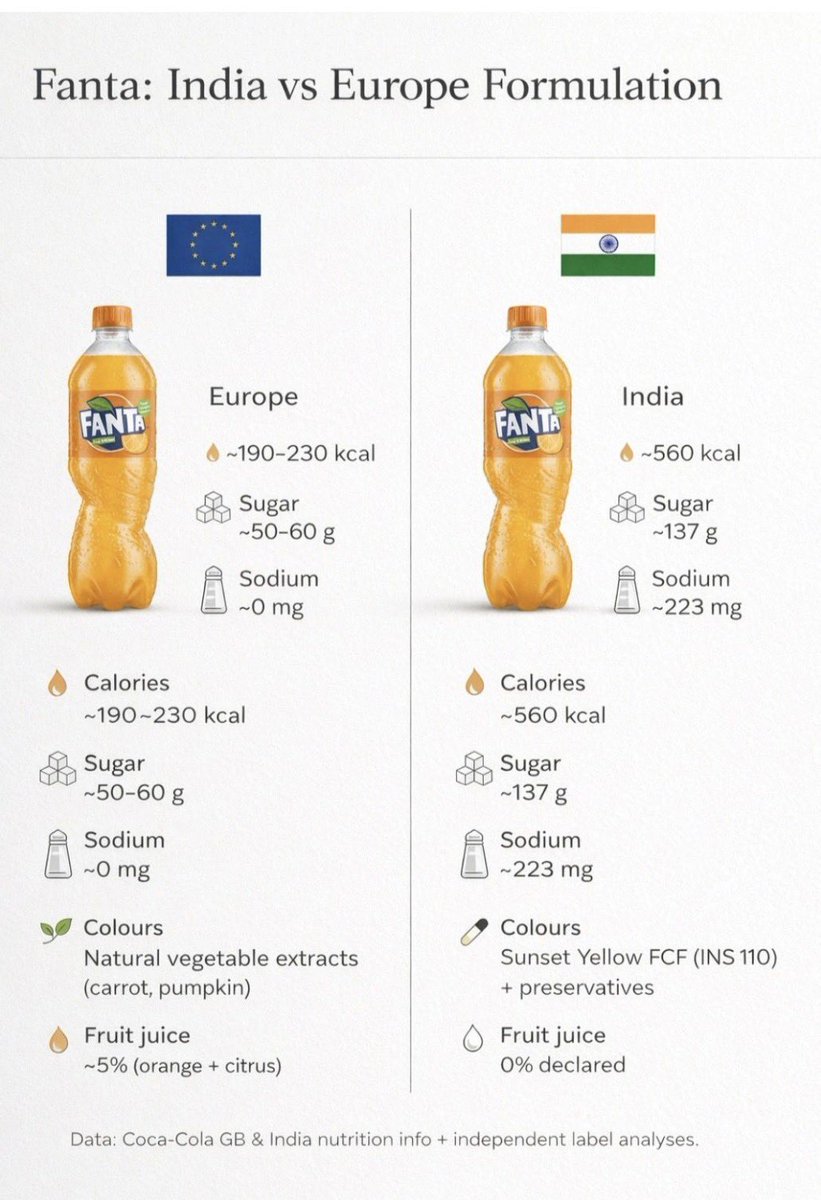
Received this image on Arattai today.
Shocking to say the least.
@fssaiindia - Isn't this the reason diabetes is increasing in India? We need to stop this now. Our children's health is critical.
Request my audience to amplify this for awareness.
#FI
Today I turn 55.
I’m the fittest, sharpest, and happiest I’ve ever been.
If I’m an outlier, it’s not because I’m built different or discovered a secret formula. The truth is far less glamorous:
It’s a million tiny choices, compounded over decades.
Here are 55 of them:
1. Walk 15+ miles a week, even if you do other exercise. Humans are uniquely made to move slowly over long distances—it’s critical to longevity.
2. Develop a writing practice. It’s the single best way to sharpen your mind. And remember, you don’t have to be a good writer to write. Start with 10 minutes a day.
3. Swap out your toothpaste, deodorant, lotions, soap, shampoo, and other personal care products for natural versions. Here’s a rule of thumb: Don’t put anything on your skin that you couldn’t safely eat.
4. If you have a positive thought about someone, don’t keep it to yourself—share it immediately. Encouragement defies the laws of physics: When you give energy, you also receive it.
5. Wear shoes with a wide forefoot (I like Topo Athletic) and wear toe spreaders around the house (search “yoga toes” on Amazon). Spine health begins with the feet.
6. Get sunlight regularly. Moderate sun exposure (without sunscreen) is hugely important for overall health.
7. Do a 3-minute deep (“ass to grass”) squat every morning. Deep squats are often called the anti-aging exercise. It’s been said that, “It’s not that you can’t do deep squats because you’re old, it’s that you’re old because you can’t do deep squats.”
8. Explore minimalism (it’s not what you think it is).
9. Set boundaries on toxic relationships. We tend to cling to relationships past their expiration date, and it takes a bigger toll on our health than we recognize.
10. Eat real food. Not too much. Don’t eat garbage. Binge occasionally. Fast occasionally. That’s the diet.
11. Learn about FIRE. It’s a great framework for financial success.
12. Don’t take antibiotics except in emergency situations. They’re massively over-prescribed and aren’t needed in most cases. Antibiotics have done untold damage to our guts, which is where health begins. Great natural alternatives are out there.
13. Get 8 hours of quality sleep each night. To optimize sleep:
—Don’t eat after 6pm
—Get blackout shades and cover LEDs with black tape
—No screens 2 hours before bed
—Try ashwagandha (an herb) to calm the nervous system
14. Stop drinking, even in moderation. People find all sorts of ways to justify drinking, but there’s no escaping the simple fact that alcohol is a toxin and it limits your potential.
15. Travel as much as possible. Nothing expands the mind like seeing the world. And travel doesn’t have to be expensive—the best experiences happen outside of fancy resorts, when you live like a local.
16. Let go of resentment. When you forgive someone, you release the prisoner, and the prisoner isn’t them… it’s you.
17. Show up on time, every time. Poor time management limits success more than most people realize. If you struggle with punctuality, stop everything else and fix that first.
18. Spend lots of time in nature and touch the earth. Humans evolved over 300k years to live in harmony with nature, and only recently have we retreated indoors. If you don’t spend time outside, you’re fighting biology (hint: You won’t win.)
19. Stop doing dumb things. As Leo Tolstoy said, “People try to do all sorts of clever and difficult things to improve life instead of doing the simplest, easiest thing—refusing to participate in activities that make life bad.”
20. Find your happy place and (eventually) move there. Most people live where they live because... that's where they live. We are products of our environment—choose yours carefully.
21. Find a hobby and pursue mastery. You can’t have a happy life without a passionate pursuit that isn’t your vocation. Your work—even if you enjoy it—isn’t enough.
22. Avoid mainstream medicine except as a last resort. The results are in—our healthcare (or more appropriately, sick care) system is badly broken and only makes people sicker.
23. Have a mindset of abundance. There is no advantage to being a pessimist—even if you’re right, it’s a miserable way to live. In a very real way… whatever you believe, you’re right!
24. Do hard things. Choose courage over comfort. Everything you want is on the other side of fear and hard work. As Jerzy Gregorik said, “Hard choices, easy life. Easy choices, hard life.”
25. Ignore haters. Hurt people hurt people. Negative/toxic people live in a prison of their own design. Don’t join them!
26. Say no. Protect your time and energy like it’s your most precious asset… because it is.
27. Become a water snob. As an alien said on Star Trek, humans are “ugly bags of mostly water.” You are what you drink—literally! We have Mountain Valley Spring water delivered in glass 5-gallon jugs and also have whole-house water filter (Aquasana Rhino).
28. Stop drinking sodas and sugary energy drinks. After a few weeks you won’t miss them, and a few months later they’ll seem disgusting. Refined sugar causes inflammation, which is the root of most disease.
29. If you’re over 35, find a good functional/longevity medicine doctor and start tracking your hormones. Modern life is hell on the endocrine system and restoring healthy hormone levels can change your life. As we get older, we either accept a slow decline in performance or we do something about it—choose the latter!
30. Develop a morning routine and follow it faithfully. Win the morning, win the day!
31. Invest in experiences, not things. People frequently regret buying things, but rarely regret investing in great experiences (especially when shared with loved ones). Remember, there’s nothing you can buy in a mall that you’ll remember in ten years.
32. Explore spirituality. It’s arrogant and small-minded to believe there’s nothing going on in our universe that is beyond our comprehension. We know less about our universe than an ant meandering on a sidewalk understands about this planet.
33. Have a strong bias toward action—doing rather than talking. If you ask a bunch of old people about their regrets, they’ll talk about the things they *didn't* do—the shots they didn’t take—more than the things they did do (even if it went wrong). As Wayne Gretzky famously said, “You miss 100% of the shots you don’t take.” Most people don’t take enough shots.
34. Stay lean. Men in particular are obsessed with muscle mass these days, but bulk doesn’t age well. The goal is to be strong but lean. The fittest guys in their 50s and beyond aren’t meatheads, they’re lean guys who are serious about a sport.
35. Curate your inner circle carefully. Surround yourself with people you admire and who challenge you to grow. Remember, we’re the average of our 5 closest relationships.
36. Be the fittest version of yourself. Your body is your only vessel for experiencing life—so treat it as such. Fitness isn’t working out a few times a week, it’s a lifestyle. The older you get, the more time you need to devote to your health.
37. Take the time to appreciate art and beauty in all its forms.
38. Think globally, but act locally. Too many people put their energy into far-away problems they don’t understand and can’t impact, while ignoring problems right under their nose. Want to change the world? Start at home.
39. Try psychedelics. It’s one of those things everyone should do at least once, and it might be the breakthrough you’ve been looking for.
40. Limit bad habits, including unhealthy thought patterns. We all have them—practice avoidance and find substitutes. Get professional help if needed.
41. Be a lifelong learner. Your brain is just like a muscle—if you don’t feed and flex it regularly, it will atrophy.
42. Find your purpose. People with a strong sense of purpose are happier and live longer. Lack of purpose sucks energy and magnifies depression.
43. Only take advice from people who embody the traits you want to have. Talk is cheap—emulate those who have DONE it.
44. The goal is not to retire and do nothing, it’s to build a great day-to-day life that you don’t need to escape. A life of leisure is a slow death. Happiness isn’t possible without a little struggle, uncertainty, and skin in the game.
45. Have fun! Do frivolous and silly things that make you smile. As George Bernard Shaw famously said, “We don't stop playing because we grow old; we grow old because we stop playing.”
46. Whatever you want to do or achieve in life, start NOW. Don’t fall victim to “someday thinking” because someday never comes.
47. Accumulate assets—things that grow in value over time. It’s the #1 habit of rich people, and it can be done in tiny chunks. Instead of spending $100 on an impulse purchase that has no lasting value, put that money into an index fund or Bitcoin. It becomes addictive (in a good way).
48. Don’t ignore the big 3 canaries in the coal mine for health:
—Low libido (and ED)
—Frequent sinus & respiratory issues
—Depression
These usually aren’t medical conditions in themselves, they’re symptoms of an underlying problem. Find a good doc (outside of the mainstream) and figure out the root cause.
49. Have a clear vision for your future. How can you decide which direction to go if you haven’t clearly defined the destination? It sounds obvious, but 95% of people haven’t defined their “Ideal End State” in detail and in writing. (Check out my thread on this topic.)
50. Make your own decisions. We live in an era where most of what society tells us is wrong. Don’t be afraid to break from societal norms—if people say you’re crazy, it’s a sign that you’re doing something right.
51. Get hardcore about mobility exercise. As you age, it’s usually the knees, hips, and lower back that limit physical performance. 30 min a couple times a week can spare you a lifetime of pain. YouTube is a great resource.
52. Go all in on family. Get married, stay married, have kids. Burn the boats. In the end, family is all that matters.
53. Be ruthless with your time. Money comes and goes. Time only goes. Audit your calendar ruthlessly—cut the trivial, double down on the meaningful, and spend your hours like your life depends on it. (Because it does.)
54. Have a strong bias toward action. Be curious, try things, meet people—it’s how you increase your surface area for serendipity, the most powerful unseen force in our lives.
55. Reinvent yourself every decade. Over time, we slowly drift off course from our priorities, values, and true identity. Take stock and don’t be afraid to hit the reset button. Bold, calculated moves made for the right reasons almost always pay off—usually even more than you can imagine.
🎁 P.S. If you enjoyed this post, would you give me a birthday gift? Repost or comment with the item number(s) you liked best?
In the last few years, MicroStrategy has become a Bitcoin SPAC, with investors attributing savant-like status to Michael Saylor. Its success has led some to push companies to shift their cash into bitcoin. As a general principle, this is a bad idea, but there are four carveouts. https://t.co/icYZfNyHc0
✅Always choose forgiveness over anger for your own good!
▶️Two friends, Ravi and Arun, grew up together in the same quiet South Indian town. Both were smart, hardworking, and ambitious — but they were vastly different in one way: their response to hurt and injustice.
Arun – The Unforgiving Flame
Arun was sharp and principled — but he couldn’t let go of slights. Whether it was a friend's betrayal, a coworker’s backstabbing, or a family argument, he held on to the pain tightly.
“I’ll never forget what he did,” he would say.
Anger simmered within him — not always explosive, but always present.
🔴Over the years, Arun developed:
1. High blood pressure
2. Frequent migraines
3. Poor sleep and chronic fatigue
4. And at 48, he had his first minor heart attack
▶️Doctors found elevated cortisol and CRP levels — signs of long-standing stress and inflammation. "You’re carrying too much anger," his physician said. But Arun shrugged it off — “Some people don’t deserve forgiveness.”
Inside, his heart had been waging a silent war for years.
Ravi – The Quiet Release
▶️Ravi faced his share of pain too — betrayal, failure, family tensions. But he had cultivated a habit his grandmother once taught him: “Let go — not for them, but for yourself.”
▶️He practiced forgiveness — sometimes with effort, sometimes through journaling, prayer, or deep conversations.
▶️His health reflected that choice:
1. Normal blood pressure
2. Rarely fell ill
3. Slept peacefully
4. Emotionally resilient, even in crisis
▶️Doctors noted his high heart rate variability (a sign of good stress regulation) and low inflammatory markers. “You have the heart of someone ten years younger,” they once told him during a check-up.
▶️At 50, Ravi was not just physically healthier — he was lighter in spirit.
✅Take Home Message
▶️We all carry wounds — but how we carry them shapes our health.
▶️Forgiveness is not about excusing others. It’s about freeing yourself from the physiological grip of anger, bitterness, and stress.
✅Forgiveness-
1. Lowers stress hormones
2. Protects your heart
3. Boosts mental clarity
4. Strengthens immunity
5. Improves sleep and peace of mind
▶️Forgive — not because they always deserve it, but because you deserve health, peace, and freedom.
(Names have been changed. Based on real life people, with evidence from literature).
There is a pitfall in being rich or intelligent.
Rich people feel that all problems can be solved by money.
Intelligent people feel that all problems can be solved by logic or intelligence.
But not all problems can be solved by money or intelligence.
Some problems need other qualities like empathy, EQ, acceptance etc.
And sadly, some problems are unsolvable. They need acceptance only.
#Wisdom
The Weight of the Bottle🍻
▶️At thirty, Ajay’s life was a shadow of what it could have been. Twelve years ago, he was a vibrant college student, chasing dreams of becoming a graphic designer. A beer here, a shot there—it started innocently, a way to unwind with friends. But the drinks became a crutch, then a necessity. By his mid-twenties, Ajay’s days revolved around the bottle, and by thirty, it had taken nearly everything from him.
▶️The first sign something was wrong came at twenty-five. Ajay noticed his hearing fading, like someone was slowly turning down the volume on the world. At first, he brushed it off—maybe it was just loud music or earwax. But an ENT evaluation confirmed sensorineural hearing loss, a condition linked to chronic alcohol abuse. The damage was irreversible. Conversations became a struggle, and the world grew quieter, isolating him further.
▶️Two years later, his vision started to blur. Reading emails or sketching designs became impossible. Another diagnosis: optic neuropathy, inflammation/damage of the optic nerve, likely triggered by years of alcohol poisoning his system. His once-sharp eyes, critical for his art, now betrayed him. He could barely make out faces across a room, let alone create the vibrant designs he’d once dreamed of.
▶️Walking was no easier. Ajay’s steps grew unsteady, his balance faltering as if the ground itself was tilting. Clinical evaluation by a neurologist was suggestive of Myeloneuropathy—a neurological condition caused by alcohol’s toxic assault (with additional vitamin B12 deficiency) on his spinal cord and nerves. His legs felt heavy, unreliable, and a burning, tingling sensation in his feet kept him awake at night. Simple tasks like walking to the store became daunting, and the pain in his feet was a constant reminder of the price he was paying.
▶️Ajay’s health wasn’t the only casualty. His graphic design career, already shaky from missed deadlines and sloppy work, collapsed entirely. Clients stopped calling, and his portfolio gathered dust. Unemployment followed, and with it, financial ruin. Bills piled up, and his small apartment became a cluttered prison of unpaid notices and empty bottles. Friends drifted away, tired of his excuses and the chaos that followed him. His family tried to help, but Ajay’s pride and denial pushed them back.
▶️One evening, sitting alone in the dark, Ajay poured another drink. His hands trembled, not from need but from the nerve damage that made even holding a glass a challenge. He stared at the amber liquid, its familiar burn no longer a comfort but a taunt. This was his life now: deafened, half-blind, stumbling, and broke. The bottle had promised escape but delivered a slow, relentless destruction.
▶️Another visit to the neurologist was a turning point. Ajay was asked to join alcohol deaddiction program. Reluctantly, he went. There, he heard stories like his—lives unraveled by alcohol, bodies and futures broken. For the first time, he saw his path clearly: continue drinking and lose what little remained, or fight for a chance at redemption.
▶️Ajay chose to fight. Sobriety was grueling. Withdrawal shook him to his core, and the cravings were relentless. But with each sober day, he felt a flicker of hope. He leaned on the support group, reconnected with his family, and sought medical care to manage his conditions. His hearing and vision wouldn’t fully recover, and the nerve damage could only be partially recovered, but physical therapy helped him walk with more confidence. He found a part-time job, not in design but in a community center, where he could help others avoid his mistakes.
▶️Ajay’s story isn’t one of a miraculous recovery. The scars of his addiction—physical, financial, and emotional—will never fully fade. But it’s a story of truth: chronic alcohol abuse can steal your health, your livelihood, and your future. It can leave you disabled, jobless, and drowning in debt. Ajay learned too late that the bottle’s promises are lies, but he’s proof that even in the wreckage, there’s a chance to rebuild—if you choose to put the drink down.
▶️Message: Chronic alcohol abuse can devastate your body and life, leading to irreversible disabilities like hearing loss, vision impairment, and neurological damage. It can strip away your career, finances, and relationships, leaving you isolated and struggling. Recovery is possible, but the cost of addiction is steep—don’t wait until it’s too late to change.
(Based on a patient whom I had earlier managed. Name has been changed to maintain privacy)
When my uncle was about 45, his wife passed away, and everyone kept telling him to remarry.
But he wasn’t interested. “I don’t need a wife,” he said. “I’ve got a son, and with him, I’m set for life.”
Little did he know, life had a surprise in store for him, one he didn’t see coming…
Introverts want a quiet life. No drama. No games. No stress. Just peace and good vibes. Doing their thing. Chilling & vibing. Sitting on the porch, deep conversations with a loved one, sipping tea, and watching the sun go down in silence. A simple life. That's all they want.
Preserving wealth
“The father buys, the son builds, the grandchild sells and his son begs.” says a Scottish Proverb.
The Chinese have a saying, “Fu bu guo san dai”, which means wealth never survives three generations.
Traditional wisdom holds good for modern days as well. I come across data, articles and stories in this regard.
It is very difficult to be rich. Only 1% can be in top 1%. According to Credit Suisse if you have more than Rs.5 crores, you are among top 1% of the world population. A million dollars (Rs.6.5 crores) puts you in top 0.7%.
We have to get rich only once as long as we don’t do anything foolish. As both investor and advisor, our focus is always on avoiding permanent loss of capital and at the same time to grow wealth at a reasonable rate.
Ben Carlson in a recent article points out that about 70% of people who receive a financial windfall lose it within a few years. Also nearly 80% of NFL players are broke or bankrupt after being out of the league for two years. Sixty percent of NBA players are broke after being out for 5 years.
If you are interested like me in studying about wealth, there is so much of information and data available.
The above example shows how difficult it is to stay rich in our generation itself. I’ve also seen people lose their wealth by taking unwanted risks.
I came across an article in Time magazine. It says that 70% of wealthy families lose their wealth by the second generation, and a stunning 90% by the third generation.
Out of the people who get rich, not all stay rich. Even amongst those who are able to stay rich, 70% lose it in second generation and by third generation it becomes 90%.
One way to minimise such happening is to teach children and grand children the value of money and the art of money management. There is no such thing as easy money and by design only few are endowed with good wealth. If we don’t value something we have, it would start slipping away. Not to talk us up, but having a financial advisor who can be a mentor and coach would definitely help.
This should also make us ponder over giving, as part of wealth management. Not all focus on giving as much as saving and spending. We all create wealth because of the opportunities provided by the society and we need to give at least something back. In our case, our family has decided to allocate 10% of our wealth for charity when I turn 60. There is no hard and fast rule for giving. But we thought 10% is the least we should do.
Like all things in life, wealth is also ephemeral. By teaching next generation, you can at least prolong it. By giving, you can make positive impact in the life of less privileged.
Some points to ponder for the weekend.
(I wrote this piece in 2017)
If you are uncertain about sequencing or which class may best work for you, this flowchart may (or may not) help you in your choice. https://t.co/mlfsK9tKuy
#Diagnosis
Inability to remain “Happy” is largely due to 2 things.
1. Hating too many people and too much.
2. Loving too many materials and too much.
Review. Restart.
Keep Laughing.
#Focus
@whirlpool_india Bought a refrigerator 2 months back and service guy came for installation cheated 2k after installing the stabilizer. I'm keep following up on the refund amount, no response. Worst service