@WaveAgency_ × @MultyrProtocol Community Collaboration Announcement 🎊
We’re excited to announce our latest community partnership with Multyr! 🕊
Multyr is a non-custodial, rule-based capital allocation protocol on Arbitrum. Users deposit USDC into ERC-4626 vaults and receive vault shares; capital is allocated across whitelisted DeFi strategies through deterministic on-chain logic exposure caps, risk limits, oracle checks and no discretionary asset management by the operator.
Live in shadow mainnet.
Learn more: https://t.co/VGwsrczUFY
🌊 WE ARE BACK
Our journey starts once again!
We're grateful to Ewave, DCII, and Multyr Protocol for trusting us and giving us the opportunity to deliver our best.
We're ready to grow, build, and create more opportunities in Web3.
🌐 https://t.co/INiz9d8I6D
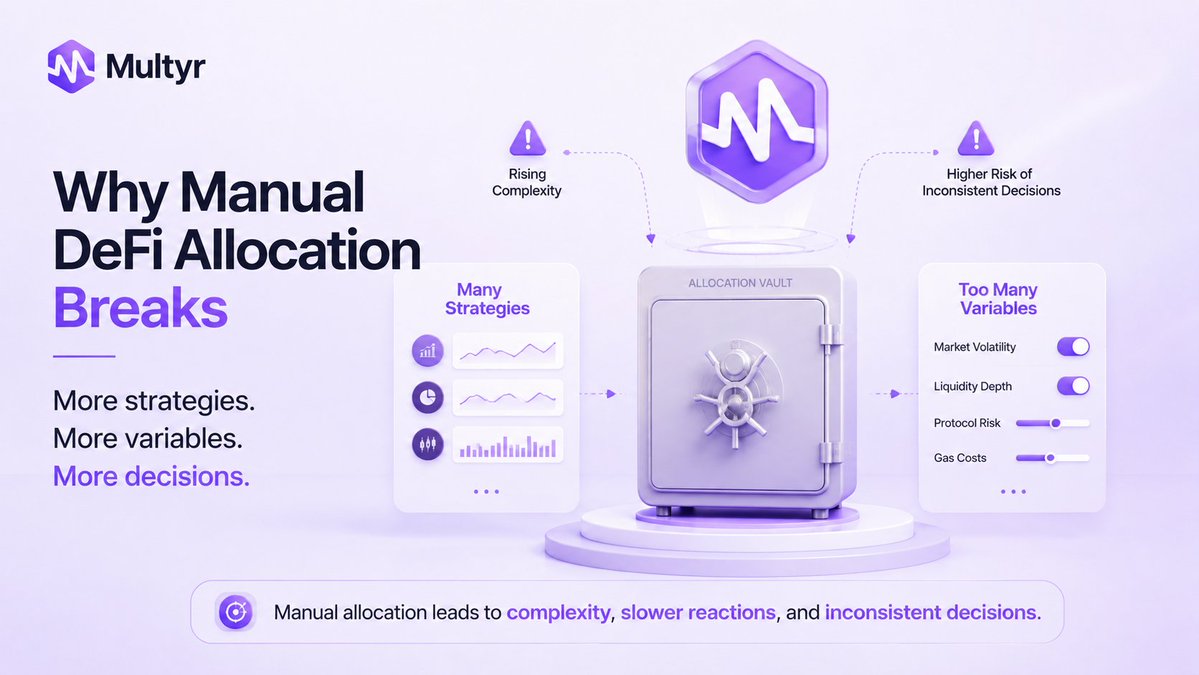
Why Manual DeFi Allocation Breaks at Scale
Manual allocation can work when you have a handful of positions and enough time to monitor them.
It gets harder as strategies, protocols and market variables multiply.
Yield changes.
Liquidity moves.
Strategy capacity fills.
Exposure shifts.
Execution costs change.
And manual decisions don’t automatically enforce exposure caps, loss limits or rebalancing thresholds.
Then there’s execution.
Moving capital has a cost: gas, slippage and other execution costs. A rebalance only makes sense if the expected improvement justifies the move.
Finally, capital spread across multiple protocols makes it harder to maintain a consistent view of exposure, liquidity and capacity.
This is the problem Multyr is being built around.
Instead of depending on constant manual decisions, capital allocation can operate within predefined on-chain rules and constraints.
Security first, always. After @HackenProof ‘s audit of our token contracts, we're continuing the same rigor with the core protocol and strategy layer before any public deposits.
Every layer audited, every finding remediated, reports public. That's the standard.
A lending market can still offer an attractive APY while becoming a worse place to allocate capital.
Multyr doesn’t treat yield as automatic eligibility.
If a target breaches configured health or risk conditions, new allocation can be restricted and exposure reduced through rebalancing, subject to liquidity and execution constraints.
The question isn’t only:
“Where is the highest yield?”
It’s also:
“Should this market still be eligible to receive capital?”
That’s rule-based capital allocation.
When we first got @ChooTheRescue … pure love from the very first day.
We knew he was a special boy.
Next couple weeks gonna blow peoples minds.
Straight up cookin’!