Interesting to see @SentinelP2P evolving from a single dVPN app into a full bandwidth + node infrastructure stack.
It tend to matter less for raw rankings and more for whether they can standardize “bandwidth as infrastructure” across apps.
For years, the Sentinel Network has ranked among the most active networks in the Cosmos ecosystem by real users and real transactions.
Now the ecosystem is expanding beyond decentralized VPN applications into end-to-end infrastructure for creating, deploying, managing, and scaling decentralized VPN services.
Compared against Solana ecosystem applications:
• 4,132,538 transactions in the past 30 days
• Ranked 93rd out of 1018 projects by monthly transactions
• 44,099 Daily Active Users
• Ranked 16th on Solana for DAU among projects with 1000+ active users
Infrastructure across the Sentinel ecosystem now includes released and upcoming utilities for:
• Node deployment and hosting
• Subscription plan infrastructure
• Transparent node testing
• AI agent connectivity via x402
• Open-source SDK integrations
• Programmable bandwidth infrastructure
• Whitelabel dVPN tooling
Institutional custody is finally plugging directly into staking execution.
@CactusCustody + @LidoFinance V3 stVaults is a clear step toward “custody-to-strategy” workflows where institutions can run validator infrastructure, manage risk, and interact with DeFi.
Powered by stVaults.
stVaults are now supported by @CactusCustody, the digital asset custody arm of @BITofficial_EN.
Clients can create & manage stVaults via Cactus Link: Choose validators, fees & MEV routing with on-demand liquidity via stETH minting.
https://t.co/UVOUY9km68
DeFi vaults don’t fail in normal conditions but fail when can’t respond under stress.
The Kelp incident showed that isolation + routing flexibility matter as much as security itself. Without the ability to move capital across venues fast, even well-audited systems can get stuck.
@ssv_network is closing the loop between validator infrastructure and token holders.
As DVT adoption grows across Ethereum staking, cSSV gives users a way to share in the network activity they’ve been supporting all along.
Meet the Syndicate.
Lido. https://t.co/6chgxuylnC. Puffer. Mantle. Origin.
Five protocols already running on SSV infrastructure. Their users qualify for the cSSV Syndicate Boost.
Snapshot: June 5
A lot happening behind the scenes at the @cosmoshub.
The combination of a native liquidity layer, deeper tokenomics analytics from @gauntlet_xyz, and the USDC migration strategy shows @cosmos is focusing on strengthening both capital efficiency and ecosystem growth.
This week on the Hub:
- Our next community call topic: Hub liquidity layers
- Gauntlet's first tokenomic report is coming
- USDC migration, a call for feedback
- Ecosystem Growth delegations RFP reviews
Forum Recap: https://t.co/2dZo1HdZRZ
TradFi isn’t being replaced, it’s being re-architected.
@CantonNetwork's “need-to-know” model is the missing piece that lets institutional-scale markets move onchain without breaking compliance, privacy, or existing custody rails.
Most instruments that are frequently traded will be traded onchain within the next five years.
@drwconvexity and @YuvalRooz on the infrastructure required to get there.
↓ Full recap.
https://t.co/SooUi91dAf
Interesting move! @CantonNetwork's retail onboarding strategy finally getting real execution layers behind it.
Bridging from @base into a native Canton wallet with usable assets is the kind of step that starts converting “institutional rails” into everyday liquidity flows.
Base assets now have a direct path onto Canton.
@Send is bridging USDC, cbBTC, SEND, and frxUSD from Base into Canton wallets, expanding retail access to institutional settlement infrastructure.
↓ Learn how.
Interesting to see governance participation and infrastructure operation converging this tightly.
If validators are also actively embedded in protocol, tokenomics, compliance, and comms committees, it shifts the model to something much closer to protocol co-design 🧩 @ZenithFdn
Zenith doesn't just build on @CantonNetwork, it helps govern it.
As a Tier-1 Super Validator with maximum weight - earned through Canton's CIP process based on demonstrated contribution - Zenith participates directly in the decisions that shape how the network evolves. Beyond validator operations, Zenith's team holds active seats across Canton Foundation committees, the bodies that translate governance into practice.
Tech & Operations Committee @NorbertVadas: protocol standards, network upgrades, and the developer tooling that underpins Canton's infrastructure.
Tokenomics Committee @HeslinKim, @NorbertVadas, and @GArentoft: the economic decisions that shape $CC issuance, rewards distribution, and how value flows through the network. Heslin sits as one of 8 voting members and also on the Protocol Development Fund, the body responsible for evaluating and funding contributions to Canton's core infrastructure. Gustav brings five years of governance experience from Stable Labs to the committee.
Accountability Committee @Henrixbor: milestone verification, SV compliance, and reward escrow oversight. The enforcement layer ensuring governance commitments are met.
Marketing Committee @SuontamaJulia: how Canton communicates its ecosystem development to the broader market.
Across these committees, Zenith's team participates in the technical standards, economic decisions, governance enforcement, and ecosystem communication of a network that JPMorgan, DTCC, Goldman Sachs, and Visa depend on for live production operations. That presence is what building for the long term actually means.
Zth.
@CantonNetwork is positioning itself well as a “familiar dev front-end, new infra back-end” stack.
If EVM/Solana devs can deploy without rewriting everything, but still gain privacy + atomic composability, that’s a strong bridge between ecosystems. 🔗⚙️
Existing Solidity contracts deploy on Canton through @ZenithFdn without modification, routed through the protocol with atomic composability to Daml applications.
EVM and Solana developers get direct access to Canton's architecture without changing their tooling.
↓ Learn more.
USDCx expanding to exchanges and incentive programs like this is another step toward stablecoin interoperability becoming the default, not the exception.
The real signal is composability + liquidity flowing across institutional-grade networks like @CantonNetwork.
USDCx is now supported on @Gate.
CIP-56 compliance means every asset built to the standard is interoperable with Canton's applications, wallets, and infrastructure by default.
A timely conversation for the entire industry. Quantum risk may not be immediate, but preparation can't wait until the threat arrives.
Encouraging to see projects across the ecosystem already exploring post-quantum security and migration paths before it becomes a necessity. 🔐
@MidnightNtwrk's DUST model is a clever approach to UX and scalability.
By decoupling transaction fees from direct token ownership and enabling fee sponsorship, developers can build privacy-focused apps with a much smoother onboarding experience for mainstream users. 🌙⚡️
Want to learn more about the mechanics of how NIGHT tokens generate the DUST resource? 🤔
There are multiple pathways to generate DUST, from multiple NIGHT addresses, or even multiple NIGHT UTXOs from a single address.
Midnight’s UTXO-based architecture ensures that DUST generation is flexible down to the individual token output.
This is a powerful mechanism for utility and adoption. Learn more: https://t.co/G0anp6dajX
For #Cardano builders, this is an important step toward a more capable and consistent Plutus environment.
New primitives, improved efficiency, and alignment across V1, V2, and V3 help lay the groundwork for the upcoming hard fork and the next generation of smart contracts. 🔧⚡️
The Plutus Cost Model update proposal is now live on Mainnet!
A meaningful upgrade for the Plutus ecosystem, introducing new primitives, improved consistency across versions, and important groundwork ahead of protocol version 11.
Formal verification is becoming more accessible on #Cardano.
Huge milestone for the Blaster consortium, bringing Lean-powered verification, UPLC proofs, developer-friendly tooling to the ecosystem.
Open-source and focused on helping builders ship more secure smart contracts ⚡️
I want to thank the #Cardano community for granting our consortium 13.08m ada to deliver the extended version of Blaster and bring formal verification to all DApp developers.
We're fully aware this is a significant amount of ada. We believe in our tool and in our vision of what good, accessible formal verification tooling should look like. We're glad to see the community shares that vision.
The tool is open-source, but still at an early stage. We're still very much heads-down on this year's deliverables.
So far, we built a #Lean automated reasoning backend that outperforms the academic competition on neutral benchmarks, and is the only one able to prove UPLC programs running on the CEK machine: https://t.co/rR7ZzAuwwu
We delivered a complete formalization of the CEK machine, Plutus Core builtins, and UPLC, tailored for Blaster, but usable by anyone who wants to prove correctness of UPLC programs in Lean: https://t.co/JlBARn4kMR
We're now delivering the different ledger rules for script contexts and the Cardano Ledger API formalization (at the Data level!), also tailored for Blaster so users can easily express what a "correct script context" is: https://t.co/SHdWP72cqK
Work is in progress: optimizations are being pushed, we're formalizing the new builtins, the new CEK machine rules, the new cost models, and more.
And just because something has been delivered doesn't mean we stop: we're continuously improving the reasoning core, the formalizations, all of it.
If you want to use the tool and are looking for help, we're on Discord: https://t.co/vQajBBJi9m
I promise, we're friendly. We just want to see the tool actually used by people ❤️
Big milestone for #Cardano infra: Mithril signer hitting v1.0.0 and going production-ready after years of mainnet hardening.
Static builds, node 11.0.1 support, and protocol fixes all reinforce faster, trustless chain bootstrapping as it moves into production. 🚀
The Mithril signer has reached v1.0.0 and is now production-ready on mainnet.
Distribution 2617.0 includes:
• Mithril signer 1.0.0, stable and ready for production deployments
• Support for Cardano node 11.0.1
• Statically built binaries with no glibc dependency
• Protocol improvements and bug fixes
This release follows nearly three years of testing, feedback, and hardening alongside stake pool operators running Mithril on the mainnet.
The result: a major step toward fast, trustless chain bootstrapping for Cardano.
Full release notes:
https://t.co/No1fhLXBUY
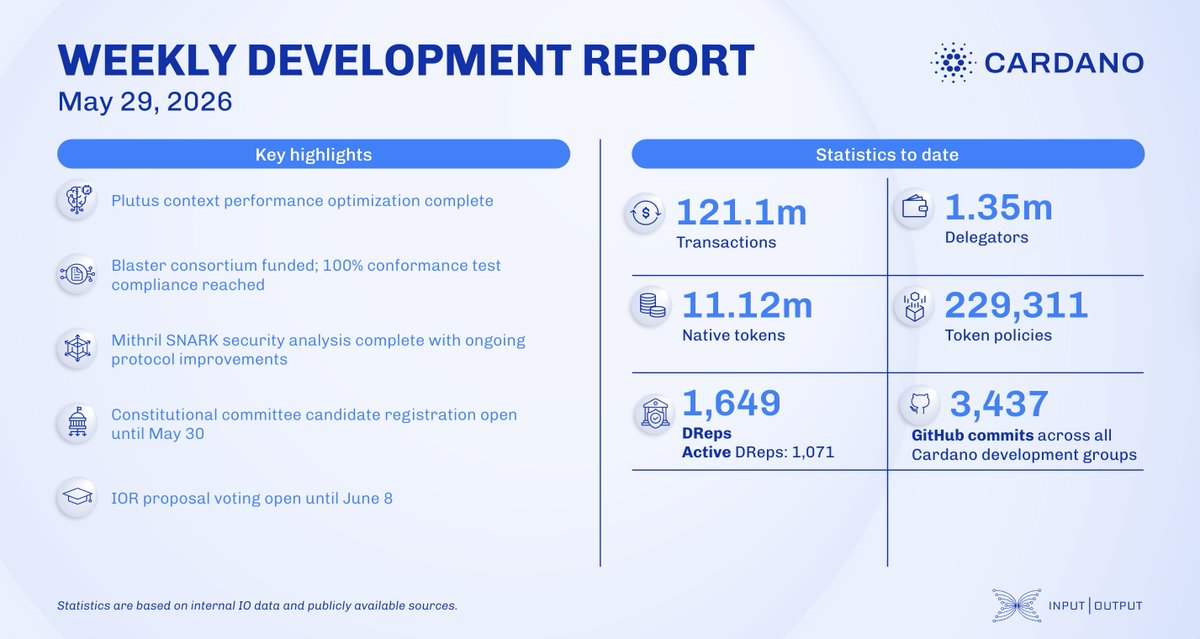
Strong across-the-stack progress this week: Dijkstra prep, Plutus optimizations, full smart contract conformance, Mithril SNARK upgrades, and major Leios milestones with funding approved and design tightened.
#Cardano’s pipeline is clearly converging on scalability + security.
In this week’s development report: Leios protocol efficiency improved significantly – certificate sizes dropped 40× thanks to a new stake-based committee design, and the reference implementation was rebased onto Dijkstra. The Blaster consortium secured funding to bring formal verification tooling to Aiken, Pebble, Futura, and Scalus, reaching 100% conformance test compliance. The Mithril team completed their SNARK security analysis.
Constitutional committee candidate registration is open until May 30.
Find out more from other teams: https://t.co/pw8wzB5C4g
SONAR proves a simple point: benchmark winners don't always win in production.
Real-world audio, dialects, and demographics can completely reshape model rankings.
That's exactly what @psdnai is exploring with SONAR and Numo.
The best voice AI model depends on the audio you test it on.
In SONAR’s Bengali case study, 8 models were evaluated across 6 datasets using the PSDN Score, a composite metric that blends word accuracy, character accuracy, and semantic similarity.
No single model held the top spot across every dataset.
This is exactly what @psdnai is building with Numo and SONAR.
The future of AI isn't making people communicate like software, it's helping software understand how people naturally speak, think, and share knowledge.
a lot of the world’s knowledge never makes it into software because it dies somewhere between thought and typing.
google adding voice-first drafting across docs, gmail, and keep is part of a bigger shift.
work software can finally start absorbing the messy context people actually carry: tone, memory, corrections, half-formed ideas, lived expertise.
including from people who know what they mean, but might not write like an office worker.
https://t.co/IZeD1PbSrg
A key milestone for #Cardano’s next upgrade cycle.
PreProd hard fork is moving ahead with ratification on May 31 and enactment on June 5.
Good to see tooling (Ogmios/Kupo) being aligned early so SPOs and devs can upgrade smoothly before mainnet. 🚀
Hard fork progress update 🛠️
Following the Hard Fork Working Group call on May 28, 2026 the decision has been made to ratify the PreProd test network hard fork in the current epoch.
PreProd HF:
Ratification - May 31, 2026 00:00 UTC
Enactment - June 5, 2026 00:00 UTC
SPOs, DApps and developers are highly encouraged to upgrade their nodes and tooling ahead enactment on June 5. See next post for Ogmios and Kupo updates.
We're giving away 2 tickets to @ethconf in New York — June 8–10.
To enter:
☀️Follow @FlareNetworks and @FlareDevHub
☀️Retweet and comment on this post
Winners announced next week. Good luck!