This week on @Calderaxyz
Caldera continue to power more and more innovative projects that are changing the game, lets dive into this week new integrations
A short 🧵
1/ Ever checked your position on the @PrismaXai teleoperation queue, see like 5 people ahead of you, you’re almost up… then you check in a few minutes later and see this 👇
@MaxC16134@vivianrobotics
Kash: Designing for the Decision, Not the Feed
The @kash_bot card visual design reflects a shift from browsing markets to making decisions.
Instead of presenting markets as compressed rows in a list, Kash elevates each one into a self contained unit. The question is prominent. The probability is immediately legible. The Yes and No actions are positioned as the next step.
This design changes how users interact with the product.
In a list based interface, attention is divided. Users scan, compare, and move on. The interaction stays passive. Even when the data is clear, the path to action is less direct.
The card interface reduces that distance.
By isolating a single market and giving it visual weight, Kash reduces the number of decisions a user has to make before taking a position. There is less need to filter through competing options or interpret dense layouts.
The question stands on its own, and the response becomes immediate.
Decision making in prediction markets already requires effort. Users are evaluating probabilities, time horizons, and incomplete information. Interface complexity adds to that burden.
Kash removes that layer.
The probability bar provides context. Volume anchors credibility. Time left introduces urgency. The binary action is always within reach. Each element supports the same outcome, helping the user commit. Thanks to the genius of @miguelsantafe
There are trade offs.
A card based system reduces how many markets can be viewed at once. For users who prefer scanning multiple opportunities quickly, this slows things down.
Kash is making a clear bet.
That deeper engagement per market matters more than surface level interaction across many.
If that holds, the impact is straightforward. More participation per market leads to stronger liquidity and more reliable price signals.
The interface does not change the nature of prediction markets. It changes how users arrive at a decision. The process is more direct, with fewer steps between understanding a question and taking a position.
1/ The controversy around @Polymarket “MSTR BTC sell” market is exactly why prediction markets must evolve to become truly decentralized and AI-powered like @kash_bot
We can’t keep accepting flawed human resolutions.
We're launching not one, but two competitions on @DecibelTrade at 5PM CET🔥
1. Decibel Stocks Rally
Daily competitions until June 11.
$2,500 + 2,500 AMP up for grabs.
Trade stocks. Generate volume. Climb the leaderboard.
Signal > Noise
@MaxC16134 reached out after seeing my recent posts and said:
“Really solid stuff. They’re all long-form breakdowns, explaining step by step what we’re working on. Pls keep it up.”
This serendipitous feedback highlights something important about @PrismaXai itself.
What’s being built isn’t something you best explain in one-line or hype threads.
It’s layered. It’s technical and it’s evolving in real time.
And that’s exactly why I’ve chosen this approach.
I haven’t just been posting updates, but breaking things down step by step:
• What’s being built
• Why it matters
• How it actually works
Because PrismaX isn’t something you give surface level attention, It’s something you understand over time.
And if the people building it recognize the value in that clarity,
then it’s clear this direction matters.
So I’ll keep going.
Not for engagement.
But for understanding
I just joined House Tonari. "The eternal stack." and @vijayanest22031 Tribe
I joined as a tribute to her dedication to this project.
She has been supporting Purinta far before any KOL
Purinta is bringing utility to meme culture. Your rugged coin can now serve as collateral to borrow other asset
Here is my Code: 65F9EFA67D
When you use it, you are joining my Tribe. Join my tribe: https://t.co/7akrju4TpO
@purintaxyz
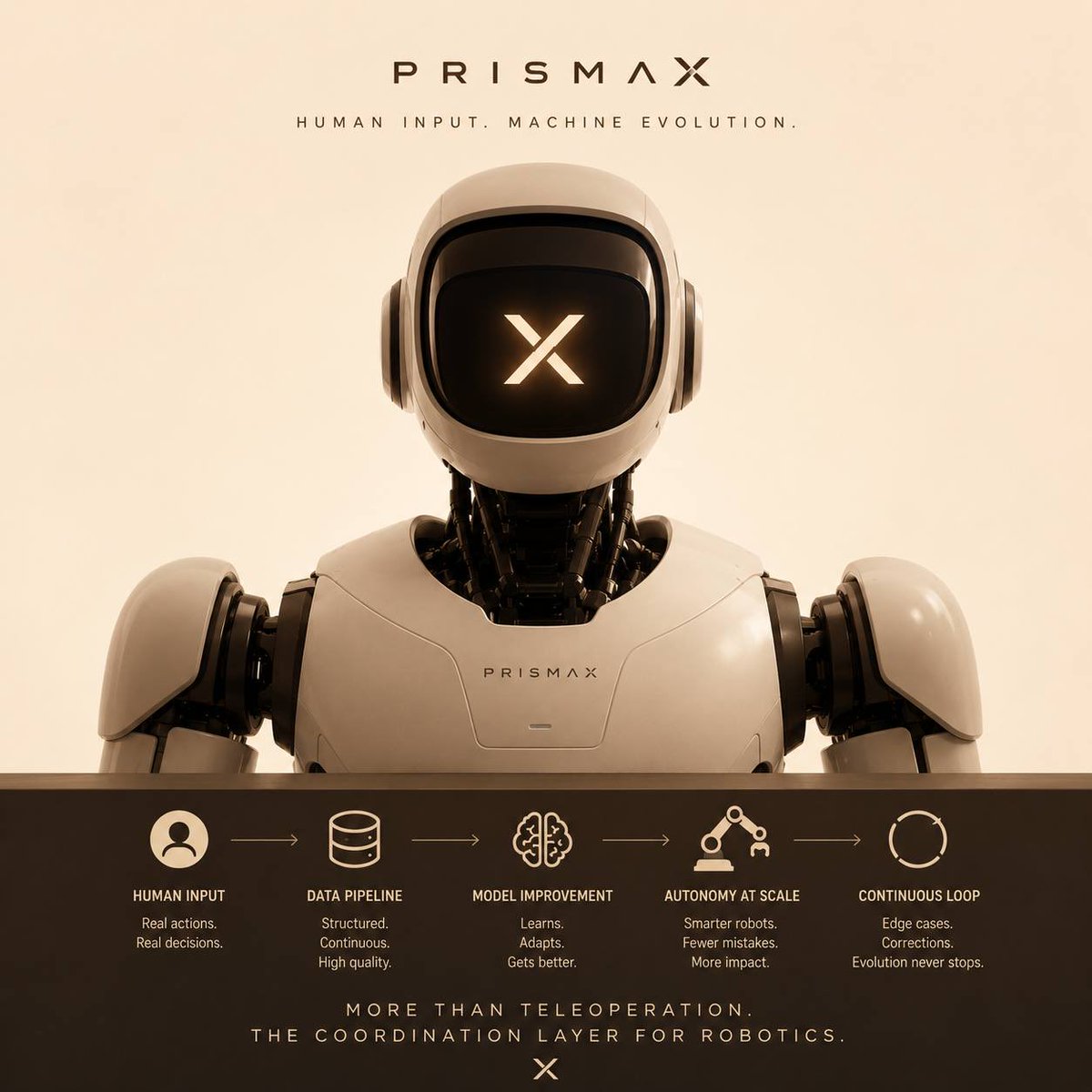
Most people misunderstand @PrismaXai .
They think it’s a teleoperation platform.
It’s not.
It's a service layer.
Teleoperation is just where it starts.
Right now, robots are not reliable enough to operate fully on their own. So humans step in and control them. That part is obvious.
What is less obvious is what PrismaX is actually building underneath that.
Every session produces structured data:
• actions taken
• time to completion
• failure points
• corrections
This data is what improves the system.
So today, PrismaX looks like a human control centre for robots.
But functionally, it is a data pipeline.
Human input → data → model improvement → better autonomy
That loop is the foundation.
If it works, robots need less human input over time.
If it doesn’t, then nothing is actually improving.
Now here is the important part.
Even if robots become highly autonomous, the need for this system does not disappear.
Because autonomy is not final.
Models degrade. Environments change. New edge cases appear.
So the system still needs:
• continuous data
• human corrections
• validation
This is where PrismaX evolves.
Not as a tool for controlling robots,
But as a coordination layer:
• deciding when humans are needed
• routing edge cases
• capturing high-quality corrections
• feeding that back into the models
In that stage, teleoperation is no longer the main product.
It becomes one of several services.
The real role of PrismaX is to manage the interaction among humans, data, and machines.
So the question is not whether teleoperation becomes obsolete.
It might.
The real question is whether PrismaX can position itself as the system that keeps autonomous robots improving after deployment.
As a service layer? Yes, which doesn't just remain relevant, it becomes necessary.
Cc @MaxC16134@vivianrobotics
Just saw @lmc_security post about Kash’s new permissionless API, and it immediately hit me how this accelerates the agentic economy.
Hear me out.
The agentic economy isn’t some distant future, it’s an emerging reality we can’t ignore. And as builders ship, they must build with agents in mind.
Circle is already going all-in with ARC L1, an entire Layer 1 designed for agent infrastructure.
The realization is that, @kash_bot isn’t just building for people. It’s building for agents too, even if that’s not the core pitch. Why haven't I thought of this until now?
While most blockchain dApps remain closed and restrictive, Kash refuses to inherit those limitations.
Its permissionless API will allow agents to spin up prediction markets on any trend, trade them, resolve via ZK, and operate at machine speed.
AI agents are already dominating large portions of prediction market activity. Kash just handed them the final piece that turn them, from passive tools that surf social noise, into active participants that create and interact with programmable economic primitives.
And the long-tail markets are exactly what AI agents need. They thrive on specialized, high-signal markets. On Kash, those markets are fully tradable without liquidity headaches.
This development isn’t an incremental add-on. Kash is infrastructure for the agentic age.
Do you remember exactly where you finished in Week 1 and Week 2 of the Kash Sprint?
Don’t worry, most of us don’t either.
The good news? You no longer have to rely on memory.
The @kash_bot team has thoughtfully organized the entire leaderboard by sprint weeks, making it easy and reliable to track your performance.
Now you can simply head to the Players section and use the filter to view:
• Week 1 Leaderboard
• Week 2 Leaderboard
• Week 3 Leaderboard
• And the All-Time Leaderboard
Each weekly leaderboard also displays key stats like number of participants, total volume traded, and total predictions made, giving a complete picture of how competitive each sprint really was.
This update is a big win for users. It lets you;
Accurately track your progress across sprints
Analyze trends and see how the competition is evolving
Stay motivated with clear, transparent records
On the team’s side, this move speaks volumes. It shows a strong commitment to transparency, user experience, and building genuine trust with the community.
They’re not just building a platform, they’re creating a fair and professional prediction market environment where results are clear and verifiable.
Well done @miguelsantafe@lmc_security
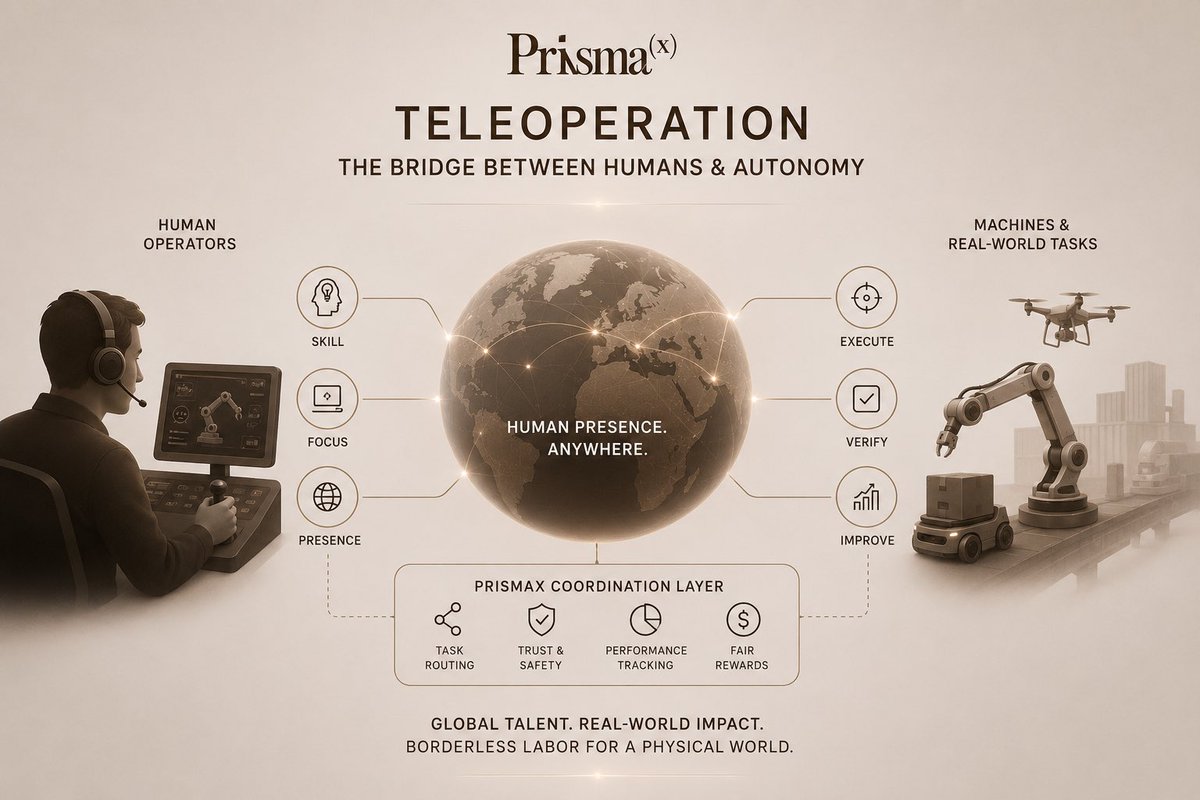
Beyond Remote Control: PrismaX and the Globalization of Human Presence
An idea latched onto me while teleoperation earlier today, maybe a little radical and crude but worth sharing.
We speak about teleoperation like it’s just about controlling machines remotely.
I understand it's the easy way to understand it.
A robot in one place, a human in another, connected through a screen and some controls.
But that framing misses the bigger shift entirely.
Because teleoperation isn’t really about machines.
It’s about presence.
Let me explain.
For the longest time, human work has been tied to location.
If a job needed to be done in a specific place, a human had to be there physically.
That constraint shaped everything:
where people live, where companies hire, how economies grow.
Remote work changed that, but only for digital tasks.
Teleoperation goes a step further.
It brings that same flexibility to physical tasks.
Imagine this:
A skilled operator sitting in Lagos controlling warehouse systems in Europe
Handling precision equipment in Asia
Managing logistics operations in the Middle East
Not in theory, but as a normal workday.
Same skill. Multiple environments. Zero relocation.
This is possible with teleoperation and I think
@PrismaXai direction starts to make more sense when we see things from this perspective.
Because once you remove location from physical work, a new problem appears:
coordination.
Who does what?
How are tasks assigned?
How do you verify that work was actually done?
How do you reward people fairly across borders?
These are not robotics problems.
They are system problems.
Teleoperation at scale doesn’t break because of hardware.
It breaks because there’s no structured way to:
connect operators to machines,
route tasks efficiently,
and align incentives across everyone involved.
And this is the less discussed layer PrismaX seems to be leaning into.
Not just enabling remote control.
But building the coordination layer around it.
A system where:
operators, machines, and tasks
exist in a shared environment
that can distribute work, track performance, and reward contribution.
In that sense, the real shift isn’t remote control.
It’s the emergence of a global market for physical execution.
Where human skill is no longer local.
Where presence becomes something you can deploy.
Of course, this doesn’t come without friction.
Latency still matters.
Regulation will push back.
Security becomes critical when machines are remotely accessible.
So this won’t happen overnight.
But the direction is already forming.
Teleoperation is often framed as a hardware story.
But it’s not.
It’s a labor story.
And if PrismaX gets this layer right,
it won’t just be about controlling machines from anywhere.
It will be about making human presence itself borderless.
Cc @vivianrobotics