10 crypto sectors most likely to survive and grow in the next 6 months
Agentic Finance
Infrastructure for AI and physical AI
Prediction Markets
Perp DEXs
Onchain Vaults
RWA-backed DeFi
Crypto x Privacy
Crypto cards and Neobanks
Stablecoin infra & Payment Rails
Consumer Culture
Details on why 👇
Base is probably the best textbook example for crypto GTM so far.
What @base achieves:
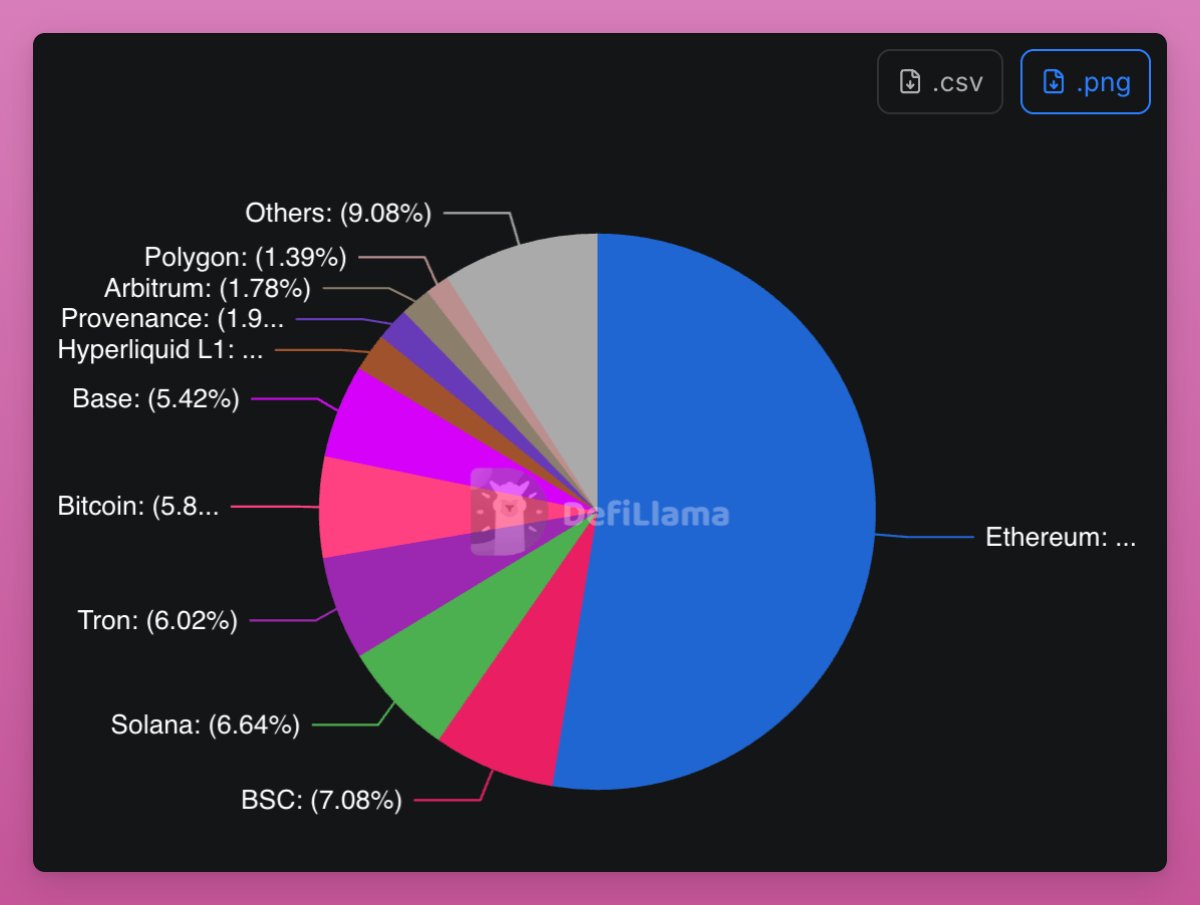
- Surpassed Ethereum in 7-day DEX volume
- Absolutely dominates 7-day bridge volume on @debridge
- Native DEX @AerodromeFi hit close to $1B volume in a day
- Top crypto AI performers ( @AskVenice, @virtuals_io) are built on Base. So are other emerging AI agents and physical AI
- The boom of consumer apps ( @trylimitless, @Beezie, @sportfun) that you don't see on other chains
- Read "This Week on Base" and you'll be amazed by the length
What has Base done?
6 months ago, we posted our thesis on 11 potential crypto narratives.
Today, 8/11 have clearly played out. Here's the scorecard 🧠
Top winners:
1. Prediction Markets: @Polymarket and @Kalshi grew from <$2B monthly volume in Aug 2025 to >$18B by Feb 2026. Both raised at ~$20B valuations. The category won, but breaking the Polymarket-Kalshi duopoly is tough. Some onchain alternatives like @trylimitless and @Rain__Protocol are steadily keeping up.
2. RWA / Tokenization: Market cap doubled to $34.5B in 2026. Private credit overtook treasuries, but most assets remain siloed from DeFi. Tokenized stocks are growing, led by @OndoFinance and @xStocksFi. Yet most value is captured by spot holders and perps traders, not issuers' token holders.
3. Stablecoins: Continue crypto's biggest PMF, with supply surpassing $300B. Transaction volume exceeded Visa and Mastercard combined, and regulatory clarity accelerated adoption. Yield-bearing money like $USDe, $USDS, $USDf, DAT-backed and RWA-backed dollars are top 30D performers.
4. Neobanks: Crypto payments went mainstream, but adoption concentrates among a few winners. @RedotPay controls ~60% market share, while @raincards powers cards for @ether_fi, RedotPay, @KASTxyz and others.
5. Perp DEXs: Daily volume topped $28B in Q1 2026. @HyperliquidX expanded its dominance with RWA trading and pre-IPO trading. The sector won; picking the next winners was much harder.
6. Crypto x Privacy: The winners weren't FHE/ZK plays. $ZEC surged over 1,000% as institutional views on privacy shifted. $NEAR successfully combined privacy and AI infrastructure.
7. Crypto x AI infrastructure: Infrastructure outperformed agent coins. @Base emerged as the leading agentic economy, @virtuals_io showed real usage, @AskVenice built a large user base, $TAO led AI revenue, and @NEARProtocol connected AI with privacy. Hermes by @NousResearch
8. Revenue-generating Protocols: Buybacks, revenue sharing, and fee switch became DeFi's dominant value-accrual model. Hyperliquid, @Pumpfun, @AerodromeFi led the shift toward cash-generative protocols. Other blue-chip DeFi protocols like @SkyEcosystem, @Uniswap followed.
Losers / Need more time:
1. ICO / Token Sale Platforms: Peaked in late 2025 with Kaito, Echo, Legion, and Buidlpad, but momentum cooled in 2026. The high-FDV, low-float problem remains largely unsolved.
2. Crypto x Robotics: Projects like @xmaquina and @openmind_agi attracted attention, but the sector never achieved a meaningful breakout. Most projects remain early-stage and largely speculative.
$ETH gets hate, but $SOL isn’t in a much better spot:
Sure, Solana generates similar fees, and it’s cheaper and faster. Its monolithic design also doesn’t suffer from L2 leakage like Ethereum.
But Solana doesn’t have the same neutrality, decentralization, or censorship-resistant premium that Ethereum has.
Worse, we make fun of the EF for dumping $ETH, but we don’t even really know how much the Solana Foundation holds (and sells) in $SOL.
Their last 'Transparency Report' was published in Aug 2020
Whales also seem to prefer Ethereum for high-value DeFi: Solana has ~$5.2B in TVL vs ~$42B on Ethereum. Even BNB Chain has more.
Solana benefited from memecoins, but it hurt its reputation. And the pivot to perps is a crowded arena, with HL and all major CEXs competing for it.
Tokenization of stocks is amazing, but Ethereum leads in RWAs too.
I still hold some $SOL and want it to do well, but it’s possible $SOL is the new $ETH, and it may take Solana years to find its next engine for growth.
The Arbitrum Foundation is asking the DAO for ~$43.5M to fund another year of operations.
- $16M in RWAs/stablecoins
- 1,740 ETH (~$3.5M)
- and 230M $ARB (~$24M).
230M ARB is ~3.7% of total supply. For a year.
Meanwhile the DAO made $23.49M in revenue in 2025.
So the Foundation is operating at 2.3x DAO revenue.
The previous AI coins boom with $GAME, $ZEREBRO, $AI16Z, etc., are vaporware, no utilities, just memes.
That was when tech had not caught up with anticipation.
When hype died down, people got more skeptical about crypto and AI.
This time feels more realistic. In the last 3 weeks:
→ Base MCP (Coinbase) connects wallets to Claude/ChatGPT so users can swap, send, and use DeFi via chat, with x402 payments built in.
→ @RobinhoodApp allows Agentic Trading for equities and crypto. They also shipped a credit card for your agent to spend on.
→ @NousResearch, a decentralized AI training network, is behind Hermes, the AI agent with a built-in learning loop. 33M+ downloads on HuggingFace. Ranked as the #1 most active agent on OpenRouter. They also shipped Nous Portal, pulling 300+ models and onchain news straight into agent workflows. Point it at your wallet, and it becomes a 24/7 onchain analyst.
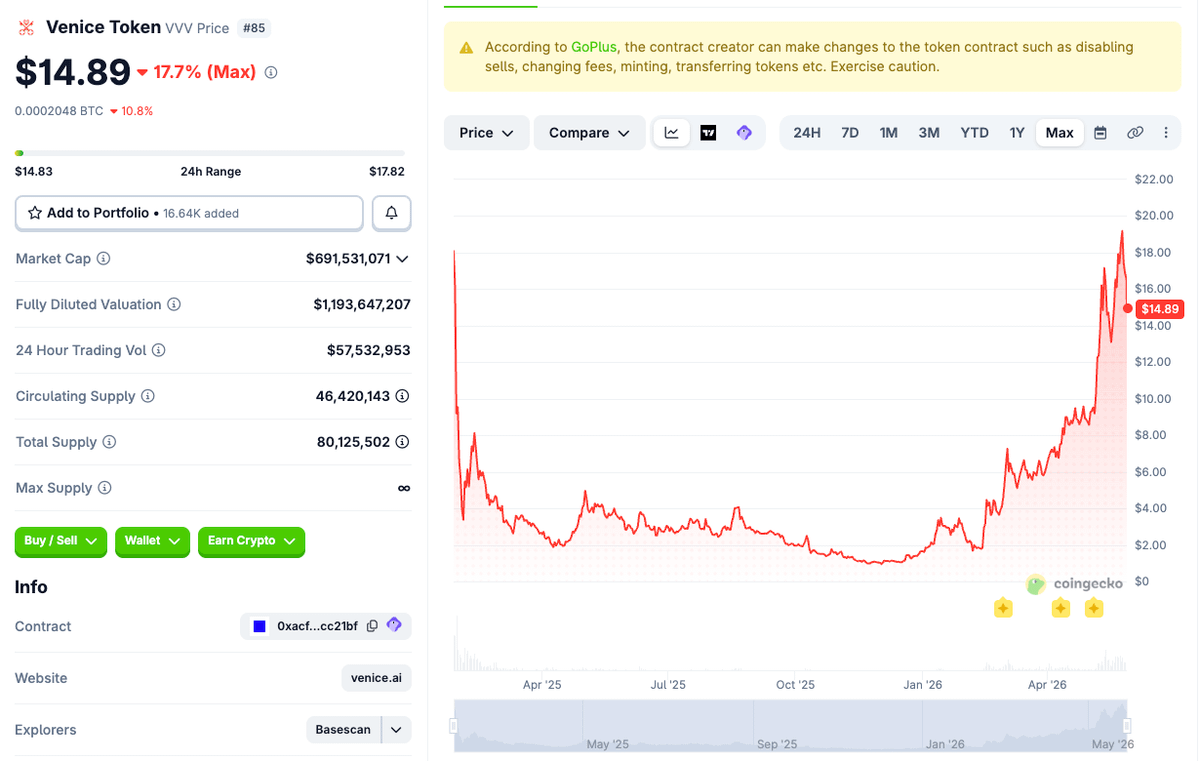
→ @AskVenice is the revenue story on private, uncensored AI inference, tied economically with crypto. The model changes per-request pricing. Stake $VVV, lock it to mint $DIEM, and every $DIEM is $1/day of API credit.
Crypto's job isn't to be the narrative anymore. It's to be the rail. AI showed up as a user, not a thesis.
Top 10 tokens by holder revenue in 24 hours 🧠
1. $HYPE @HyperliquidX - 99% of trading fees flow into the Assistance Fund to buy back $HYPE. $912.56M $HYPE bought back so far.
2. $PUMP @Pumpfun - No governance utility. Platform has spent 2.96M $SOL ($386.7M) buying back $PUMP, with 136.7B tokens burned so far, offsetting 13% of total supply and 38.5% of circulating supply.
3. $EDGE @edgeX_exchange - Aggressive buyback-and-burn mechanics. Over $13m in buybacks since April, including 2.5M tokens burned.
4. $ORE @ore - Solana “digital gold” protocol. 10% of losing $SOL buys back $ORE. 90% gets burned, 10% goes to stakers.
5. $AERO @AerodromeFi - Base’s leading ve(3,3) DEX. veAERO lockers earn protocol revenue and control emissions. Base is the top 1 chain by DEX volume recently. Big win for Aero.
6. $UNI @Uniswap - After years of debate, the fee switch is finally live. Revenue now supports 100M $UNI burns and deflationary tokenomics.
7. $LIT @Lighter_xyz - Revenue fund token buybacks. 13.53M $LIT have been repurchased so far.
8. $NEST @NestExchange - Similar to Aero's model, Nest is HyperEVM MetaDEX, where veNEST lockers earn 97% of trading fees and direct emissions.
9. $CAKE @PancakeSwap - No vetoken, no emissions. PancakeSwap has burned 1.20B $CAKE YTD, cutting supply by 53.65M CAKE since peak supply, or 13.7% overall.
10. $JUP @JupiterExchange - 50% of protocol fees buy back and burn $JUP, with purchased tokens locked for 3 years.
What's the reason onchain options never picked up?
Too complex for crypto degens?
Memecoin/altcoin volatility more exciting, with better ROI potential?
Years ago, I wrote a blog post about options booming. I was wrong.
The Reddit crowd still loves options, but not the crypto degens.
Not $BASE, it's just @base launching its new AI MCP.
AI agents can now analyze, trade/swap/deposit, and interact with Base crypto apps.
If you're in the crypto markets, here's how to set up Base MCP with examples 🧵
Top DAO discussions and proposals to pay attention to last week 🧠
1. @Uniswap is expanding protocol fee collection to 3 additional chains: BNB Chain, Polygon, and Celo.
2. Ethereum community debate intensified after Dankrad Feist proposed a new $1B+ ETH advocacy organization, while multiple senior EF departures sparked wider discussions around leadership, governance, and Ethereum’s long-term direction. Bankless's David Hoffman sold all his personal $ETH.
4. @arbitrumdao_gov DAO voted on a proposal to release 30,765.67 $ETH in rsETH recovery effort. A new funding proposal requests $16M in RWAs, 1.7k ETH, and 230M $ARB to fund operations over the next year.
5. @FlareNetworks community vote on Firelight Phase 2 launch timing, the rollout of FAssets v1.3 for easier FXRP minting from CEXs, and continued discussion around FIP.16’s revamped FLR tokenomics and buyback framework.
5. @LidoFinance DAO: NEST proposal Snapshot vote active on May 18
6. @megaeth ended its Terminal points program after 3 weeks. $MEGA rose 10% after the news.
7. @SkyEcosystem increased $SKY Staking Rate from 1.31% to 5.71% fueled by buybacks.
8. @ensdomains Temp Check: ENS DAO Coordination Layer. Pilot program to replace current Working Groups with a single “Coordination Layer” focused on operations and execution ($1M budget, 3 stewards, with timelocks and delegate veto).
9. @berachain introduces PoL Next, a major overhaul of its Proof of Liquidity system that phases out BGT, redirects emissions into growth-focused incentives, and new redemption and staking flows ahead of testnet launch on May 26 and mainnet rollout in late June.
Variational raised $50M to develop an RFQ-based perp DEX for RWAs.
Now some are debating which model works better for onchain perps: CLOBs, pool-based, or RFQ.
Orderbook (CLOB)
You trade against other people's resting bids and asks. The book itself discovers the price. Makers compete on spread.
Tightest pricing and real price discovery on liquid markets, but only when pro market makers show up, and it needs a fast chain to run. A thin book is a dead market.
→ Top projects: @HyperliquidX, @edgeX_exchange, @Lighter_xyz, @Aster_DEX, @PhoenixTrade, @risextrade
Pool-based
You trade against a shared LP vault, aka the house. No book. The price is fed by an oracle, so you get zero slippage at any size, and almost anything with a price feed can be listed. It also carries oracle risks.
The LPs are your counterparty, so your profit is their loss, and a single whale on a run can bleed the pool.
→ Top projects: @GMX_IO, @JupiterExchange Perps, @GainsNetwork_io, @Ostium, @gmtrade_xyz
RFQ
You request a quote, and a market maker (or competing hedgers) responds with a firm price that you either accept or reject. There’s no public order flow to front-run, and makers can source liquidity from CEXs or OTC desks to quote deep or exotic markets from day one.
The tradeoff is that you rely on the maker to quote fairly, and the model is still relatively young.
→ Top projects: @variational_io, @symm_io (AMFQ). @Lighter_xyz has also introduced RFQ for some RWA markets.
From the asset perspective:
- Orderbooks: liquid majors and high-volume assets with strong two-sided flow.
- Pools: assets with reliable oracles but limited natural liquidity, like long-tail alts, memecoins, and tokenized RWAs such as gold, FX, equities, and indices.
- RFQ: exotic or bespoke markets like pre-market tokens, vol indices, illiquid assets, RWAs, and large block trades that makers can hedge elsewhere.
From the user perspective:
Retail traders usually prefer pool-based perps and CEX-like orderbooks: simple UX, high leverage, low minimums, and easy access to long-tail pairs. On pool-based perps, small trades often fill near the oracle price without needing to read market depth.
Institutions prefer orderbooks for liquid majors and RFQ for size. CLOBs provide real depth, limit orders, APIs, and genuine price discovery. RFQ is better for block trades, private fills, and minimizing market impact. Most institutions avoid pool-based systems because OI caps and LP-backed liquidity struggle with large, sharp flows.
RFQ comes with tradeoffs. The maker sees who’s requesting the quote, so pricing can be tailored to the trader profile, and “last look” mechanisms may allow makers to pull quotes.
On CLOBs, flow is more anonymous and permissionless. Your order are matched by whether a market maker or another user. Counterintuitively, smaller traders can sometimes face less adverse selection on a book than through an RFQ quote designed specifically around them.
The same question in 3 models: who absorbs toxic flow?
- CLOBs: priced into the spread
- Pool-based: absorbed by LPs
- RFQ: makers can widen or refuse quotes
None of them truly “wins.” They specialize in different asset types and user profiles.
Jeff Bezos: "If I do my job right, the value to society and civilization from my for-profit companies will be much, much larger than the good that I do with my charitable giving."
Fun one: $OBOL 'DAO' removed the investor vesting cliff replacing lockups with 'voluntary commitments to hold.'
A ~33% unlock was ~1 week away before the decision.
They cited a Pantera conviction thesis as the proof of conviction.
But Pantera's allocation got consolidated months ago and 17.67M OBOL moved to Bybit to sell.
And Bybit delisted $OBOL yesterday.
$OBOL is down ~50% since the DAO decision.
Although there was no DAO voting, just the announcement.
Where to find crypto 'alpha' in the AI age?
We used to read whitepapers, forums, but now LLMs aggregate CT in real time and we consume same 'consensus trades' takes.
I think our human edge will stay where AIs can't 'enter':
- Opening new apps yourself and forming opinions from actually using the product. Get a degen wallet, try stuff that's trending on CT or your friends recommend. Have your opinion on it.
- Talk to builders. I love builders who tweet their progress and thoughts. DMs to devs are hard if you don't have many followers, but don’t be afraid to try your luck with genuine feedback or questions.
- Read the sources that drive to an announcement (governance forum posts, unlock schedules, even gossips in-real-life, especially conferences).
- Niche researcher curation. Smaller accounts on specific ecosystems (bullish on HYPE? -> Check accounts that cover HyperEVM). That's how I found Altdontfun $ALT early.
As a relatively big account, we worry about shilling small caps and it's socially often safer to shill later than early.
- Geographic specific knowledge arbitrage. You Korean? Chinese? Nigerian? Often narrative start locally and expand globally to English CT much later.
Anything else I missed?
Honestly, LLMs are great for analyzing narratives and calculating P/S ratios to recommend tokens, but I feel overwhelmed by the amount of info....
LLMs usually end up flip-flopping their opinion with each new source you feed them.