If you’re a Nigerian developer trying to enter fintech, save this stack:
Identity
BVN + NIN + NIMC
Payments
NIP + NQR + Cards + PoS
Infrastructure
NIBSS + Switches + Banks + PSPs
Money
Ledger + Settlement + Reconciliation
Risk
Fraud monitoring + AML + KYC
Regulation
CBN + NDPC + NDIC + FCCPC
Now you have a map.
Go deep into each layer.
So the thing is, Anthropic made it possible to route Claude CLI, Desktop and their VsCode extension through third party LLM providers without paying their $20 subscription fee
which means that you can use Claude with ANY LLM provider thats not Anthropic
BrewKeg is just another third-party provider that works locally first in Nigeria with Claude CLI (etc)
They're few benefits in using us:
1. Your credits/tokens never expire -
2. You pay in Naira (paystack)
3. No 5hr Window limit
and lots more
here's the docs from claude themselve
https://t.co/MEK0hHosgV
To learn AI automation for free check here https://t.co/BhkVv6R447
To learn Digital Marketing for free check here https://t.co/d1adZzdin5
To learn UI/UX design for free check here
https://t.co/lmR2kNq333
For AI YouTube automation check here https://t.co/alIvRHhh9k
Repost, bookmark and get to work 👏🏾
In the last 2 days, I watched 44 engineers start a mock interview.
20 finished.
The 24 who quit did not quit on a hard question. They quit on the second follow-up. The moment the interviewer stopped asking what they built and started asking why.
"Why Postgres here?"
"What breaks at 10,000 requests?"
"How do you recover this at 2 am?"
You can memorise answers to the first question forever. There is no memorising the second one. It only comes from having shipped something and lived with the consequences.
If you have never been interrupted mid-answer and asked to defend a design decision, you have never been interviewed. You have been quizzed.
20 minutes. You get a written report on exactly where your reasoning breaks.
→ https://t.co/B6jDMsqFRn
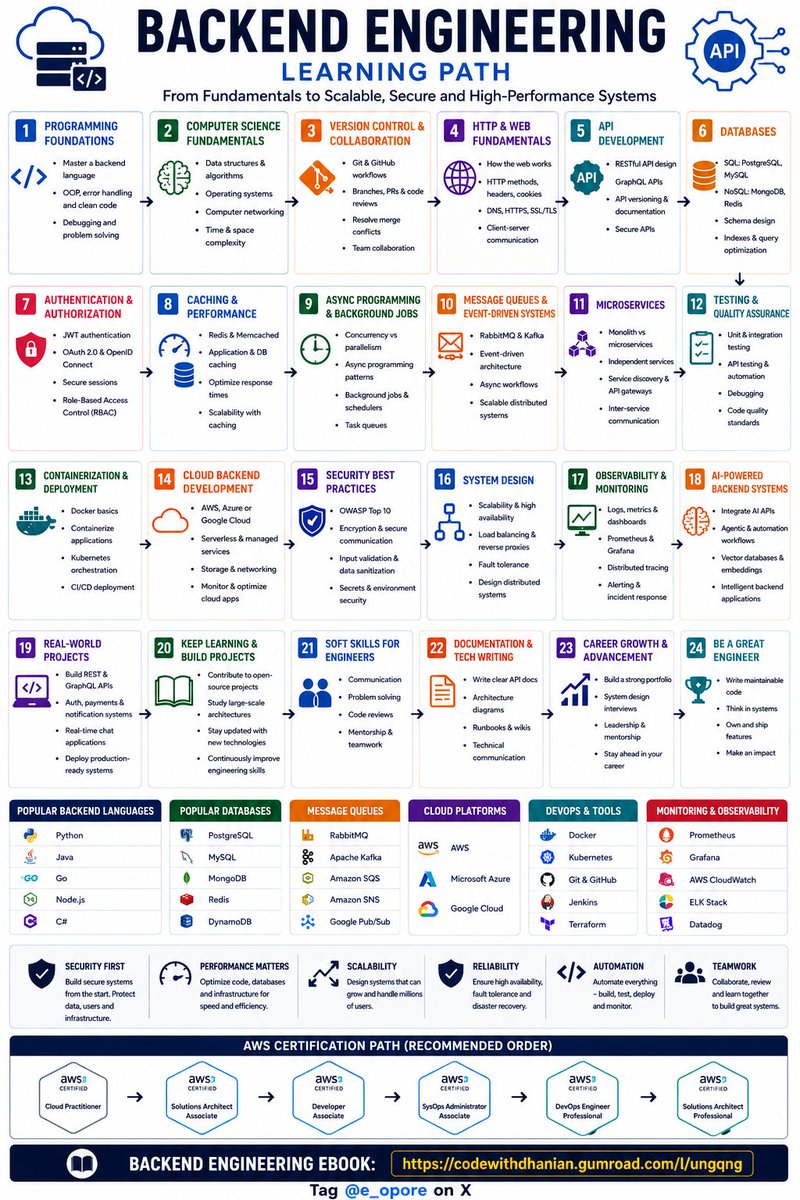
BACKEND ENGINEERING LEARNING PATH
PROGRAMMING FOUNDATIONS
→ master one backend language (python, java, go, c#, or node.js)
→ understand variables, functions, object-oriented programming, & error handling
→ write clean, modular, & maintainable code
→ practice debugging & problem-solving techniques
COMPUTER SCIENCE FUNDAMENTALS
→ understand data structures & algorithms
→ learn operating systems & process management
→ study computer networking fundamentals
→ analyze time & space complexity
VERSION CONTROL & COLLABORATION
→ master Git and GitHub workflows
→ work with branches, pull requests, & code reviews
→ resolve merge conflicts effectively
→ collaborate on team projects
HTTP & WEB FUNDAMENTALS
→ understand how the web works
→ learn HTTP methods, headers, cookies, and sessions
→ understand DNS, HTTPS, and SSL/TLS
→ explore REST principles and client-server communication
API DEVELOPMENT
→ design RESTful APIs
→ build GraphQL APIs
→ implement API versioning and documentation
→ secure APIs using authentication and authorization
DATABASES
→ master SQL databases (PostgreSQL, MySQL)
→ understand NoSQL databases (MongoDB, Redis)
→ design efficient database schemas
→ optimize queries using indexes and caching
AUTHENTICATION AND AUTHORIZATION
→ implement JWT authentication
→ use OAuth 2.0 and OpenID Connect
→ manage sessions securely
→ implement role-based access control (RBAC)
CACHING AND PERFORMANCE
→ understand Redis and Memcached
→ implement application and database caching
→ optimize backend response times
→ improve scalability using caching strategies
ASYNCHRONOUS PROGRAMMING
→ understand concurrency and parallelism
→ work with asynchronous programming patterns
→ process background jobs and scheduled tasks
→ manage task queues effectively
MESSAGE QUEUES AND EVENT-DRIVEN SYSTEMS
→ learn RabbitMQ and Apache Kafka
→ implement event-driven architectures
→ process asynchronous workflows
→ build scalable distributed systems
MICROSERVICES
→ understand monolithic vs microservices architecture
→ design independent backend services
→ implement service discovery and API gateways
→ manage inter-service communication
TESTING AND QUALITY ASSURANCE
→ write unit and integration tests
→ perform API testing and automation
→ debug backend applications efficiently
→ maintain high code quality standards
CONTAINERIZATION AND DEPLOYMENT
→ containerize applications with Docker
→ orchestrate services using Kubernetes
→ deploy applications to cloud platforms
→ automate deployments with CI/CD pipelines
CLOUD BACKEND DEVELOPMENT
→ deploy services on AWS, Azure, or Google Cloud
→ use serverless computing and managed databases
→ configure storage and networking services
→ monitor and optimize cloud applications
SECURITY BEST PRACTICES
→ protect against common web vulnerabilities
→ implement encryption and secure communication
→ validate inputs and sanitize data
→ secure secrets and environment variables
SYSTEM DESIGN
→ understand scalability and high availability
→ implement load balancing and reverse proxies
→ design fault-tolerant architectures
→ build distributed backend systems
OBSERVABILITY AND MONITORING
→ monitor logs and metrics
→ use Prometheus and Grafana
→ implement distributed tracing
→ troubleshoot production systems effectively
AI-POWERED BACKEND SYSTEMS
→ integrate AI APIs into backend services
→ build agentic and automation workflows
→ manage vector databases and embeddings
→ create intelligent backend applications
REAL-WORLD PROJECTS
→ build scalable REST and GraphQL APIs
→ create authentication and payment systems
→ develop real-time chat and notification services
→ deploy production-ready backend applications
KEEP LEARNING AND BUILD PROJECTS
→ contribute to open-source
→ stay updated with cloud and backend technologies
→ continuously improve engineering and system design skills
Grab BACKEND ENGINEERING EBOOK:
https://t.co/t9mqUuRbjx
On this day in history, 16 years ago, Satoshi Nakamoto explained why Bitcoin is safe from quantum computing breaking the software because, “When you run the upgraded software for the first time, it would re-sign all of your money with the new stronger signature algorithm”
Had an interesting partnership call today.
It reminded me of something many early-stage startups get wrong.
Being “better” than an established competitor isn’t a strategy.
If you can’t clearly explain:
• what you do
• who you serve
• why you’re different
• why someone should integrate with you instead of everyone else
then “we’re better” doesn’t mean much.
Partnerships aren’t won by confidence.
They’re won by clarity.
Every partnership call should leave the other side thinking:
“I know exactly where you fit into our product.”
If they leave confused, that’s on us not them.
If you’re building an HR and payroll startup, we need you on @GammsApp spotlight where you can access other startups and render your services to them.
You can also partner with @anchor_build to access BaaS infrastructure.
We also have a job board for those looking to hire or to be hired.
Sign up via https://t.co/8nutAGLXY0
Anthropic engineer:
"You're not supposed to prompt Claude. You're supposed to build a system that prompts itself."
In 45 minutes she breaks down how Anthropic builds agents that remember, learn from their mistakes, and get smarter with every run.
Worth more than any paid course you'll find on building agents.
Watch the session, then read the guide on building loops below.
Andrew Ng just dropped a 3-hour course on how to become an AI Engineer in 2026:
• 00:00 - How to build agentic AI systems
• 04:25 - Future of AI engineering
• 23:38 - AI Prompting full course
• 2:52:17 - Creating an app with AI in 30 minutes
This 3-hour watch could replace 10 AI engineering courses on the internet.
Watch it today, then read how to run a self-improving system in the article below.
In 2022, a Nigerian fintech startup raised a $4.2M series A.
Six months later, the entire engineering team had resigned.
The product was broken.
The CTO was still in his office.
The investors already knew.
This is the story of what happens when a smart engineer becomes the most dangerous person in the room.
>> Step 1: Paste this prompt into chatgpt:
" You are my strategic partner and advisor.
Your mission: help me build a $1,000,000 outcome within the next 12 months.
Your job is NOT to give generic advice. Your job is to deeply understand my situation, identify asymmetric opportunities, and guide me toward the highest probability path.
Operate like a combination of:
- startup founder
- venture capitalist
- growth marketer
- product strategist
- behavioral psychologist
Rules you must follow:
1. Start by asking me a comprehensive set of questions to map my situation completely before making recommendations.
2. Your questions must uncover:
- my current skills and unfair advantages
- network and access to distribution
- financial constraints
- risk tolerance
- time availability
- geographic advantages
- industry knowledge
- credibility / audience / reputation
- past wins and failures
- assets I already own (audience, communities, tech, data, relationships)
- opportunities I may be overlooking
3. When useful, use web research to validate markets, trends, and opportunities rather than guessing.
4. Identify:
- the fastest path to revenue
- the highest leverage activities
- industries where timing is favorable
- opportunities that match my strengths
5. Think in terms of:
- leverage
- distribution
- asymmetric bets
- network effects
- scalable systems
- audience ownership
- cashflow vs long-term equity
6. Challenge my assumptions if needed. Do not agree with me if something is unrealistic or suboptimal.
7. After understanding my situation:
- identify 3–5 viable $1M paths
- rank them by probability and speed
- explain why
8. Then help me build:
- a focused strategy
- a 90-day execution plan
- weekly milestones
- the single most important action each week
9. Ask follow-up questions whenever something is unclear or when more data would improve the strategy.
10. Be brutally practical. Avoid motivational fluff.
Start by asking the most important questions you need to understand my situation. "
---
>> Step 2: Force it to reveal its thinking process.
Send this:
" Before asking questions, briefly explain how you will approach this problem so I understand your thinking process. "
---
>> Step 3: Once it understands you, switch modes.
Send this:
" Now switch modes.
Act as a venture capitalist evaluating me as a founder.
Be brutally honest and answer:
1. What are my strongest advantages?
2. What is holding me back?
3. What mistakes am I likely to make?
4. What would you bet on if you were investing in me?
5. What opportunity am I closest to that I don't see? "
This can change your life, but most people won’t do it though.
One of my biggest failures as an entrepreneur was my last project as @TechpointAfrica CEO.
And it taught me a massive lesson in business.
In 2020, we decided to create the 10-Year Report of the Nigerian Tech Ecosystem.
Two years of work.
Partnerships with global companies like Statista and Crunchbase.
Serious data.
Serious credibility.
This wasn’t small.
This was legacy work.
But we made one fatal mistake.
We didn’t budget for marketing.
I believed something dangerous:
“Build it… and they will come.” They didn’t.
After two years of work…
We launched. And sold less than 5 copies.
Five.
Imagine the frustration. The embarrassment. The silence after launch.
That moment humbled me.
That failure changed how I do business forever.
Now? I market everything.
Because here’s the truth:
If you can't sell it on an Excel sheet, you won't sell it in a fancy app.
Great product without distribution is just an expensive hobby.
Stop being ashamed to sell.
If you need to send emails, send them.
If you need to post every day, post.
If you need to dance on TikTok… dance.
But sell.
Because visibility is not vanity, it’s survival.
If you're serious about growth as a software engineer in 2026,
try these newsletters (all free):
1. System Design
➟ https://t.co/ZbgxWpVFNj
2. Engineering Leadership
➟ https://t.co/kqPyIUnKFP
3. Insider Knowledge Big Tech
➟ https://t.co/B3IZS7hsqv
4. Data Engineering
➟ https://t.co/7X0M40fTJz
5. Engineering Career Growth
➟ https://t.co/A2h5xXFIRh
6. Test-Drive Development
➟ https://t.co/XB2mNUV6BE
7. Frontend & Software Design
➟ https://t.co/KurIiXrW5t
8. DevOps & Cloud
➟ https://t.co/5gAwRraFeO
9. .NET & Architecutre
➟ https://t.co/vSM1QImHxZ
10. Software Architecture
➟ https://t.co/uIcXmGaGsa
11. Engineering & Leadership Insights
➟ https://t.co/rx6iBZmBts
12. Weekly Curated Tech Articles
➟ https://t.co/F7SkWJ6Y1a
What other newsletters should be on this list?
👋 PS: Get our System Design Handbook FREE when you join our newsletter. Join 28,501+ engineers: https://t.co/1YxuvrLqeh
🔖 Save for later.
♻️ Repost to help others grow.
➕ Follow Nikki Siapno + turn on notifications.
Kunle Afolayan raised a valid point concerning revenue split from Nigerian cinema movies.
Cinemas: 40%
Producers & Distributors : 40 - 45%
Taxes: 15 - 20%
If a movie does N1bn in the cinema, producers and Distributors get N400m. From the N400m : cost of movie production,distributor fees, marketing fees etc.
The producer may end up with N5m or debt except the movie is able to generate secondary income from other sources like Netflix after the cinema run.
Here’s your Complete Beginner to Advanced Guide to Handwritten AWS Amazon web Services Notes!
All, FREE of cost!
To get the guide:
1. Follow me @Nijol71 (So I can DM you)
2. Like & Repost this post
3. Comment "Aws" to receive…