I don’t think Elon actually plans for SpaceX to be a neocloud long-term
I think he’s rushing to build as much compute as possible right now bc it can be paid for by other companies within 6-9 months at current spot prices
Then, in 2 years from now as pricing begins to stabilize he can re route that same compute to Grok, FSD, robotaxis and humanoids as they scale up
So all that compute he’ll need in a couple years is just getting paid for by other companies now
And the most interesting thing from this is right now he builds a GW for $30-$45B (with Vera Rubin) and then rents it for $50B/year
Once he re routes that compute to his products, he’ll generate upwards of $100B+/GW, which is the current return for companies like OpenAI and Anthropic
Obviously there’s risk if the demand for compute subsides in the short-term, before his other products scale, but I think it’s an incredibly smart move that’s going to pay off massively
For that reason, $SPCX has become a core asset in my portfolio. You can see my entire real-time portfolio here: https://t.co/NyRpAKYOwu
The unlock isn't the API. It's that a non-coder can now describe a rule in plain English and have a working alert by the afternoon. The best first build I've seen is a daily check that flags any holding that moves past a set % and drafts the "why" from the news. Keep the agent read-only on orders until you trust it.
$BE stock -12% after fantastic earnings.
I think its a BTD, and here is why!
The issue for them is most certainly not demand, but cash conversion.
Contract assets went from ~$241m to ~$859m in nine months. Q3 cash: OCF −$27m while FCF ~−$181m.
CFO Simon Edwards addressed this in the earnings call: He explained that they account for revenue on delivery and invoice only after certain milestones in the data centre buildout.
While I think this is a risk that needs to be managed, as they could run into a liquidity issue in the worst case, the growth and stronger profitability suggest it's a BTD.
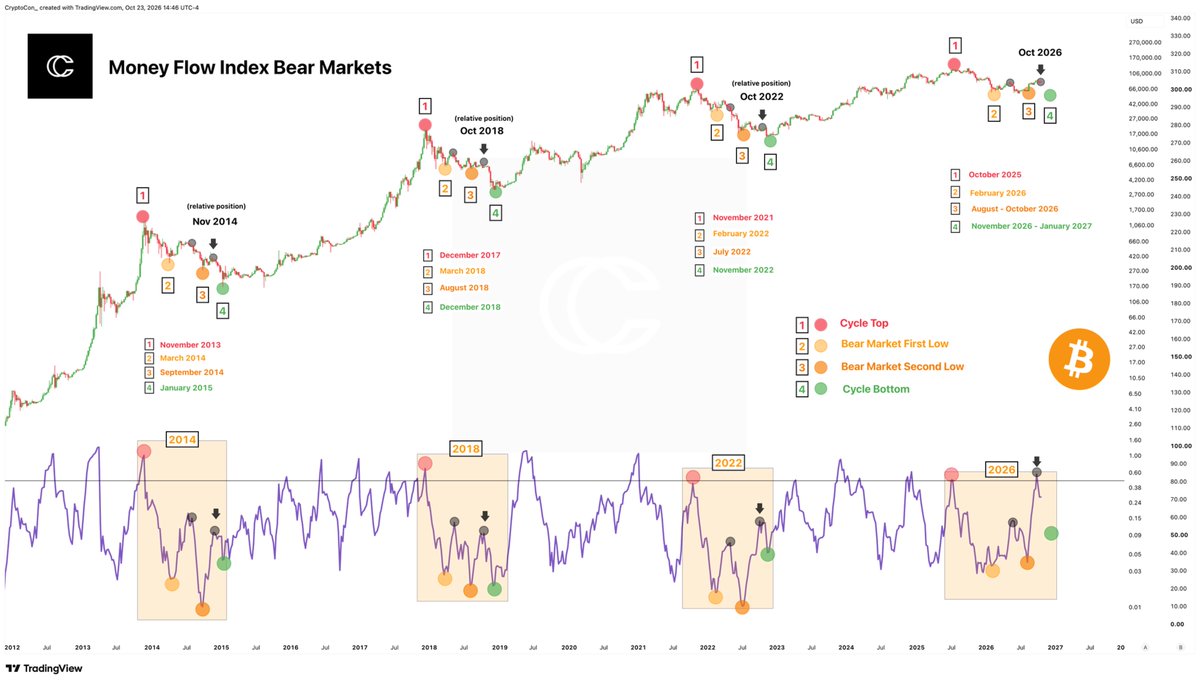
Biggest rally between a phase 3 and 4 on weekly MFI ever.
Needless to say, a cooldown is warranted.
Phase 4 is underway and then finally, according to this observation, the bear market is complete!
$TSLA just released its new Robotaxi Safety Report and the numbers are pretty incredible.
According to Tesla, its Robotaxi fleet has now driven over 3.3M miles autonomously, with zero reported injuries counted under its methodology, ZERO airbag deployments in its vehicles, and zero pedestrians or cyclists hit. To put that into perspective, Tesla estimates that human drivers covering the same distance under comparable conditions would have been involved in approximately 9.1 injury collisions, 4.1 collisions involving airbag deployments, and 0.52 collisions involving pedestrians or cyclists.
What's particularly interesting here is that Tesla is finally giving investors a dedicated way to track the safety performance of its Robotaxi fleet, rather than simply relying on demonstrations or statements from Elon Musk. And this is extremely important because safety is arguably one of the biggest hurdles Tesla needs to overcome before Robotaxis can scale nationwide. Regulators, insurers, and consumers all need evidence that autonomous vehicles can operate safely without someone behind the wheel.
Now, keep in mind that these figures cover a specific subset of Tesla's operations without onboard safety monitors, and 3.3 million miles is still a relatively small sample when we're talking about proving long-term safety across different driving conditions. But if Tesla can maintain these results as its fleet expands into more cities and accumulates tens or eventually hundreds of millions of miles, the implications could be enormous for the broader autonomous driving industry.
For $TSLA shareholders, this is exactly the kind of progress we want to see and the next challenge is proving these safety results can hold up at a much larger scale.
$SPCX is a buy, even though they will not hit their 10 GW compute target by the end of 2027!
My base for end-2027 is 6-7 GW.
Let me explain why 10 GW is super hard to get to.
The issue is not really capital.
At $50B per GW, that would be ~430B to reach 10GW (they currently have 1.4GW).
With ~100B on their balance sheet + 40B in debt coming, it's a stretch, but doable for Elon, I guess.
Engineering- and chip-wise, I see the bigger issues.
Engineering-wise, going from 1.4GW to 10 GW means adding ~1.4 GW every quarter.
That's 3.5x SpaceX's Q2 reported pace (+0.4 GW in Q2), six quarters straight.
Chips-wise, Jensen said this week that frontier labs get about 25-30% of Nvidia's compute currently.
That bucket covers OpenAI, Anthropic, Google, Meta and xAI.
Adding ~8 GW in 2027 alone would mean Elon taking roughly that whole slice. Remember, Elon said "we're exclusive to NVIDIA".
See why I think that's a stretch?
Not sure if Jensen wants to be so dependent on Elon, and he also needs to make sure his other customers are happy.
From a power perspective, SpaceX CFO says they have line of sight to power for 5-10 GW next year.
So power could be a bottleneck as well.
Nevertheless, for the stock to work, I do not think they need 10GW by end of 2027!
The current stock valuation assumes ~4.7 GW by the end of 2027.
(Assuming SPCX makes~$36bn per GW a year, with 70% of compute rented out at a 15.5x revenue multiple, + the rest of SpaceX business).
So, hitting my target of 6-7 GW implies 1.3-2.3 GW more than currently priced in.
Obviously (all else equal):
more GW = more revenue
more $/GW = more revenue
higher % of GW rented out = more revenue
Google just released its MOST powerful AI model ever and it is going straight after OpenAI and Anthropic.
Sundar Pichai announced today that Gemini 4 Argon is live globally for developers and enterprises in the paid tier of the Gemini API and the Gemini platform.
Ultra subscribers can use it in Google Antigravity, and both Pro and Ultra subscribers can use it in the Gemini app and Search.
Google says Argon is now the NUMBER ONE model on the Vals Index, which measures economic impact across finance, coding, legal, and tax work, with each sector weighted by its contribution to United States GDP.
Argon scored 68.9% on that index, ahead of Claude Opus 5.5 at 67.0% and GPT-6 Astra at 63.1%.
On DeepSWE, a test of long, real world software engineering tasks, Argon set a new record at 77.9%, compared to 74.2% for Opus 5.5 and 74.1% for GPT-6 Astra.
The long context results are where the gap really opens up, with Argon scoring 84.2% on GraphWalks between 256K and 1M tokens while Opus 5.5 came in at 66.8%.
Google also raised the output limit to 1 MILLION tokens, up from just 64K before, which means the model can keep reasoning and writing through a huge task in a single run instead of stopping halfway.
It is not a clean sweep, though, because Argon still trails Claude Opus 5.5 and GPT-6 Astra on terminal heavy coding tests like Terminal Bench 4.0 and FrontierSWE.
The pricing might be the most aggressive part of this launch, with an introductory rate of $2 per million input tokens and $10 per million output tokens, and cached input at 95% off.
After the introductory period, the price rises to $4 and $20, the same as Anthropic's Opus.
Google says more than 100,000 of its own employees battle tested Argon over the last month, using it for everything from daily debugging to large codebase migrations.
For $GOOGL, this is a big deal because Google owns the chips, the cloud, the distribution, and now arguably the strongest all around model in the world.
The frontier race is far from over, but Google just made it very clear that it is not falling behind anyone.
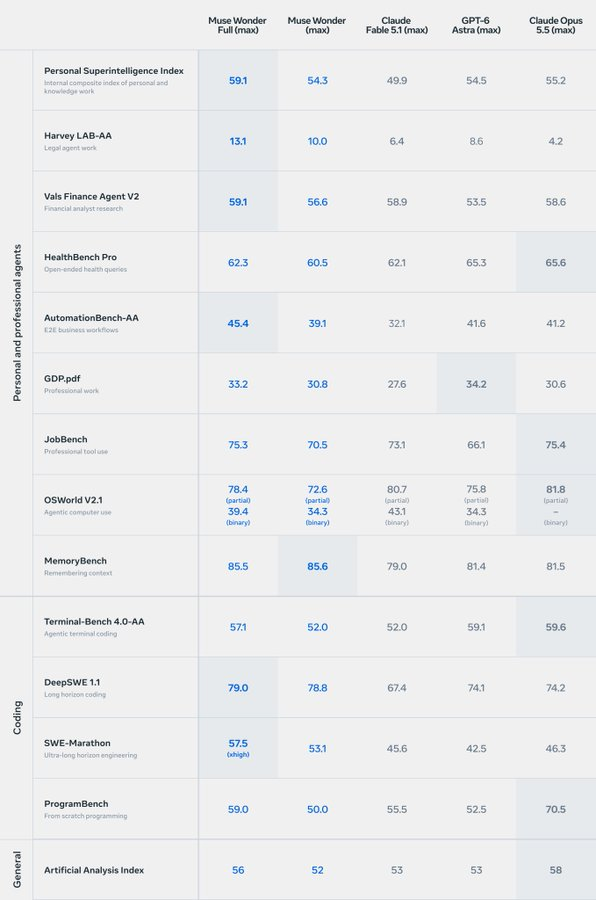
Mark Zuckerberg just told the Financial Times that $META has caught up with OpenAI and Anthropic at the frontier of AI.
And today Meta backed that up by releasing Muse Wonder, its new frontier model built for AI agents.
The benchmarks are really impressive.
On Meta's Personal Superintelligence Index, Muse Wonder Full scored 59.1, ahead of Claude Opus 5.5 at 55.2 and GPT-6 Astra at 54.5.
On long-horizon coding (DeepSWE), it scored 79.0 versus 74.2 for Claude Opus 5.5 and 74.1 for GPT-6 Astra.
On legal agent work (Harvey LAB-AA), it more than tripled Claude Opus 5.5, 13.1 versus 4.2.
It also led on business workflow automation, financial analyst research and remembering context.
Now, it does not win everything, Claude Opus 5.5 still leads on from scratch programming, terminal coding and the overall Artificial Analysis Index, 58 versus 56.
But a year ago, nobody was putting Meta in the same conversation as OpenAI and Anthropic.
Zuckerberg also brushed off calls to slow down and said Meta is already working on the next step up.
That tells me the spending is not stopping anytime soon and I think this is great news for the companies selling Meta the chips, memory and networking to build all of this.
This is the reason Microsoft is cutting its Claude token usage.
Microsoft just announced it will scale its own AI chip, Maia, to multigigawatt deployments starting in 2027. Maia will become the main system running AI inside Microsoft's products and services. Maia 200 is already live in the United States, Europe and Australia, running Microsoft Copilot today. Microsoft says Maia 200 delivers up to 1.7x more tokens per watt than leading GPU systems in Teams and Copilot.
The next chip, Maia 300, is built on $TSM's 2 nanometer process with eight HBM4 memory stacks. Microsoft says it will deliver 40% more tokens per megawatt than leading GPU systems. A full Maia 300 rack holds 96 chips and pushes up to 7x the token output of Maia 200. The Information reported that Microsoft cut its projected internal Claude spend by more than a third, down from over $1 billion a year. Its Cloud and AI group also cut per employee AI budgets from $100,000 a month to about $10,000. Microsoft is now building the chips and the models itself. Every token moved off Claude and onto Maia is money that stays with Microsoft. I think this is a long term margin story for $MSFT that most people are missing.
Nvidia is now redesigning how AI memory works and it is pulling TSMC right into the middle of the HBM business.
According to TheElec, Micron will use TSMC to make the base die for its HBM4E. Nvidia's custom NVHBM moves the memory controller into that base die, and Nvidia says it delivers up to 30% more bandwidth and 15% lower power than standard HBM4E. Samsung is also letting customers choose between its own foundry and TSMC for the base die.
This is a CRAZY shift. I think the base die is quickly becoming a logic chip, and that makes TSMC a key supplier to the memory makers too.
$NVDA $TSM $MU
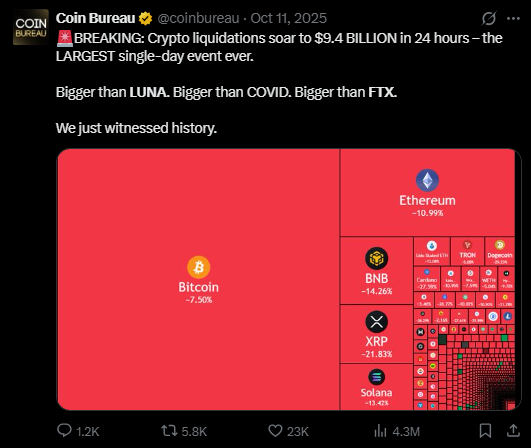
🚨One year ago, crypto saw its BIGGEST liquidation ever, and Bitcoin is down 33% since.
Bitcoin traded above $122,000 before the crash and now sits around $82,000.
It never got back above $117,000 after the crash.
The final count topped $19 BILLION in liquidations in 24 hours.
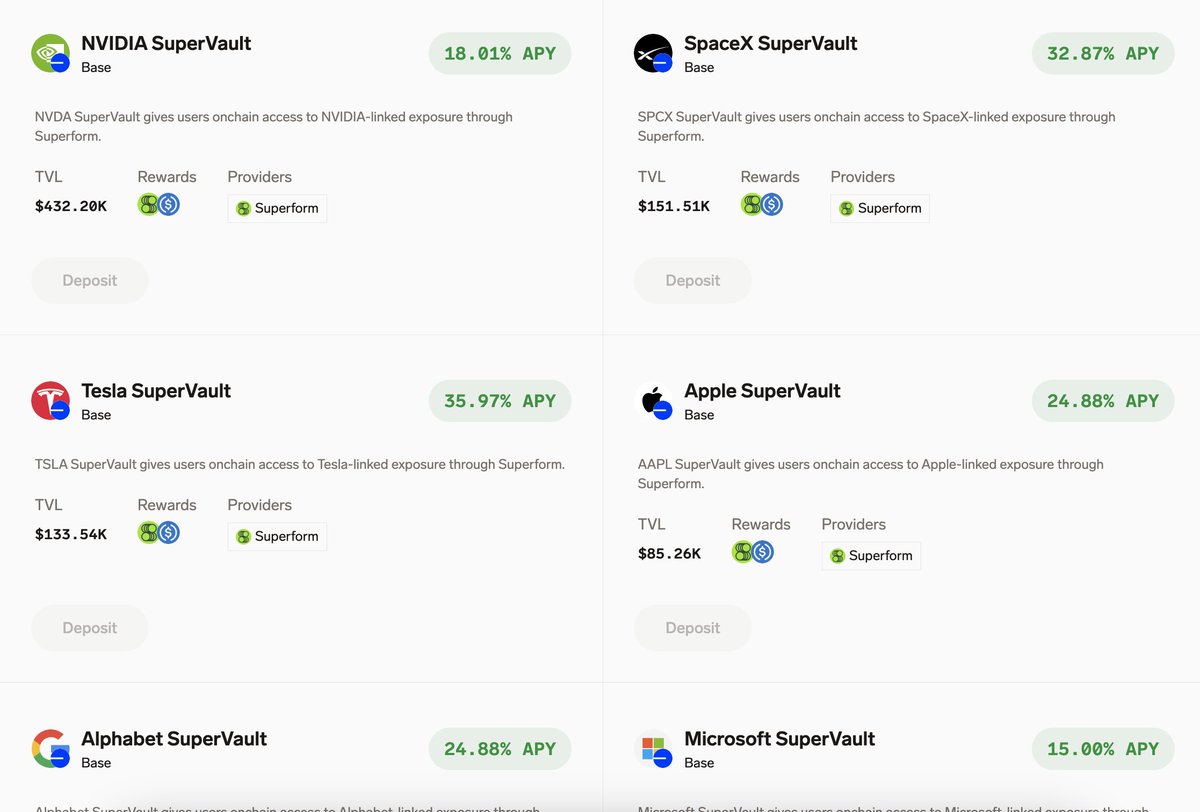
The prophecy being fulfilled--earn yield on stocks.
Tokenized stocks, collateralized on @aave V4.
Packaged for users in-app by @superformxyz.
Powered by @base, secured by Ethereum ⚡️
The strongest argument against a market crash is right here.
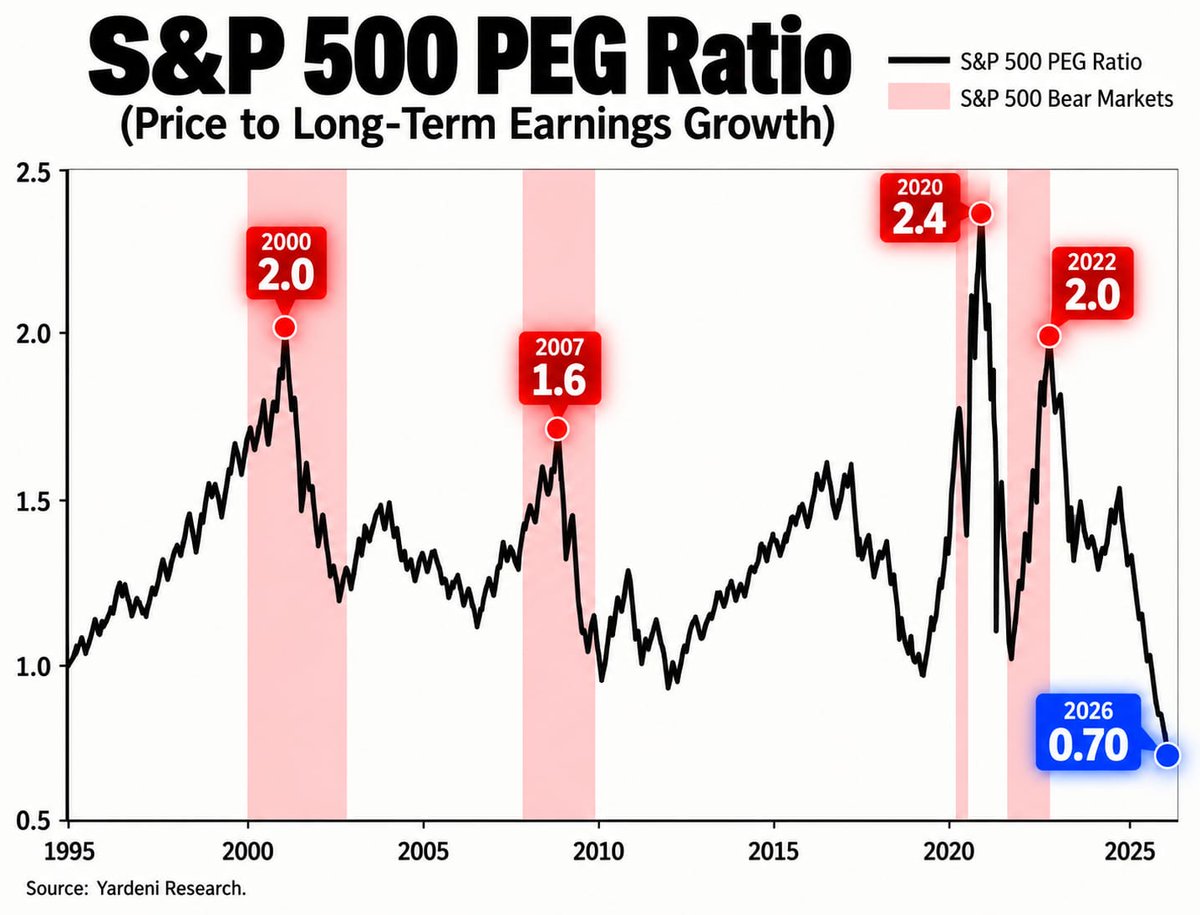
The S&P 500’s PEG ratio has fallen to 0.70, its lowest level on this chart since 1995 and that is far below the levels reached around previous bear markets: 2.0 in 2000, 1.6 in 2007, 2.4 in 2020 and 2.0 in 2022.
The PEG ratio compares the market’s price to earnings multiple with its expected earnings growth ands a falling ratio means investors are paying less for every percentage point of projected profit growth.
Stocks have not become cheap because prices collapsed but they look cheaper because corporate earnings are growing faster than stock prices.
The S&P 500 trades at roughly 19 times forward earnings, down from 22 times at the beginning of 2026 and slightly below its 10 year average while, earnings are expected to grow around 32% for the full year.
Third quarter earnings are projected to rise 29.5%, marking a potential third consecutive quarter above 25% and analysts have also raised that forecast from 26.7% at the beginning of the quarter.
This rally is being supported by rising profits rather than investors simply paying higher multiples.
How could you not stay bullish after hearing this??
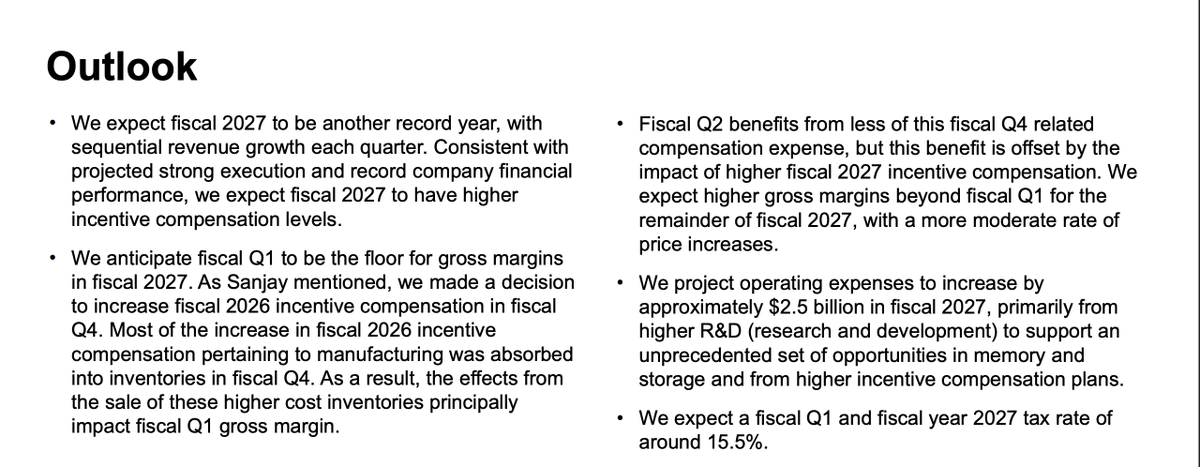
This is one of the most bullish part of $MU’s outlook.
Micron expects fiscal 2027 to be another record year, with revenue growing sequentially every single quarter.
Even more importantly, management said Q1 should be the floor for gross margins, with margins expected to move higher through the rest of 2027.
They are also increasing R&D because they see an “unprecedented set of opportunities��� in memory and storage.
This memory cycle still has a lot of room left.
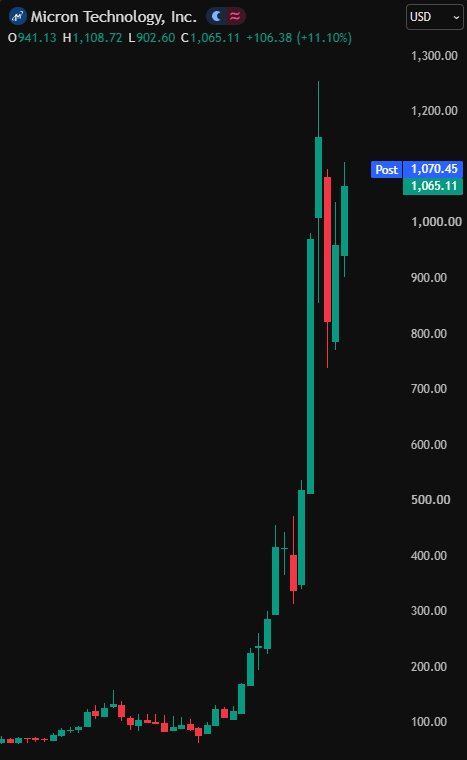
🚨HUGE: Micron posts a RECORD $133.2 BILLION in yearly revenue, as profit surges to $85 BILLION.
The memory chip maker's quarterly revenue hit $54.2 BILLION, nearly 5x a year ago, beating Wall Street's $51.5 BILLION estimate.
It made $37.7 BILLION in profit in those three months alone.
Adjusted earnings came in at $33.42 per share, up from $3.03 a year ago.
Micron now expects as much as $63 BILLION next quarter, saying memory supply will be "much tighter" in 2027 and 2028.
GOOGLE IS BACK IN THE AI RACE.
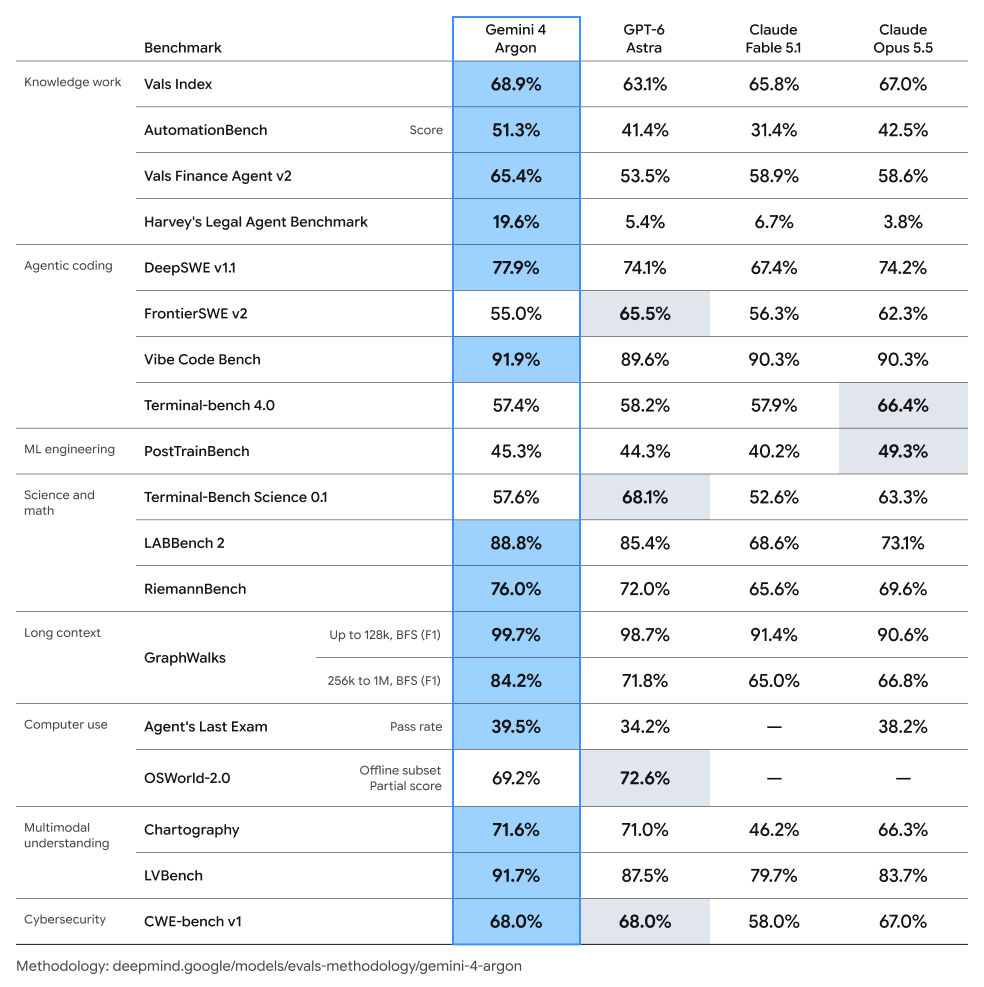
Google DeepMind just introduced Gemini 4 Argon, a frontier model built for complex workflows across coding, enterprise knowledge work, science and cybersecurity.
It is initially rolling out to trusted testers through Google’s Fairwind Program rather than launching broadly today but the early benchmarks look extremely strong.
Argon leads outright on 13 of the 19 listed tests, ties for first on cybersecurity and trails on only five and some of its largest advantages are in areas businesses will actually pay for.
It scores 65.4% on the finance agent benchmark versus 53.5% for GPT 6 Astra and it also scores 19.6% on Harvey’s legal agent benchmark, compared with 5.4% for GPT 6.
Google does not win everything.
GPT 6 leads several software, science and computer use benchmarks, while Claude Opus leads Terminal-Bench and PostTrainBench and Argon is not universally superior, but it appears unusually balanced across many workloads.
That matters because the AI race is moving beyond chatbots toward agents that can complete real work.
Google also has a distribution advantage that OpenAI and Anthropic cannot easily match because it can place Gemini across Search, Workspace, Android, YouTube and Google Cloud while using its own TPUs and data center infrastructure.
If Argon’s real world performance matches these early results, Google could control the model, chips, cloud infrastructure and distribution inside one ecosystem.
OpenAI just announced that the $200 subscription will get half the amount of usage moving forward
It’s clear where all of this is going
All AI companies within the next 2 years will exclusively use API pricing. No more subscriptions
Subs only made sense when companies were willing to lose billions of dollars to get you into their ecosystem
Now that basically every AI company will be attempting to go public, they’ll no longer be able to burn extraordinary amounts of money
They’ll have to report their earnings to the street, and if the number isn’t going up and to the right, that’ll be really bad
I don’t think this is doomsday. The cheaper models like Luna and Sonnet are now actually really good. Compared to 6 months ago, they’d actually be frontier
That’s more than enough to be spectacularly productive for a good price
The consumer behavior is going to have to change. You are going to need to be fine with using an intelligence level appropriate for your work. Not just Astra 6 Max for every single thing you do
If you have a Ferrari and a Model 3 in your driveway, you don’t drive the Ferrari to pick up milk from 7/11. Sometimes you use the daily driver car
The days of AI subsidies are coming to an end, and it’s probably time we start getting used to it. The party is over.