We are excited to announce that SFT Labs is officially opening our innovative achievement - the "SFT Contract Account" technology based on the ERC-3525 and ERC-6551 standard.
Github: https://t.co/lVjaHtBbrt
[Official Press Release] Solv Foundation Unveils Project DESFT: A Blockchain-Based Digital Credential Solution for Financial Inclusion
(Singapore, November 15, 2023) At the 2023 Singapore FinTech Festival inaugurated today, Solv Foundation announced Project DESFT, a blockchain-featured trusted digital credential platform developed in collaboration with the innovative concepts from the Monetary Authority of Singapore (MAS) and the Bank of Ghana (BOG). The team has also showcased a proof-of-concept product for this project to the public.
Project DESFT aligns with the open strategies of the Monetary Authority of Singapore and the Bank of Ghana in the field of inclusive FinTech. The project aims to promote trusted digital credentials tokenization on blockchain for micro, small, and medium enterprises (MSMEs) in developing countries. This approach is designed to support MSMEs in participating in international trade while gaining access to efficient, accurate, and affordable financial services.
Credentials, encompassing licenses, badges, tickets, certificates, bills, and other contractual documents, are carriers of trust in both daily life and business. It is well known that international trade involves professional processes driven by the handling of various types of credentials. However, MSMEs in developing nations usually encounter substantial difficulties in provisioning these credentials. For instance, an MSME in Ghana may find it excessively challenging to prove its basic information's authenticity to an overseas party, not to mention the licenses, qualifications, transaction history, and financial credentials. Due to this, many MSMEs are simply excluded from cross-border trade and supply chain finance.
Project DESFT is building an end-to-end open and interoperable digital credential system that augments existing centralized platforms. It orchestrates different roles to collaborate around digital credentials in the context of international trade and inclusive finance: MSMEs claim, proof, store, and present the credentials; authorized parties issue or attest to them; service providers verify the credentials to determine the services to provide, and regulators watch, suspend, revoke, or reactivate them. In general, by leveraging the strengths of blockchain, cryptography, and digital identity technologies, Project DESFT aspires to create a scalable network for trust in business.
Key features of Project DESFT include:
- A One-Stop Blockchain Credential Utility: A holistic digital utility that facilitates the claim, attestation, verification, presentation, transfer, and regulation of trusted digital credentials.
- Decentralization: The attestation, and verification of digital credentials are fully based on cryptography. This approach negates the need for the conventional trusted third-party model and centralized platforms, placing users in complete control of their data ownership. This addresses prevalent concerns regarding supremacy of centralized platforms.
- Paired Credential-Token Structure: Each digital credential is jointly expressed by a pair of cryptographically linked credential documents and on-chain token. This structure ensures the protection of private data while maintaining transparency, transferability, and regulability.
- Versatility: Project DESFT’s system can represent a vast array of credentials, ranging from corporate and personal IDs, badges, licenses, tickets, bills, invoices, and permits to more complex instruments like L/Cs, B/Ls, promissory notes, and various contractual agreements and documents.
- Alignment with UTC Standards: The project aligns with the Universal Trusted Credential (UTC) standards promoted by the United Nations Development Programme (UNDP), MAS, and other organizations. This alignment assists MSMEs in developing regions, streamlining credit verification in global trade and providing a gateway to inclusive finance services.
- Built-in RegTech Support: The project equips regulatory technology that enables regulators to modify credential statuses, revoke, suspend, or issue warnings regarding the validity of certificates.
- Integration with Digital Assets: Ensuring compatibility with prevalent digital asset standards, such as ERC-20, ERC-721, and ERC-1155, Project DESFT integrates seamlessly into payment programming and digital asset management ecosystems.
Mr Sopnendu Mohanty, Chief FinTech Officer, MAS, said, "MAS has been collaborating with the Bank of Ghana to explore the creation and use cases for a
Digital Economy Semi-Fungible Token (DESFT). We are supportive of projects which delve into DESFT. It is encouraging to see companies like Solv Foundation
participate in this interesting development towards a functional solution.Furthermore, given its incorporation of the UNDP Universal Trusted Credentials, it has the potential to transform how MSMEs tokenize their value and open up new access points towards more inclusive and accessible financial services. We invite more of such companies to take part in this initiative.”
Dr Maxwell Opoku-Afari, First Deputy Governor of the Bank of Ghana, expressed enthusiasm of how The Bank of Ghana is delighted to co-initiate this innovative and profoundly significant project with the MAS, exploring the advantages of blockchain in managing trusted digital credentials. He explained in his keynote address how trusted digital credentials will play an essential role in trade and financial services.
“Through collaboration and partnership with MAS and Solv Foundation, we are exploring various applications of combining UTC, Decentralized Identity (DID), Verifiable Credential (VC), and ERC-3525 technologies, demonstrating tremendous flexibility and potential.”
Dr Maxwell Opoku- Afari reiterated the need for regulatory oversight to ensure the sound implementation of the trusted credential platform, “As a central bank, we pay special attention to the scheme's regulatory support, proposing a unique 'Four-eyes Principle' regulatory model. Following a successful design we will pilot in the real world by running actual international trade cases, actively exploring how tokenized digital credentials can be integrated and operated with our central bank digital currency, e-Cedi. We'll continue to innovate in regulatory technology, helping Ghana's MSMEs seize new opportunities in the global supply chain reshaping, accelerate Ghana's economic growth through the next-generation digital economy infrastructure, and serve as a model for other African countries."
Mr. Yan Meng, a co-founder of Solv Foundation and the chair of SFT Labs, has played a major role in incubating Project DESFT. Mr. Meng noted: "Blockchain must solve real problems in the real world. The global supply chain is undergoing restructuring, characterized by decentralization, meaning many new MSMEs in developing countries will participate in the global supply chain. They will depend on a vast array of trusted digital credentials to coordinate intricate processes and collaborations across various jurisdictions. Our collaboration with MAS and Bank of Ghana allows us to harness blockchain for enhancing these credentials, bridging the gap between these economies and the global market, and ensuring a more inclusive trade landscape."
As one of the designers of ERC-3525 standard, Mr. Meng said: "Project DESFT's use of ERC-3525 to tokenize Verifiable Credentials introduces 'Controllable Transparency', a departure from the 'Radical Transparency' typical of many blockchain solutions. This strikes an optimal balance between privacy and visibility. It marks another milestone progress of ERC-3525 following the success of the ‘Tokenized Invoices’ project from the Australian CBDC pilot program. We're optimistic about ERC-3525's potential to reshape the way we view digital credentials, especially when combined with technologies like CBDC and regulated stablecoins.
Dr. Xiao Zhang, core advisor to Project DESFT and founder of zCloak Network, provided cryptography, Verifiable Credential (VC), Decentralized Identifier (DID), and other technical support for Project DESFT. He commented: "VC and DID advocated by W3C are becoming hot topics today. Project DESFT is the world's first attempt to tokenize VCs and DIDs on the blockchain. It is innovative and groundbreaking in terms of technology. We see that the Token-Credential Pair structure in Project DESFT has struck a balance of privacy protection, regulability, and transferability, which we believe is an inspiring work for VC/DID communities. In addition, Project DESFT has a high potential to integrate and interact with burgeoning technologies such as programmable CBDC, Purpose-Bound Money, Zero-Knowledge Proofs, and AI to promote the digital economy up to another level."
According to reports, Project DESFT will start its second phase immediately after the Singapore FinTech Festival with forward looking partners such as Ample FinTech to build broader real world use cases. In the new phase, the project will be integrated with other related projects promoted by MAS and Bank of Ghana to support the complete cross-border trade process of MSMEs in Ghana. It will also interact with CBDC systems to facilitate payment programming in the context of international trade and supply chain finance.
Annex:
Solv Foundation is a Singapore based entity established in early 2021. Solv is renowned in the DeFi industry for its innovative contribution in designing the ERC-3525 token standard.
ERC-3525 is a token standard which defines the Semi-fungible Tokens, or SFTs. It was approved by the Ethereum community in September 2022. SFTs are especially suitable for representing programmable digital credentials and financial instruments.
SFT Labs is a R&D and incubating organization initiated by Solv Foundation and established in November 2022. It is dedicated to developing a booming, diverse, and sustainable ecosystem for Semi-fungible Token technology. SFT Labs has incubated Unizon Blockchain Technology in Australia and Ample FinTech in Singapore.
zCloak Network is a real-world identity (RWI) infrastructure for Web3, featuring privacy-first DID powered by zero knowledge proof. It aims to provide user data sovereignty by moving both the storage and computation of data into user devices from centralized servers. With zCloak Network, people can use their real-world data for on-chain DeFi, Identity, Biometric applications without disclosing their privacy.
Ample Fintech is a FinTech startup based in Singapore. With its technical strength, Ample FinTech is committed to providing tailored FinTech and blockchain solutions for Web3 and FinTech industries. Ample FinTech also provides education and consulting services about blockchain, DID, VC, Tokenization and RWA technologies.
Contact: [email protected]@SolvProtocol@zCloakNetwork@Will42W@RyanChow_DeFi
@TusharB73825926@myanTokenGeek You can define all attributes for each types of cars in the slot struct and use those attributes as the partial data in the tokenURI, if you have further questions please let me know or join and ask in the ERC3525 builders Telegram group https://t.co/N9xnSCt9pr
@TusharB73825926@myanTokenGeek then you can burn 5 normal cars from the user's wallet and mint 1 sport car to that wallet in your logic smart contract.
Being able to import crates to handle JSON parsing, JPG processing, parsing EVM bytecode, and verifying ECDSA signatures means you can quickly build complex applications.
All of these examples are working today:
You can start analyzing ANY web3 protocol/product in five minutes by understanding how to use this new @duneanalytics dashboard.
No solidity knowledge or protocol context needed! 📔I used @opensea for this thread.
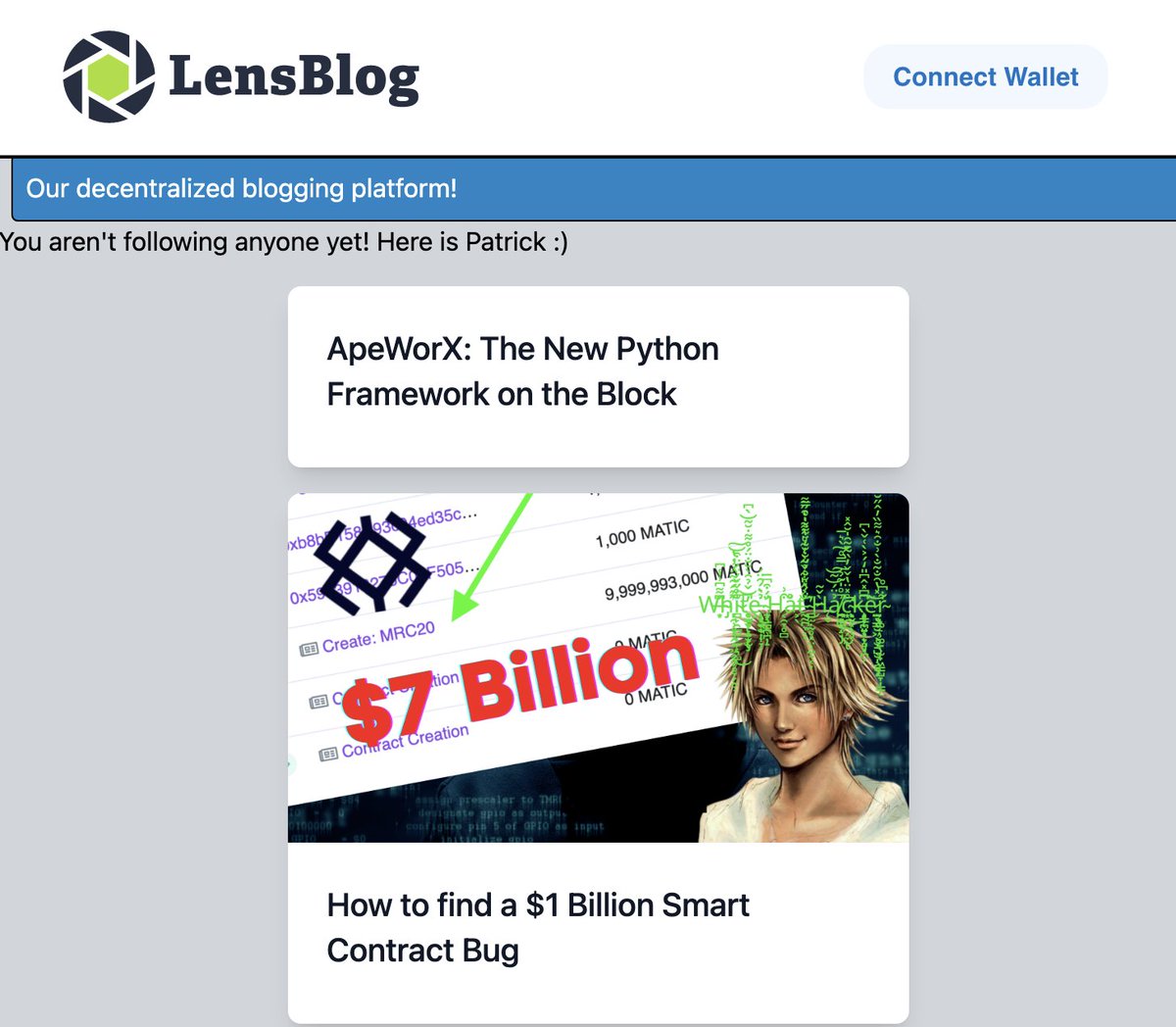
🌱 Want to build a decentralized next-generation social media or blogging app using Lens Protocol?
🏋️♂️ WE GOT YOU 🏋️♂️
👇 Get out your popcorn and bring your javascript framework cuz here is how you can create your decentralized social media.
🌱 Lens Protocol is a decentralized composable social graph enabling developers to make the next generation of social media, with their backend already done!
Here is what makes @LensProtocol such a game changer for web3 devs 👇
If you had failures over the past 4 hours on Goerli, try again.
We ran out of the first batch of 12.5k ETH faster than expected but have refilled with 1M ETH. Should last a bit longer.
Need test ETH on both Goerli and Sepolia Testnets? access and collect 10 ETH on https://t.co/2QofpEjBcH as long as the connected wallet has deployed one or more contracts on Mainnet / Goerli / Sepolia before November 15, 2022. Thanks to @a16zcrypto for offering this 🚀
Need test ETH on both Goerli and Sepolia Testnets? access and collect 10 ETH on https://t.co/2QofpEjBcH as long as the connected wallet has deployed one or more contracts on Mainnet / Goerli / Sepolia before November 15, 2022. Thanks to @a16zcrypto for offering this 🚀
finally, some wallpapers for you.
all ai generated with sd + midjourney.
choose your favorite one, set as your desktop/lockscreen, and reply with a screenshot.
Thanks @myanTokenGeek. It's been a great experience to build something big with ERC3525 - proposed by the kudos @SolvProtocol team. It's just the beginning, and there will be more powerful and innovative dApps built on top of ERC3525 coming up sooner or later.
1/ A Web3 developer @web5next recently published his ERC-3525 example at https://t.co/qOdArbWTE7. Though it is just a rough cut, it has shown a few features the Web3 world never saw. Let me introduce.